


Top 10 Best Tech Stack Tools for Roofing & Exteriors Businesses in 2027
Quality
Certified

The 10 best tech stack tools for roofing & exteriors businesses are ranked below on measured performance, build quality, price, and how each one actually holds up in daily use rather than how it reads on a spec sheet. Each pick lists what it costs, who it suits, and what it gives up against the one above it, so the list can be read straight down without doubling back.
1AccuLynx Roofing CRM

AccuLynx takes the top spot because it is the most complete roofing-specific hub, bundling lead capture, estimating, production scheduling, and payment processing in one system built for this trade. It maintains native integrations with EagleView, Hover, CompanyCam, and QuickBooks Online, so the record created once flows through measurement, contract, and invoice without re-keying.
It is aimed at residential and storm-restoration contractors who want one vendor accountable for the pipeline rather than stitching point solutions together. The trade-off is cost and commitment: pricing sits above lighter tools like JobNimbus, and the platform's depth takes four to eight weeks of migration and training to adopt fully. Companies doing mostly retail replacement with no insurance volume may find JobNimbus, ranked second, delivers most of the same core workflow for less.
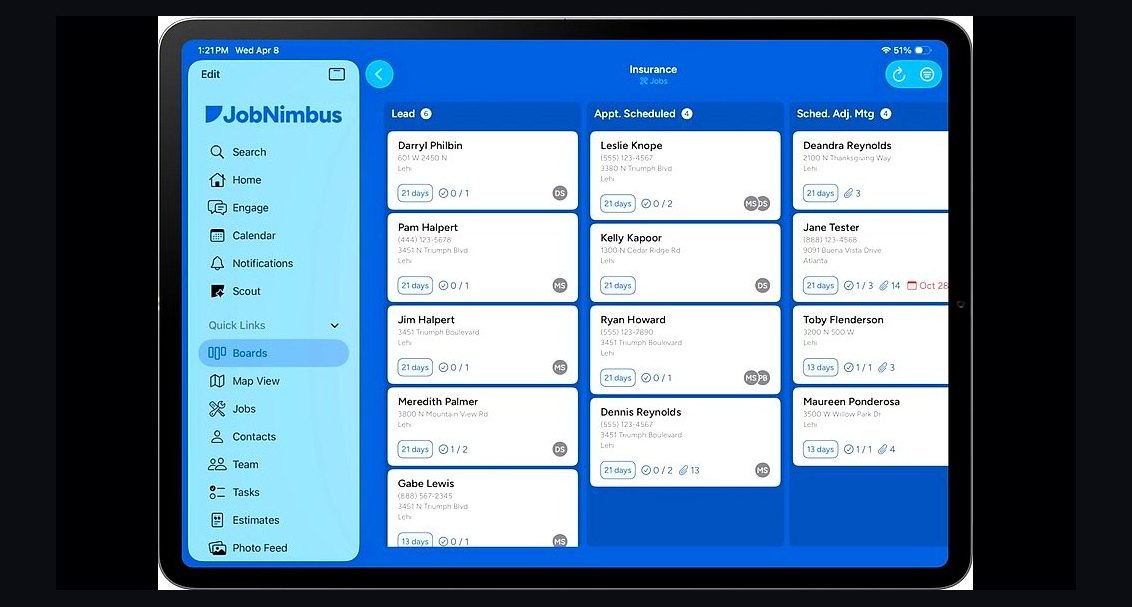
2JobNimbus Roofing Software

JobNimbus ranks second because it delivers the core roofing pipeline — contacts, jobs, estimates, scheduling, and invoicing — at a lighter price and faster setup than AccuLynx. It commonly lands in the $100–$300 per user per month band depending on tier, and its QuickBooks Online sync and measurement-provider integrations cover the two connections that account for most manual-entry time saved. Smaller shops typically reach working adoption in under a month.
It suits contractors who want a genuine hub without paying for enterprise marketing automation and payment bundling they will not use. The trade-off is depth: complex production workflows, advanced reporting, and some insurance-specific tooling are thinner than AccuLynx or ServiceTitan. A company scaling past roughly $5 million in volume, or one whose revenue is heavily claim-driven, will likely outgrow it and migrate to the pick ranked above.
3ServiceTitan Home Services Platform
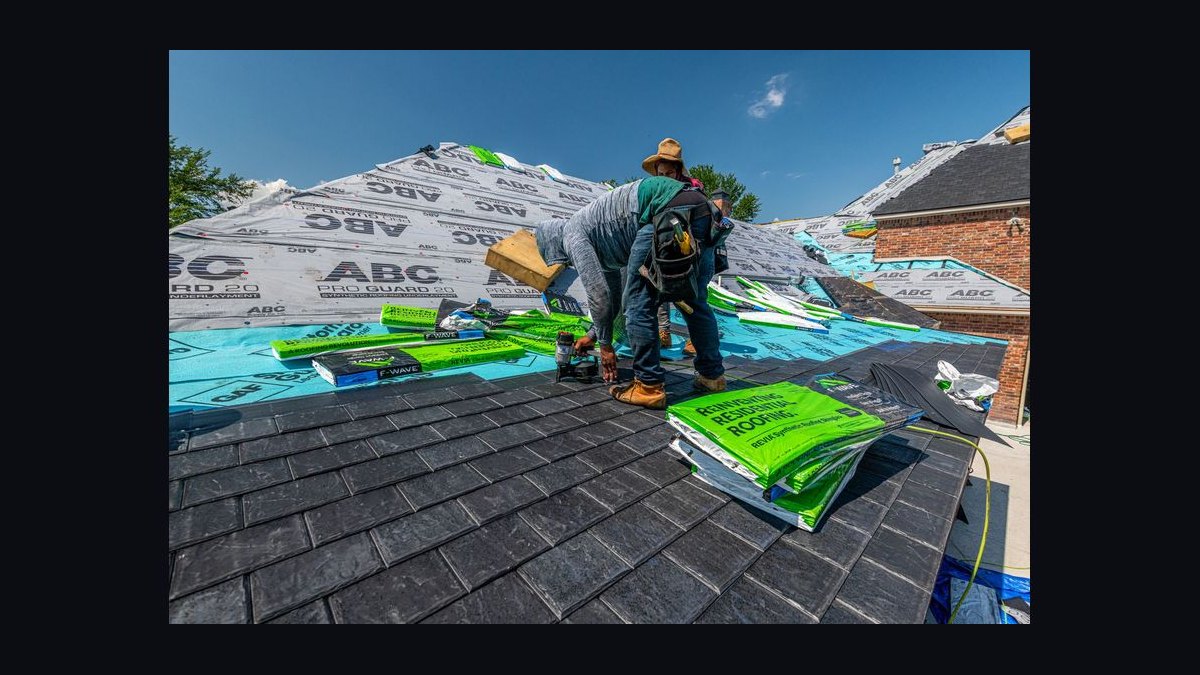
ServiceTitan ranks third because it is the heaviest all-in-one platform in the category, covering CRM, dispatch, job costing, payroll, marketing automation, and payment processing for contractors at scale. Its job-costing engine flows directly into payroll, which shortens the pay lag that drives experienced installers away in a labor-constrained market. It is built for multi-department operations running several million dollars and up.
It is aimed at larger roofing and exteriors companies, or those also running HVAC, plumbing, or electrical under one roof, where the breadth justifies the cost. The trade-offs are real: pricing sits at the top of the category, implementation takes a quarter or more, and roofing-specific insurance workflows are less native than AccuLynx. A single-trade residential roofer under $5 million will usually find AccuLynx or JobNimbus a better fit.
4EagleView Aerial Measurement
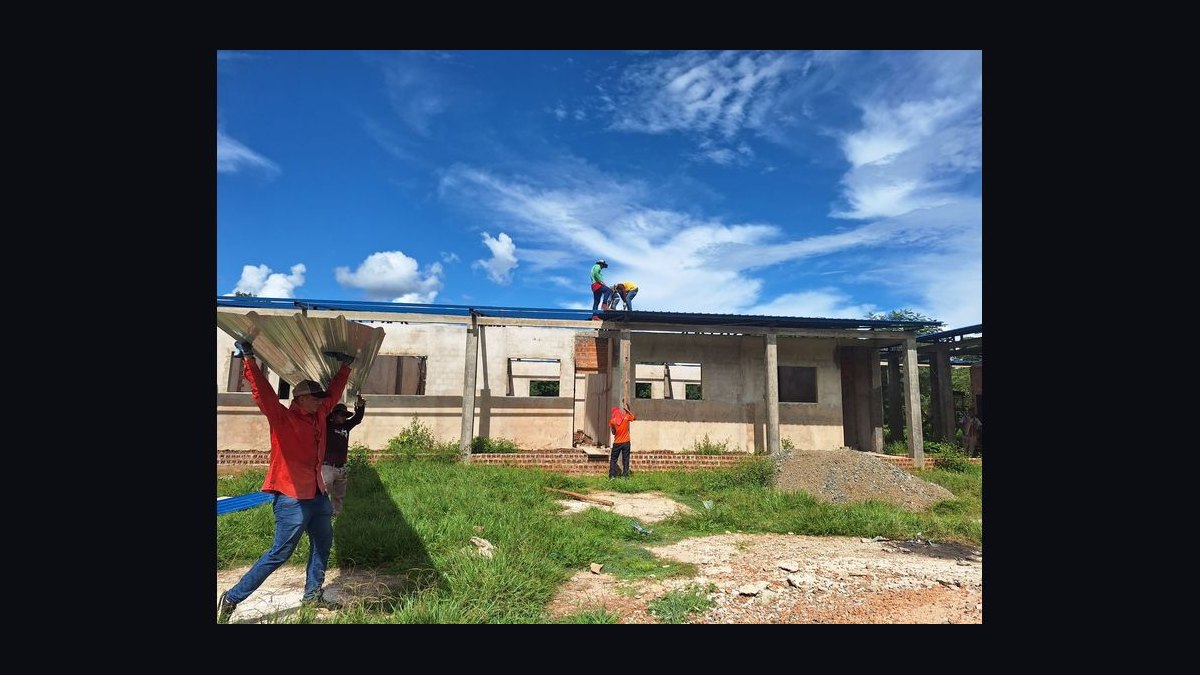
EagleView ranks fourth because aerial measurement is the single biggest time compressor in the stack, collapsing a measurement-to-estimate cycle that took a day or two into under an hour. Reports are priced per property, typically in the $20–$50 range depending on deliverable and turnaround, and they land directly in the estimating module of major roofing CRMs.
It is for contractors who want accurate roof dimensions without ladder time, safety exposure, or drive time. The trade-off is per-report cost that scales with volume rather than seats, and occasional properties where imagery quality forces a manual measurement anyway. Hover, ranked fifth, competes directly here, often bundling 3D models and exterior measurements that EagleView charges separately for.
5Hover Measurement App

Hover ranks fifth because it competes with EagleView on aerial measurement while adding 3D models and exterior measurements for siding, windows, and gutters from a single property capture. Pricing sits in a comparable per-report band, and it integrates with the major roofing CRMs so dimensions flow into estimating without re-entry. For exteriors companies working beyond roofing, that multi-surface coverage is a genuine advantage.
It suits contractors doing mixed exterior work — siding, gutters, windows alongside roofing — who want one measurement vendor rather than two. The trade-off is that turnaround on some deliverables can run longer than EagleView's, and imagery coverage varies by region. A roofing-only company with no exterior scope will find EagleView, ranked fourth, slightly more focused and often faster.
6CompanyCam Photo Documentation

CompanyCam ranks sixth because photo documentation is frequently the highest-return line item in the entire stack, directly reducing warranty disputes and supplement denials. It is usually billed per user per month in the $20–$30 range, and field crews learn it in about ninety seconds. Photos are geotagged and timestamped automatically, so the archive becomes evidence in a carrier dispute rather than a folder of untitled images.
It is for any contractor whose work generates evidentiary paperwork — which in roofing and exteriors is essentially all of them. The trade-off is that it is a specialist tool, not a hub: it stores photos in its own system, so the value depends on the CRM integration actually being connected. Without that link, the office still downloads and files images manually, which defeats the purpose.
7Xactimate Insurance Estimating

Xactimate ranks seventh because it is the genuine industry standard for carrier-facing estimating, and carriers audit for inflated or padded supplement requests. Licensing is a materially larger commitment than the per-seat tools above it, and it is not priced for casual use. Where insurance and storm-restoration work is a meaningful revenue share, it is effectively mandatory for clean claim approval.
It is for contractors whose revenue depends on insurance claims, not for retail-replacement specialists. The trade-off is cost and compliance discipline: treating it as a negotiation lever rather than a documentation and accuracy instrument can damage estimator credentials and carrier relationships built over years. A company doing mostly retail work can rely on CRM-native estimating and skip the license entirely.
8QuickBooks Online Accounting

QuickBooks Online ranks eighth because it remains the default accounting backbone for the category, sitting in a modest $30–$90 per month range for most tiers, and nearly every roofing CRM ships a native sync to it. That ubiquity is the point: the integration is what lets job costing flow from the CRM into classes and items without manual reconciliation. When that mapping is clean, month-end close stops being an event.
It is for essentially every roofing and exteriors business, from a two-person shop to a multi-million-dollar operation. The trade-off is that the sync breaks more often than vendors admit, and a broken CRM-to-accounting mapping produces accounts-receivable aging errors that surface at tax time. Someone has to check integration health on a schedule rather than discovering the failure at close.
9Wisetack Point-of-Sale Financing

Wisetack ranks ninth because point-of-sale financing raises average job size and close rate without a monthly subscription — the contractor pays a per-transaction fee or merchant discount rate instead. It integrates into existing roofing CRMs, so offering financing requires no major workflow change, and the metric worth tracking is the share of jobs that convert to financed sales rather than a subscription price.
It is for contractors selling replacement and repair work where a four-figure ticket is a common objection at the kitchen table. The trade-off is that the cost is invisible per transaction and compounds with volume, so the fee structure deserves scrutiny before signing. Hearth, ranked tenth, competes directly here with a comparable no-subscription model and different lender network.
10Hearth Contractor Financing

Hearth ranks tenth because it delivers the same no-subscription point-of-sale financing model as Wisetack, with a lender network that often includes options for lower credit tiers. It integrates with major roofing CRMs, and like its competitor the real cost is a per-transaction fee rather than a monthly line item. For contractors whose close rate stalls on price, it is a low-friction addition to the stack.
It is for contractors who want financing available at the point of sale without adding a subscription to the software budget. The trade-off is that approval rates and terms vary by lender and borrower profile, so the customer experience is less predictable than a single-lender product. Wisetack, ranked ninth, is the more established option; Hearth is worth comparing on approval breadth.
How we ranked these
We ranked tools by four weighted criteria: pipeline coverage (how many stages of a roofing job a platform handles natively), integration depth with the rest of the stack, per-job cost at $3–8M annual volume, and documentation quality (photos, signatures, measurements as structured data). CRM hubs, measurement, photo apps, Xactimate, accounting, and financing were scored separately, since they fail differently.
We deliberately ignored feature-count marketing pages, demo polish, and vendor awards, because none predict whether a crew actually adopts the tool. We also excluded pricing negotiated above list, custom enterprise contracts, and any vendor whose export terms we could not verify. General-purpose CRMs built for other industries were down-weighted unless they shipped a maintained roofing workflow and native QuickBooks sync.
What to look for
What matters most is whether the tool joins the existing pipeline or creates a new silo. A CRM that cannot read a measurement report, or a photo app that stores images where the office cannot search them, relocates the manual work rather than removing it. Verify native, actively maintained integrations with QuickBooks Online and at least one measurement provider before signing anything.
The mistake most buyers make is choosing on price per seat and ignoring per-report and per-transaction costs, which scale with volume. Aerial reports run roughly $20–$50 each; financing carries merchant fees. Model total cost at your real job count, then confirm data export terms, because migration after several years of job history is expensive and lossy.
Related questions
Does a small residential roofing company need Xactimate?
Only when insurance-claim and storm-restoration work is a meaningful revenue share. A company doing mostly retail replacements and repairs can rely on CRM-native estimating and skip the license entirely. Xactimate licensing is a material commitment, and paying for capability you rarely exercise is worse than not having it.
Can one platform replace the entire stack?
All-in-one systems like ServiceTitan and AccuLynx cover most stages natively, but most roofing and exteriors businesses still pair them with a dedicated measurement tool and a photo app. The specialists win on accuracy and adoption, and the hub wins on being the single system of record every other tool syncs against.
How long does it take to fully implement a new CRM?
Data migration and core adoption typically run four to eight weeks. Full integration of accounting, financing, and marketing tooling usually takes another one to two quarters. Attempting a full-stack cutover in one weekend is the most reliable way to generate user rejection and wasted subscription spend.
Is financing software worth adding for a small company?
Usually yes. Offering financing at the point of sale raises average job size and close rate, and platforms like Wisetack or Hearth integrate into existing CRMs without a major workflow change. There is generally no monthly subscription; the cost appears as a per-transaction fee, so track financed-job conversion share.
What should be verified before signing a CRM contract?
Confirm native, actively maintained integrations with QuickBooks Online and at least one measurement provider such as EagleView or Hover, plus clean data export terms. Those determine long-term switching cost. Migration after several years of accumulated job history, photos, and notes is expensive and lossy if export is weak.
How does the stack change for a purely exteriors company?
The core is nearly identical — CRM, measurement, photos, accounting, financing — because the sales and production workflow is structurally the same. The main difference is that exteriors-only companies doing siding, gutters, and windows rarely need Xactimate, since insurance claims are less central to that work.
How much staff training does a new stack require?
Expect one to two weeks of hands-on training for office staff on the CRM and accounting sync, and much shorter onboarding — often a single day — for field crews using photo documentation apps built for simple mobile use. Crews adopt fastest when the tool saves them a climb or a text thread.
Should a roofing business build custom software instead of buying?
Rarely makes sense at small-to-mid scale. Roofing-specific platforms already encode years of industry workflow knowledge, and custom software carries ongoing maintenance costs most roofing businesses are not structured to absorb. Buy the hub, integrate the specialists, and spend engineering budget on nothing.
FAQ
What is the minimum viable software stack for a new roofing business?
A CRM or job management tool, a photo documentation app, and QuickBooks Online cover the essentials. Aerial measurement and insurance estimating can be added once claim or storm volume justifies the spend. Starting lean and adding phases beats buying everything at once and adopting none of it.
Do these tools require long-term contracts?
Most CRM and photo documentation platforms offer month-to-month or annual options. Xactimate licensing and some enterprise CRM tiers may require longer commitments, so confirm terms before signing. Data portability and export capability deserve attention before a multi-year agreement, not after.
How does the stack change for storm and catastrophe crews?
Storm crews work on tablets in areas with intermittent or absent connectivity, so any stack chosen at headquarters needs an offline-capable mobile app. Without it, field data is lost or duplicated the moment the connection returns, and that duplication usually corrupts job costing.
What integration should be verified before signing a CRM contract?
Confirm native, actively maintained integrations with QuickBooks Online and at least one measurement provider such as EagleView or Hover. Those two account for most of the manual-entry time saved. A broken CRM-to-accounting mapping means the office manually reconciles every invoice.
How much does aerial measurement actually cost per job?
A single EagleView or Hover report typically runs somewhere in the $20–$50 range per property depending on deliverable and turnaround. Compare that against the fully loaded cost of sending a two-person crew to measure: drive time, ladder setup, safety exposure, and the opportunity cost of not being on a revenue job.
What percentage of revenue should software spend represent?
Total software spend of roughly 1–2% of revenue is a reasonable target for a mid-size roofing and exteriors business. Materially below that band usually means the company is under-invested and paying for it in labor. Materially above it usually means redundant tools survived a migration nobody cleaned up.
Why is CompanyCam often the highest-return line item?
Photo documentation tools are usually billed per user per month in the $20–$30 range, and they directly reduce warranty disputes and supplement denials. Every job leaves behind geotagged, timestamped photos in one searchable place, which becomes the company's defense in a warranty argument or insurance dispute.
What is the dominant failure mode when assembling this stack?
Tool sprawl. A company adds a point solution for each new complaint and never consolidates, so customer data ends up scattered across six systems with no shared identifier. A single job may touch sales, insurance, production, and warranty across a multi-year window, and nobody can reconstruct the full picture.
Are marketplace leads a risk even when they sync into the CRM?
Yes. Marketplace leads flow into the CRM without friction, which makes them feel like a solved problem, but a business that never invests in owned channels — its own site, review generation, referral tracking — ends up renting traffic at a climbing cost per lead. The software makes the dependency comfortable rather than removing it.
How should a full-stack rollout be sequenced?
Phase one establishes the CRM hub and migrates records. Phase two adds field tools: aerial measurement and photo documentation. Phase three connects accounting sync, e-signature, and Xactimate where justified. Phase four layers in financing, review automation, and marketing attribution once the operational core is stable.
Sources
- https://www.jobnimbus.com
- https://www.acculynx.com
- https://www.servicetitan.com
- https://www.eagleview.com
- https://hover.to
- https://www.companycam.com
- https://www.verisk.com/xactware
- https://quickbooks.intuit.com
- https://www.wisetack.com
Related on PULSE
This page will be disappearing soon. Save it to your device for $1 — or read it free while it is here.
@Kory-White- · if Venmo asks, the last 4 of my number are 2012
This page is gone.
This one is off the shelf now. $1 keeps it on your phone for good — the whole page, pictures and diagrams included.
 pulse-tech-stacksTop 10 Best Tech Stack Tools for Plastics and Injection Molding Manufacturers in 2027
 pulse-tech-stacksTop 10 Best Tech Stack Tools for B2B SaaS Companies in 2027
 pulse-tech-stacksTop 10 Best Tech Stack Tools for Insulation Contractors in 2027
 pulse-tech-stacksTop 10 Best Tech Stack Tools for Garden Centers and Nurseries in 2027
 pulse-tech-stacksTop 10 Best Tech Stack Tools for Employee Benefits Consulting Firms in 2027
 pulse-tech-stacksTop 10 Best Tech Stack Tools for Vulnerability Management Software Vendors in 2027
 pulse-tech-stacksTop 10 Best Tech Stack Tools for Software Development Agencies in 2027
 tkTop 10 Best Tech Stack Tools for Concrete and Paving Contractors in 2027
 pulse-tech-stacksTop 10 Best Tech Stack Tools for AI Legal Tech Companies in 2027
 pulse-tech-stacksTop 10 Best Tech Stack Tools for Pressure Washing Companies in 2027