

Best Cellular and Wireless Carrier in Pennsylvania in 2027
 Curated byKory White · Fractional CRO · Maryland
Quality
Certified

For most Pennsylvania residents in 2027, T-Mobile is the strongest overall cellular carrier because its mid-band 5G reaches the largest share of the population and delivers the fastest everyday speeds. Verizon is the better pick if you live, work, or drive through the rural northern tier, where low-band reach matters more than peak throughput.
Why the T-Mobile versus Verizon question dominates Pennsylvania
Pennsylvania is an unusually hard state to cover, and that is the entire reason the "best wireless carrier" question does not resolve cleanly. The commonwealth spans 67 counties, two large metros at opposite corners, a ridge-and-valley system running diagonally through the middle, and a genuinely remote north-central plateau that carriers market as the Pennsylvania Wilds. A carrier can be excellent in Philadelphia and functionally absent in Potter County, and both facts can be true in the same month.
The two leading answers split along a technical axis worth understanding before you compare plans. T-Mobile's advantage comes from mid-band spectrum around 2.5 GHz, marketed as Ultra Capacity 5G. Mid-band is the sweet spot: it carries far more data than low-band and travels far further than millimeter wave. That is why T-Mobile posts the higher average download speeds in Pennsylvania's populated corridors and along interstates like I-76 and I-81, and why its coverage claims skew toward population percentage rather than land area.
Verizon's advantage runs the other direction. Its 5G Nationwide layer sits on low-band spectrum in the 850 MHz neighborhood, which propagates well through terrain and foliage and reaches deeper into valleys. Verizon's high-capacity 5G Ultra Wideband — a mix of C-band and millimeter wave — is concentrated in downtown Philadelphia, Pittsburgh, and Harrisburg, so outside those cores you are usually riding the low-band layer. The result is a network that rarely gives you 300 Mbps but also rarely gives you nothing.

AT&T occupies a legitimate third position rather than a distant one. Its coverage is strong along the major highway spine, including I-80 across the northern half of the state, and its 5G+ deployment includes State College, which matters enormously if your household includes a Penn State student. AT&T also operates FirstNet, the dedicated public-safety network, which gives eligible police, fire, and EMS users priority access — a differentiator no competitor matches for that specific population.
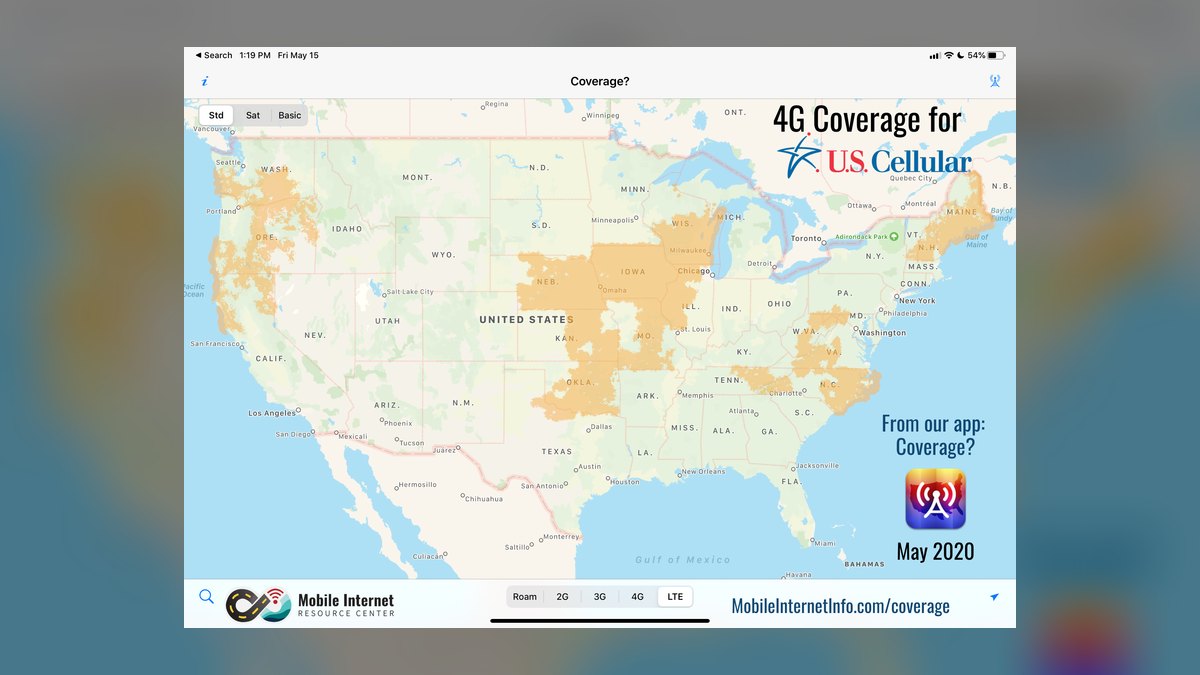
The practical read: if you spend most of your time in or between Philadelphia, Pittsburgh, Allentown, Erie, Harrisburg, or Scranton, T-Mobile is the default and the burden of proof falls on anyone recommending otherwise. If your daily radius includes Tioga, Bradford, Sullivan, or the Allegheny National Forest region, Verizon becomes the default and the question flips. If you are in the north-central Wilds specifically, a regional operator like UScellular can beat both, which is the kind of result that never shows up in a national ranking.
Where the MVNO layer changes the calculation
The postpaid answer is only half the market. Pennsylvania has heavy cable-company penetration, and that reshapes the value question in ways a pure network comparison misses.

Xfinity Mobile runs on Verizon's network and is bundled with Comcast internet, which is available across a large majority of Pennsylvania households and dominates the southeastern counties — Philadelphia, Montgomery, Delaware, Bucks, Chester. If you already pay Comcast for internet, the per-line mobile pricing plus the bundle discount routinely beats what Verizon charges directly for the same underlying radio access. Spectrum Mobile plays the identical game on the western side of the state, where Charter's cable footprint is stronger, including Erie and much of the Pittsburgh suburbs.
The catch on both is deprioritization. As an MVNO, your traffic yields to the host network's own postpaid subscribers once you cross a monthly threshold, and Pennsylvania has predictable congestion points where that bites: Pittsburgh International and Philadelphia International terminals, Beaver Stadium on a home Saturday, the Turnpike service plazas on a holiday weekend, and downtown Philadelphia during a Center City event. On a normal Tuesday you will not notice. On the days you most want your phone to work, you might.

Cricket Wireless is AT&T's prepaid arm and behaves similarly against AT&T's low-band network, with no access to AT&T's 5G+ layer. Consumer Cellular targets the AARP demographic, runs across both AT&T and T-Mobile, and consistently rates near the top for customer support quality — a real factor if the line belongs to a parent in Lancaster County who will actually call the help desk rather than search a forum. Google Fi rides T-Mobile's network and is the outlier worth naming for one reason: its international roaming is genuinely generous, which matters if you fly out of Philadelphia or Pittsburgh regularly for work.
Boost Mobile, now under EchoStar, is the odd case — it blends its own build-out with roaming onto other networks, so its Pennsylvania performance is inconsistent by market rather than uniformly good or bad. In dense Philadelphia it can be very fast; in a smaller market like Scranton the experience is a different network entirely.
The upstream effect most people miss: choosing an MVNO tied to your home internet provider quietly increases your switching cost on both services at once. Cancel the cable internet and the mobile discount evaporates, so what looked like a mobile decision was actually a two-product lock-in decision. That is worth pricing consciously rather than discovering at renewal.

How to decide between them
Decision quality here comes from sequencing, not from reading more reviews. The single highest-value step costs nothing: pull the official coverage maps for T-Mobile, Verizon, and AT&T and enter the specific addresses where you actually use your phone — home, work, the school, the in-laws, the trailhead. Not your ZIP code centroid. Pennsylvania terrain is steep enough that a ridge between you and the tower can kill a signal within a mile of it, and ZIP-level maps average that away.
Then check the FCC's national broadband map, which publishes carrier-submitted coverage by location and lets you file a challenge if what you experience does not match what was claimed. It is the only source in this comparison that is not marketing copy from the company being evaluated.
After the maps, run a real trial. Every major carrier sells prepaid SIMs and eSIMs cheaply, and modern phones hold multiple eSIM profiles simultaneously. Buy one month on your top candidate, keep your existing line active, and carry both for a full cycle including a weekend trip on whatever route you drive most. This converts an argument about coverage claims into a measurement of your actual life, and it is the step almost nobody takes.

Weight the criteria honestly. If you are a remote worker doing video calls from a home office, upload speed and jitter matter more than peak download, and your home address is the only location that counts. If you are a field service rep covering three counties, in-vehicle coverage continuity outranks everything. If you are buying for a household of teenagers, per-line price and hotspot policy dominate. These lead to different winners, and a ranking that ignores your usage pattern is entertainment rather than advice.
Concrete numbers behind each option
Structural numbers you can rely on, stated as ranges rather than false precision, because carrier performance in Pennsylvania varies materially by market and by month.
Coverage claims. All three national carriers advertise coverage above roughly 90% of the U.S. population, and Pennsylvania sits above the national average on population coverage because its people cluster in metros and river-valley corridors. Land-area coverage is the number that diverges — a carrier can cover the large majority of Pennsylvanians while leaving substantial fractions of the state's square mileage thin. When you see a coverage percentage, always ask whether it is people or acres.

Speed tiers. In Pennsylvania metros with mid-band 5G, real-world downloads commonly land in the low hundreds of megabits per second. Low-band 5G, which is what most rural Pennsylvania gets, typically runs in the tens of megabits — often 30 to 100 Mbps depending on load and distance. Millimeter wave delivers gigabit-class speeds but only within line of sight of a small cell, so it is a stadium and downtown-block technology, not a coverage layer. Independent measurement outfits like Ookla and Opensignal publish state-level and metro-level figures that update regularly; check the current report rather than trusting a number quoted in an article.
Plan pricing shape. Premium unlimited postpaid single lines from national carriers generally sit in the $70 to $90 range before autopay discounts, dropping toward $60 to $75 with autopay and paperless billing. Mid-tier unlimited runs roughly $50 to $70. Four-line family pricing typically lands somewhere between $25 and $40 per line, which is why multi-line is the single largest lever on cost per person. Cable-bundled MVNO lines are usually the cheapest unlimited option available, often less than half a postpaid line, with the deprioritization tradeoff. Prepaid unlimited from the national brands' own budget arms sits in between.
Fees and the real bill. The advertised price is not the bill. Pennsylvania applies state and local surcharges plus federal Universal Service Fund contributions and 911 fees on top of many plans, and these typically add a meaningful percentage. Some carriers advertise taxes-included pricing and some do not, which makes headline comparison misleading — always compare the final out-the-door monthly number for your specific address.

Premium data allotments. Unlimited plans are unlimited in name; each has a premium-data threshold, commonly somewhere between 20 GB and 100 GB per line per month, after which you are deprioritized during congestion. Hotspot data has its own separate and usually much smaller high-speed allotment before throttling. If you tether a laptop regularly, the hotspot number is the plan spec that will actually determine your experience, and it is buried three clicks deep on every carrier site.
Switching incentives. Carriers routinely offer port-in credits, device trade-in promotions spread over 24 or 36 monthly bill credits, and line-add deals. The critical detail: bill credits usually require you to stay on the qualifying plan for the entire credit term. Downgrade in month 14 and the remaining credits stop, which converts a "free phone" into an outstanding device balance. Treat any promotional device offer as a multi-year contract with a different name.
Fixed wireless as a side effect. T-Mobile and Verizon both sell 5G home internet in Pennsylvania markets, priced well under typical cable rates, and both discount it when bundled with mobile. Performance depends entirely on the same tower load as your phone — if your address gets weak mobile signal, fixed wireless will disappoint identically. But in a suburb with strong mid-band, it is a legitimate cable replacement and frequently the reason a household consolidates its mobile lines onto that carrier.

Implementation details and sequencing
Switching a household is a small project with a right order. Doing it out of order is how people end up with a dead line on a Monday morning.
Start by unlocking. A phone financed through a carrier is usually locked until the device is paid off or a policy window elapses. Confirm unlock status before you buy anything, because an unlocked phone gives you the option to test rival networks with a cheap eSIM and a locked one does not.
Check band compatibility next. A phone that technically works on a network but lacks the right band support will fall back to slower service. This matters most for T-Mobile's 2.5 GHz mid-band, which is exactly the layer that produces its speed advantage — a device without it gets a materially worse T-Mobile experience than the reviews describe. Verify the specific model against the carrier's compatibility checker rather than assuming.
Gather your port-out credentials before initiating anything: account number and the account PIN or transfer PIN from your current carrier, which is often different from your voicemail PIN and sometimes must be generated explicitly in the account portal. Never cancel your old service yourself. Porting the number is what closes the old account, and cancelling first releases the number and can make it unrecoverable.
Port one line first, ideally the least critical one in the house. Confirm inbound and outbound calls, SMS from both short codes and people, MMS group threads, data, visual voicemail, Wi-Fi calling, and emergency dialing. Group MMS and short-code delivery are the two things that most often break silently after a port, and you want to find that on a spare line rather than on the phone your employer calls.
Use the trial window deliberately. Most carriers offer a return or satisfaction period; note the exact date and treat it as a hard deadline for the go/no-go call. In fringe areas, ask about a signal booster or femtocell — carriers frequently provide one free to qualifying addresses, and in ridge-shadowed Pennsylvania homes it converts an unusable address into a fine one. Wi-Fi calling covers the same gap for free if your home broadband is solid, and for many rural Pennsylvania households it is the actual fix rather than switching carriers at all.
Sequence the family plan last. Multi-line discounts and bundle credits usually require all lines on the same account, so consolidating is what unlocks the pricing you were quoted. Move them in one batch after the pilot line proves out, then verify on the first full bill that every promised credit is present. Promotional credits that fail to attach are common and are almost always fixable in the first billing cycle — much harder six months later.
Finally, re-evaluate on a calendar. Networks change: new towers light up, spectrum gets refarmed, and a market that was mediocre in one year can be strong two years later. Set a reminder to re-check coverage and pricing when your device credits end, because that is the moment your switching cost drops to near zero and your leverage is highest.
Related questions
Does the best carrier differ between Philadelphia and Pittsburgh?
Less than people assume. Both metros have dense deployments from all three national carriers, including high-capacity 5G downtown. Differences show up in the suburbs and the cable-bundle math — Comcast dominates the southeast, Charter is stronger in the west — which changes the cheapest good option more than the fastest one.
Is 5G actually necessary, or is LTE still fine?
LTE remains fully functional for calls, messaging, navigation, and most streaming. 5G matters for congestion resilience, hotspot use, and video uploads. Carriers are also gradually reallocating spectrum away from LTE, so a 5G-capable phone is more about future-proofing than immediate need.
What about coverage on Pennsylvania's interstates?
Highway corridors are prioritized by every carrier because they concentrate traffic. I-76, I-81, I-80, and I-79 generally have solid service, with thinner stretches through mountain cuts and tunnels. The Turnpike tunnels specifically drop most signals regardless of carrier.
Can I keep one carrier for phones and another for home internet?
Yes, and it is often cheaper than bundling if you do the arithmetic. Bundles win when the discount exceeds what a standalone competitor charges. They lose when the discount locks you into an overpriced product on one side of the pair.
Do prepaid plans work on the same towers as postpaid?
Same towers, same radios, different priority. Prepaid and MVNO traffic yields to the host carrier's postpaid subscribers when a cell is congested. In uncongested conditions the experience is identical; at a packed stadium or airport it is not.
FAQ
Which carrier has the broadest 5G coverage across Pennsylvania?
T-Mobile generally leads on mid-band 5G reach across Pennsylvania's population, which is what produces its speed advantage in cities, suburbs, and along major corridors. Verizon and AT&T lead in specific rural pockets where low-band propagation matters more than capacity. The honest answer is that "broadest" depends on whether you mean people covered or square miles covered, and the three carriers rank differently on each measure.
Is Verizon still the right answer for rural Pennsylvania?
Often, particularly in the northern tier counties and forested regions where low-band reach outperforms capacity-focused deployments. But this is exactly where a regional carrier can beat all three nationals, and where a signal booster or Wi-Fi calling may solve the problem without switching at all. Verify against your specific address on the official maps and the FCC broadband map before deciding.
What is the cheapest way to get unlimited data in Pennsylvania?
A cable-bundled MVNO line, if you already buy internet from Comcast or Charter, is typically the lowest per-line unlimited price available. Prepaid unlimited from a national carrier's budget brand comes next. Both trade away data priority during congestion. Postpaid multi-line family pricing is the cheapest option that keeps full priority.
How much do taxes and fees add to a Pennsylvania wireless bill?
Meaningfully — state and local surcharges, federal Universal Service Fund contributions, and 911 fees stack on top of many advertised prices. Some carriers quote taxes-included pricing and some quote pre-tax, which makes headline comparison unreliable. Always ask for the total monthly amount for your billing address before committing.
Will switching carriers cost me my phone?
Not if you sequence it correctly. Confirm the device is unlocked and paid off, verify band compatibility with the new network, and understand that outstanding device credits from your current carrier usually stop if you leave or downgrade. Any remaining balance becomes payable, so check what you still owe before you port.
Does a signal booster actually help in mountainous areas?
Yes, when there is a usable outdoor signal to amplify. A booster relays and strengthens existing signal, so it fails in true dead zones with nothing to capture. In ridge-shadowed homes with weak-but-present service, it is highly effective, and carriers often supply one free to qualifying addresses. Wi-Fi calling is the alternative when broadband is available.
Sources
- FCC National Broadband Map
- T-Mobile Coverage Map
- Verizon Coverage Map
- AT&T Wireless Coverage Map
- Ookla Speedtest Performance — Pennsylvania
- Opensignal Reports
- FCC Consumer Guide: Cell Phone Unlocking
- Pennsylvania Public Utility Commission
- CTIA — Wireless Industry Resources
- J.D. Power U.S. Wireless Studies
Related on PULSE
This page will be disappearing soon. Save it to your device for $1 — or read it free while it is here.
@Kory-White- · if Venmo asks, the last 4 of my number are 2012
This page is gone.
This one is off the shelf now. $1 keeps it on your phone for good — the whole page, pictures and diagrams included.
 telcoWhat are the most common mistakes in Telco in 2027?
 telcoHow much mobile data does a family of four actually need in 2027?
 telcoWhy is my cell phone data so slow and am I being throttled in 2027?
 telcoAre autopay and paperless discounts worth it in 2027?
 telcoHow do I switch carriers without changing my phone number in 2027?
 telcoWhat is the best plan if I barely use data in 2027?
 telcoCan I bring my own phone to a new carrier (BYOD) in 2027?
 telcoWhat is the best backup option if my home internet goes down in 2027?
 telcoWhat is the best family cell phone plan for four lines in 2027?
 telcoAT&T vs T-Mobile: which is better in 2027?