
Should I Hire a Fractional CRO If I Just Hit 5 Million in ARR?
 Curated byKory White · Fractional CRO · Maryland
 PULSEKNOWLEDGE LIBRARY
Quality
Certified

At 5 million in ARR, hire a fractional CRO only if your bottleneck is process rather than pipeline capacity. Fractional revenue leadership buys architecture — documented stages, forecast discipline, coaching cadence — at a fraction of a full-time executive's cost. If you simply need more closed deals this quarter, hire a senior AE instead.
This vs. the common alternatives
The question is almost never "fractional CRO or nothing." It is fractional CRO versus four other ways to spend the same money, and founders who skip that comparison tend to buy the title rather than the outcome. Lay the options side by side before you take a single intro call.
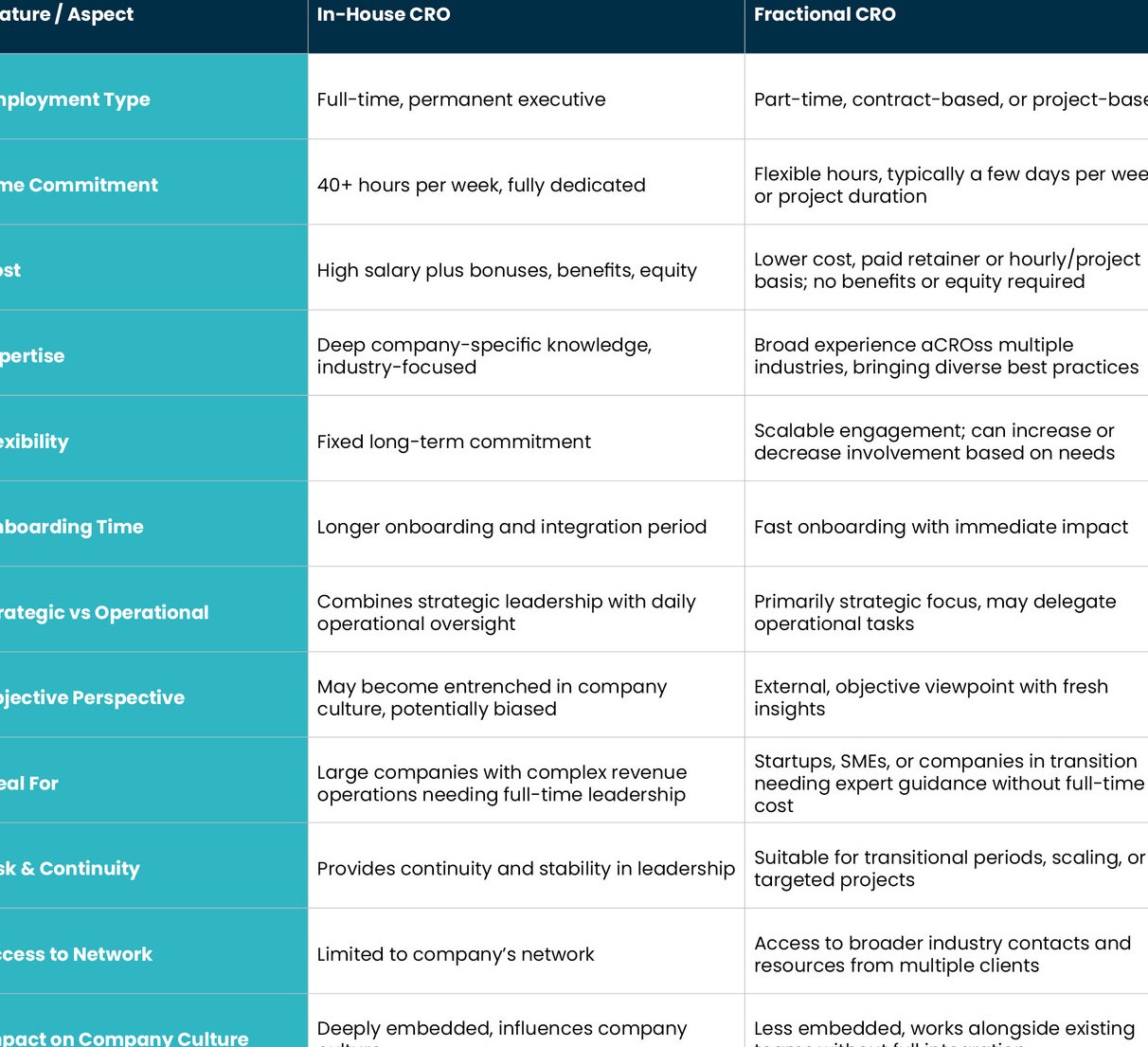
Full-time CRO. A permanent chief revenue officer at this stage locks you into a large annual base plus variable comp plus meaningful equity, and the search itself typically runs three to five months. The upside is cultural embedding: someone in every standup, every pricing debate, every hiring loop, making decisions in hours instead of at the next scheduled sync. The downside is that you are committing to a permanent org chart before you have validated that the revenue motion underneath it is repeatable. If the engine still runs on founder charisma, a full-time CRO spends their first two quarters discovering what a fractional would have documented in ninety days — at several times the burn and with a painful unwind if the chemistry is wrong.
Full-time VP of Sales. This is the most commonly confused alternative, and the distinction matters. A VP of Sales manages people and hits a number. A CRO — fractional or not — designs the system that spans marketing handoff, sales execution, and post-sale expansion. If you already have a documented playbook that works and you need someone to run it, recruit, coach to quota, and enforce activity discipline, the VP is the correct and cheaper hire. If nobody can articulate what the playbook is, a VP inherits ambiguity and improvises a process from their last company, which may or may not fit your motion. The sequence most companies want is: fractional CRO builds the architecture, then a VP of Sales is hired into it with a clear job to do.
Senior individual contributor. Run the arithmetic honestly. A strong enterprise AE with domain relationships costs base plus commission and, in a good year, closes new ARR several times their fully loaded cost. A fractional CRO does not carry a bag and does not generate leads — they improve the conversion of demand you already have. So the comparison is: does incremental capacity at the top of the funnel beat incremental efficiency through the middle? If you are converting well but starved for at-bats, the AE wins on pure math. If you are drowning in leads that go nowhere and nobody can explain why, the leadership hire wins.

RevOps hire or agency. A dedicated RevOps analyst or a specialist agency can rebuild your CRM, wire up attribution, and produce clean dashboards for meaningfully less than fractional executive rates. What they cannot do is sit in a deal review and tell a rep that they are negotiating against themselves, or tell the founder to stop taking every call. Tooling without judgment produces beautiful reports nobody acts on. Judgment without tooling produces opinions nobody can verify. At 5 million, many companies genuinely need both, and the honest answer is often "fractional CRO for two quarters, with a RevOps contractor executing underneath them."
Coach or advisor. The cheapest option: a few hours a month of pattern-matched advice from someone who has scaled a similar business. This works when you know what to build and need a sounding board on judgment calls. It fails when nobody on the team has the bandwidth or the authority to actually build it. An advisor recommends; a fractional CRO owns.
The deciding variable across all five is accountability. A consultant delivers a document. A fractional CRO owns pipeline health, forecast accuracy, and rep development as outcomes — they are on the hook for whether the thing works, not just whether it was recommended. If a candidate is unwilling to be measured on those numbers, you are buying advisory hours with an executive title stapled on.

How to choose between them
Start with a diagnosis, not a job description. Three questions, answered honestly with data rather than instinct, will route you to the right hire faster than any interview loop.
First: can you predict next quarter's revenue within twenty percent? If your forecast swings wildly, the problem is stage definition and qualification discipline — squarely fractional CRO territory. If your forecast is reliable and simply too small, the problem is demand, and no amount of forecasting rigor creates at-bats.
Second: do your top two reps have materially different win rates, and can you explain the gap with evidence? Territory quality, lead source mix, skill, and luck all produce the same surface symptom. If you cannot decompose the variance, you lack the reporting layer and the coaching cadence that a revenue leader installs. If you can explain it precisely and the answer is "one rep is better," you need recruiting, not architecture.
Third: did you lose a deal in the last ninety days whose root cause you genuinely do not understand? Undiagnosable losses mean your closed-lost data is fiction — reps pick whatever dropdown value exits the record fastest. That is a process defect, and it compounds silently until it poisons every strategic decision you make about pricing, ICP, and competitive positioning.

Layer a second filter on top: is your product actually ready to be sold at scale? If monthly logo churn runs above roughly five percent, if support escalations dominate your leadership meetings, or if you are still changing pricing every few weeks, you have a product-market fit problem wearing a revenue costume. Revenue leadership cannot fix a value proposition that is still being discovered. The strongest candidates say this out loud in the first conversation and talk themselves out of the engagement — treat that as the single best signal you will get. Anyone who nods along and quotes a retainer while your churn is double digits is optimizing for their invoice.
Third filter: runway. Fractional engagements are paid monthly in cash. If you cannot comfortably fund six months at the proposed rate without threatening payroll, do not start — a fractional CRO cut loose at month three leaves you with a half-built process and a distracted team, which is strictly worse than the founder-led chaos you started with.
Notice what the diagnostic does not ask: how big your team feels, or whether competitors have a CRO. Peer benchmarking is the worst possible input here, because two companies at identical ARR can have completely different bottlenecks — one selling six-figure enterprise contracts on nine-month cycles, the other running product-led self-serve with a two-week close. The first needs deal architecture and procurement navigation; the second needs lifecycle marketing and expansion motion. Same revenue number, opposite hires.
Costs, timelines, and expected impact
Fractional CRO pricing is a function of days committed, sales-cycle complexity, travel expectations, and whether equity is part of the package. Rather than quoting numbers that vary wildly by market and vertical, evaluate the structure of the offer.

Days per month is the primary lever. Light engagements — a handful of days monthly, fully remote — buy oversight and board-level perspective. You get judgment on strategy, a second opinion on hiring, and monthly reviews. What you do not get is hands in the CRM. Deeper engagements, roughly ten to twelve days monthly with quarterly on-sites, buy operational ownership: weekly coaching, dashboard construction, deal inspection, and hiring loops. The second model is what most companies at this stage actually need, and the first is what most companies mistakenly buy because it is cheaper.
Equity is the most underdiscussed line item. Fractional executives frequently ask for a fraction of a percent, vesting over two to three years with a one-year cliff. Model that against a plausible next-round valuation before you agree — a small percentage of a company that raises well is real money, and it dilutes alongside everyone else. Negotiate cash and equity as one package in one conversation. Founders who settle the retainer first and treat equity as a handshake afterward routinely give away more than they intended.
Budget framing beats absolute numbers. A workable heuristic: total revenue leadership spend — sales, marketing, and customer success leadership combined — lands somewhere in the low-to-mid teens as a percentage of revenue at this stage. If you are spending far under that, you are almost certainly underinvesting in the infrastructure that makes the next doubling possible. If you are spending far over it, you have bought more titles than the revenue base can support. A fractional CRO should fit inside that envelope alongside a marketing lead and a CS lead, not consume it.

The hidden cost is bad architecture. A retainer wasted is annoying. A wrong pipeline model is expensive. If someone installs a stage framework that does not match how your buyers actually decide, or a forecast methodology that produces confidently wrong numbers, you accumulate institutional debt that a future leader must tear out. Rebuilding a CRM taxonomy after reps have been entering data against it for a year costs months of clean history and a great deal of trust. This is why the vetting bar matters more than the rate card: an expensive operator with a track record of building revenue engines from zero is a better buy than a cheap generalist optimizing an existing one.
Timeline expectations, honestly stated. Week one is access and audit — CRM, closed-lost data, call recordings, pipeline reports, comp plans. By roughly day seven you should have a current-state assessment with real numbers: pipeline coverage ratio, stage-to-stage conversion, sales cycle length by segment and by lead source, win rate by rep. By day thirty there should be one measurable quick win — commonly a pipeline scrub that removes dead deals from the forecast, or a deal-review cadence that surfaces stalls before they become losses. Nothing concrete by day thirty is a directional problem, not a patience problem.
By day ninety you should be able to point to a documented process, a dashboard the team actually opens, a weekly coaching rhythm, and a hiring plan for the next two quarters. Improvement in qualification rigor typically shows up as higher SQL-to-opportunity conversion and a shorter, cleaner pipeline — often the pipeline gets *smaller* first, which alarms founders who mistake volume for health. Forecast accuracy tightening is usually the slowest metric to move, because it requires two or three quarters of clean stage data before the model has anything trustworthy to learn from.
The return that rarely appears in a monthly report is fundraising leverage. Investors at the next round will ask how revenue is produced, not just how much. A documented motion, a forecast that has held within a tight band for consecutive quarters, and reps closing without the founder in the room change the story from "charismatic founder sells well" to "the company has a repeatable engine." That narrative shift moves diligence faster and reduces the discount applied to founder-dependent revenue. It is a real return, it is hard to quantify precisely, and it is frequently the largest one.

Implementation and handoff details
Sourcing comes first, and the channel determines the quality of the pool. The strongest fractional operators rarely advertise — they are referred by founders they have worked with, by investors who have watched them turn a business around, and by operator communities. Ask your board and your investors for names before you touch a marketplace. Talk to three to five candidates. Screen for stage fit, not career prestige: someone who ran a five-hundred-person sales org at a public company may have never designed a motion from zero, which is precisely the skill you are buying.
The interview that actually predicts performance is a live diagnostic. Hand them a real stalled deal from your pipeline — a six-figure opportunity sitting a hundred and twenty days in stage, champion enthusiastic, procurement silent — and ask exactly how they would coach the rep to move it in thirty days. Strong answers are operational and sequenced: map the full decision committee, identify the economic buyer's stated priorities, build a mutual close plan with named owners and dates, reframe the proposal against those priorities rather than feature lists, and set a defensible expiry rather than a fake discount deadline. Weak answers are motivational: create urgency, escalate to the CEO, apply pressure. That gap tells you everything.
Reference checks should be stage-matched. Ask for founders whose companies were between roughly three and ten million in ARR when the engagement started; references from much larger companies describe a different job. Ask each one three questions: what was the single most valuable thing done in the first ninety days, what did they miss or get wrong, and would you hire them again at the same stage. The second question is the one that produces signal — every reference has a positive answer ready for the first.

Structure the engagement as a ninety-day pilot with named deliverables and a thirty-day mutual opt-out. Deliverables should be artifacts, not activities: a written sales process with stage exit criteria, a working pipeline dashboard fed by clean data, a documented weekly coaching cadence with attendance, and a hiring plan with role definitions and comp bands. Experienced operators agree to this structure readily — hesitation about being measured on artifacts is itself the answer.
Set the boundaries explicitly in writing, because scope creep is how these engagements quietly fail. A fractional CRO is not managing daily SDR activity, not fielding support escalations, not sitting in every all-hands, and not owning product roadmap. Those belong to a sales manager, a CS lead, and the CEO. Every hour pulled into firefighting is an hour not spent building the system that stops the fires.
Handoff is the part everyone skips and everyone regrets. The engagement's durable output is a revenue playbook a new leader can absorb in a couple of days: methodology and qualification criteria, stage definitions with exit gates, pricing and discounting guidelines with approval thresholds, competitive positioning, objection-handling patterns drawn from real recorded calls, and a hiring rubric with interview scorecards. If someone cannot or will not document to that standard, they are building dependency on themselves rather than infrastructure you own. That is a consulting relationship, and it is the failure mode that makes founders swear off fractional leadership entirely.
Adjacent to the handoff, decide who inherits the tooling. Dashboards decay the moment nobody owns them. Name an internal person — a RevOps analyst, an ops-minded sales manager, sometimes the CEO for a stretch — who takes over report maintenance, field governance, and data hygiene when the engagement ends. Without a named owner, the CRM drifts back to custom fields nobody fills and stages nobody respects within two quarters, and you will be relitigating this hire in a year.

Where fractional leadership consistently underperforms
Some businesses are structurally poor fits regardless of how good the operator is, and recognizing yours early saves two quarters.
Extreme seasonality. If most of your bookings land in a narrow window — education selling against academic budget cycles, tax software, retail-adjacent tooling — a fractional leader working a handful of days a month struggles to build momentum during the trough and is stretched thin during the peak. The rhythm of the business fights the rhythm of the engagement.
Deep technical domains. Defense, biotech, semiconductor tooling, complex infrastructure — markets where coaching a rep on an objection requires genuine technical literacy. A revenue generalist can install pipeline hygiene and forecast discipline, but they cannot help a rep navigate a technical evaluation they do not understand. In these markets, weight domain experience heavily over general SaaS pedigree, and accept that the qualified pool is small.
Mid-pivot businesses. Moving from services to software, from self-serve to enterprise, or from a single product to a platform creates ambiguity that a part-time leader cannot resolve. Pivots demand someone present for the daily judgment calls over twelve to eighteen months. Fractional leadership needs enough clarity to build against; a pivot removes it by definition.

Founder unwillingness to let go. The most common quiet failure. If the founder cannot stop inserting themselves into every deal, the process never gets exercised and reps learn that the real approval path runs through the CEO. The engagement produces documentation nobody follows. Before signing, decide which deals you will stay out of entirely and commit to it — including the ones you will probably lose. Losing a few deals to prove the system can run without you is the actual price of the transition, and founders who will not pay it should not start.
Adjacent moves worth considering first
Before committing to any revenue leadership hire, several cheaper interventions frequently resolve the symptom that prompted the search.
Run a closed-lost review yourself. Pull every loss from the last two quarters and call ten of them. Not a survey — actual conversations with the buyer. Founders routinely discover that deals were lost on implementation concerns, procurement friction, or a competitor's integration rather than price or rep skill. That finding may point at product, partnerships, or pricing rather than sales process, and it costs you a week.

Audit the demand mix. Break pipeline down by source and measure conversion end to end for each. If one channel produces most of the volume and almost none of the revenue, the fix is upstream in marketing qualification, not downstream in sales coaching. This is the single most common misattribution at this stage: a demand quality problem diagnosed as a sales execution problem, treated with an expensive sales leadership hire.
Instrument before you architect. Basic call recording, honest stage definitions, and a single agreed-upon definition of a qualified opportunity cost very little and can be implemented in weeks. Any incoming leader will need this data anyway, and having it already flowing means their first thirty days go to interpretation rather than plumbing — which is a genuine acceleration of whatever you eventually buy.
Fix comp before you fix process. Compensation drives behavior more reliably than any coaching cadence. If reps are paid identically on new logos and renewals, or if accelerators kick in so late that nobody chases them, you will see exactly the behavior you are paying for. Comp plan redesign is cheap, fast, and often produces a larger behavioral shift in one quarter than a process rebuild does in two.
Consider a fractional RevOps lead instead. A part-time operations leader — cheaper than a CRO, focused on systems, data, and reporting — solves the infrastructure half of the problem without the coaching half. If your reps are competent and your data is a mess, that is the more precise instrument. Many companies at 5 million discover their actual gap was RevOps capacity all along, and that the founder's coaching, while imperfect, was never the binding constraint.
Related questions
How does a fractional CRO differ from a sales consultant?
A consultant delivers recommendations and exits. A fractional CRO owns outcomes — pipeline health, forecast accuracy, rep development — and is measured on them. The engagement is leadership with accountability, not advisory hours with a deck at the end.
Can a fractional CRO close deals for us?
Rarely, and you should not hire one for that. They design systems and coach the people who close. If you need someone personally responsible for booking new revenue this quarter, hire a senior account executive or a full-time VP of Sales.
How long should the engagement run?
Start with a ninety-day pilot carrying explicit deliverables and a thirty-day mutual opt-out. Extend six to twelve months if the artifacts are real and adopted. The endpoint is a company capable of hiring a full-time leader into a functioning system.
What should improve in the first ninety days?
Cleaner pipeline with dead deals removed, stage-to-stage conversion you can explain, a coaching cadence that happens weekly without reminders, and a meaningful reduction in founder hours spent on deal management. Forecast accuracy improves later, after clean data accumulates.
Should we hire RevOps support alongside the CRO?
Often yes. The CRO designs and coaches; a RevOps analyst or contractor executes the CRM changes, builds reports, and maintains data hygiene. Pairing them prevents the leader from burning expensive days on administration nobody else owns.
FAQ
Is 5 million in ARR too early for a fractional CRO?
Not inherently — it is roughly where founder-led selling stops scaling. The gating factors are whether you have a team to coach, stable product-market fit, and six months of cash for the retainer. Without a sales team to build around, you are buying advice rather than leadership, and an advisor costs far less.
How much equity should a fractional CRO receive?
Fractional executives commonly ask for a fraction of a percent vesting over two to three years with a one-year cliff. Model it against a realistic next-round valuation and negotiate it in the same conversation as cash. Treating equity as a separate afterthought is how founders give away more than they planned.
What tools should a candidate know?
Deep fluency in a major CRM, plus working familiarity with sequencing, conversation intelligence, and forecasting tooling. More telling than the tool list is how they talk about data governance. Anyone who dismisses RevOps as overhead does not understand how a modern revenue function is instrumented.
Does remote fractional leadership actually work?
Yes, with deliberate rhythm: a standing weekly executive session, a monthly written board-style review, asynchronous channels for daily decisions, and quarterly on-sites. Prioritize stage and domain fit over proximity — a remote operator who has built this exact motion beats a local generalist who has not.
What if the engagement is not working?
Use the thirty-day mutual opt-out you negotiated up front. If you cannot name a concrete, measurable improvement in revenue operations by then, exit and require a documented handoff of whatever was built. Sunk retainer is cheaper than two more quarters of drift and a team learning to ignore new process.
Should we hire a fractional CRO or a full-time VP of Sales?
Fractional CRO if no documented playbook exists and the motion still depends on the founder. Full-time VP of Sales if the playbook works and the gap is execution, recruiting, and quota management. Many companies do both in sequence — architecture first, then someone hired into it.
Sources
- Pavilion
- SaaStr
- OpenView Partners research library
- Bessemer Venture Partners — State of the Cloud
- a16z enterprise go-to-market writing
- First Round Review
- HubSpot Sales Blog
- Salesforce resources
- Gong Labs research
- Harvard Business Review — sales management
Related on PULSE
- [Should I Hire a Fractional CRO If I Just Hit 20 Million in ARR in 2027?](/knowledge/tl0376)
- [Should I Hire a Fractional CRO If My VP of Sales Just Quit in 2027?](/knowledge/tl0357)
- [Should I Hire a Fractional CRO If I Just Lost My Biggest Account in 2027?](/knowledge/tl0567)
- [Should I Hire a Fractional CRO If A PE Firm Just Acquired Us in 2027?](/knowledge/tl0363)
- [Should I Hire a Fractional CRO If I Just Raised a Series A in 2027?](/knowledge/tl0354)
- [Should I hire a fractional CRO in Dupont Circle in 2027?](/knowledge/tl19206)
This page will be disappearing soon. Save it to your device for $1 — or read it free while it is here.
@Kory-White- · if Venmo asks, the last 4 of my number are 2012
 pulse-toolsWhere do I find a fractional head of revenue in Nashville in 2027?
 pulse-toolsShould I Hire a Fractional CRO If I Need to Build a Partner Channel in 2027?
 pulse-toolsHow do I find a fractional CRO in Minneapolis in 2027?
 pulse-toolsShould I Hire a Fractional CRO If I Need to Rebuild Trust After a Failed CRO in 2027?
 pulse-toolsWhat should an SMB company look for in a fractional CRO in 2027?
 pulse-toolsShould I Hire a Fractional CRO If I Need to Fix Attribution Before Raising in 2027?
 pulse-toolsShould I Hire a Fractional CRO If I Need Interim Leadership During a CRO Search in 2027?
 pulse-toolsHow do I find a fractional CRO in Austin in 2027?
 pulse-toolsWho is the best fractional CRO in Frederick in 2027?
 pulse-toolsWhere do I find an interim CRO in Fort Lauderdale in 2027?