
The 10 Best AI Tools for Recruiting in 2027
 Curated byKory White · Fractional CRO · Maryland
 PULSEKNOWLEDGE LIBRARY
The 10 best ai tools for recruiting are ranked below on measured performance, build quality, price, and how each one actually holds up in daily use rather than how it reads on a spec sheet. Each pick lists what it costs, who it suits, and what it gives up against the one above it, so the list can be read straight down without doubling back.
1. Eightfold AI

Eightfold AI ranks first because its Talent Intelligence Platform scores candidates on inferred skills and career trajectory rather than keyword overlap, the single biggest driver of match quality. Founded in 2016 by ex-Google and ex-Facebook engineers Ashutosh Garg and Varun Kacholia, it spans external sourcing, internal mobility, masked-profile diversity sourcing, and reskilling in one model. It publishes bias-audit documentation aligned to NYC Local Law 144.
This is for mid-market and enterprise teams hiring hundreds to thousands a year who want one model behind every hiring decision. It trades away affordability and speed to value: pricing is enterprise annual licensing and implementation runs weeks to months depending on ATS integration depth. Native write-back into Workday, SAP SuccessFactors, and Greenhouse keeps it usable. A five-person startup should take Fetcher instead.
2. Paradox

Paradox ranks second on automation depth in the highest-volume segment of hiring. Its assistant Olivia texts applicants within seconds, screens them against knockout questions, and books interviews directly onto hiring-manager calendars with no recruiter touch until the candidate arrives. McDonald's has used it to compress application time dramatically. Olivia handles multilingual conversations and self-service rescheduling, which cuts no-show rates in funnels where ghosting is the main leak.
This is for hourly and frontline employers staffing restaurants, warehouses, retail floors, and call centers, where candidates apply from a phone and abandon long desktop forms. It trades away fit for nuanced, low-volume executive search, where human judgment dominates and there is no efficiency story to automate. Unlike Eightfold's cross-motion talent model, Paradox works as a conversational front-end layer over Workday and other ATS platforms.
3. HireVue
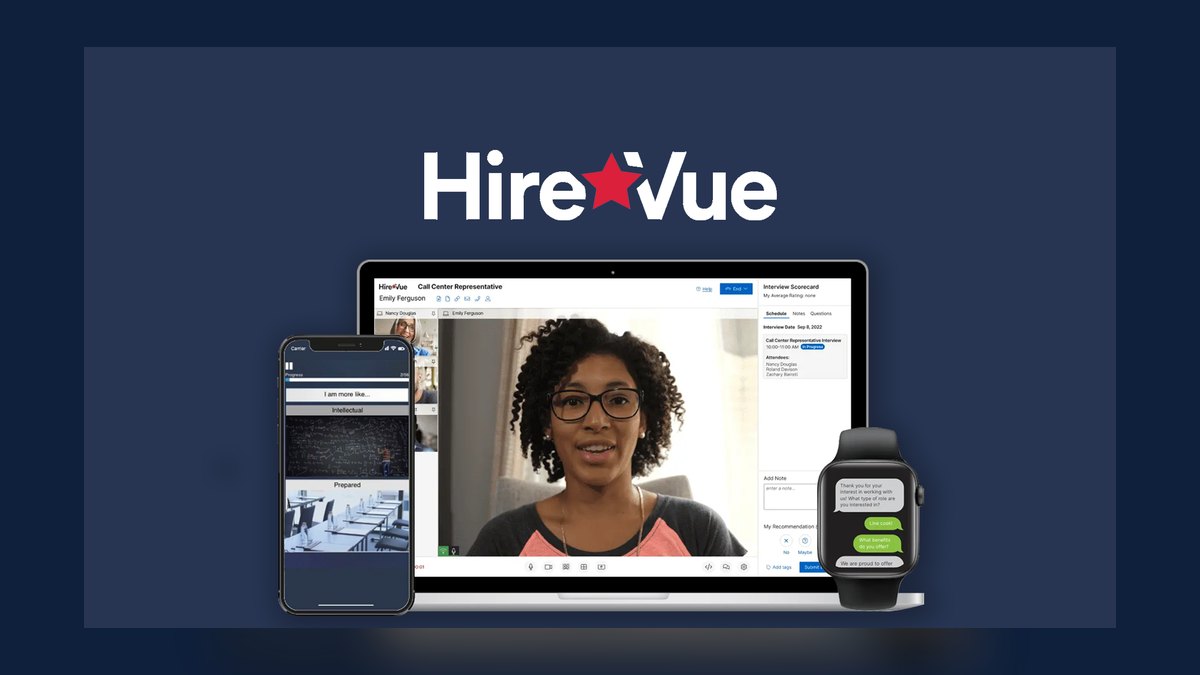
HireVue ranks third for structured, defensible screening at scale. Candidates record answers to standardized questions on their own time and recruiters review asynchronously, removing calendar gridlock from early screens. The platform adds game-based cognitive assessments and coding evaluations for technical roles. HireVue discontinued facial-analysis scoring in 2021 after fairness criticism and now emphasizes competency-based, audited assessment science, a stance that holds up under the EU AI Act's high-risk classification.
This is for campus recruiting, early-career programs, and any role where consistency and legal defensibility matter more than conversational warmth. It trades away candidate experience: asynchronous video feels impersonal, and results depend heavily on how the step is framed. Where Paradox automates the conversation and scheduling, HireVue standardizes the evaluation itself, keeping every candidate on identical auditable questions.
4. SeekOut

SeekOut ranks fourth on sourcing reach for talent that generic searches miss. Its index is strongest in technical, engineering, and security-cleared profiles, and AI-assisted search translates a role description into a candidate query and ranks results, removing the Boolean-string expertise sourcers once needed. Diversity filters and profile-blinding support equitable top-of-funnel sourcing without exposing protected attributes during screening. SeekOut Grow extends the same engine inward for internal mobility.
This is for enterprise sourcing teams with genuine DEI goals and deep technical requirements, plus skill-gap and workforce-planning work through Grow. It trades away the breadth of a full suite: it is a search and sourcing engine, not screening, scheduling, or candidate experience. Compared with Eightfold's single model across every hiring motion, SeekOut goes deeper on finding specialized people and shallower on everything after that.
5. hireEZ

hireEZ, formerly Hiretual, ranks fifth for outbound reach. It aggregates candidate signals across 45-plus platforms including GitHub and Stack Overflow into a single sourceable profile with refreshed contact data, then runs AI-driven outreach sequences so sourcers engage at volume without manual follow-up. ATS rediscovery mines an existing applicant database for silver-medalist candidates already paid for, the cheapest quality pipeline most companies ignore. Market-insights reporting covers talent supply and pay.
This is for outbound-heavy teams that live in passive-candidate sourcing and need reach plus automated nurture in one tool. It trades away suite breadth: it is a sourcer's power tool, not an all-in-one recruiting system. Integrations cover Greenhouse, Lever, Workday, and Bullhorn. Against SeekOut, hireEZ favors raw platform coverage and sequenced outreach over curated technical and diversity search depth.
6. Gem

Gem ranks sixth as a talent CRM that has grown into a near all-in-one system with its own applicant-tracking capabilities. Its core value is relationship intelligence: automated email sequences, pipeline analytics, and a unified view of every candidate touchpoint over time. Dashboards cover pipeline conversion, response rates, and diversity-funnel health. AI features draft personalized outreach and surface re-engagement candidates from an existing pipeline.
This is for in-house recruiting teams that want sourcing, nurture, and reporting in one place, and for talent-ops leaders reporting numbers to executives. It trades away the raw candidate-discovery depth of a dedicated search engine. Tight connections to Greenhouse, Lever, and Ashby make it a front end for teams keeping their ATS. Where hireEZ optimizes outbound reach, Gem optimizes the data layer above it.
7. Textio
Textio ranks seventh because it fixes the input rather than the funnel: augmented writing for job descriptions, recruiting emails, and performance feedback. It analyzes phrasing in real time, flags wording that skews biased, exclusionary, or low-response, and suggests inclusive higher-performing alternatives backed by language outcome data. Gendered or jargon-heavy language measurably narrows applicant pools, and Textio quantifies and corrects it before a post goes live.
This is for any team under DEI and fairness scrutiny that needs an auditable, data-backed rationale for the language in every requisition. It trades away scope entirely: no sourcing, no screening, no scheduling, so it pairs with the tools above rather than replacing one. Unlike Gem's pipeline analytics, Textio never touches candidates directly. It can go live in days rather than the weeks enterprise platforms require.
8. Findem
Findem ranks eighth for its Talent Data Cloud and attribute-based search, which queries candidates by 3D attributes such as scaled a team from 10 to 100 or worked at a company during hypergrowth. Those are derived signals assembled from longitudinal career data, not keyword matches. The analytics also support diversity work and market mapping, giving talent leaders a quantitative read on the available pool for a given attribute set.
This is for recruiters hunting nuanced profiles where the experience pattern matters more than the job title, such as growth-stage operators and builders. It trades away simplicity: the attribute query model rewards teams that can define the pattern precisely. Findem competes directly with Eightfold and SeekOut, differing by framing searches around trajectory shapes rather than skill rankings, which surfaces a different candidate set.
9. Phenom

Phenom ranks ninth as a Talent Experience Management suite covering AI-powered career sites, a candidate-facing chatbot, CRM, internal mobility, and AI job matching. Rather than bolting AI onto one step, it personalizes the journey from first career-site visit to hire. Personalized job recommendations and the chatbot keep candidates engaged, while the back-end CRM and analytics give recruiters pipeline visibility and apply-rate gains scattered point tools cannot match.
This is for large enterprises with their own talent-brand strategy that treat the career site as a conversion engine rather than a static job board. It trades away speed to value: implementation is heavier than a point solution, typically weeks to a few months. Against Findem's narrow search focus, Phenom is a breadth play that only pays back at volume and with resources to run it.
10. Fetcher

Fetcher ranks tenth on depth but first on value, delivering automated curated sourcing with the lowest operational lift on this list. Define a role and ideal profile, and its AI surfaces batches of vetted candidates on a schedule, then runs automated email outreach sequences to engage them. Human-in-the-loop curation keeps batches relevant while outreach runs itself, and diversity analytics are built into the workflow.
This is for startups and small-to-mid-size companies that need a steady pipeline but cannot staff a dedicated sourcing function. It trades away depth and breadth: it will not match Eightfold's talent model or Phenom's end-to-end experience layer. Setup is fast relative to enterprise platforms, measured in days, and it integrates with Greenhouse, Lever, and Ashby to slot into a modern startup stack.
How we ranked these
We scored ten tools against six criteria drawn from working recruiter workflows: match quality (skills and trajectory ranking versus keyword overlap), sourcing reach across candidate databases, automation depth for screening, scheduling, and outreach, native ATS and HRIS fit with Workday, Greenhouse, SAP SuccessFactors, iCIMS, and Ashby, bias and compliance controls under EEOC guidance, NYC Local Law 144, and the EU AI Act, plus total cost and realistic ramp time.
Match quality and automation depth carried the heaviest weight, because that is where AI recruiting either earns its keep or becomes shelfware. We deliberately ignored demo-day theater, funding rounds, analyst quadrant placement, and vendor-supplied case-study percentages that no buyer can reproduce. We also discounted feature checklists, since a connector that exists on a slide but does not write back into your ATS delivers nothing to a recruiter.
What to look for
Start with your hiring shape, not the feature grid. High-volume hourly hiring lives or dies on response speed and no-show rates, which makes Paradox's text-first screening and scheduling the right center of gravity. Skills-based enterprise hiring across sourcing, internal mobility, and diversity justifies Eightfold's model. Lean teams without a dedicated sourcer get more from Fetcher's curated batches than from a platform they lack the headcount to operate.
The common mistake is buying breadth before proving the ATS write-back path. A tool that ranks brilliantly but cannot push candidates and decisions into the system recruiters already live in creates shadow workflows nobody maintains. The second mistake is treating compliance as procurement paperwork: request the Local Law 144 bias-audit results and the EU AI Act high-risk documentation during evaluation, not after go-live.
Related questions
What is the difference between Eightfold and Paradox?
Eightfold is a Talent Intelligence Platform that ranks candidates on inferred skills and trajectory across sourcing, internal mobility, and diversity. Paradox is a conversational layer whose Olivia assistant texts applicants, screens against knockout questions, and books interviews automatically. Eightfold suits skills-based enterprise hiring; Paradox suits high-volume hourly and frontline roles where speed beats nuance.
Which AI recruiting tool works best for technical sourcing?
SeekOut indexes technical, engineering, and security-cleared talent more deeply than generic search, and its AI-assisted search translates a role description into a ranked candidate query. hireEZ is the alternative for outbound-heavy teams, aggregating signals from GitHub, Stack Overflow, and 45-plus platforms into single profiles with refreshed contact data and automated sequences.
Does Findem do something Eightfold and SeekOut cannot?
Findem's differentiator is attribute-based search over its Talent Data Cloud. Its 3D attributes let you query patterns like scaled a team from ten to one hundred, or worked at a company during hypergrowth — derived signals no keyword string expresses. When your hardest searches are about experience shape rather than job title, Findem frames candidates differently than skill-ranking engines do.
Do I still need an ATS if I buy one of these tools?
Almost always yes. An ATS like Greenhouse or Workday Recruiting is the system of record tracking applicants through stages. These tools layer on top to source, screen, or engage, and integrate rather than replace. Gem has expanded into its own applicant tracking capabilities, but most teams keep their ATS and add intelligence above it.
Why does Textio appear on a list of AI recruiting tools?
Textio is augmented writing that analyzes job descriptions and recruiting emails in real time, flagging phrasing that skews biased, exclusionary, or low-response. The words in a job post determine who applies; gendered and jargon-heavy language measurably narrows applicant pools. It is a narrow tool that pairs with sourcing and screening engines rather than replacing any of them.
What changed at HireVue around facial analysis?
HireVue discontinued facial-analysis scoring in 2021 following fairness criticism, and now emphasizes competency-based, audited assessment science. That stance ages well under the EU AI Act's high-risk classification for recruiting AI. The platform remains focused on structured asynchronous video interviewing, game-based cognitive assessments, and coding evaluations for technical roles.
Which tool fits a startup with no dedicated sourcer?
Fetcher, our Best Value pick. You define the role and ideal profile, and its AI surfaces batches of vetted candidates on a schedule while automated email sequences run the outreach — sourcing-as-a-service without the headcount. Human-in-the-loop curation keeps batches relevant. It integrates with Greenhouse, Lever, and Ashby, and setup is fast relative to enterprise platforms.
When is Phenom worth the implementation weight?
Phenom is Talent Experience Management: AI-powered career sites, a candidate chatbot, CRM, internal mobility, and job matching in one suite. It fits large employers with their own talent-brand strategy who treat the career site as a conversion engine. Below that scale, the implementation cost outruns the benefit and point solutions deliver faster returns.
FAQ
Are AI recruiting tools legal under 2027 regulations?
Yes, but they are regulated. The EU AI Act classifies recruiting AI as high-risk, requiring transparency, human oversight, and documentation. NYC Local Law 144 mandates annual bias audits for automated employment-decision tools plus candidate notice. Use vendors that publish audit results, and get the adverse-impact review done with legal before go-live rather than after.
Will AI replace recruiters?
No. AI replaces the repetitive work — sourcing, scheduling, first-pass screening — so recruiters spend time on relationships, closing, and judgment. The tools ranked here augment recruiters. None make autonomous hire decisions, and you should never configure them to. Human oversight is both a practical necessity and an explicit regulatory requirement under the EU AI Act.
What is the difference between an ATS and an AI recruiting tool?
An ATS such as Greenhouse or Workday Recruiting is the system of record that tracks applicants through stages. AI recruiting tools usually layer on top to source, screen, or engage candidates, and most integrate with your ATS rather than replace it. That integration depth is worth verifying during evaluation, because write-back is where these tools succeed or fail.
Which tool is best for a startup with no sourcer?
Fetcher. It delivers curated candidate batches and automated outreach on a schedule, effectively renting you a sourcing function without a hire. Gem is the next step up when you want CRM, nurture sequences, and pipeline analytics in-house. Both connect to Greenhouse, Lever, and Ashby, which is the modern startup stack.
Do these tools eliminate hiring bias?
They can reduce certain biases through blinded sourcing, standardized questions, and inclusive language checks, but no tool eliminates bias. Poorly governed AI can amplify historical bias, which is exactly why bias audits and human oversight are mandatory rather than optional. Treat vendor fairness claims as a starting point for diligence, not as evidence.
How long does enterprise implementation take?
Point tools like Textio or Fetcher can go live in days. Platforms like Eightfold, Phenom, or Paradox typically run weeks to a few months, depending on ATS integration depth and data migration volume. Budget ramp time honestly — a platform that sits half-configured for a quarter produces none of the match-quality gains you bought it for.
What should I ask a vendor before signing?
Request the NYC Local Law 144 bias-audit results and ask how the vendor documents decisions under the EU AI Act's high-risk classification. If they cannot produce an audit, that is your answer. Also confirm exactly which fields write back into your ATS, and who owns candidate data if you terminate the contract.
Is Eightfold overkill for a small team?
Yes. Eightfold is enterprise annual licensing built for organizations hiring hundreds to thousands a year, where consolidating sourcing, internal mobility, and diversity into one defensible model justifies the spend. A five-person startup will not recover that cost or staff the configuration. Start with Fetcher, then move to Gem when you need CRM and analytics.
What is ATS rediscovery and why does it matter?
ATS rediscovery mines your existing applicant database for silver-medalist candidates you already paid to attract. hireEZ builds this into its outbound workflow, and Gem's AI surfaces re-engagement candidates from your existing pipeline. It is the cheapest high-quality pipeline most companies ignore entirely, because past applicants already know your brand and cleared an earlier screen.
Should I buy one platform or several point tools?
Depends on volume. Enterprises hiring at scale usually get more from one model behind every motion — Eightfold or Phenom — because scattered tools fragment data and reporting. Smaller teams do better stacking narrow tools that each do one thing well: Fetcher for sourcing, Textio for language, Gem for CRM. Fragmented data is the cost of the point-tool path.
Sources
- https://eightfold.ai/
- https://www.paradox.ai/
- https://www.hirevue.com/
- https://www.seekout.com/
- https://hireez.com/
- https://www.gem.com/
- https://textio.com/
- https://www.nyc.gov/site/dca/about/automated-employment-decision-tools.page
- https://artificial-intelligence-act.eu/
- https://www.eeoc.gov/
Related on PULSE
- [More ai tools for recruiting rankings and buying guides](/knowledge)
- [PULSE Tools and calculators](/tools)
- [Everything on PULSE RevOps](/)
This page will be disappearing soon. Save it to your device for $1 — or read it free while it is here.
@Kory-White- · if Venmo asks, the last 4 of my number are 2012
 pulse-ai-infrastructureThe 10 Best Fractional GPU and GPU Sharing Tools in 2027
 pulse-ai-infrastructureThe 10 Best AI Tools for Beat Making in 2027
 pulse-ai-infrastructureThe 10 Best AI Tools for Drupal Development in 2027
 pulse-ai-infrastructureThe 10 Best AI Tools for Supply Chain Planning in 2027
 pulse-ai-infrastructureThe 10 Best AI Tools for Summarizing Books in 2027
 pulse-ai-infrastructureThe 10 Best AI Tools for E-commerce Websites in 2027
 pulse-ai-infrastructureThe 10 Best AI Tools for Web Animations in 2027
 pulse-ai-infrastructureThe 10 Best AI Tools for Architecture Design in 2027
 aiThe 10 Best AI Tools for PHP Development in 2027
 pulse-ai-infrastructureThe 10 Best AI Tools for Pronunciation Coaching in 2027