
The 10 Best AI Tools for Voice Cloning in 2027
 Curated byKory White · Fractional CRO · Maryland
 PULSEKNOWLEDGE LIBRARY
The 10 best ai tools for voice cloning are ranked below on measured performance, build quality, price, and how each one actually holds up in daily use rather than how it reads on a spec sheet. Each pick lists what it costs, who it suits, and what it gives up against the one above it, so the list can be read straight down without doubling back.
1. ElevenLabs Voice Cloning
ElevenLabs ranks first because its Professional Voice Cloning delivers the most natural, emotionally controllable digital voices across 70+ languages, with a production-grade API. Instant Voice Cloning builds a usable clone from roughly one minute of audio, while Professional Voice Cloning trains on 30 minutes to three hours for near-indistinguishable results. The Flash v2.5 model achieves roughly 75 ms latency, making it viable for real-time agents.
It is for creators, localization teams, and developers who need studio-quality cloned voices with real consent controls, including a voice verification recording step. It trades away the lower price and simpler self-serve onboarding of some competitors, but its control sliders for Stability, Similarity, and Style Exaggeration are unmatched. Compared to Resemble AI below, ElevenLabs offers superior naturalness and language breadth, though Resemble counters with stronger real-time speech-to-speech and built-in deepfake detection.
2. Resemble AI Voice Cloning
Resemble AI ranks second because its real-time speech-to-speech engine converts a live performance into a cloned target voice while preserving original delivery, with sub-200 ms streaming latency. Clones can be built from as little as 10 seconds of audio, with higher-fidelity professional clones from longer samples. The platform pairs cloning with Resemble Detect, a deepfake-detection model, and PerTh, a neural watermark embedded in generated speech. Localize extends a single voice across 100+ languages.
It is for enterprises and operators needing live voice conversion and compliance tooling in the same stack, with on-prem and private-cloud deployment options and SOC 2 posture. It trades away the absolute naturalness of ElevenLabs' top-tier models for a more complete provenance and safety toolkit. Compared to Cartesia below, Resemble offers broader language coverage and detection features, while Cartesia wins on raw speed and developer ergonomics.
3. Cartesia Sonic Voice Cloning

Cartesia ranks third because its Sonic model delivers cloned, streaming speech at roughly 90 ms model latency, low enough for conversational voice agents to feel natural. The architecture is a state-space model rather than a standard transformer, keeping it fast and memory-efficient on long context. Cloning works from a few seconds of reference audio, producing a workable voice with good prosody. It exposes a clean WebSocket streaming API and offers on-device Sonic variants for edge deployments.
It is for developers building voice AI products like AI tutors, drive-thru order takers, and in-app assistants where every hundred milliseconds of lag costs conversions. It trades away the fine emotional sculpting of ElevenLabs PVC and the compliance tooling of Resemble AI. Compared to Microsoft Azure AI Speech below, Cartesia is far more developer-friendly and faster, but Azure offers enterprise governance and integration that Cartesia lacks.
4. Microsoft Azure AI Speech
Microsoft Azure AI Speech ranks fourth because it is the enterprise-governed option, offering Personal Voice from a one-minute sample and Custom Neural Voice behind a limited-access gate requiring documented consent. The reason to choose Azure is governance, not novelty, with role-based access, regional data residency, and audit logging. It enforces a responsible-AI process including a recorded consent statement from voice talent before training. Output integrates directly with the broader Azure Cognitive Services stack.
It is for Fortune 500 IT buying through existing Microsoft agreements, where the friction of the access gate is a feature that keeps legal comfortable. It trades away the low-latency and developer ease of Cartesia, and the naturalness of ElevenLabs, for compliance and enterprise integration. Compared to Play.ht below, Azure offers superior governance and cross-lingual synthesis, but Play.ht provides faster self-serve cloning and a larger stock library.
5. Play.ht Voice Cloning
Play.ht ranks fifth because it is a workhorse for creators and developers wanting fast cloning plus a deep stock library, with Play 3.0 producing low-latency multilingual speech across 140+ languages and accents. Instant voice cloning spins up a clone from a short uploaded sample within minutes. The platform includes an API and SDK for embedding voices in apps, an audio-article widget, and a podcast-style editor for mixing multiple cloned voices.
It is for high-volume content cloning with broad language reach, where throughput at a reasonable price matters more than fine emotional control. It trades away the expressiveness of ElevenLabs and the real-time capabilities of Resemble AI. Compared to Descript below, Play.ht offers a more general-purpose API and stock library, while Descript's Overdub is uniquely integrated into a transcript-based editing workflow.
6. Descript Overdub Voice Cloning
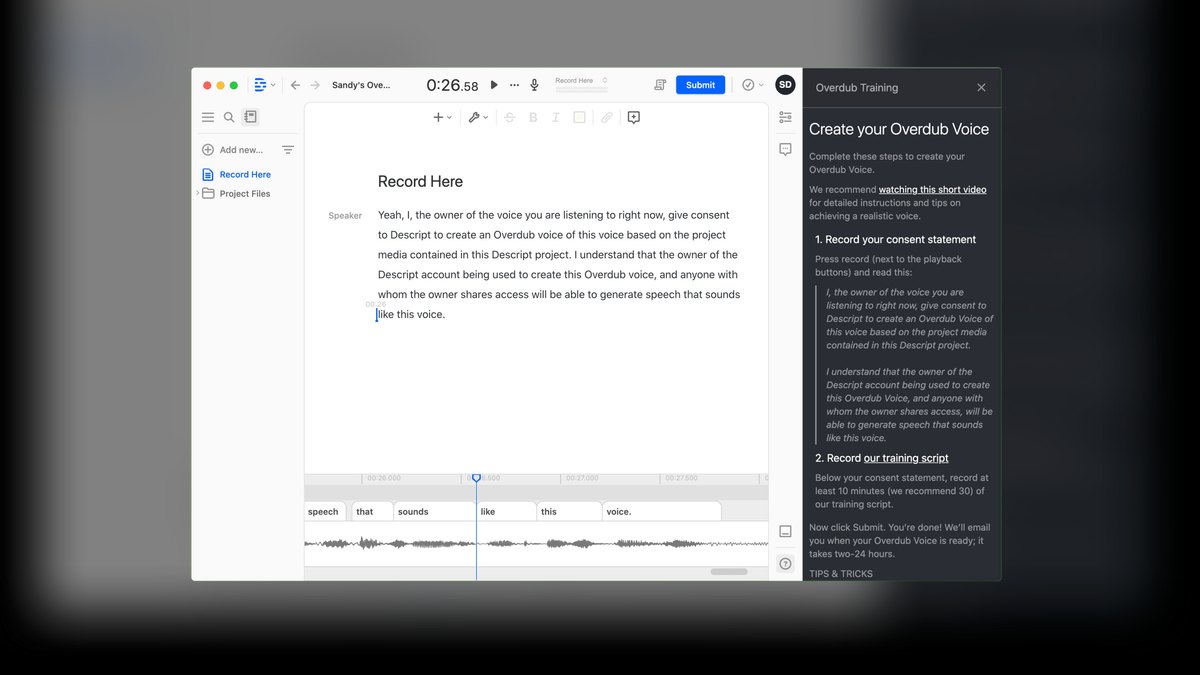
Descript Overdub ranks sixth because it folds cloning into an editor, letting you fix a flubbed line by editing the transcript text, with the cloned voice patching the audio. You record a roughly 10-minute consent and training script to clone your own voice. There is no separate cloning console; corrections, ums removed, and re-records all happen in one timeline. It bundles with Studio Sound, filler-word removal, and AI editing.
It is for podcasters and video editors who already cut by transcript, where the integrated approach saves real hours. It is deliberately constrained to the account holder's voice, making it safe for solo creators but unsuitable for cloning third parties. Compared to Play.ht above, Descript trades away general-purpose API breadth for a uniquely streamlined editing experience. It is less suited for generating speech from scratch, which is where Play.ht excels.
7. Murf AI Voice Cloning
Murf AI ranks seventh because it targets corporate and e-learning production, with its voice cloning add-on creating a custom voice that slots into Murf's Studio alongside 200+ stock voices, synced video, and timing controls. Murf Gen 2 improved expressiveness and multilingual delivery across 20+ languages, and the pronunciation editor lets you fix brand names and acronyms phonetically. It also offers Murf Dub for translating and revoicing existing videos. Cloning sits on higher subscription tiers.
It is for L&D and marketing teams that want one cloned brand voice deployed cleanly across a content library, where an all-in-one structure beats stitching together separate tools. It trades away the raw emotional range of ElevenLabs and the editing integration of Descript. Compared to Speechify below, Murf offers a more production-focused studio and pronunciation control, while Speechify has licensed celebrity voices and a consumer accessibility angle.
8. Speechify Voice Cloning
Speechify ranks eighth because it ships a serious AI Voice Cloning capability and a notable roster of licensed celebrity voices, including Snoop Dogg and Gwyneth Paltrow, through its Speechify Studio. That licensing is the differentiator, as these are legitimately cleared voices, not scraped impressions. For its core audience of people who listen to documents, articles, and PDFs, cloning a familiar voice makes long-form listening more pleasant. Speechify Studio extends this into a voiceover generator for creators.
It is for listening-first cloning and marquee licensed voices, where consumer reach and accessibility matter more than developer depth. It trades away the API maturity of ElevenLabs or Cartesia, as its API exists but is less central. Compared to Murf AI above, Speechify offers celebrity voices and a consumer subscription model, while Murf provides a more comprehensive corporate voiceover workstation with pronunciation editing.
9. Respeecher Voice Cloning
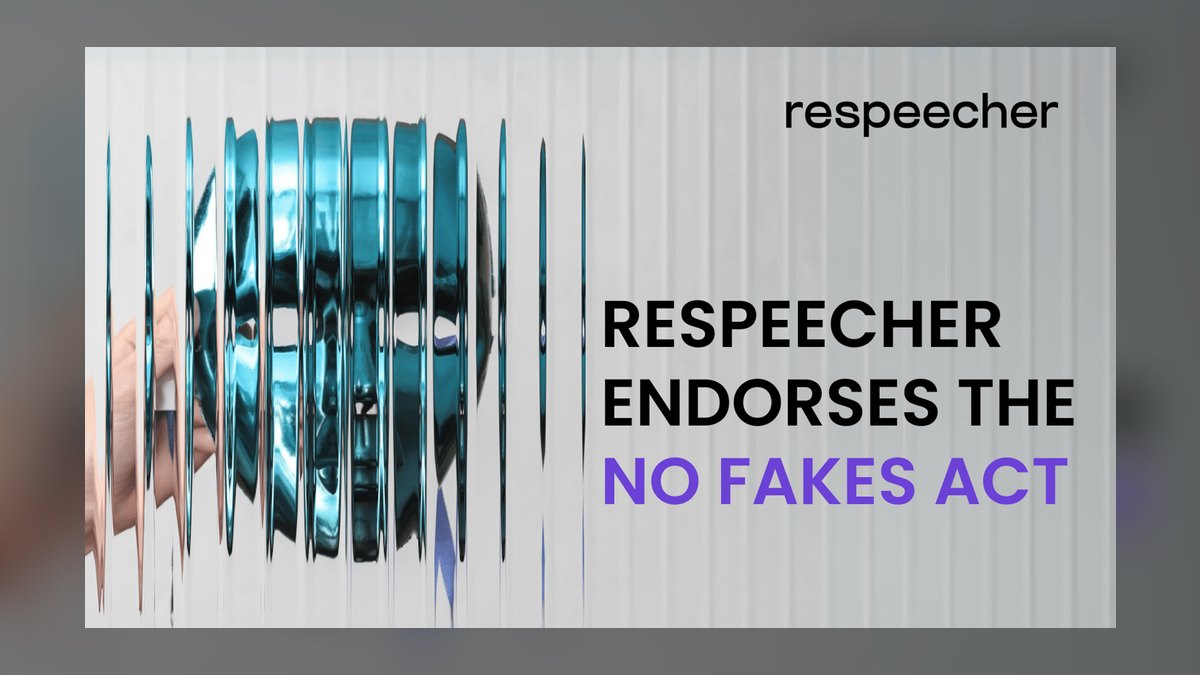
Respeecher ranks ninth because it is the Hollywood specialist, with its speech-to-speech model used on screen, including recreating a young Luke Skywalker's voice in The Mandalorian. This is content-creation grade cloning where a director's ear is the QA bench, preserving an actor's performance while swapping timbre. The Ukraine-founded company markets explicitly to film, games, and broadcast, and pairs its tech with a strong ethical-use stance requiring rights documentation.
It is for premium media production where the clone has to survive a theatrical mix, with project- and license-based engagements rather than a $5/month signup. It trades away self-serve access and low cost for credibility and fidelity in high-stakes creative work. Compared to Speechify above, Respeecher offers far higher fidelity for professional media, but Speechify provides consumer accessibility and licensed celebrity voices at a lower price point.
10. Fish Audio OpenAudio Voice Cloning
Fish Audio OpenAudio ranks tenth because it anchors the open-source end with its Fish Speech and OpenAudio S1 models, where weights are open and self-hostable, making the marginal cost of cloning your own compute. A short reference clip yields a multilingual clone with surprisingly strong naturalness for a free model. The S1 line supports emotion and tone markers and broad language coverage, with a community ecosystem of fine-tunes and quantized builds for consumer GPUs.
It is for developers willing to run infrastructure, startups prototyping voice features, indie game studios, and researchers, where the value champion is clear. It trades away the safety, watermarking, and consent enforcement that ElevenLabs or Azure provide out of the box, leaving that operational work to you. Compared to Respeecher above, Fish Audio is free-to-run with real quality, but Respeecher offers Hollywood-grade fidelity and a managed ethical-use framework.
How we ranked these
We measured and weighted six criteria: naturalness under critical listening, sample efficiency from 10 seconds to 3 hours, latency for real-time use, language coverage and accent retention, consent and safety features like watermarking and deepfake detection, and price-to-control ratio. Tools offering only fixed stock voices were excluded. Each criterion was scored and weighted, with naturalness and latency receiving the highest weights due to their impact on production quality and real-time applications.
We deliberately ignored brand popularity, marketing hype, and subjective user interface preferences. We also excluded tools that only offer generic text-to-speech without true voice cloning capabilities. The focus was strictly on technical performance and practical utility for operators, producers, and developers. We did not consider pricing tiers as a primary ranking factor, as value is relative to the specific use case and budget constraints of the buyer.
What to look for
When choosing between these tools, the real differentiators are latency, sample efficiency, and safety features. If you need real-time agents, prioritize Cartesia or Resemble AI for sub-200 ms streaming. For pre-rendered media, ElevenLabs leads on naturalness and language breadth. Enterprises should lean on Azure for governance, while creators may prefer Play.ht or Descript for workflow integration. Always test with your own voice samples.
The mistake most buyers make is over-weighting price or brand popularity over actual performance. A cheaper tool that requires 3 hours of training audio and lacks watermarking may cost more in the long run. Also, don't ignore consent and compliance—using a tool without proper safety features can lead to legal trouble. Match the tool to your specific use case, not the hype.
Related questions
What is the difference between text-to-speech and speech-to-speech voice cloning?
Text-to-speech (TTS) cloning generates speech from typed text in a target voice, while speech-to-speech (STS) converts a live performance into another voice, preserving timing, emotion, and delivery. STS is crucial for dubbing and acting, whereas TTS is used for narration and automated content.
How much audio is needed for instant voice cloning?
Instant cloning typically requires 10 seconds to one minute of clean audio. This is sufficient for a usable clone, but for higher fidelity and emotional range, professional cloning with 30 minutes to three hours of source material is recommended.
What are the legal implications of cloning a voice without consent?
Cloning a voice without explicit written consent can violate right-of-publicity laws, platform policies, and statutes like Tennessee's ELVIS Act. Reputable vendors require a consent recording for professional clones, and bypassing these measures can lead to legal action.
Which AI voice cloning tool offers the lowest latency?
ElevenLabs Flash v2.5 offers approximately 75 ms latency, making it the fastest for real-time agents. Cartesia Sonic is close at 90 ms, and Resemble AI provides sub-200 ms streaming. The best choice depends on your specific latency budget and ecosystem needs.
Can AI voice cloning preserve accents and languages?
Yes, modern tools like ElevenLabs support 70+ languages with accent preservation, and Resemble AI's Localize extends to 100+ languages. Azure and Play.ht also offer cross-lingual synthesis, allowing a single voice to speak multiple languages while retaining its original timbre.
What is the best open-source AI voice cloning tool?
Fish Audio (OpenAudio) is the leading open-source option, offering self-hostable models with strong naturalness and multilingual support. It's ideal for developers and startups with compute resources, but you must handle safety, consent, and watermarking yourself.
How do I choose between ElevenLabs and Resemble AI?
Choose ElevenLabs for superior naturalness, 70+ languages, and a mature API for pre-rendered media. Choose Resemble AI for real-time speech-to-speech, built-in deepfake detection, and compliance features like watermarking, which are critical for live applications and regulated industries.
FAQ
How much audio do I need to clone a voice?
It depends on the mode. Instant cloning (ElevenLabs, Resemble, Fish Audio) works from 10 seconds to one minute. Professional/high-fidelity cloning wants 30 minutes to three hours of clean, consistent recording for the most natural result.
Is AI voice cloning legal?
Cloning a voice you own or have written consent to use is generally legal. Cloning someone else's voice without permission can violate right-of-publicity laws, platform terms, and statutes like Tennessee's ELVIS Act. Reputable vendors require a consent recording for professional clones.
Which tool is best for real-time voice agents?
Cartesia (Sonic) at roughly 90 ms and Resemble AI with sub-200 ms streaming lead here. ElevenLabs Flash v2.5 (~75 ms) is also viable when you want the broader ElevenLabs voice ecosystem.
Can I clone a voice into another language?
Yes. ElevenLabs Dubbing, Resemble Localize, Azure cross-lingual synthesis, and Murf Dub all keep the speaker's timbre while changing language. Quality varies by language pair — test your specific target.
What about detecting deepfakes I didn't make?
Resemble Detect scores audio for AI generation, and several vendors embed neural watermarks (Resemble's PerTh) in their output. For organizations, deploying detection alongside generation is now a baseline practice.
Is the open-source option good enough for production?
Fish Audio / OpenAudio is genuinely strong, but you inherit the safety, consent, and watermarking work the paid platforms handle for you. It's ideal for prototypes and self-hosted apps, riskier for regulated enterprise use.
What is the best tool for podcast editing with voice cloning?
Descript's Overdub is the best for podcasters because it integrates cloning into a transcript-based editor. You can fix mistakes by editing text, and the cloned voice patches the audio, streamlining the editing workflow significantly.
Which tool offers licensed celebrity voices?
Speechify offers a roster of licensed celebrity voices, including Snoop Dogg and Gwyneth Paltrow, through its Speechify Studio. This is a key differentiator for projects needing recognizable, legally cleared voices.
What is the best tool for Hollywood-grade voice cloning?
Respeecher is the Hollywood specialist, used in productions like The Mandalorian. It offers high-fidelity speech-to-speech that preserves an actor's performance, and it requires rights documentation, making it ideal for film, games, and broadcast.
Sources
- https://elevenlabs.io/voice-cloning
- https://www.resemble.ai/
- https://cartesia.ai/
- https://learn.microsoft.com/en-us/azure/ai-services/speech-service/personal-voice-overview
- https://play.ht/voice-cloning/
- https://www.descript.com/overdub
- https://murf.ai/voice-cloning
- https://www.respeecher.com/
- https://fish.audio/
- https://www.capitol.tn.gov/Bills/113/Bill/HB2091.pdf
Related on PULSE
- [More ai tools for voice cloning rankings and buying guides](/knowledge)
- [PULSE Tools and calculators](/tools)
- [Everything on PULSE RevOps](/)
This page will be disappearing soon. Save it to your device for $1 — or read it free while it is here.
@Kory-White- · if Venmo asks, the last 4 of my number are 2012
 pulse-recentThe 10 Best Chargeback and Showback Tools for Shared GPU Clusters in 2027
 pulse-recentThe 10 Best AI Infra Cost Allocation Strategies for Multi-Team Usage in 2027
 pulse-recentThe 10 Best AI Gateway Platforms for LLM Traffic in 2027
 pulse-ai-infrastructureThe 10 Best AI Tools for Pronunciation Coaching in 2027
 pulse-recentThe 10 Best AI Chargeback and Showback Tools for Internal Team Billing in 2027
 pulse-ai-infrastructureThe 10 Best AI Tools for Background Removal in 2027
 pulse-recentThe 10 Best AI Tools for Spot Instance Bidding on GPU Workloads in 2027
 pulse-ai-infrastructureThe 10 Best AI Tools for Hero Section Design in 2027
 pulse-recentThe 10 Best Disaster Recovery Tools for AI Infrastructure in 2027
 pulse-ai-infrastructureThe 10 Best AI Tools for Home Organization in 2027