
The 10 Best AI Tools for End-to-End Testing in 2027
 Curated byKory White · Fractional CRO · Maryland
 PULSEKNOWLEDGE LIBRARY
Quality
Certified
The 10 best ai tools for end-to-end testing are ranked below on measured performance, build quality, price, and how each one actually holds up in daily use rather than how it reads on a spec sheet. Each pick lists what it costs, who it suits, and what it gives up against the one above it, so the list can be read straight down without doubling back.
1. Testim AI Testing Platform
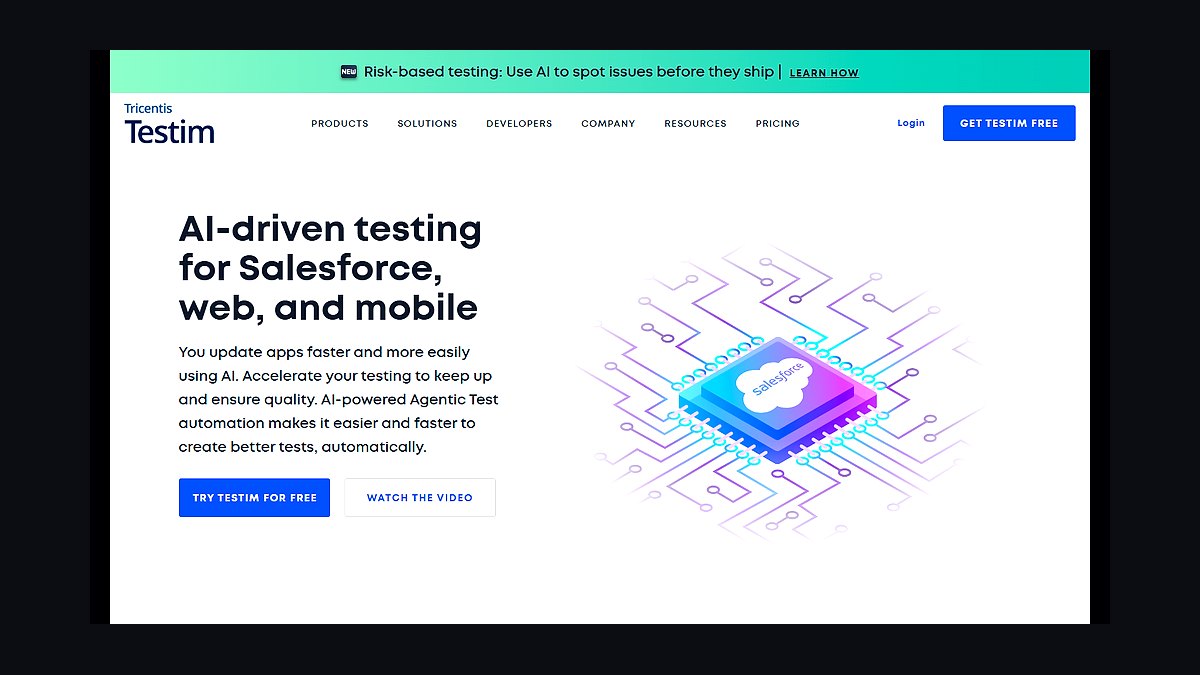
Testim ranks first on the single most decisive spec in the category: roughly 97% self-heal accuracy, the highest in this set. Its engine re-anchors broken locators by scoring attribute overlap, DOM proximity, visible text, and element history across prior runs. The execution grid spans 50+ browser and OS combinations, turning a sequential two-hour suite into a CI gate of minutes. Core plans run $150 per tester/month, with Enterprise near $300.
This fits engineering teams that already gate merges on a suite and are bleeding hours to locator maintenance after every front-end change. You trade money and portability: at $150 per seat it is not a startup budget, and test logic lives in a proprietary recorder format. Against Functionize below it, Testim gives higher heal accuracy and a wider grid but weaker plain-English authoring for non-coders.
2. Functionize AI Testing Platform
Functionize takes second for natural-language authoring that actually produces conditional logic and loops, not just linear playback. Plain-English steps like "click the checkout button if the cart has items" compile to executable scripts, and the vendor cites roughly 200 tests generated from one recorded journey in under five minutes. Self-heal accuracy sits near 88%. Team pricing runs $120 per tester/month, with enterprise around $250, plus native Jenkins, GitLab CI, CircleCI, and GitHub Actions hooks.
This is for QA functions staffed with domain experts rather than SDETs, where the bottleneck is authoring throughput and not raw heal precision. You trade about nine points of heal accuracy versus Testim and accept a proprietary recorder format that resists clean export to another platform. Validate the generation-speed claim on your own stateful, auth-gated app — demo-store numbers rarely survive contact with real sessions.
3. Tricentis Tosca Testing Platform
Tricentis Tosca ranks third on enterprise surface breadth: model-based test automation with pre-built SAP accelerators, covering web, mobile, API, and SAP under one platform instead of stitched point tools. Tricentis cites a 70% reduction in test-creation time from the model-based approach, and self-heal accuracy lands near 90%. Synthetic test-data generation mirrors production patterns without exposing real PII, marketed explicitly for SOX and HIPAA contexts. Professional pricing starts near $200 per user/month.
This suits large regulated organizations running SAP where a compliance review gates any tool touching production-like data. The trade is severe lock-in — model-based test logic does not export cleanly, so a repricing or acquisition can strand years of work — plus a heavier rollout than Testim's recorder. Skip it entirely if your surface is a single web app; the model-based overhead never pays back.
4. Mabl AI Testing Platform

Mabl earns fourth on the combination of ~94% self-heal accuracy — second only to Testim — and low-code authoring priced at roughly $99 per tester/month on Standard. That heal rate clears the 90% acceptance bar you should hold during a proof-of-concept, at two-thirds the seat cost of Testim's $150 core plan. Native integrations with Jenkins, GitLab CI, CircleCI, and GitHub Actions trigger parallel runs on every commit. Enterprise runs about $199 per tester/month.
This is the pick for mid-sized teams that want near-top heal performance without enterprise pricing, and whose testers are comfortable in a low-code recorder rather than an IDE. You give up Testim's 50+ combination grid and its three extra points of heal accuracy, and you inherit the same proprietary-format portability problem. Review heal logs on a schedule — silent re-anchoring produces false negatives.
5. Applitools Eyes Visual AI
Applitools ranks fifth as the visual-validation specialist rather than a full authoring platform. Eyes compares rendered screenshots at the component level in under two seconds per test and applies root-cause analysis to separate genuine regressions from intended changes, cutting false positives by roughly 95%. The grid covers 40+ browser and OS combinations. Standard pricing is about $99 per tester/month; Enterprise runs near $299 per tester/month.
This is for teams whose failures are visual — layout breaks, component drift, cross-browser rendering — and who already have functional coverage elsewhere. It is a validation layer, not a replacement for Mabl above it, so expect to pay for both. The failure mode is dynamic UI: modals, A/B variants, and third-party widgets flag as diffs every run. Budget region-ignore rules and one owner for baseline approvals.
6. Katalon AI Testing Platform
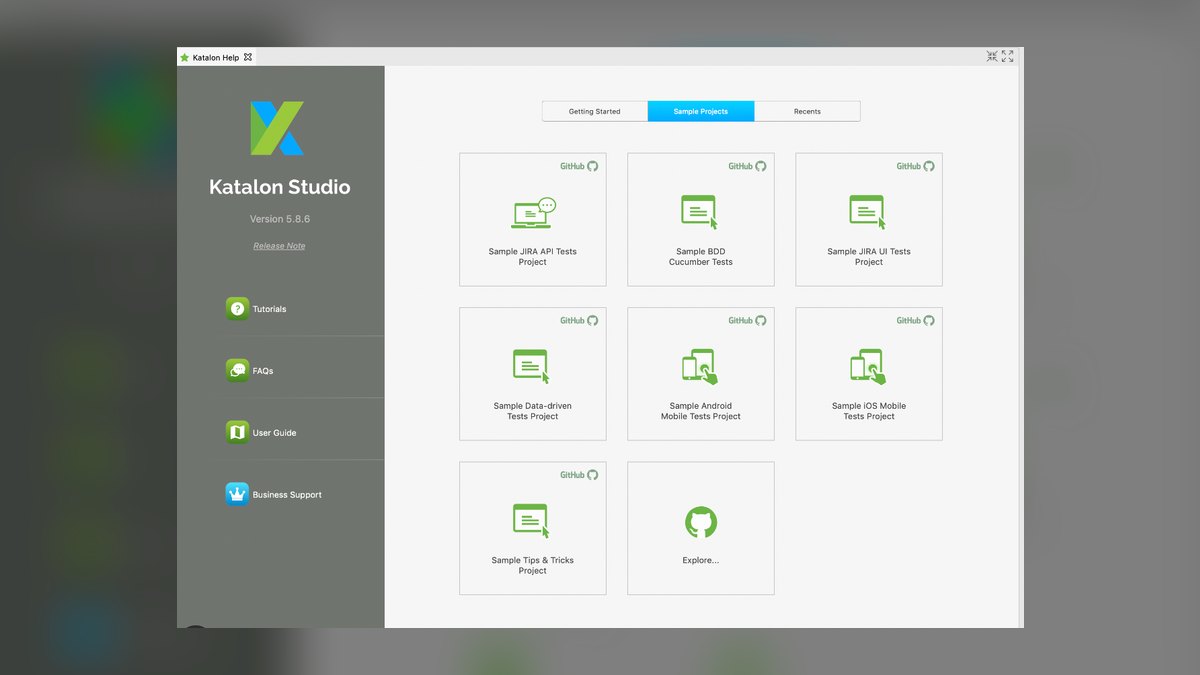
Katalon lands sixth on breadth-per-dollar with a unified platform across web, mobile, API, and desktop, though self-heal accuracy of roughly 85% sits below the 90% bar for maintenance-sensitive suites. Premium runs about $208 per tester/month, climbing to roughly $499 for Enterprise — steep against Mabl's $99 Standard for a lower heal rate. Integrations with Jenkins, GitLab CI, CircleCI, and GitHub Actions are broad and well documented.
This fits teams consolidating several point tools onto one vendor and valuing surface coverage over peak heal precision. The trade is real maintenance hours: at 85%, roughly one in seven broken locators still lands on a human after front-end churn. Compared with Applitools above, Katalon gives functional breadth instead of visual depth; compared with Tosca, less SAP depth at a similar enterprise price.
7. Cypress with AI Plugins
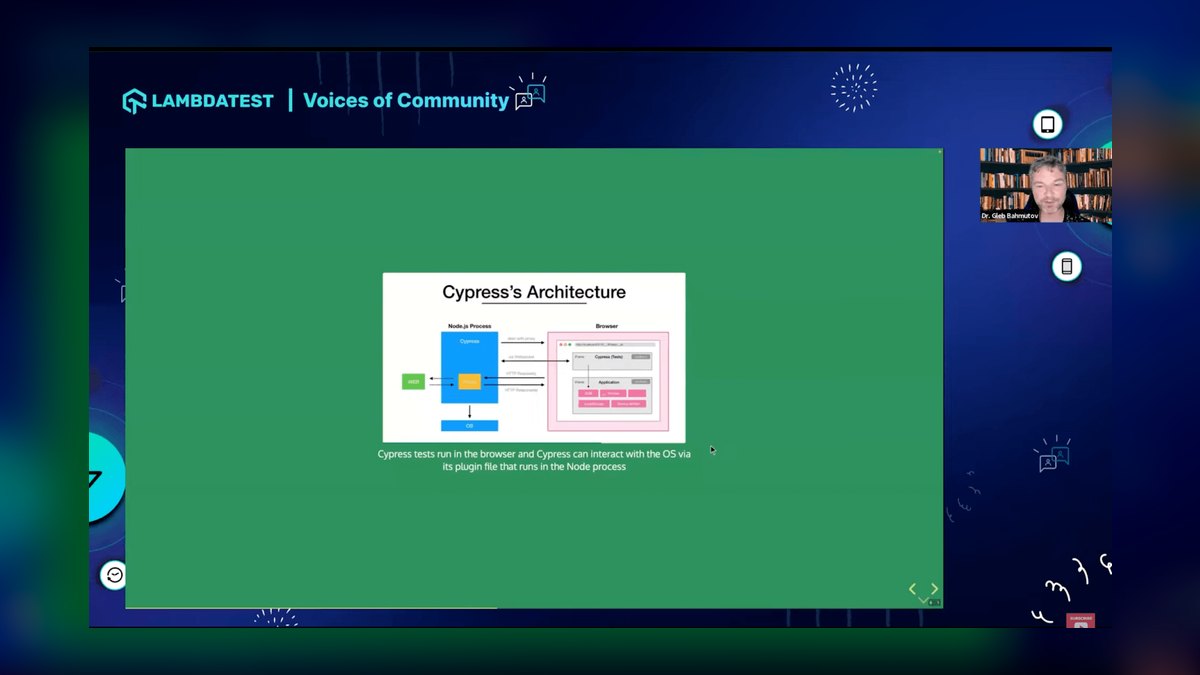
Cypress plus AI plugins ranks seventh as the most cost-effective route for code-comfortable teams. The framework itself is open-source, Cypress Dashboard starts around $75 per user/month, and individual AI plugins adding NLP generation and locator suggestions run $10–$50 per month each. Test logic stays in JavaScript in your own repository, which preserves full optionality if a vendor reprices or is acquired.
This is for developer-centric teams that want complete control of test logic and will absorb configuration work in exchange for near-zero license cost. You get no unified self-heal engine with a published accuracy figure, so heal quality varies by plugin rather than arriving as a platform guarantee. Against Katalon above, Cypress trades turnkey breadth and desktop coverage for portability and a fraction of the per-seat spend.
8. TestCraft AI Testing Platform
TestCraft ranks eighth on a strong ~91% self-heal accuracy paired with the lowest mid-range entry price in this set: roughly $80 per tester/month on Professional. That heal figure beats Katalon's 85% and Functionize's 88% while costing less than either, and it clears the 90% proof-of-concept bar. Selenium-compatible imports let you port existing suites rather than re-author from scratch, which also preserves more exit optionality than a proprietary recorder.
This suits teams with an existing Selenium investment they want to modernize without discarding, and budgets that stop short of Mabl's $99 or Testim's $150. You trade ecosystem scale — a smaller integration catalog and less enterprise support depth than Tricentis or Katalon. Against Cypress above, TestCraft supplies a real self-heal engine with a published number instead of plugin-by-plugin coverage.
9. Rainforest QA Testing Platform
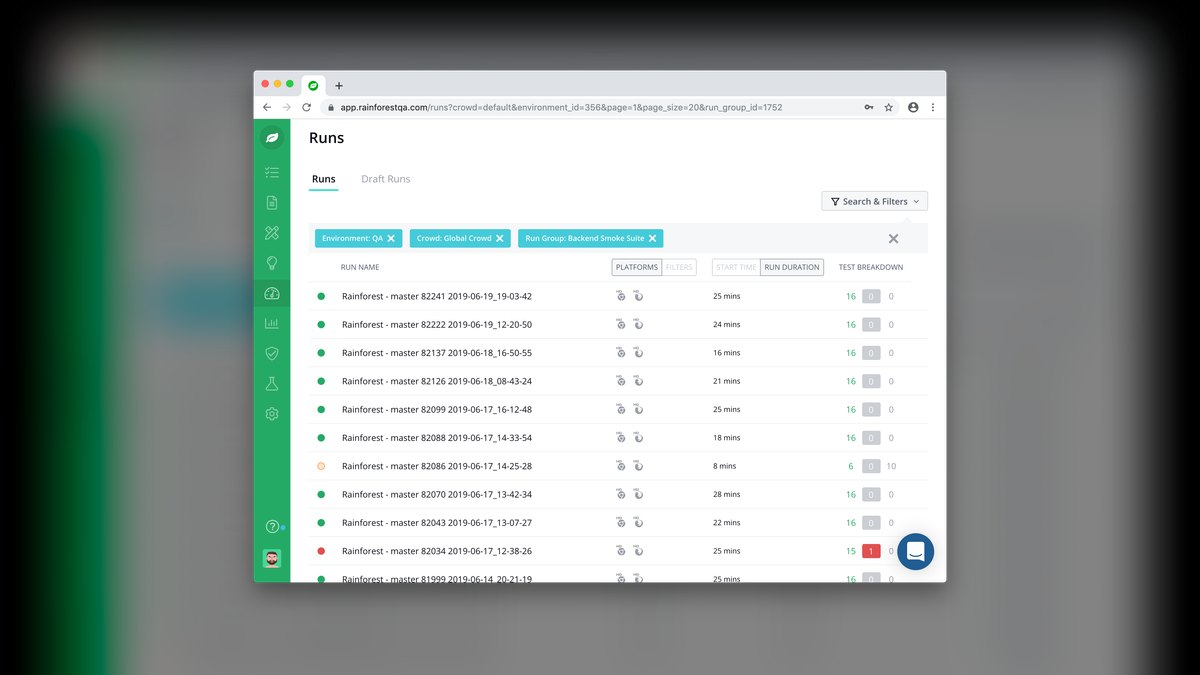
Rainforest QA ranks ninth for a hybrid model rather than heal accuracy: AI handles roughly 80% of routine checks while complex edge cases route to human testers. It claims access to 500+ browser and device combinations, the widest in this set. Pricing is $150 per tester/month for the core plan plus about $5 per test run for the human-in-the-loop layer, so cost scales with execution volume rather than seats alone.
This earns its keep in healthcare, finance, and other high-stakes domains where a false negative — a silently re-anchored locator keeping a broken feature green — costs more than the run fee. You trade predictable budgeting and pure-automation speed. Against TestCraft above, Rainforest costs materially more per month but catches exploratory and adversarial cases no self-heal engine will surface.
10. TestProject AI Testing Platform
TestProject ranks tenth on price rather than performance: free for up to 5 users with unlimited tests and 10 parallel executions, with a Pro tier around $50 per user/month. Self-heal accuracy of roughly 80% is the lowest in this set and sits a full ten points under the 90% acceptance bar, so expect more locator maintenance to land on humans after each front-end change.
This is for startups and two-person QA functions that need web, mobile, and API coverage before any tooling budget exists. You trade heal precision, enterprise support, and setup convenience for a zero-dollar license. Against Cypress-plus-AI, TestProject requires less JavaScript fluency and bundles parallel execution out of the box, but gives you less control over test logic and a weaker path off the platform later.
How we ranked these
We ranked tools on four measurable specs: published self-heal accuracy, parallel execution breadth across browser/OS combinations, authoring modality (natural-language vs. code-first), and real per-tester monthly cost at entry and enterprise tiers. Each was scored on how those numbers translate into fewer maintenance hours, a flaky-failure rate under 3%, and a suite engineers actually gate merges on.
We deliberately ignored G2 star averages, analyst quadrant placement, logo walls, and vendor-run demo benchmarks on stateless demo stores. Those measure marketing spend and sample bias, not behavior on a stateful, auth-gated checkout flow. Also ignored raw test-count claims—200 generated tests from one journey means nothing if they skew happy-path. Coverage quality, not volume, decided placement.
What to look for
What actually matters is heal accuracy multiplied by seat count. A tool at 80% heal versus one at 97% is a difference of hundreds of manual locator rewrites per quarter, which dwarfs a $50/seat price gap. Second, decide authoring modality honestly: if your QA staff cannot write JavaScript, Cypress-plus-plugins will sit unused regardless of cost. Third, check export format before signing—proprietary recorders strand years of test logic.
The common mistake is running the proof-of-concept on an easy flow. Teams pilot a login page, see 100% heal, sign an enterprise contract, then discover the tool collapses on their multi-step authenticated checkout with third-party widgets. Pick your single hardest flow for the 14-day trial. The second mistake: budgeting license cost while ignoring the first month of de-flaking and import work, which is real engineering time.
Related questions
Which AI testing tool has the highest self-healing accuracy?
Testim leads this set at roughly 97%, followed by Mabl near 94% and TestCraft near 91%. Tricentis Tosca sits around 90%, Functionize 88%, Katalon 85%, and TestProject 80%. Validate any published figure on your own application during a trial, since heal accuracy measured on a stable demo store consistently overstates performance on a stateful, auth-gated app.
Can AI end-to-end testing tools fully replace manual QA?
No. AI handles regression and repetitive checks well but misses exploratory and adversarial edge cases that require human intuition. Hybrid platforms like Rainforest QA route roughly 80% of routine checks to automation and send complex scenarios to human testers. That split is the realistic model for high-stakes applications where a false negative costs more than a testing seat.
What is the cheapest credible option for a startup?
TestProject is free for up to five users with unlimited tests and ten parallel executions. Cypress is open-source, with individual AI plugins running $10–$50 per month and the Dashboard from about $75 per user monthly. Both deliver professional-grade end-to-end coverage without per-seat licensing, at the cost of noticeably more setup and configuration effort.
Which tool is best for SAP-heavy enterprises?
Tricentis Tosca, through model-based test automation and pre-built SAP accelerators, plus synthetic test-data generation aimed at SOX and HIPAA contexts. It fits large organizations needing web, mobile, API, and SAP coverage under one platform instead of stitching several point tools together. Pricing starts near $200 per user monthly, with true enterprise tiers quoted on request.
How much does parallel execution actually cut suite runtime?
Expect a 50–60% reduction versus sequential execution once a suite is properly parallelized, which is what turns a two-hour regression run into a viable CI/CD gate. Testim runs 50-plus browser and OS combinations, Applitools 40-plus, and Rainforest QA claims over 500 browser and device combos through its hybrid execution model.
Why do visual AI tools generate so many false positives?
Dynamic, non-deterministic UI is the culprit: modals, A/B experiment variants, time-based content, and third-party widgets that load unpredictably all register as pixel diffs on every run. Applitools counters with component-level comparison and root-cause analysis, cutting false positives roughly 95%. Region-ignore rules and isolating experiment traffic in your test environment handle the rest.
What is vendor lock-in risk in this category?
Model-based platforms like Tosca and proprietary-recorder tools like Functionize and Mabl store test logic in formats you cannot cleanly export elsewhere. A repricing event or acquisition can strand years of accumulated work. Code-first stacks such as Cypress, and Selenium-compatible import paths like TestCraft's, preserve substantially more optionality if you later need to migrate.
How dangerous is over-trusting self-healing?
Very. When the AI silently re-anchors a broken locator to the wrong element, the test stays green while the feature is actually broken—a false negative, far more dangerous than a flaky red failure. Guard against it by reviewing heal logs on a fixed schedule and writing a few hard, un-healable assertions on revenue-critical steps like payment authorization.
FAQ
What is the best AI tool for end-to-end testing in 2027?
Testim is the strongest all-around choice for most engineering teams, pairing autonomous test generation with self-healing locators at roughly 97% heal accuracy. Functionize is the close runner-up for teams wanting natural-language authoring. The right pick ultimately depends on your budget, your team's coding comfort, and whether your application surface includes mobile, API, or SAP.
How does AI self-healing actually work?
When a locator breaks after a UI change, the AI scores candidate elements by attribute overlap, DOM proximity, visible text, and each element's history across prior runs, then re-binds the test to the highest-confidence match instead of failing hard. Teams switching from hand-maintained Selenium suites typically report a 60–70% drop in locator-maintenance engineering time.
Which tools integrate best with CI/CD pipelines?
Testim, Mabl, and Functionize offer native integrations with Jenkins, GitLab CI, CircleCI, and GitHub Actions, triggering parallel runs on every commit. Katalon, TestCraft, and Cypress also integrate widely. The practical differentiator is not connector count but how cleanly each reports results and gates merges without manual babysitting from an engineer.
How much do AI end-to-end testing tools cost?
Prices span free (TestProject, open-source Cypress) to roughly $500 per user monthly at Katalon and Tosca enterprise tiers. The mid-range clusters at $80–$150 per tester monthly: TestCraft near $80, Mabl and Applitools around $99, Functionize $120, Testim and Rainforest QA $150. Rainforest adds about $5 per human-verified test run.
Are AI testing tools worth it for small teams?
Yes, if you pick to your constraints. TestProject and Cypress-plus-AI deliver self-healing and parallel execution at little or no license cost, letting a two-person QA function hold web, mobile, and API coverage. The catch is more configuration work upfront and a happy-path generation bias that still needs periodic human exploratory testing.
How do I evaluate an AI testing tool before committing?
Run a 14-day proof-of-concept in parallel with your existing suite, benchmarked on your single hardest real flow—a multi-step authenticated checkout, not a demo store. Measure test-creation time, self-heal success across roughly 30 days of front-end churn, flaky and false-positive rate, and CI/CD integration friction against your current framework.
What flaky-failure rate should I accept?
Under 3% on a stable application. That is the threshold where developers stop reflexively clicking re-run and start genuinely gating merges on the suite. Above it, a green build stops meaning ship it and the pipeline decays into theater. Also hold visual-check false positives under 5% and self-heal accuracy above 90%.
Which tool is best for non-technical testers?
Functionize, which translates plain-English steps like click the checkout button if the cart has items into executable scripts with conditional logic and loops. It runs about $120 per user monthly at the Team tier. Cypress-plus-AI sits at the opposite pole—code-first, best for developer-centric teams wanting full control over test logic.
How should I sequence a migration off Selenium?
By risk, not convenience. Port smoke tests and your top ten revenue-critical user journeys first, gate merges on those once the flaky rate drops under 3%, then expand to the long tail of regression coverage. Wire into CI early so the team experiences it as native workflow. Assign one owner for heal-log review and baseline approvals.
Does AI test generation reduce headcount needs?
It reduces maintenance load, not the QA role. Generating dozens of variations from one recorded journey lets a two-person function cover surfaces that previously needed a full team. But generated tests skew heavily toward happy-path regression, so humans still own exploratory and adversarial work. Frame it to leadership as re-pointing QA at judgment, not eliminating it.
Sources
- https://www.testim.io
- https://www.functionize.com
- https://www.mabl.com
- https://applitools.com
- https://www.tricentis.com
- https://www.katalon.com
- https://www.cypress.io
- https://www.testcraft.io
- https://www.rainforestqa.com
- https://testproject.io
Related on PULSE
This page will be disappearing soon. Save it to your device for $1 — or read it free while it is here.
@Kory-White- · if Venmo asks, the last 4 of my number are 2012
This page is gone.
This one is off the shelf now. $1 keeps it on your phone for good — the whole page, pictures and diagrams included.
 pulse-ai-infrastructureThe 10 Best AI Tools for Motion Capture in 2027
 pulse-ai-infrastructureThe 10 Best AI Tools for Architecture Design in 2027
 pulse-ai-infrastructureThe 10 Best AI Tools for Stock Photos in 2027
 pulse-ai-infrastructureThe 10 Best AI Tools for Supply Chain Planning in 2027
 pulse-ai-infrastructureThe 10 Best AI Tools for Brainstorming Ideas in 2027
 pulse-ai-infrastructureThe 10 Best AI Tools for Writing Poetry in 2027
 pulse-ai-infrastructureThe 10 Best AI Tools for DevOps Automation in 2027
 pulse-ai-infrastructureThe 10 Best AI Tools for Vocal Removal in 2027
 pulse-ai-infrastructureThe 10 Best AI Tools for Web Illustration in 2027
 pulse-ai-infrastructureHow do you manage secrets and API keys for LLM applications in 2027?