
Why is my aquarium pH dropping overnight and how to prevent it in 2027?
 Curated byKory White · Fractional CRO · Maryland
 PULSEKNOWLEDGE LIBRARY
Quality
Certified
Overnight aquarium pH drops happen because photosynthesis stops after lights-out while fish, plants, and bacteria keep respiring, dumping CO₂ into water that forms carbonic acid. Weak carbonate hardness (KH below about 4 dKH) lets that acid win. Prevent it by raising KH, increasing surface agitation, and cutting organic waste.
What the overnight swing actually is and why it matters
The daily pH curve in a freshwater tank is not a malfunction. It is the visible output of a carbon dioxide budget that flips direction twice every twenty-four hours. During the photoperiod, plants and algae pull dissolved CO₂ out of the water column faster than the livestock and the biofilm produce it. Removing CO₂ removes carbonic acid, and pH climbs. The moment the lights cut off, photosynthesis stops within minutes, but respiration never pauses — plants respire in the dark, fish respire continuously, and the nitrifying colony in your filter media respires around the clock. CO₂ accumulates for eight to fourteen hours with nothing consuming it, and pH slides down.
How far it slides depends almost entirely on one measurement most hobbyists never take: carbonate hardness, expressed as dKH or as alkalinity in ppm. KH is the reservoir of bicarbonate and carbonate ions that intercept incoming hydrogen ions before they register as a pH change. A tank at 6–8 dKH absorbs a night's worth of CO₂ with a swing of roughly 0.2 to 0.4 units. The same tank at 1–2 dKH can drop 0.8 to 1.5 units on the identical bioload, because there is almost nothing left to neutralize the acid. This is why two tanks with the same fish, the same lights, and the same feeding schedule behave completely differently — the buffer, not the bioload, sets the amplitude.
A modest swing is normal and generally harmless. Wild rivers and lakes swing daily; fish evolved inside that rhythm. What matters is the magnitude and the direction of the trend line. A repeatable 0.2–0.3 unit dip that returns to the same morning baseline is a healthy tank breathing. A dip that keeps getting deeper week over week, or a baseline that is itself creeping downward, means your KH is being consumed faster than it is replaced — and that ends in a pH crash, where the buffer hits zero and pH falls off a cliff into the fives or lower in a matter of hours.
The stakes are physiological. Rapid pH movement stresses gill function and the osmoregulatory load fish carry. Species adapted to soft, acidic blackwater — cardinal tetras, chocolate gouramis, many wild-caught apistogramma — tolerate low pH fine but still dislike fast movement. Rift lake cichlids, livebearers, and most snails and shrimp genuinely need the alkalinity and suffer at low pH: shrimp molt poorly, snail shells pit and erode. There is one counterintuitive interaction worth knowing: ammonia toxicity is pH-dependent. At pH 6.4, nearly all ammonia sits as relatively harmless ammonium; at pH 8.0, a meaningful fraction becomes free ammonia, which is far more toxic. So a falling pH temporarily masks an ammonia problem — and correcting the pH quickly can unmask it violently. That is the single best argument for fixing buffer chemistry gradually rather than in one dramatic dose.
There is also a nitrification tax nobody accounts for. Every milligram of ammonia your filter converts to nitrate consumes alkalinity — roughly seven parts alkalinity per part ammonia-nitrogen oxidized. A heavily stocked, heavily fed tank is running a slow-motion acid titration on itself every single day. Combine that with tap water that is already soft, and you have a system whose buffer drains steadily until one night it simply runs out. The overnight CO₂ cycle is then just the trigger; the real cause was weeks of quiet alkalinity depletion.
The step-by-step diagnostic and correction process
Work this in order. Skipping straight to dosing buffer is the most common mistake, because it treats the symptom without telling you which of four different mechanisms is actually running.
Step one — establish the real curve, not a single reading. Take a pH reading right before lights-out, another two to three hours after, and a final one immediately before lights-on the next morning, before any surface disturbance. Do this for three consecutive nights. Use a calibrated digital probe if you have one; liquid reagent tests are acceptable but the color-matching error is around 0.2 units, which is the same size as the effect you are trying to measure. Never use paper strips for this — their resolution is too coarse to be useful. Record the numbers. A curve that dips and fully recovers by morning is a CO₂ story. A curve that dips and does *not* recover is an alkalinity story.
Step two — measure KH and GH, before and after. Test carbonate hardness at lights-out and again at dawn. If KH is stable overnight but pH swung hard, you have a CO₂ ventilation problem: the acid is forming and dissipating, and your buffer is doing its job but is set too low. If KH itself dropped by a degree or more overnight, something is consuming buffer — heavy nitrification, decomposing organics producing humic and fulvic acids, or an acidic substrate actively stripping carbonates. General hardness tells you separately whether you are dealing with genuinely soft source water.
Step three — test the source water in isolation. Fill a clean container with tap or RO water, let it sit uncovered and aerated for twenty-four hours, then test pH and KH. Fresh tap water is often supersaturated with CO₂ from pressurized mains and reads artificially low; after outgassing it may rise half a unit or more. If your degassed tap water sits below about 3 dKH, water changes are diluting your buffer rather than restoring it, and no amount of tank-side tinkering fixes that upstream problem. If you use RO or RO/DI, remineralization is mandatory — pure water has effectively zero buffering capacity and will chase whatever acid is present.
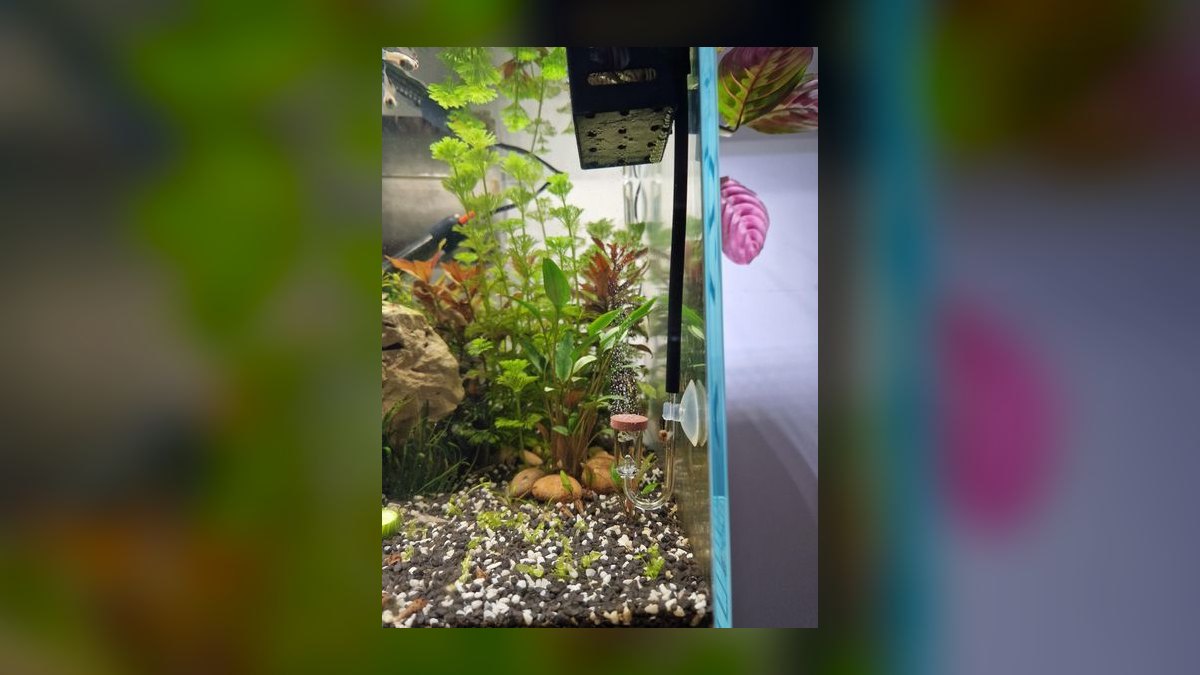
Step four — quantify the CO₂ side. A drop checker with 4 dKH reference solution gives a lagging but honest reading of dissolved CO₂: blue is low, green is the target range, yellow is excessive. Check it in the evening and again at dawn. If it is yellow by morning in a tank with no CO₂ injection, respiration alone is saturating the water and you have a gas exchange problem, not a chemistry problem. If you *do* inject CO₂, confirm the solenoid is actually closing at lights-out and that the check valve is not leaking gas into a tank with no plants photosynthesizing to use it.
Step five — audit the organic load. Vacuum a section of substrate and look at what comes out. Pull the filter media and squeeze it in tank water. Sniff for sulfur. Decomposing food and detritus produce organic acids continuously and disproportionately at night when oxygen is lowest. Lift decor and check for anaerobic black patches under it.
Step six — change one variable, then re-measure. Increase surface agitation first, because it is free, reversible, and immediate. Wait forty-eight hours and re-run the three-point pH curve. Only then adjust buffer, and only in small increments — no more than roughly 1 dKH per day, targeting a rise of at most 0.2 pH units in twenty-four hours.
Costs, timelines, and typical ranges you should expect
Fixing an overnight pH drop is one of the cheapest interventions in the hobby, which makes the amount of money hobbyists throw at it faintly absurd. Here is the realistic ladder from free to fully automated.
Free to under twenty dollars. Raising the outflow of an existing filter so it breaks the surface, angling a spray bar upward, or lowering the water line by an inch to create splash costs nothing and typically recovers 0.1 to 0.3 units of overnight swing on its own. Reducing feeding from twice daily to once, and removing uneaten food within two minutes, cuts the organic acid load measurably within a week. Plain baking soda — sodium bicarbonate from the grocery aisle — raises KH reliably at roughly a teaspoon per twenty gallons per degree of hardness, and a box costs a couple of dollars and lasts years. Dissolve it in a cup of tank water and add it slowly over an hour, never dumped straight in.
Twenty to sixty dollars. An air pump, tubing, check valve, and air stone run on a night-only timer is the single highest-value purchase for this specific problem, because it targets exactly the window where CO₂ accumulates. Crushed coral or aragonite in a media bag is inexpensive per pound and dissolves passively as pH falls, self-regulating in a way that dosing cannot — it works harder when pH is lower and slows down when pH rises. Start with a small amount, roughly a quarter pound per ten gallons, and add more only after testing. A decent liquid KH and GH test kit falls in this range and pays for itself immediately by ending the guesswork. If you use RO water, a bag of remineralizing salt is a recurring cost of a few dollars a month for a typical tank.
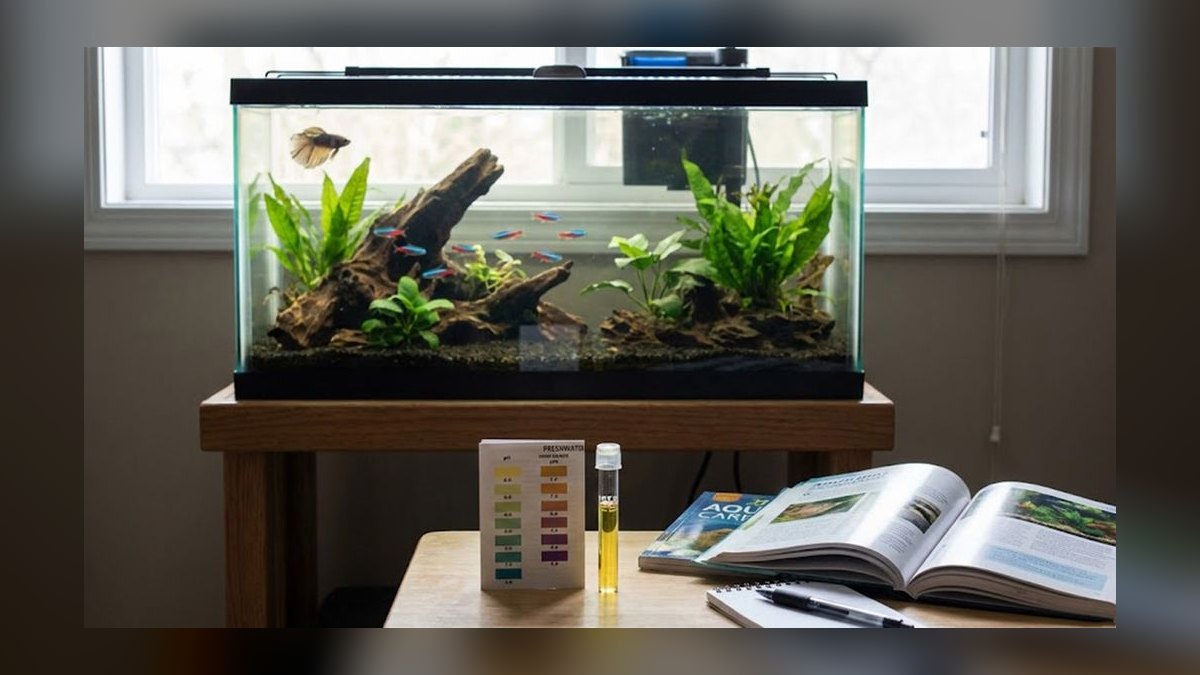
Sixty to two hundred and fifty dollars. A digital pH monitor or pen with automatic temperature compensation gives you resolution the liquid kits cannot, but budget for calibration solutions and expect the probe itself to be a consumable with a service life measured in one to two years. Continuous controllers that log pH over time are genuinely useful because they show the *rate* of change, which distinguishes a sharp CO₂-driven dip from a slow organic-acid slide. Dosing pumps sit at the top of this bracket and are honestly unnecessary for most freshwater tanks — the problem is usually solved upstream by gas exchange and a sensible KH floor.
Timelines. Surface agitation changes show up the very next morning. Buffer additions register within hours in the water column but take one to two weeks to stabilize as the system equilibrates. Substrate and detritus cleanup improves things over three to six weeks of consistent weekly vacuuming, because you are removing an accumulated reservoir, not a single event. Active planted-tank soils that intentionally drive pH down do so aggressively for the first two to four months and then taper as their ion exchange capacity depletes, typically over twelve to eighteen months — a tank that suddenly develops swings after a year on such a substrate is not broken, it is simply exhausted.
Target ranges worth memorizing. KH of 4–6 dKH suits the vast majority of community tanks and holds the overnight swing under about 0.3 units. Rift lake and hard-water setups want 8–12 dKH. Dedicated soft-water blackwater tanks run 1–3 dKH deliberately and accept larger swings, which is fine provided the baseline is stable and the stock is chosen for it — the danger there is that the margin for error is nearly zero, so those tanks need more frequent testing, not less. Dissolved CO₂ in a non-injected tank should sit in the low single digits of ppm; injected planted tanks target roughly 20–30 ppm during the photoperiod only, with the gas off at night. Never adjust pH faster than about 0.2 units per day on an established tank with livestock in it.
Where aquarists get this wrong
Chasing pH instead of managing alkalinity. The commercial "pH up" and "pH down" products that adjust pH without touching KH are the most reliable way to make this problem worse. They move the number, the buffer snaps it back, and the fish absorb the whipsaw. Stability beats any particular target value. A tank sitting rock-steady at 6.6 is healthier than one oscillating between 6.6 and 7.6 twice a day in pursuit of a "correct" reading from a book.
Testing at the wrong time and concluding the wrong thing. Most people test in the evening after a full day of photosynthesis and see a comfortable number, or test right after a water change with freshly outgassing tap water. Both readings are artifacts. The measurement that tells you the truth about an overnight drop is the one taken at dawn before anything disturbs the surface. Test kits also expire — reagents degrade, and a bottle that has been open two years will happily report a fiction.
Dosing buffer to fix what is actually a gas exchange problem. If KH is holding steady overnight and pH still drops hard, adding more buffer masks the swing rather than fixing it, and you end up with a tank at 10 dKH that still cycles because the CO₂ has nowhere to go. Open the surface first. Gas exchange happens at the air-water interface and essentially nowhere else, which is why a tightly lidded tank with a gentle canister return is the classic profile for this complaint.
Treating a crash as an emergency requiring a massive water change. When pH has fallen into the fives and KH reads zero, the instinct is a fifty percent change with hard tap water. That can shift pH a full unit in fifteen minutes and unmask accumulated ammonium as free toxic ammonia simultaneously. The correct response is a series of smaller changes — fifteen to twenty percent, spaced hours apart — with dechlorinator and an ammonia binder on hand, plus aeration running throughout.
Ignoring the upstream water supply. Municipal water chemistry is seasonal. Utilities switch sources, adjust treatment, and flush mains. A tank that was stable for a year and started swinging in the spring may be reacting to a source change, not to anything inside the glass. Test the tap independently, twice a year at minimum, and after any local water advisory.
Overstocking and calling it something else. Respiratory CO₂ scales directly with biomass. A tank carrying substantially more fish than its surface area can ventilate will drop overnight no matter how much buffer you add, and the same overstocking simultaneously accelerates alkalinity consumption through nitrification. Adding more equipment to compensate for too many fish is a treadmill.
Forgetting the room. Tanks in closed bedrooms, basements near combustion appliances, or small offices sit in air whose CO₂ concentration itself rises overnight when a building is sealed and occupied. Aeration equilibrates the water with the *room*, so if the room is high in CO₂, aggressive aeration can pull pH down rather than up. This is uncommon but genuinely catches people, and it is trivially testable: run the same tank's aeration with a window cracked for two nights and compare.

Assuming plants are always the villain. Heavily planted tanks do respire at night, but a mature planted tank often has *better* overnight stability than a bare one, because the plant mass has stripped nitrate and organics that would otherwise be acidifying the water continuously. The problem is rarely the plants themselves; it is injected CO₂ left running past lights-out, or a dying plant mass decomposing unnoticed behind the hardscape.
Adjacent scenarios: reef tanks, ponds, shrimp, and hydroponics
The same chemistry shows up in neighboring systems with different names, and understanding the parallels sharpens the diagnosis.
Reef and marine tanks live and die by this cycle. Saltwater is naturally well buffered — alkalinity around 8–11 dKH is the standard target — but reef systems run huge photosynthetic loads in the display and often a reverse-lit refugium specifically to counteract the nighttime dip. Running macroalgae on an opposite light schedule keeps something consuming CO₂ around the clock, flattening the curve. Calcium reactors and two-part dosing exist precisely because corals consume alkalinity continuously as they calcify, exactly as nitrification consumes it in freshwater. The reef world's obsessive alkalinity logging is the same discipline this problem calls for, applied more rigorously.
Garden ponds show the most dramatic version of the swing anywhere in the hobby, because their surface-to-volume ratio and algal biomass are enormous. A pond with a heavy algal bloom can swing over a full unit between dawn and dusk. When such a bloom crashes, the decomposing mass consumes oxygen and produces CO₂ simultaneously, and fish losses follow at first light. Pond keepers manage it with aeration running through the night and with alkalinity maintenance — the same two levers, at a larger scale.

Shrimp tanks invert the usual advice. Caridina keepers deliberately run active soil substrates that pull KH to near zero and hold pH in the low sixes, because the shrimp require it. That means they have surrendered their buffer on purpose and must compensate with very light bioload, minimal feeding, and constant parameter discipline. Neocaridina go the other direction and want the alkalinity. The lesson generalizes: the right KH is a function of what you are keeping, not a universal number.
Aquaponics and hydroponics run headlong into the same conflict. Nitrification steadily acidifies the system while plants prefer a slightly acidic root zone, so operators buffer with potassium bicarbonate or calcium carbonate on a schedule and log alkalinity as a routine metric. Commercial recirculating aquaculture does the same thing at industrial scale, dosing carbonate continuously to offset the acid produced by converting fish waste. If professional operations treat alkalinity as a consumable input that must be replenished, a home aquarium running the identical biology should too.
Bottled and specialty water. Blackwater setups using botanicals — leaves, cones, driftwood — release tannins and organic acids deliberately. In a low-KH tank, adding a large batch of botanicals at once can drop pH sharply within days. Add them incrementally and watch KH, and be aware that their acidifying effect is strongest in the first week or two after they go in.
Decision framework: choosing the right intervention
The correct fix depends on which of four signatures your data shows. Match the pattern, then act — and change one thing at a time so you can attribute the result.
If pH swings but recovers fully every morning and KH is holding, you have a ventilation-limited tank. Fix the surface: raise the return, add a night-timed air stone, remove a tight lid, tilt a powerhead toward the surface. Do not touch chemistry.
If KH drops overnight and the morning baseline is trending down week over week, you have a buffer depletion tank. Find the consumer — bioload, detritus, acidic substrate, or soft source water — then both remove the consumer and restore the buffer. Crushed coral in the filter is the low-maintenance answer; bicarbonate dosing is the fast one.
If the drop is sharp and clock-aligned with lights-out on an injected tank, it is CO₂ equipment. Confirm the solenoid closes, add an hour of aeration overlap after lights-off, and verify the drop checker is not yellow at dawn.
If pH is low and flat rather than swinging, and the tank smells earthy or sulfurous, you have an organic load problem and no amount of buffer will hold until the detritus is physically removed.
Building a maintenance rhythm that keeps it fixed
The diagnostic work is a one-time cost; the stability is a habit. Weekly, change 20–30 percent of the water with pre-matched, degassed, and if necessary remineralized water, and vacuum a rotating third of the substrate so the whole bed gets covered monthly. Test KH weekly and pH at dawn — two tests, three minutes, and they catch every version of this problem before it becomes an emergency. Monthly, rinse filter media in removed tank water, never under the tap, and check that crushed coral or aragonite has not become so coated in biofilm that it stops dissolving; a rinse restores it.
Keep a simple log. Date, dawn pH, evening pH, KH, and anything you changed. Four columns in a notebook is enough. The value is entirely in the trend — a single reading tells you almost nothing, while eight weeks of readings tells you whether your buffer is being drained, whether a substrate is aging out, or whether a seasonal source-water shift just landed. Almost every aquarist who says a crash came out of nowhere had six weeks of warning sitting in numbers they never wrote down.
Quarterly, replace test reagents that are past date, recalibrate any digital probe against fresh 4.0 and 7.0 standards, and re-test your source water. Annually, plan for substrate aging if you run an active soil, and reassess stocking honestly — fish grow, and a tank that was correctly stocked two years ago may not be now.
Related questions
Is a small overnight pH drop normal?
Yes. A dip of roughly 0.2 to 0.4 units between lights-out and dawn is the normal signature of respiration in a tank with adequate carbonate hardness. Fish handle it without stress. Concern begins above about 0.5 units, or when the morning baseline itself trends downward week over week.
Will adding an air stone raise my pH?
Usually yes, modestly. Aeration drives dissolved CO₂ toward equilibrium with the surrounding air, and in a CO₂-saturated tank that means outgassing and a pH rise of roughly 0.1 to 0.3 units. The exception is a tank in a sealed room where ambient air CO₂ is itself elevated overnight.
Should I use baking soda or a commercial buffer?
Sodium bicarbonate is cheap, predictable, and sufficient for most freshwater tanks — roughly a teaspoon per twenty gallons per degree of KH, dissolved first and added slowly. Commercial buffers add convenience and sometimes carbonate blends targeting a specific pH. Neither substitutes for fixing the underlying cause.
Can driftwood or leaves cause my pH to fall?
Yes. Botanicals and untreated driftwood release tannins and organic acids that lower pH, and the effect is strongest in the first week or two after they are added. In a tank with KH under about 3 dKH, a large batch added at once can drop pH sharply. Add them incrementally.
Does a pH crash kill fish immediately?
Rarely instantly, but a fall of a full unit or more within hours causes serious osmotic and gill stress, suppresses immune response, and kills sensitive species and invertebrates. The greater hidden danger is correcting it too fast afterward, which converts stored ammonium into toxic free ammonia.
FAQ
What KH should I target to stop overnight swings?
For a general community aquarium, 4 to 6 dKH holds the overnight swing under roughly 0.3 units and gives comfortable margin against the alkalinity that nitrification consumes. Hard-water and rift lake setups run 8 to 12 dKH. Dedicated soft-water and Caridina shrimp tanks deliberately run 0 to 3 dKH and accept larger swings, which requires much lighter stocking and much more frequent testing to stay safe.
Why does my tap water test differently after sitting out overnight?
Water delivered under pressure is often supersaturated with dissolved CO₂. Straight from the faucet it reads artificially low in pH. After twenty-four hours of outgassing, that CO₂ leaves and pH commonly rises by half a unit or more. Always test source water after it has sat aerated for a day — that degassed number is what your aquarium will actually experience, and it is the one to plan around.
My CO₂ injection is on a timer, so why is pH still dropping overnight?
Check three things. First, confirm the solenoid genuinely closes rather than leaking — a slow bleed puts gas into a tank where no plant is photosynthesizing to consume it. Second, gas already dissolved at lights-out takes hours to outgas without agitation. Third, plant respiration adds its own CO₂ after dark. Overlap an air stone for an hour after lights-off and re-measure.
Can I just add crushed coral and forget about it?
Nearly. Crushed coral and aragonite are self-regulating: they dissolve faster as pH falls and slow down as it rises, which makes them the lowest-maintenance option for holding a KH floor. The one failure mode is biofilm coating the media over months until dissolution effectively stops. Rinse it in removed tank water when you service the filter, and top it up as it visibly erodes.
How fast is it safe to raise pH in a tank that has crashed?
No more than about 0.2 units in twenty-four hours on an established tank with livestock. A crashed tank has likely accumulated ammonium, which is comparatively harmless at low pH but converts to toxic free ammonia as pH rises. Move slowly, run aeration continuously, keep an ammonia binder available, and use a series of small water changes rather than one large one.
Does a planted tank make overnight drops better or worse?
Both, depending on the tank. Plants respire after dark and add CO₂, which worsens the dip. But a mature, well-planted aquarium continuously strips nitrate and organics that would otherwise acidify the water around the clock, which improves the baseline. The genuinely problematic cases are injected CO₂ left running past lights-out, or decaying plant mass hidden behind hardscape.
Sources
- EPA — pH and Alkalinity, Water Monitoring & Assessment
- USGS Water Science School — pH and Water
- USGS Water Science School — Dissolved Oxygen and Water
- NOAA — Ocean Acidification and Carbonate Chemistry
- Florida Department of Environmental Protection — Alkalinity and Buffering
- University of Florida IFAS Extension — Water Quality for Aquaculture: Alkalinity and Hardness
- Southern Regional Aquaculture Center — Interactions of pH, Carbon Dioxide, Alkalinity and Hardness in Fish Ponds
- Texas A&M AgriLife Extension — Aquaculture Water Quality
- World Health Organization — pH in Drinking-water Background Document
Related on PULSE
This page will be disappearing soon. Save it to your device for $1 — or read it free while it is here.
@Kory-White- · if Venmo asks, the last 4 of my number are 2012
This page is gone.
This one is off the shelf now. $1 keeps it on your phone for good — the whole page, pictures and diagrams included.
 pulse-aquariumsHow do I safely treat tap water for a shrimp-only nano aquarium in 2026?
 pulse-aquariumsTop 10 Sand Sifting Cleaner Kits for Bare-Bottom Aquarium Maintenance (2027)
 pulse-aquariumsBest small, low-maintenance fish for a 5-gallon desk tank?
 pulse-aquariumsTop 10 Planted Tank CO2 Regulators for Beginner Aquascapers in 2027
 pulse-aquariumsHow do I treat fin rot in freshwater fish without medication in 2026?
 pulse-aquariumsHow often should I replace the filter media in a sponge filter for a fry tank in 2026?
 pulse-aquariumsTop 10 Mistakes to Avoid When Setting Up a Freshwater Aquarium in 2027
 pulse-aquariumsHow do I remove brown diatom algae from aquarium glass without chemicals in 2026?
 pulse-aquariumsTop 10 Canister Filters for Large Cichlid Tanks Over 100 Gallons (2027)
 pulse-aquariumsTop 10 Snail-Free Algae Eaters for Small Community Aquariums in 2027