
Best GMC Models in 2027
 Curated byKory White · Fractional CRO · Maryland
 PULSEKNOWLEDGE LIBRARY
The best GMC for 2027 is the Sierra 1500 Denali, starting near $66,500, pairing a 420-hp 6.2L V8 or 305-hp Duramax diesel with a genuinely upscale cabin, the MultiPro tailgate, and available Super Cruise. The Terrain, around $31,000, is the value pick; the Sierra 2500HD tows most, at roughly 22,500 pounds.
What the 2027 GMC lineup actually is and why the shape of it matters
GMC is not a full-line brand and has not tried to be one for years. There are no sedans, no hatchbacks, no small economy cars. Every 2027 GMC is a pickup or a sport-utility, and most of them are large. That single fact does more to narrow a shopper's decision than any spec sheet, because it means the entire cross-shop happens on two axes: how much you tow, and how many people you carry. Luxury is the third axis, and in GMC's world luxury is spelled Denali.
The lineup splits cleanly. On the truck side you have the midsize Canyon, the half-ton Sierra 1500 in gas and diesel, the electric Sierra EV, the heavy-duty Sierra 2500HD and 3500HD, and the Hummer EV Pickup as the halo. On the SUV side you have the compact Terrain, the midsize three-row Acadia, the full-size Yukon and the stretched Yukon XL, and the Hummer EV SUV. That is roughly ten distinct nameplates covering a price band from about $31,000 to well past $108,000 — a spread of nearly four times, inside a brand that sells one body philosophy.
Denali is the mechanism that makes this work commercially. It started as a trim on the Yukon in the late 1990s and has become the single most important sub-brand in GM's portfolio, routinely accounting for a large share of Sierra and Yukon transactions. The escalation went further with Denali Ultimate, a trim layer above Denali that adds full-grain leather, massaging front seats, exclusive interior themes, and standard Super Cruise. The strategic point: GMC discovered it could capture near-luxury transaction prices without the cost of a separate dealer network, a separate platform, or a separate brand launch. A Sierra Denali Ultimate stickers in the mid-$80,000s on the same assembly line that builds a $40,000 work-spec Sierra Pro.
Why this matters to a buyer is simple arithmetic. The hardware underneath a $50,000 Sierra and an $84,000 Sierra Denali Ultimate is substantially the same truck — same frame, same 6.2L V8, same 10-speed automatic, same 13,300-pound maximum tow rating. What you are buying with the extra $34,000 is materials, seat function, audio, and standard rather than optional Super Cruise. That is a legitimate purchase if you sit in the truck two hours a day. It is a poor one if you use it as a jobsite tool. Being honest with yourself about which of those you are is worth more than any comparison test.

The second structural fact worth understanding is that GMC's 2027 range straddles three powertrain philosophies at once, and they do not overlap in use case. The gas V8s are the default. The Duramax diesels — the 3.0L inline-six in the half-ton, the 6.6L V8 in the HDs — are the towing and highway-efficiency answer. And the Ultium electrics, Sierra EV and both Hummers, are the range-and-spectacle play. Very few buyers are genuinely cross-shopping across all three. Most people know within about thirty seconds which column they belong in, and the rest of the decision is trim and size.
Model-by-model: what each 2027 GMC is actually for
Sierra 1500 Denali. The center of gravity of the whole brand. Standard 6.2L V8 at 420 hp and 460 lb-ft through a 10-speed automatic; optional 3.0L Duramax inline-six diesel at 305 hp and 495 lb-ft, returning roughly 24 mpg highway. Maximum towing lands near 13,300 pounds. The Denali trim brings open-pore wood, real aluminum trim, a 13.4-inch touchscreen, the six-way MultiPro tailgate that works as a step and a workbench, and available Super Cruise across more than 750,000 miles of mapped North American roads. Starting MSRP around $66,500. It earns the top ranking because nothing else in the lineup balances real work capability against daily livability this cleanly.
Sierra 1500 Denali Ultimate. Same 420-hp V8, same 13,300-pound rating, but the cabin moves into genuine luxury-brand territory: full-grain leather, available massaging front seats, 22-inch wheels, and the Vader Chrome and Topaz Leather themes. Super Cruise, head-up display, and premium audio are standard rather than optional. Around $84,000 to start. Cross-shop it against a loaded Ram Limited or a mid-trim luxury SUV, not against other Sierras.

Yukon Denali. The full-size three-row. The 6.2L V8 at 420 hp, an available Duramax diesel for highway work, and — critically — an independent rear suspension that transformed both ride quality and usable third-row space compared with older body-on-frame SUVs. Magnetic Ride Control and air suspension are available. Towing tops out near 8,400 pounds, seating goes to eight, and a 16.8-inch portrait touchscreen anchors the dash. About $77,000. Its natural rivals are the Ford Expedition and Jeep Wagoneer.
Yukon XL Denali. Roughly 15 inches longer, which buys about 41 cubic feet behind the third row — close to double the standard Yukon — and over 144 cubic feet with everything folded. Same V8, same diesel option, same Denali appointments. Near $80,000. This is the answer for large families, shuttle duty, or anyone who needs to tow four tons and carry eight people on the same trip.
Acadia Denali. The midsize three-row, meaningfully enlarged in its current generation so it no longer overlaps the Terrain. A 2.5L turbo four making 328 hp and 326 lb-ft — more powerful than the V6 it replaced — with an eight-speed automatic. A 15-inch touchscreen and available Super Cruise. About $45,000 in Denali trim. It exists for families who want three rows without full-size bulk or a full-size fuel bill.
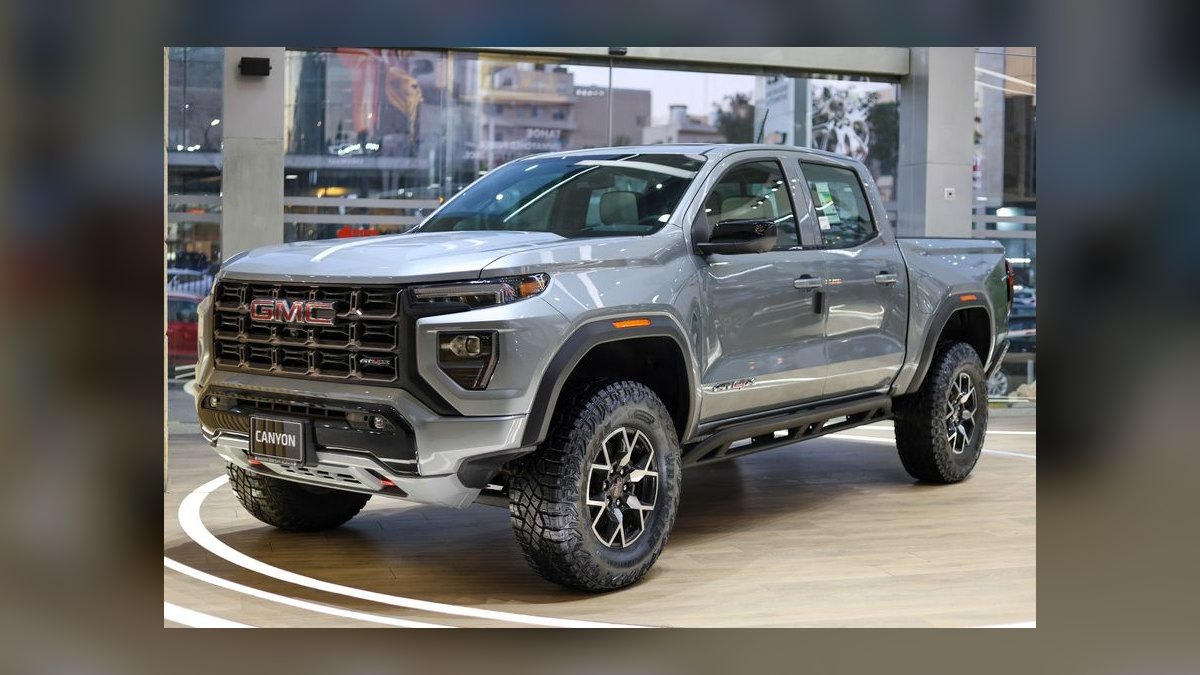
Terrain. The value champion and the easiest GMC to recommend on price. A 1.5L turbo four around 175 hp, available all-wheel drive, an 11-inch touchscreen with wireless Apple CarPlay and Android Auto standard. The Terrain AT4 adds raised suspension, all-terrain tires, and a terrain mode for light off-road use. Around $31,000, thousands under the Acadia.

Sierra 2500HD Denali. Heavy towing, no compromise on cabin. The 6.6L Duramax turbodiesel V8 makes 470 hp and 975 lb-ft, enabling conventional towing near 22,500 pounds and higher on gooseneck. A gas 6.6L V8 at 401 hp is standard. The HD adds a 15-inch trailering-focused screen, integrated trailer brake controller, and up to 14 camera views including a transparent-trailer view. Near $78,000.
Sierra EV Denali. The Ultium half-ton, platform-shared with the Silverado EV. The Denali Edition 1 carries roughly a 200-kWh pack for an estimated 440 miles of range — among the longest of any electric truck — with dual motors producing over 760 hp in Wide Open Watts and four-wheel steer. The Midgate opens the cabin to extend bed length. 800-volt architecture supports fast charging. Around $92,000 for the loaded launch trim, with lower-priced versions following as production ramps.
Hummer EV Pickup. Tri-motor 3X trim over 830 hp, CrabWalk diagonal steering, removable roof panels, Extract Mode air suspension for obstacle clearance, and roughly 300 to 355 miles of range depending on configuration. It weighs over 9,000 pounds. From about $98,000 past $108,000.
Hummer EV SUV. Nine inches shorter in wheelbase, which makes it materially more usable in a city than the pickup. Same CrabWalk, up to roughly 830 hp in 3X, 300-plus miles estimated. Enclosed cargo instead of a bed. From about $98,000.

How to work through the decision, step by step
The efficient path is elimination, not comparison. Most buyers waste weeks cross-shopping vehicles that were never viable for their actual use.
Step one — body style. Do you need an open bed? Not "would it be nice," but do you regularly haul something that cannot go inside a vehicle. If yes, you are in Sierra or Canyon territory and the SUVs are gone. If no, you are in Terrain, Acadia, Yukon, or Hummer SUV territory. This single question removes half the lineup in under a minute.
Step two — the towing number. Get an honest figure for the heaviest thing you will pull, loaded, including tongue weight and the water in the tanks. Under 5,000 pounds, a Canyon or Acadia handles it. Under 9,000, the Yukon or a half-ton Sierra. Between 9,000 and 13,000, the Sierra 1500 with the diesel or the 6.2L. Above 13,000 — and especially above 15,000 or with a fifth-wheel — you need the 2500HD and there is no shortcut around it. Buyers who try to make a half-ton do heavy-duty work end up with brake heat, sagging rear suspension, and a truck that feels unsafe on grades.

Step three — seats and cargo, honestly counted. Third rows are not equal. The Acadia's third row is usable for children and short adult trips. The Yukon's, thanks to the independent rear suspension, is genuinely adult-viable. If you need both a usable third row and cargo behind it simultaneously, only the Yukon XL really delivers it.
Step four — powertrain. Gas V8 is the default and the easiest to live with. Diesel makes sense if you tow frequently or drive long highway miles; it costs several thousand up front and pays back in fuel and towing composure over years, not months. Electric requires reliable home or workplace charging — if you cannot charge where you park, the Sierra EV and Hummer are the wrong purchase regardless of how much you like them.
Step five — trim. Work backward from where you actually sit. Time in the seat justifies Denali; occasional use does not.
Costs, timelines, and the numbers that actually move
MSRP is the least useful number in the transaction. Here is what the money actually looks like across the range and across ownership.

Entry points by segment. Terrain from roughly $31,000. Acadia Denali near $45,000. Sierra 1500 Denali around $66,500. Sierra 2500HD Denali near $78,000. Yukon Denali about $77,000, Yukon XL Denali about $80,000. Sierra Denali Ultimate roughly $84,000. Sierra EV Denali Edition 1 around $92,000. Hummer EV Pickup and SUV from about $98,000, past $108,000 on top trims. That is a $77,000 spread inside one brand.
Options move the number more than trim jumps. On the half-ton, the diesel is a several-thousand-dollar option that changes both the fuel math and the resale story. Super Cruise carries a subscription after the included trial period — budget for it as a recurring cost, not a one-time box. Air suspension and Magnetic Ride Control on the Yukon are meaningful ride upgrades and meaningful money. Twenty-two-inch wheels look sharp and cost real money in replacement tires, which on a full-size SUV can be a four-figure event.
Fuel and energy. A 6.2L V8 half-ton in mixed driving is a low-to-mid-teens mpg proposition, worse when towing. The 3.0L Duramax reaching roughly 24 mpg highway is the single largest running-cost lever in the lineup — over 15,000 miles a year, the gap between 16 and 24 mpg is hundreds of gallons. For the electrics, the relevant number is not mpg-equivalent but cost per charge at your actual utility rate, and whether you can charge overnight. Public DC fast charging at commercial rates erases most of the operating-cost advantage of an EV truck.

Depreciation. Full-size trucks historically hold value better than most segments, and Denali trims tend to hold a higher absolute residual while losing a larger absolute number of dollars — a truck that cost $84,000 loses more real money in three years than one that cost $66,500, even at a better percentage. EV residuals in the truck segment have been more volatile than gas equivalents, which is a genuine risk to price into a purchase or, more sensibly, a reason to lease rather than buy.
Timelines. Configuration-to-delivery on a factory order typically runs a couple of months, longer for low-volume trims and launch editions. Model-year changeover matters: shopping the outgoing year in late calendar-year sells at a discount, while the new model year commands full price for the same hardware. If you are flexible on color and options, buying dealer stock in the last weeks of a quarter is where the discount lives.
Upstream and downstream costs people forget. A gooseneck or fifth-wheel setup adds real installed cost on top of the truck. HD trucks need heavier tires and take more expensive brake work. Insurance on a six-figure Hummer is not comparable to insurance on a Terrain. And for fleet buyers, the Denali premium rarely survives a total-cost-of-ownership review — this is why the same dealer sells a fleet manager a Sierra Pro and a contractor-owner a Denali Ultimate.
Where buyers and fleets get this wrong
Buying trim instead of capability. The most common error is spending the budget on Denali Ultimate and then discovering the half-ton cannot pull the trailer. Capability is a hardware question — engine, axle ratio, cooling, brakes, chassis — and no amount of leather changes it. Sort tow rating first, luxury second. Reversing that order is expensive and irreversible.

Trusting the maximum tow rating. The headline 13,300-pound figure for the Sierra 1500 applies to a specific configuration: particular cab, bed, drivetrain, and axle. Your configuration may rate thousands of pounds lower. Payload is the more common real-world constraint anyway — passengers, gear, and tongue weight consume payload fast, and a well-optioned crew cab has less of it than a stripped one. Read the yellow payload sticker on the door jamb of the actual truck, not the brochure.
Assuming three rows means three usable rows. Vehicles are marketed on seat count and bought on seat count, then lived with on legroom. The Acadia's third row is a children's row. Test it with the people who will actually sit there, with the second row positioned where they will actually want it.
Going electric without charging. The Sierra EV's estimated 440 miles is genuinely impressive and completely irrelevant if you live in an apartment with no plug. EV truck ownership is excellent for buyers with a garage circuit and predictable daily mileage, and frustrating for everyone else. The failure mode is not range anxiety; it is the weekly time cost of public charging a vehicle with a very large battery.
Ignoring physical size. A Yukon XL and a Hummer EV Pickup are enormous. Garage depth, parking structure clearance, and drive-through widths are real constraints. Measure the garage before signing. This sounds trivial until a $100,000 vehicle does not fit in the space it was bought to live in.
Fleet-side: not separating the buyer from the driver. In commercial purchasing, the person approving the spend rarely drives the truck. Fleets that specify purely on acquisition cost get high-turnover, unhappy drivers; fleets that let drivers spec freely get Denali Ultimates on a work-truck budget. The functional middle is a capability floor set by the job and a trim ceiling set by finance, with the delta available as a driver-paid upgrade. That structure is common in industries where the vehicle is both a tool and a compensation signal — trades, field service, energy, and real estate all run some version of it.
A framework for choosing, and how the same logic applies beyond GMC
The framework that works here is not GMC-specific and it generalizes to any capital purchase with a wide trim ladder. Set a hard floor on capability, set a hard ceiling on price, and then treat everything between them as a comfort-versus-cash trade you make with full information rather than by momentum on the showroom floor.
Establish the floor first. Capability floor is towing, payload, seats, and drivetrain. It is non-negotiable, and it is determined by what you actually do, not what you might do twice a year. For the twice-a-year case, renting a bigger truck for a weekend is dramatically cheaper than buying two classes up and living with the fuel economy for six years.
Establish the ceiling second. The ceiling should be a monthly total-cost number, not a sticker price: payment, insurance, fuel or energy, expected tires and service. A Terrain and a Sierra Denali Ultimate can look like similar payments under the right term and down payment, and be wildly different monthly costs once fuel and insurance land.
Spend the middle on time-in-seat. The honest rule of thumb: the more hours per week you sit in it, the more the Denali content is worth. Two hours a day of commuting or jobsite driving justifies seat comfort, audio, and Super Cruise. Four hundred miles a year of hardware-store runs does not.
The adjacent lesson. This is the same structure that governs enterprise tooling decisions — set a capability floor from the requirements, a ceiling from the budget, and spend the delta on the thing people touch daily. It is also why Denali works as a revenue strategy for GM: it monetizes the middle of that band, where buyers have already cleared their capability floor and are deciding purely on comfort, which is precisely where willingness to pay is highest and price sensitivity is lowest.
When to wait. If a nameplate you want is at the end of its generation and a redesign is announced, waiting is usually right for a buyer keeping the vehicle a decade, and usually wrong for a leaseholder, who benefits from the discount on the outgoing model. If you are shopping the electrics, watch pricing on lower trims as production ramps — launch editions are always the most expensive way to buy a new EV platform.
Related questions
Which 2027 GMC is best for a growing family?
The Acadia Denali for most families — three rows, 328 hp, around $45,000, without full-size running costs. Step to the Yukon if you need an adult-usable third row or tow over 5,000 pounds, and to the Yukon XL if you need cargo space behind that third row.
Is the Duramax diesel worth the upcharge on a Sierra 1500?
If you tow regularly or drive high highway miles, yes. Roughly 24 mpg highway and 495 lb-ft of low-end torque change both fuel cost and towing composure. For a light-duty truck driven under 10,000 miles a year, the payback period is long enough that the gas V8 is the better buy.
How does the Sierra EV compare with other electric trucks?
Its estimated 440 miles from a roughly 200-kWh pack is at the top of the segment, with over 760 hp available and an 800-volt architecture for fast charging. The trade is price and mass. Cross-shop it against the Rivian R1T and F-150 Lightning, and only if you can charge at home.
What is the difference between Denali and Denali Ultimate?
Same mechanicals, different cabin. Ultimate adds full-grain leather, available massaging seats, 22-inch wheels, exclusive interior themes, and makes Super Cruise and head-up display standard. On the Sierra 1500 that is roughly $84,000 versus $66,500 for identical towing capability.
Does GMC sell anything smaller than the Terrain?
No. The Terrain is the entry point at roughly $31,000, and GMC offers no sedans, hatchbacks, or subcompacts. Buyers wanting something smaller need to look at Chevrolet or Buick within GM, or outside the group entirely.
FAQ
What is the most affordable GMC model in 2027?
The Terrain, starting around $31,000. It is a compact SUV with an approximately 175-hp 1.5L turbo four, available all-wheel drive, and an 11-inch touchscreen with wireless Apple CarPlay and Android Auto standard. It is the only GMC that starts under the mid-$30,000s and the natural entry point to the brand.
Which GMC has the highest towing capacity?
The Sierra 2500HD, at roughly 22,500 pounds conventionally and higher on a gooseneck, using the 6.6L Duramax turbodiesel V8 rated at 470 hp and 975 lb-ft. The 3500HD rates higher still for the heaviest fifth-wheel work. No half-ton comes close — the Sierra 1500 tops out near 13,300 pounds.
Is the Hummer EV still available in 2027?
Yes, in both pickup and SUV forms. The 3X trims produce over 830 hp with tri-motor drive, CrabWalk diagonal steering, removable roof panels, and roughly 300 to 355 miles of range depending on configuration. Pricing runs from about $98,000 past $108,000, and curb weight exceeds 9,000 pounds.
What is the most luxurious GMC for 2027?
The Sierra 1500 Denali Ultimate, near $84,000. It uses the same 420-hp 6.2L V8 as the standard Denali but adds full-grain leather, available massaging front seats, 22-inch wheels, exclusive Vader Chrome and Topaz Leather themes, and standard Super Cruise with head-up display and premium audio.
Does GMC offer any genuinely fuel-efficient models?
Relatively, not absolutely. The Sierra 1500's 3.0L Duramax diesel reaches roughly 24 mpg highway, which is strong for a full-size truck, and the Terrain's 1.5L turbo four is the most efficient combustion model in the range. The lineup is truck- and SUV-only, so nothing approaches compact-car economy.
Are there any sedans or small cars in the 2027 GMC lineup?
No. GMC sells only trucks and SUVs, and has for years. The lineup runs from the compact Terrain through the Acadia, Yukon, and Yukon XL on the SUV side, and the Canyon, Sierra 1500, Sierra EV, Sierra HD, and Hummer EV on the truck side. Shoppers wanting a car look to Chevrolet or Buick.
Sources
- https://www.gmc.com/
- https://media.gm.com/
- https://www.caranddriver.com/gmc
- https://www.edmunds.com/gmc/
- https://www.motortrend.com/cars/gmc/
- https://www.kbb.com/gmc/
- https://www.fueleconomy.gov/
- https://www.consumerreports.org/cars/gmc/
- https://www.nhtsa.gov/ratings
Related on PULSE
- [Best GMC Yukon XL Model Years (Ranked)](/knowledge/ca0556)
- [Best GMC Canyon Model Years (Ranked)](/knowledge/ca0555)
- [Best GMC Sierra Model Years (Ranked)](/knowledge/ca0554)
- [Best GMC Terrain Model Years (Ranked)](/knowledge/ca0459)
- [Best GMC Acadia Model Years (Ranked)](/knowledge/ca0426)
- [Best GMC Yukon Model Years (Ranked)](/knowledge/ca0391)
This page will be disappearing soon. Save it to your device for $1 — or read it free while it is here.
@Kory-White- · if Venmo asks, the last 4 of my number are 2012
 pulse-carsBest Audi TT Model Years (Ranked) in 2027
 pulse-carsTop 10 Cargo Vans 2027 — Best Overall + Best Value
 pulse-carsBest Used Coupes Under $40,000 in 2027 (Ranked)
 pulse-carsTop 10 Luxury SUVs 2027 — Best Overall + Best Value
 pulse-carsTop 10 Hot Hatchbacks 2027 — Best Overall + Best Value
 pulse-carsTop 10 Sports Cars 1981 — Best Overall + Best Value
 pulse-carsBest Nissan Juke Model Years (Ranked) in 2027
 pulse-carsTop 10 Sports Sedans 2027 — Best Overall + Best Value
 pulse-carsBest Acura NSX Generations (Ranked) in 2027
 pulse-carsBest Audi A3 Model Years (Ranked) in 2027