
Best Used Electric SUVs Under $50,000 in 2027 for Large Families: Top Picks with Third-Row Seats and Towing
 Curated byKory White · Fractional CRO · Maryland
 PULSEKNOWLEDGE LIBRARY
Quality
Certified

Under $50,000 in 2027, families needing three rows plus towing should shop used 2022–2024 Kia EV9, Rivian R1S, Tesla Model X, Model Y with the optional third row, and Mercedes EQB. EV9 and R1S tow 3,500–7,700 pounds; Model Y's jump seats suit small children only.
The driveway test that decides this purchase
Picture a specific family, because the abstract version of this question produces bad advice. Two adults, three kids aged four, nine, and twelve. A 17-foot fiberglass travel trailer that scales at roughly 3,100 pounds dry and closer to 3,900 loaded with water, a cooler, bikes on the tongue rack, and the inevitable bin of pool noodles. One 340-mile drive to the lake each summer, plus a 90-mile round trip to grandparents about twice a month, plus the daily 22-mile school-and-work shuttle that actually accounts for 80 percent of the odometer.
That family walks onto a lot with a $48,000 ceiling and a very different set of constraints than the enthusiast reading spec sheets. They need a real third row an actual nine-year-old can sit in for two hours without a mutiny. They need a hitch receiver the manufacturer actually rates, not an aftermarket bolt-on that voids something. They need charging math that survives a trailer, because towing an EV is where optimism goes to die. And they need the whole thing to land under fifty grand out the door, which in practice means a listing price closer to $44,000–$46,000 once tax, title, and a doc fee get stacked on top.
Here is where the used market in 2027 becomes genuinely useful rather than a compromise. Three-row electric SUVs barely existed before 2022. The Tesla Model X had been shipping a six- and seven-seat configuration for years, and the Model Y added an optional third row in 2021. Then 2022 brought the Rivian R1S, 2022 brought the Mercedes EQB with its tiny-but-real third row, and 2024 brought the Kia EV9 — the first mainstream, non-luxury, purpose-built three-row electric SUV with a normal family price. Those vehicles are now three to five years into their depreciation curves, and EV depreciation has been steeper than the internal-combustion equivalent almost across the board. A vehicle that stickered at $73,000 new is not a $73,000 problem anymore.
The trap is that "three-row electric SUV" and "three-row electric SUV that tows" are not the same shopping list, and neither is the same as "three-row electric SUV that tows the thing you actually own." A 5,000-pound tow rating on a spec sheet describes what the chassis, brakes, and cooling system can handle. It says nothing about what happens to your range, and range collapse is the single most under-discussed variable in this entire category. Families walk in comparing 300-mile EPA figures and walk out discovering that the number that matters — miles between charging stops with the trailer attached — is roughly half of that.
So the shopping frame should invert. Start with the trailer or the boat or the utility hauler. Weigh it loaded, not dry. Add tongue weight into the payload budget alongside five human bodies and their luggage. Then work backward to which of the five or six genuinely available used models can carry that load, seat that family, and still land under the number.
How towing actually eats an electric SUV's range
The mechanism is worth understanding precisely, because it explains why the used EV3-row market rewards buyers who do arithmetic and punishes buyers who trust the window sticker.
An electric SUV at highway speed spends the overwhelming majority of its energy pushing air. Aerodynamic drag scales with the square of velocity, and the power required to overcome it scales with the cube. A modern three-row EV is a reasonably slippery object — drag coefficients in this class generally land somewhere in the 0.27 to 0.35 range, with the boxier body-on-frame-styled entries at the higher end. Hitch a trailer behind it and you have effectively bolted a brick to the back of that carefully sculpted shape. The trailer adds its own frontal area, its own drag coefficient, and — critically — it destroys the clean pressure recovery behind the tow vehicle that the designers spent wind-tunnel hours creating.
Then add rolling resistance. A 4,000-pound trailer riding on four or six tires at whatever pressure the previous owner last checked contributes meaningful rolling losses. Add elevation: every foot of climb is potential energy the battery must supply, and while regenerative braking recovers a healthy fraction on the descent, the round trip is never break-even. Add the auxiliary loads — climate control for seven occupants, a battery thermal management system working harder because sustained high-power draw heats the pack.
The practical consequence is a consumption figure that roughly doubles. A three-row electric SUV that returns something like 2.8 to 3.2 miles per kilowatt-hour unladen at 65 mph will commonly return 1.4 to 1.8 miles per kWh with a mid-size travel trailer behind it. That is not a defect. It is physics, and gasoline three-row SUVs suffer the same proportional penalty — a V6 crossover rated at 24 mpg highway will show 12 to 14 mpg towing the same trailer. The difference is that the gasoline vehicle refuels in five minutes at any exit, and the electric one needs a charging stop that a trailer may not physically fit into.
That last branch is the one families under-plan. Most DC fast-charging stalls are configured like parking spaces — you back in or pull in nose-first, and a 17-foot trailer behind you makes that geometrically impossible without unhitching. Pull-through charging stalls exist and have been expanding, and both Rivian's Adventure Network and a growing share of Tesla Supercharger sites have added them, but coverage is uneven and route-dependent. The workaround families actually use is to plan stops at locations with truck-stop-style layouts or large empty lot edges where you can occupy two spaces lengthwise without blocking anyone. That is a real planning tax of maybe fifteen minutes of research per trip, and it is worth knowing about before purchase rather than in a parking lot in Missouri.
The upstream effect worth flagging: this same math applies to the adjacent use cases families are actually buying for. Hauling a 5x8 enclosed cargo trailer for a move, towing a pair of jet skis, pulling a small landscape trailer for a side business — all of them impose the same aerodynamic and mass penalties, scaled by size. A small utility trailer under 1,500 pounds with a low profile might only cost you 20 to 30 percent of range. A tall enclosed box trailer at the same weight can cost more than a heavier but lower boat trailer, because frontal area matters more than mass at highway speed. Families frequently guess wrong on this and buy more tow rating than they need while under-buying range.
What the numbers look like across the realistic candidates
Concrete figures, with the caveat that used prices move constantly by region, mileage, and condition. Treat these as ranges to check against current listings on the major aggregators rather than as quotes.

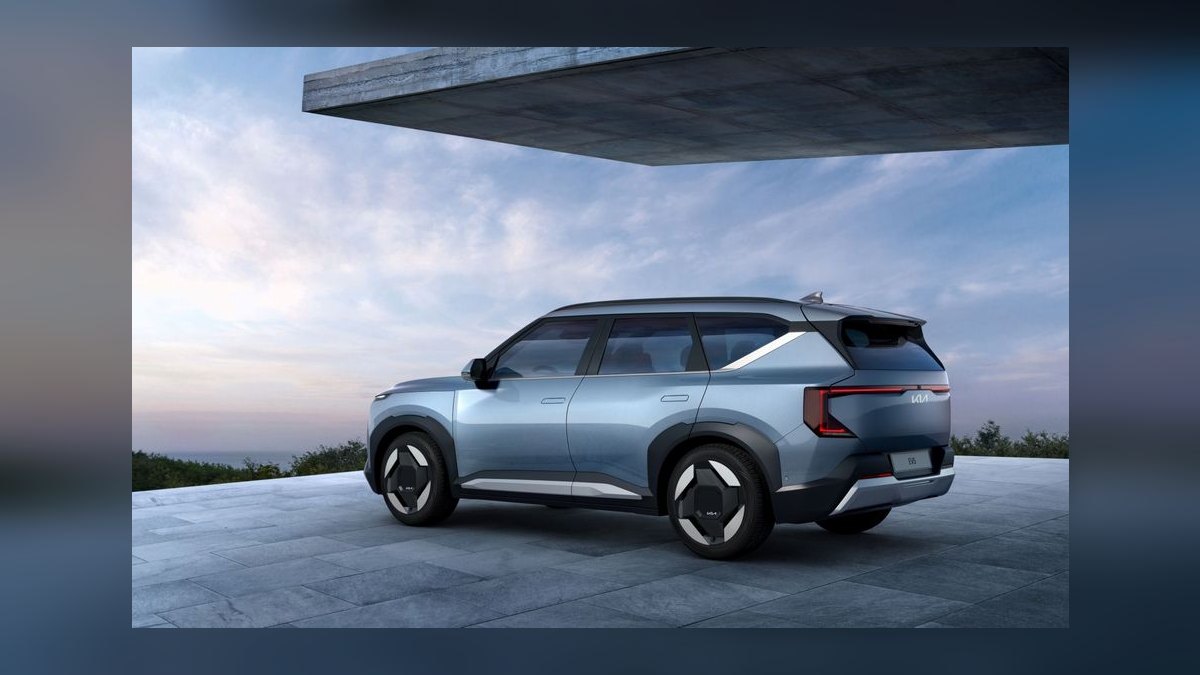
Kia EV9. This is the vehicle most families in this search should look at first, because it was designed from a blank sheet as a three-row electric family SUV rather than adapted into one. Seven-seat and six-seat captain's-chair configurations were both offered. Kia rated it to tow 5,000 pounds in the dual-motor all-wheel-drive configurations, with a lower rating on the single-motor rear-drive Light trim. EPA range figures spanned roughly 230 miles on the entry Light Standard Range up to about 304 miles on the Light Long Range rear-drive, with the popular all-wheel-drive Wind and Land trims landing near 270–280 miles. It runs an 800-volt architecture, which means fast-charging sessions in the 10-to-80-percent window measured in the low-to-mid twenties of minutes on a capable 350 kW charger — a genuine advantage on a towing trip where every stop is a longer stop. New pricing spanned roughly the mid-fifties to high seventies depending on trim. In 2027, well-used 2024 examples with 40,000 to 70,000 miles have depreciated into a band that puts Wind and even some Land trims within reach of a high-forties budget, and Light trims comfortably below it.
Rivian R1S. The capability champion of this group and the one that genuinely changes what a family can pull. Rivian rated the R1S at 7,700 pounds — a figure that puts it in the same conversation as a well-equipped gasoline body-on-frame SUV. Three rows standard, seven seats, real ground clearance thanks to the adjustable air suspension, and a frunk on top of the cargo hold. Range depended heavily on pack and wheel choice, with figures spanning roughly the high 250s to the low-to-mid 300s of miles. The catch is price: the R1S launched well north of $70,000 and Launch Edition and Adventure trims went higher. Depreciation has been meaningful, and by 2027 higher-mileage early 2022 and 2023 Explore and Adventure examples do appear under fifty thousand — but they will be the highest-mileage, earliest-build units in this comparison, and they carry the most complex repair story. Budget for that.
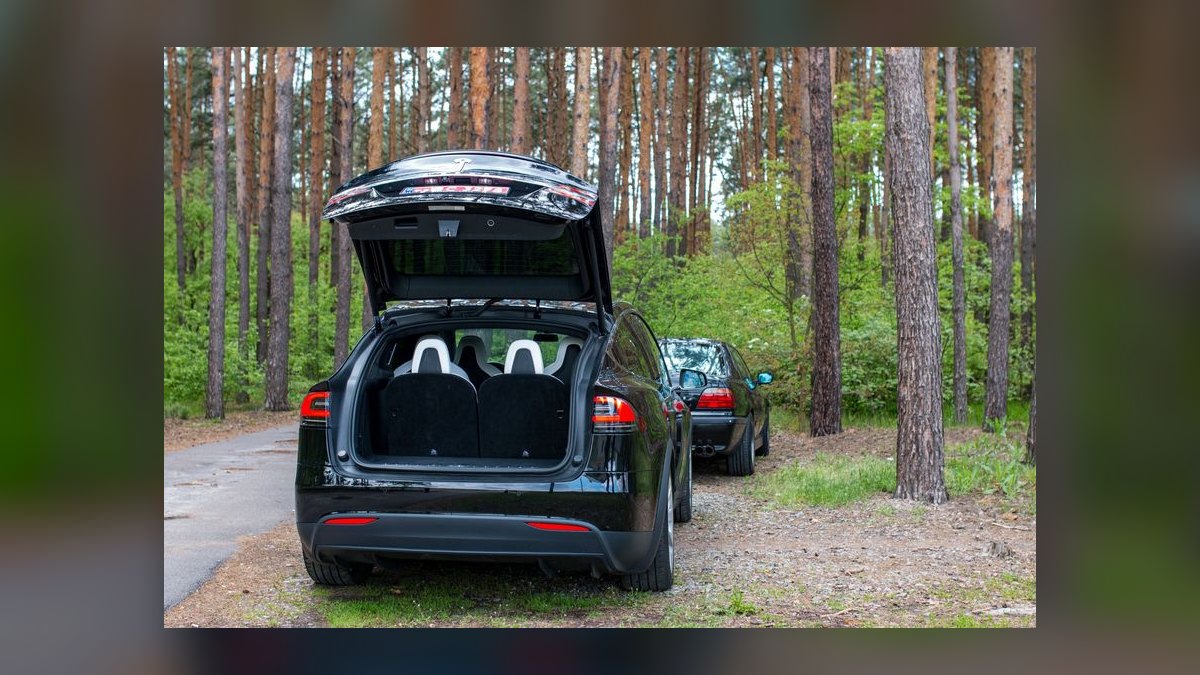
Tesla Model X. Long the default answer to "electric SUV that tows," rated at 5,000 pounds. Six- and seven-seat configurations existed across the production run, and the third row in the seven-seat layout is genuinely tight — adult-hostile, kid-acceptable. Range on the newer Long Range builds was strong, generally in the 320-to-350-mile neighborhood depending on year and wheels. Supercharger access is the practical trump card for a towing family, because it is the densest and most reliable fast-charging network in North America, and Tesla has been adding pull-through stalls specifically for towing. Depreciation on the Model X has been steep enough that older 2019–2021 examples land well under fifty thousand, and even some 2022 cars approach it at higher mileage. The falcon-wing rear doors are a genuine consideration — they are wonderful in a tight parking space and a known source of alignment and sensor complaints as the vehicle ages.
Tesla Model Y with the third-row option. Worth naming precisely so nobody buys the wrong thing. The Model Y's optional third row is a pair of small jump seats intended for children. It is not a substitute for the EV9 or R1S third row. Tow rating with the factory hitch is 3,500 pounds, which covers a small pop-up camper, a pair of personal watercraft, a small utility trailer, or a compact boat. If your "third row" need is occasional carpool overflow with elementary-age kids and your towing need is genuinely light, this is the cheapest way into the category by a wide margin — used Model Y inventory is enormous and prices sit well below the ceiling.
Mercedes-Benz EQB. The other genuinely three-row entry, and the smallest. Mercedes offered a 5+2 configuration where the rearmost pair of seats are explicitly rated for occupants under a certain height. It is a compact vehicle with an approximately 70 kWh pack and EPA range in the low-to-mid 200s. Tow ratings on U.S.-market EQB variants are modest and trim-dependent, and this is not the vehicle for a 4,000-pound trailer. It is the vehicle for a family that needs seven belted positions in a garage-sized footprint and tows almost nothing. Depreciation on lease-return EQBs has been steep, which puts them among the cheapest three-row electrics on the market.
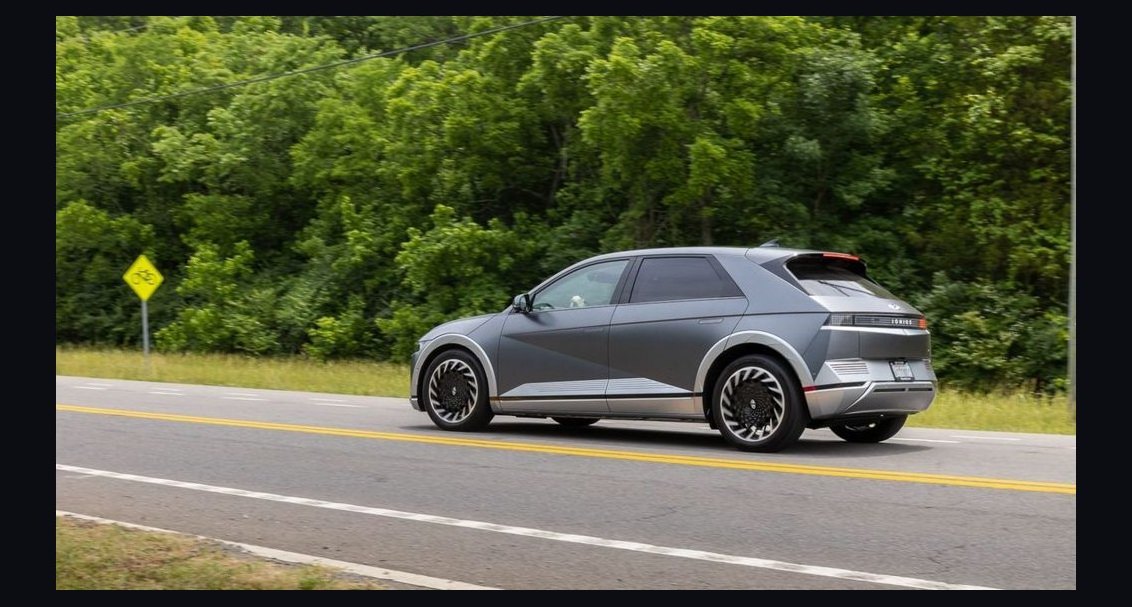
Volkswagen ID.4, Hyundai Ioniq 5, Ford Mustang Mach-E. Named here specifically to rule them out for this search. All three are two-row vehicles. They appear constantly in "best used electric SUV" lists and they are good vehicles, but none of them seats seven, so none of them answers this question. The ID.4 and Ioniq 5 do tow — modest ratings in the 2,000-to-2,700-pound range depending on configuration and market — which makes them relevant to the adjacent shopper who needs light towing without a third row.
On battery health, which is the number that should worry a used-EV buyer most: real-world fleet data and third-party analyses have consistently found modern lithium-ion packs degrading in the neighborhood of one to two percent per year under normal use, with the steepest drop in the first year and a flattening curve after. A three-year-old EV with 60,000 miles should plausibly show 90 to 95 percent of original usable capacity. Anything materially below that on a vehicle of that age deserves a hard look and a mechanic. Federal law requires EV traction battery warranties of at least eight years or 100,000 miles, and several manufacturers exceeded that, which means most vehicles in this shopping band still carry factory battery coverage that transfers to a second owner — check the specific terms, because coverage against capacity degradation typically triggers only below a stated threshold, commonly around 70 percent.
Trade-offs, and the alternatives worth considering honestly
Every choice in this category costs something, and the honest framing is that there is no vehicle here that is simultaneously cheap, long-range, spacious, and a strong tower. Pick three.
Capability versus complexity. The R1S buys you 7,700 pounds and real off-pavement ability. It also buys you air suspension, quad- or dual-motor drivetrains, and a service network that, while expanding, is far thinner than a Kia dealer network. If you live 200 miles from the nearest service center, that 7,700-pound rating is worth less than it looks.

Purpose-built versus adapted. The EV9's third row was designed as a third row. The Model Y's was added to an existing package. This shows up in headroom, in seat-fold ergonomics, in whether the second row slides forward enough for an adult to get back there without contortion, and in cargo volume behind the third row when it is up — the difference between a usable grocery shelf and a slot barely deep enough for a backpack.
Range versus charging speed. These are substitutes, not complements, and towing families should weight charging speed higher than the spec-sheet-comparison instinct suggests. A vehicle with 280 miles of range that adds 200 miles in 22 minutes beats a vehicle with 320 miles of range that needs 45 minutes for the same, once you are stopping every 130 to 160 towing miles. The 800-volt architecture in the EV9 is a real functional advantage here, not a brochure line.
New versus used, and the incentive wrinkle. This deserves care because the policy landscape shifted. The federal used clean vehicle credit — the one worth up to $4,000 on qualifying used EVs under a $25,000 sale price — was structured with an expiration tied to vehicles acquired after September 30, 2025 under the 2025 tax legislation. Anyone shopping in 2027 should verify the current federal and state situation directly with the IRS and their state agency rather than assuming any credit applies. Several states have run their own rebate programs independent of the federal one, and those have their own eligibility rules and funding cycles. Do not build the budget around a credit you have not confirmed.

The gasoline and hybrid alternative, stated fairly. A used three-row hybrid or gasoline SUV in this price band — the Toyota Highlander Hybrid, the Kia Telluride, the Honda Pilot — will tow 3,500 to 5,000 pounds, refuel in minutes anywhere, and cost less to insure and repair. What it will not do is cost two to four cents a mile to fuel on home charging, and it will not deliver the low-end torque that makes a loaded trailer feel weightless from a stop. For a family whose towing is two long trips a year and whose driving is otherwise local, the electric option is strongly favorable. For a family that tows 8,000 miles a year across the mountain west, it is genuinely a harder call and the honest answer might be gasoline.
Charging infrastructure at home is the hidden qualifier. A family without a Level 2 home charger is buying a materially worse vehicle than the same family with one. Installation costs vary enormously — a straightforward run from a panel with spare capacity in an attached garage might land in the several-hundred-dollar range plus the cost of the unit, while a long conduit run to a detached garage or a service panel upgrade can push well into four figures. Get an electrician's quote before you buy the car, not after. For renters and apartment dwellers, the calculus changes substantially, and a plug-in hybrid three-row may genuinely serve better.
Where families get burned, and how to avoid it
Buying tow rating instead of tow capability. The rating assumes the manufacturer's tow package — the wiring harness, the transmission or drive-unit cooling provisions, the hitch receiver rated to the stated tongue weight, and in some cases a software configuration the dealer enables. A vehicle without the factory package, wearing an aftermarket hitch someone bolted on, does not carry the rating regardless of what the aftermarket hitch is stamped with. Verify the build sheet. On Tesla vehicles the tow package is visible in the vehicle's own configuration menu; on the EV9 and R1S, check the window sticker or the VIN decode.
Ignoring payload while obsessing over towing. Tow rating and payload are separate budgets and both must clear. Tongue weight — typically 10 to 15 percent of trailer weight for a conventional bumper-pull — lands on the rear axle and counts against payload, alongside every passenger and every bag. A 4,000-pound trailer puts roughly 400 to 600 pounds of tongue weight on the hitch. Add five people at an average of 150 pounds and you have consumed 1,150 to 1,350 pounds before a single suitcase. EVs carry heavy battery packs, which means their payload ratings are often lower than a comparable gasoline SUV's despite the higher curb weight. Find the yellow payload sticker on the driver's door jamb and do the arithmetic. This is the single most common way families end up illegally and unsafely loaded.
Skipping the battery health report. Ask for a state-of-health readout. Tesla vehicles will run a built-in battery health test through the service menu. Third-party diagnostic services can pull pack-level data on most makes via the OBD port, and independent EV specialists increasingly offer this as a pre-purchase service for a modest fee. A written SoH number is worth more than a hundred miles of test driving. Pair it with a check of whether the battery warranty transferred and how much of it remains.
Assuming the third row is the third row you imagined. Go sit in it. Bring the actual children. The distance from the second-row seatback to the third-row seatback, the seat-bottom height off the floor (low cushions force a knees-up posture that gets uncomfortable fast), whether there are dedicated vents and USB ports back there, and whether a rear-facing car seat in the second row eliminates third-row access entirely — these determine whether the vehicle works for your family in a way no spec sheet captures. The EQB's rearmost seats in particular carry an explicit occupant height limit; know it before you buy.
Underestimating tires and insurance. Electric SUVs are heavy and their tires wear accordingly, often faster than a comparable gasoline vehicle, and replacement sets on 20- or 21-inch wheels are not cheap. Insurance premiums on EVs have generally run higher than comparable gasoline vehicles, driven by higher repair costs and parts availability. Get a real quote with your VIN before signing, because a $60-a-month surprise changes the affordability math on a $46,000 purchase.
Not accounting for winter. Cold weather reduces EV range meaningfully — commonly 20 to 30 percent in sustained freezing conditions, more when the cabin heater runs hard. Stack that on top of a towing penalty and a winter trailer trip can see effective range at 40 percent of the EPA figure. Vehicles with heat pumps fare better than those with resistive heating, which is a trim-and-year detail worth checking on any candidate.
Treating the private-party discount as free money. Private sellers price lower than dealers, sometimes by thousands. They also offer no recourse. On a vehicle with a high-voltage system, a pre-purchase inspection by a shop that actually works on EVs — not the generic corner garage — is not optional. Budget for it, and walk from any seller who resists.
Related questions
Can a used Kia EV9 really tow 5,000 pounds?
Kia rated dual-motor all-wheel-drive EV9 trims at 5,000 pounds with the factory tow package. Single-motor rear-drive Light trims carry a lower rating. Verify the specific trim and confirm the factory hitch is present on the build sheet before assuming the higher figure.
How much range do I lose towing a travel trailer?
Plan for a 40 to 55 percent reduction with a mid-size travel trailer at highway speed. A 280-mile EPA rating realistically becomes 125 to 165 usable towing miles. Frontal area matters more than weight — a tall box trailer costs more range than a heavier low boat trailer.
Is the Tesla Model Y third row usable for families?
Only for small children. It is a pair of jump seats, not a genuine third row. Adults and larger teenagers will not fit comfortably. Families needing regular third-row use should look at the EV9, R1S, or a seven-seat Model X instead.
Does the federal used EV tax credit still apply in 2027?
The used clean vehicle credit was set to expire for vehicles acquired after September 30, 2025 under 2025 tax legislation. Verify current federal and state programs directly with the IRS and your state agency. Never build a budget around an unconfirmed incentive.
What battery health percentage should I accept on a used EV?
A three-year-old EV with moderate mileage should show roughly 90 to 95 percent of original capacity. Below 85 percent at that age warrants investigation. Get a written state-of-health readout and confirm how much factory battery warranty transfers to you.
FAQ
Which used electric SUV under $50,000 has the highest tow rating?
The Rivian R1S at 7,700 pounds, by a wide margin over anything else in the category. Early 2022 and 2023 Explore and Adventure examples with higher mileage have depreciated into this budget band by 2027. The trade-off is a thinner service network and more complex systems than the mainstream alternatives, so factor repair access and a specialist pre-purchase inspection into the decision.
Is a used EV9 or a used Model X the better family choice?
The EV9 for third-row comfort, cargo practicality, and cheaper routine service. The Model X for range, Supercharger network access, and outright performance. Both are rated at 5,000 pounds. If your third row carries passengers weekly, the EV9's purpose-built packaging wins clearly. If you take long highway trips and the third row is occasional, the Model X's charging network advantage is real.
Do I need a Level 2 home charger to own one of these?
Practically, yes. A standard household outlet adds only a handful of miles per hour, which cannot keep up with a family's daily 20-to-40-mile driving plus weekend trips. Get an electrician's quote before purchase — costs range from a few hundred dollars for a simple install to several thousand if the panel needs upgrading or the run is long.
How does towing affect the battery warranty?
Towing within the manufacturer's rating with the factory package does not void the traction battery warranty. Exceeding the rating, using an unrated aftermarket hitch, or modifying the drivetrain can create a denial argument. Keep documentation of trailer weights, and use only the manufacturer-approved hitch and wiring for the specific trim you own.
What's the realistic total cost beyond the purchase price?
Budget for tax and registration, a specialist pre-purchase inspection, a home charger install, a first set of tires if the current set is past half-life, and an insurance premium likely higher than a comparable gasoline SUV. On a $46,000 purchase, several thousand dollars of first-year costs beyond the sale price is a reasonable planning assumption.
Should families needing seven seats consider a plug-in hybrid instead?
If you cannot charge at home, tow long distances frequently, or live far from fast-charging infrastructure, a three-row plug-in hybrid is a legitimately better answer. It delivers electric commuting with gasoline road-trip flexibility. Families with home charging and mostly local driving get more benefit from full electric.
Sources
- EPA Fuel Economy — EV and Hybrid Ratings
- NHTSA Vehicle Safety Ratings and Recalls
- IIHS Vehicle Ratings
- IRS Used Clean Vehicle Credit
- Kelley Blue Book
- Edmunds
- Car and Driver
- Consumer Reports — Cars
- U.S. Department of Energy Alternative Fuels Data Center
- U.S. News Best Cars
Related on PULSE
- [Best Electric SUVs Under $50,000 in 2027](/knowledge/ca0381)
- [Best Used Electric Cars Under $50,000 in 2027 (Ranked)](/knowledge/ca0851)
- [Best Used Hybrid SUVs Under $50,000 in 2027 (Ranked)](/knowledge/ca0973)
- [Best Used Off-Road SUVs Under $50,000 in 2027 (Ranked)](/knowledge/ca0861)
- [Best Used Full-Size SUVs Under $50,000 in 2027 (Ranked)](/knowledge/ca0858)
- [Best Used Compact SUVs Under $50,000 in 2027 (Ranked)](/knowledge/ca0857)
This page will be disappearing soon. Save it to your device for $1 — or read it free while it is here.
@Kory-White- · if Venmo asks, the last 4 of my number are 2012
 pulse-carsBest Hyundai Ioniq 5 Model Years (Ranked) in 2027
 pulse-carsBest Used AWD Cars Under $20,000 in 2027 (Ranked)
 pulse-carsBest Used Hybrid Cars Under $40,000 in 2027 (Ranked)
 pulse-carsBest Acura Models in 2027
 pulse-carsBest Audi TT Model Years (Ranked) in 2027
 pulse-carsBest Audi A3 Model Years (Ranked) in 2027
 pulse-carsBest Lexus UX Model Years (Ranked) in 2027
 pulse-carsTop 10 Pickup Trucks 1969 — Best Overall + Best Value
 pulse-carsBest Mercedes-Benz CLA Model Years (Ranked) in 2027
 pulse-carsTop 10 Mid-Size Sedans 2027 — Best Overall + Best Value