


“Trust compounds. So does pipeline.” — LinkedIn Banner
Quality
Certified
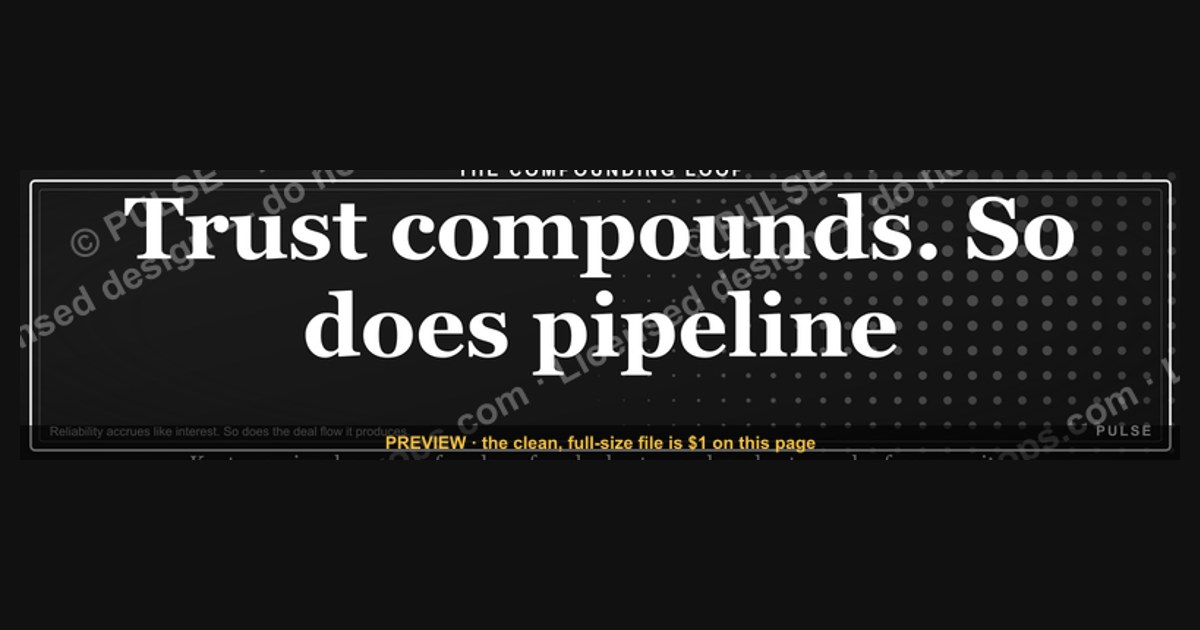

"Trust compounds. So does pipeline." is a LinkedIn banner headline that compresses a revenue operating principle into five words: reliability accrues like interest, and the deal flow it produces accrues alongside it. Kept promises generate referrals, referrals shorten cycles, and shorter cycles free capacity to keep more promises — a loop that grows quietly, then quickly.
The moment a banner stops being decoration
Picture a fractional revenue leader who has spent eighteen months doing genuinely good work — three turnaround engagements, two of them referred by the first client — and whose LinkedIn profile still reads like a résumé. The cover slot at the top of the page is the stock blue gradient LinkedIn assigns by default. Every prospect who lands on that profile from a cold connection request, a comment thread, or a conference follow-up sees the same 1584×396 pixels of nothing before they read a single word of the headline.
That blank slot is the highest-traffic, lowest-effort real estate on a professional profile. LinkedIn renders the cover image above the fold on desktop and directly behind the profile photo on mobile, meaning it is the first visual element loaded on essentially every profile view. A profile that gets 40 views a week is serving 2,000 impressions a year from that one rectangle, and a default gradient converts none of them.
The specific failure is not aesthetic, it's positional. A prospect scanning a profile is running a fast, mostly unconscious classification: *is this person a vendor, a peer, or a resource?* The banner is the first input to that classification and the only one that arrives before the reader has committed any attention. A stock gradient defaults the answer to "unknown," and unknown reads as vendor. A banner that states an operating belief — trust compounds, and so does pipeline — defaults the answer to "practitioner with a point of view," which is a materially different starting position for the conversation that follows.
The scenario that makes this concrete: two fractional CROs with near-identical experience both get profile-viewed by a VP of Sales evaluating outside help. One profile opens with a gradient and a headline listing four titles. The other opens with a dark banner carrying a single sentence about how revenue actually accumulates, under a pulse motif, followed by a headline that says the same thing in different words. The second profile has answered the classification question before the reader scrolls. That is the entire job of the asset — not to be pretty, but to pre-answer.

The failure mode on the other side is equally common: a banner so dense with logos, taglines, contact details, QR codes, and award badges that it reads as a business card scanned at low resolution. LinkedIn crops the cover aggressively on mobile and tucks the profile photo over the lower-left corner, so anything placed there disappears. A single short line in the safe zone survives every crop. Five elements competing for a 4:1 letterbox do not.
How the compounding loop actually runs
The banner asserts a mechanism, so it's worth being precise about what that mechanism is. Trust in a revenue context is not a feeling — it is a prospect's confidence interval around your future behavior. Narrow interval, high trust. Wide interval, low trust. Everything that narrows the interval builds trust; everything that widens it destroys trust. This reframing makes the compounding claim testable rather than inspirational.
Three inputs narrow the interval. Frequency of kept small promises does most of the work: answering when you said you would, sending the recap before it's requested, showing up to the call already having read the last quarter's numbers. Each instance is individually trivial and collectively decisive, because a prospect estimating your reliability has no access to your intentions — only to your track record of small observable commitments. Consistency matters second: the same response time, the same pricing logic, the same implementation estimate quoted to the champion and the CFO. Contradiction between two of your own statements costs more than either statement gains. Transparency is the multiplier: naming the part of the engagement that usually goes badly, before it goes badly, is the fastest available way to signal that you aren't managing perception.
The asymmetry is what makes the compounding metaphor honest rather than decorative. Trust accrues in small, roughly linear increments and drops in large discontinuous ones. A missed deliverable does not subtract one unit; it invalidates the reader's whole model of you and forces them to rebuild it from a worse prior. This is the same shape as compound interest with a drawdown — years of accumulation, one bad quarter, and the recovery starts from a lower base with the same clock.
Pipeline inherits the shape because pipeline is downstream of the confidence interval. A prospect with a narrow interval around your behavior needs less verification: fewer reference calls, fewer security reviews escalated, fewer rounds of legal redlines, fewer "let me socialize this internally" delays. Every one of those is calendar time. Removing them shortens the cycle, and a shorter cycle means the same headcount closes more deals per quarter, which produces more successful implementations, which produces more references — the input to the next prospect's confidence interval.

The loop has one property worth naming: it is slow at the start and indifferent to effort in the first turns. Two or three kept promises produce no visible pipeline effect, which is exactly why most people abandon the practice before it pays. The banner is a commitment device against that abandonment — a public statement of the operating principle, visible to the person who most needs reminding, which is you.
What the numbers actually look like
Precision matters here, and so does honesty about what is and isn't measurable. There is no credible universal statistic for "trust increases 20% per interaction" — trust isn't denominated in units and any specific percentage attached to it is invented. What *is* measurable, and what a revenue operator should instrument, are the proxies.
Referral share of sourced pipeline. This is the single cleanest compounding indicator. Pull the last four quarters of closed-won and sourced opportunities and tag each by origin: outbound, inbound-content, event, partner, referral. In an early-stage practice, referral share typically starts near zero and every deal is manufactured. The compounding claim is falsifiable: if the loop is running, referral share should climb quarter over quarter without additional referral-specific effort. If it's flat across four quarters, the loop isn't running and something upstream is leaking — usually delivery, not marketing.
Cycle time split by origin. Segment your closed-won deals into referred and non-referred, then compare median days from first meeting to signature. The gap is the cash value of trust, expressed in calendar time. Most operators who run this analysis for the first time find the gap is large enough to change how they allocate time. If you close 20 deals a year and referred deals run three weeks shorter, that's more than a full quarter of recovered selling capacity.
Verification-step count. A concrete, countable proxy for the confidence interval. For each deal, count discrete verification events: reference calls requested, security questionnaires, pilot demands, legal review rounds, additional stakeholders added late. Log it as a single number per opportunity. Deals originating from a strong referral consistently require fewer. Watching this count fall over time across your whole book is the most direct evidence available that trust is compounding.

Promise-keeping rate. The input metric, and the only one you fully control. Every commitment made to a prospect — "I'll send that by Thursday," "I'll introduce you to a customer in your vertical," "I'll have the pricing scenario by end of week" — gets logged with a due date. Weekly, compute kept-on-time divided by total. Teams that instrument this for the first time typically discover the real rate is well below what anyone assumed, because unlogged verbal commitments never enter the count. Getting this number visible is usually worth more than any messaging change.
Profile-side numbers for the banner itself. The cover image is 1584×396 pixels, a 4:1 ratio. Design for a safe zone: the profile photo overlays the lower-left on desktop and center-lower on mobile, and mobile crops the horizontal edges, so keep the entire message inside roughly the middle 60% horizontally and the upper two-thirds vertically. Text set below about 28px at full size becomes unreadable on a phone. An SVG scales losslessly to any of LinkedIn's render sizes; a PNG should be exported at 1584×396 or exactly 2× that for retina.
The measurement cadence that works: instrument promise-keeping rate weekly, review verification-step count and cycle-time-by-origin monthly, and evaluate referral share quarterly. Anything faster than that on the lagging metrics produces noise you'll misread as signal.
What you give up by leading with the principle
Committing your banner — and by extension your positioning — to a slow-compounding trust thesis is a real trade with real costs, and the honest version of this page names them.
You give up urgency. A banner that says "Trust compounds" is not a banner that says "Fix your pipeline in 30 days." Urgency-led positioning converts better in the short window and pulls in buyers who already know they have a fire. Trust-led positioning converts worse per impression and better per relationship. If your practice needs three clients this quarter to survive, urgency wins and you should use it — the compounding thesis is a strategy for a business with runway, not a business in a cash crunch.
You give up specificity to a segment. "Trust compounds. So does pipeline." is legible to anyone in revenue. A banner reading "RevOps for Series B SaaS, $5M–$20M ARR" is legible to a much smaller group and dramatically more compelling to them. The principle-led banner casts wider and bites shallower. The strongest resolution is usually a split: the principle in the LinkedIn banner, the segment in the headline directly below it, so the visual makes the claim and the text qualifies it.
You give up proof in the visual. A cover image showing a real result — a chart, a named outcome, a client logo wall — carries evidentiary weight a principle statement cannot. The counterargument is that logos and charts on a banner are read as marketing and discounted accordingly, whereas an operating principle is read as a belief and is harder to dismiss. Neither is universally right. The tell is your buyer: procurement-driven, evidence-first buyers want the chart; peer-driven, referral-heavy buyers want the belief.

You take on a consistency obligation. This is the underrated cost. Publishing "Trust compounds" makes every subsequent missed follow-up a visible contradiction. A prospect who read your banner and then waited nine days for a proposal has more evidence against you than one who never saw it. The banner raises the floor you're held to.
The practical resolution for most operators: use the principle banner if your business already runs on referrals or is deliberately being built to, and pair it with a headline and featured section that supply the specificity and proof the banner deliberately omits.
Where this goes wrong in practice
Treating the banner as the strategy. The most common failure is installing the image and changing nothing about the operating behavior. The banner is a claim; unbacked claims are worse than no claim, because they establish an expectation the reader then measures you against. Before changing the cover image, instrument the promise-keeping rate. If it's poor, fix that first — a banner about compounding trust above a profile belonging to someone who doesn't return messages is an own goal.
Designing outside the safe zone. Text placed in the lower-left is covered by the profile photo. Text at the far edges is cropped on mobile. Small text is unreadable at phone scale. Check the design at three sizes — desktop full width, tablet, phone — before publishing. Any element that survives all three is safe; anything that doesn't should be moved into the headline or About section.
Contradicting the banner in the headline. A cover image about long-term compounding sitting above a headline stuffed with "🚀 Growth Hacker | 10X Pipeline | DM ME" produces cognitive whiplash. The reader resolves the contradiction by discounting both. The profile has to read as one voice: banner states the principle, headline states who it's for, About section shows the mechanism, featured section supplies one piece of proof.
Confusing pipeline volume with pipeline quality. "Pipeline compounds" is frequently misread as "add more leads." The compounding effect comes from opportunities that arrive pre-trusted — referrals, repeat buyers, warm introductions — not from raising outbound volume. A pipeline that doubles through cold outreach has worse conversion and longer cycles than one that grew half as much through referral. Track referral share, not just total pipeline value, or you'll declare victory on a metric that's moving the wrong way.

Expecting a quarterly readout. The loop's first turns produce nothing visible. Operators who instrument this and check weekly will see noise, conclude it doesn't work, and revert. The referral-share metric needs four quarters to say anything. Set the review cadence at the start and hold it.
Over-transparency as a tactic. Transparency builds trust when it's specific and consequential — naming the implementation step that usually slips, the customer segment where you underperform, the pricing you'd walk away from. Performed vulnerability, disclosed to seem trustworthy rather than to inform a decision, is detected quickly and costs more than silence. The test: does this disclosure change what the buyer should do? If not, don't make it.
Letting one broken promise sit unaddressed. Because the downside is discontinuous, the recovery has to be immediate and structural, not apologetic. Name the miss, state the cause without softening it, give a revised commitment with margin, and then hit it. Repeated small on-time deliveries rebuild the interval; one large gesture does not.
Related questions
What size should a LinkedIn banner be?
1584×396 pixels — a 4:1 ratio. Export PNG at that size or 2× for retina; SVG scales losslessly. Keep the message inside the middle 60% horizontally and upper two-thirds vertically so mobile cropping and the profile photo overlay don't cut it.
Does a custom banner actually affect inbound?
It doesn't generate inbound on its own. It changes how a visitor classifies you in the first second — vendor, peer, or resource — which affects whether they read the headline and act. Treat it as a conversion element on traffic you already have.
Should the banner say what I do or what I believe?
Both, split across elements. Put the belief in the banner where it has visual weight and low information density, and put the concrete "what and for whom" in the headline immediately below. The banner earns the read; the headline qualifies it.
How long before referral-driven pipeline shows up?
Longer than most people budget for. The first turns of the loop produce no visible movement, and referral share is only meaningful across four quarters or more. Instrument promise-keeping rate weekly so you have a leading indicator while the lagging one develops.
Can I edit this banner for my own brand?
Yes — it's an SVG at 1584×396, so it opens in Figma, Canva, Illustrator, or PowerPoint. Recolor to your palette, swap the background, add your name if you want it, then export as SVG or PNG and upload to the cover slot.
FAQ

What does "Trust compounds. So does pipeline." actually mean?
It means both accumulate through repetition rather than through single events. Each kept commitment narrows a prospect's confidence interval around your future behavior; narrower intervals mean less verification, faster cycles, and more referrals, which feed the next set of opportunities. Neither trust nor pipeline responds to one heroic effort — they respond to a consistent one, sustained past the point where it feels like it's working.
Is this banner tied to a specific person?
The design is a Pulse RevOps asset associated with Kory White's fractional CRO work, and the phrasing reflects that practice's operating thesis. The file itself is free to use without attribution, so you can install it as-is or recolor it to your own brand before uploading.
How do I apply this if I'm not in a sales role?
The mechanism is identical wherever someone is forecasting your future behavior. Log the commitments you make, keep them on time, disclose problems before they're discovered, and stay consistent about it. What compounds isn't sales pipeline in that case — it's the flow of interesting work, introductions, and internal opportunities that come to you unsolicited.
Doesn't "compounding pipeline" just mean more outreach?
No, and that's the most common misreading. Volume-driven pipeline growth doesn't compound — it stops the moment the activity stops, and it converts worse. Compounding pipeline comes from opportunities that arrive already trusting you: referrals, repeat buyers, warm introductions. Track referral share of sourced pipeline rather than total pipeline value, or the metric will hide the difference.
What should I measure to know whether this is working?
Four things. Promise-keeping rate weekly, because it's the input you control. Verification-step count per deal monthly, as a proxy for how much the buyer needs to check you. Median cycle time split by referred versus non-referred. And referral share of sourced pipeline quarterly, which is the clearest compounding signal available.
What do I do after one bad miss?
Address it structurally rather than emotionally. Name the miss explicitly, state the cause without softening it, issue a revised commitment with real margin built in, then hit that commitment and several small ones after it. The confidence interval widened sharply and only narrows through repeated observable reliability — a single large apology or discount doesn't move it.
Sources
- https://www.linkedin.com/help/linkedin/answer/a563066 — LinkedIn Help: profile background photo requirements and dimensions
- https://hbr.org/2019/02/the-neuroscience-of-trust — Harvard Business Review on trust and organizational performance
- https://hbr.org/2016/03/what-salespeople-need-to-know-about-the-new-b2b-landscape — HBR on modern B2B buying behavior
- https://www.gartner.com/en/sales/insights/b2b-buying-journey — Gartner research on the B2B buying journey
- https://www.mckinsey.com/capabilities/growth-marketing-and-sales/our-insights — McKinsey growth, marketing, and sales insights
- https://edelman.com/trust/trust-barometer — Edelman Trust Barometer, annual trust research
- https://www.apa.org/topics/relationships — American Psychological Association on trust and relationships
- https://www.shrm.org/topics-tools/topics/organizational-employee-development — SHRM on organizational development and workplace trust
Related on PULSE
This page will be disappearing soon. Save it to your device for $1 — or read it free while it is here.
@Kory-White- · if Venmo asks, the last 4 of my number are 2012
This page is gone.
This one is off the shelf now. $1 keeps it on your phone for good — the whole page, pictures and diagrams included.
 graphicProduct Marketing Lead — LinkedIn Banner
 graphicMake it predictable. — LinkedIn Wallpaper
 graphic"Pipeline is the product." — LinkedIn Banner
 graphicRegional Sales Director — LinkedIn Banner
 graphic“The next call is the most important one.” — LinkedIn Banner
 graphic“Join a team that runs on pipeline.” — LinkedIn Banner
 graphicReady reps win. — LinkedIn Wallpaper
 graphicSales Recruiter — LinkedIn Banner
 graphicWhat do top-performing graphic designers do differently in 2027?
 graphicBring the energy. — LinkedIn Wallpaper