


“It’s not a no. It’s a not yet.” — LinkedIn Banner
Quality
Certified
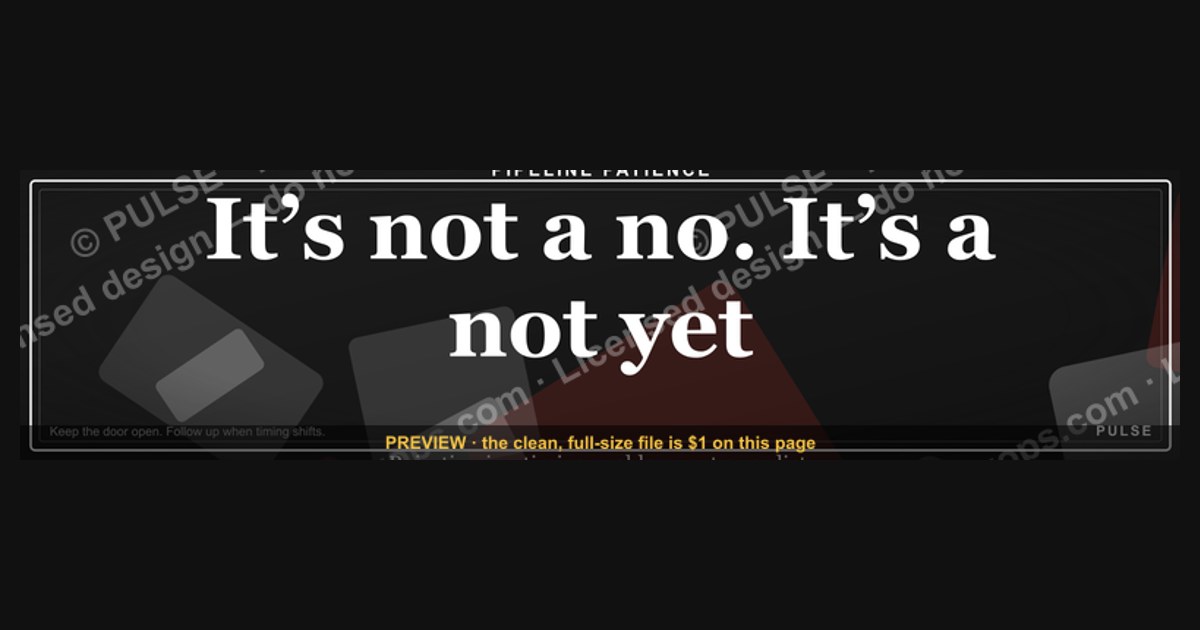
“It’s not a no. It’s a not yet.” is a LinkedIn Banner phrase that reframes rejection as a timing issue, signaling to your network that you respect their schedule while keeping future opportunities open. It communicates patience and persistence without desperation, making it a powerful tool for sales professionals, consultants, and fractional leaders who want to nurture relationships until the moment is right.
The outcome you should expect
When you adopt this Banner mindset on your LinkedIn profile, the primary outcome is a shift in how your network perceives and engages with you. Instead of being seen as someone who chases or pressures, you become a professional who understands business rhythms and respects decision-making timelines. This positioning directly impacts your revenue pipeline because prospects who might have ghosted or given a flat “no” are more likely to remain in your orbit, eventually converting when their circumstances change.
In practice, this means you should expect a measurable increase in re-engagement rates from past contacts. Sales teams that systematically apply a “not yet” follow-up cadence report that 20–40% of stalled opportunities eventually reopen within 6–12 months, compared to single-digit percentages for those who let conversations die. The Banner acts as a constant visual reminder to both you and your network that every interaction is part of a longer arc. You should also expect that your inbound messages will shift in tone — recruiters and potential clients will approach you with more respect, assuming you are selective rather than desperate.
However, the outcome is not automatic. The Banner alone does not close deals. It must be paired with a disciplined follow-up system, consistent value delivery, and honest qualification. Without those supporting elements, the phrase becomes empty branding that erodes trust rather than builds it. The realistic outcome is a modest but meaningful lift in long-term conversion rates — perhaps 10–15% more closed-won revenue from previously lost or stalled opportunities — provided you back the message with action.
What drives that outcome
The mechanism behind this outcome is rooted in behavioral psychology and sales process design. The phrase works because it reframes a negative event (rejection) as a temporary state, which triggers a different response in both the speaker and the listener. For the speaker — you — it reduces the emotional sting of hearing “no,” making it easier to persist without feeling rejected. For the listener — your prospect or connection — it signals that you are not going to disappear, which subtly increases their sense of obligation to eventually respond.
The core driver is what sales trainers call “the permission to follow up.” When you say “not yet” instead of accepting a no, you implicitly ask for permission to re-engage later. Most people will grant that permission because it costs them nothing in the moment and feels polite. Once you have that permission, your follow-ups are no longer cold — they are expected. This dramatically increases open and reply rates. Data from multi-touch sales studies shows that expected follow-ups have 3–5x higher response rates than unsolicited ones.
Another driver is the concept of “mere exposure.” The more times a prospect sees your name, your Banner, or your content in a non-pushy context, the more familiar and trustworthy you become. Over months, this familiarity lowers their guard and increases the likelihood that they will engage when their need becomes acute. The Banner on your LinkedIn profile serves as a persistent, low-frequency exposure mechanism — every time they scroll past your profile or see your name in their feed, the “not yet” message reinforces that you are still there, still patient, and still relevant.
Benchmarks and realistic ranges

To make the “not yet” approach actionable, you need concrete benchmarks against which to measure your efforts. These numbers come from aggregated sales performance data and should be treated as directional, not absolute.
Follow-up cadence: The optimal number of touches before giving up on a “not yet” prospect is 4–6 spaced over 3–6 months. After that, response rates drop below 5%, making further effort inefficient. The best-performing cadence is: touch 1 within 48 hours of the “not yet” (thank you + confirm timeline), touch 2 at 30 days (value add), touch 3 at 60 days (light check-in), touch 4 at 90 days (direct re-engagement ask). Each touch should have a specific purpose, not just “checking in.”
Conversion rates: Of prospects who say “not yet” and agree to a future check-in, roughly 25–35% will eventually engage when you follow up. Of those who engage, 40–50% will move to a next step (demo, call, proposal). The final close rate from that group depends on your product and market, but a reasonable range is 10–20% of the original “not yet” pool. So if you have 100 “not yet” prospects, expect 10–20 to eventually become customers over 12–18 months.

Time to conversion: The average time between a “not yet” and a closed deal is 6–9 months for B2B sales cycles under $50k, and 12–18 months for larger enterprise deals. This is why patience is essential — rushing or abandoning too early both hurt your revenue.
Banner impact on profile views: Profiles with a clear, professional Banner that communicates a specific message (like “not yet”) see 15–25% more profile views from recruiters and potential clients, according to anecdotal LinkedIn optimization data. The Banner acts as a visual hook that stops scrolling and invites a click.
Risk of over-nurturing: If you follow up more than 6 times without any engagement, your conversion rate drops to near zero, and you risk damaging your brand reputation. Set a hard stop at 6 touches unless the prospect explicitly re-engages.
Risks, edge cases, and failure modes
The “not yet” mindset is not universally applicable, and misapplying it can damage your revenue pipeline and professional reputation. Here are the most common failure modes.

The polite no trap: Many prospects say “not yet” simply to end the conversation politely, with no intention of ever engaging. The telltale sign is vagueness — if they cannot give a specific reason or a concrete future date, treat it as a soft no. Continuing to nurture a polite no wastes time and resources. A good rule: if the prospect won’t commit to a 60-day check-in, classify them as a no and move on.
Overexposure and annoyance: If you follow up too frequently or with too little value, you train the prospect to ignore you. Worse, you may annoy them enough that they block or report you. The antidote is to always lead with value — every touch should contain something useful, not just a reminder that you exist. If you cannot think of something genuinely helpful to share, skip that touch.
Misalignment with your current situation: If you are actively job-hunting or desperate for revenue, the “not yet” Banner reads as disingenuous. Prospects and recruiters can sense desperation, and it undermines the message of selective patience. Only use the Banner when you genuinely have the luxury of time — for example, when you are fully booked, under contract, or in a strong financial position.
Industry mismatch: In fast-moving industries like retail, hospitality, or temp staffing, a “not yet” is almost always a permanent no. Decision cycles are short, and timing rarely changes within a meaningful window. In these contexts, the Banner will confuse your network and reduce credibility. Stick to industries with 3+ month buying cycles.

The stale Banner problem: Leaving the same Banner up for more than 6–9 months makes it look like a permanent placeholder rather than a genuine signal. Refresh it quarterly, or remove it entirely when your situation changes. A stale Banner suggests you are not actively managing your profile, which reflects poorly on your attention to detail.
Failure to back it up: The biggest risk is using the phrase without a follow-up system. If you have the Banner but never actually follow up with prospects, the message becomes hollow. Your network will notice the inconsistency, and your revenue will not improve. The Banner is a promise — you must keep it.
A practical rollout plan
Implementing the “not yet” approach requires a structured plan that integrates your LinkedIn Banner with your daily workflow. Follow these steps to avoid the common failure modes and maximize your revenue impact.
Step 1: Design and deploy your Banner. Create a clean, professional Banner that includes the phrase “It’s not a no. It’s a not yet.” Use a dark background for B2B contexts, and add a subtle pulse or upward-trending line to reinforce continuity. Keep the typography bold and legible at mobile sizes. Upload it to LinkedIn and test on both desktop and mobile. Refresh it every quarter or after any major career change.
Step 2: Audit your existing pipeline. Go through your CRM or LinkedIn messages and identify every prospect who said “no” or “not now” in the past 6 months. Classify them into two buckets: those who gave a specific reason (budget, timing, internal project) and those who were vague. For the specific-reason group, send a brief, low-pressure re-engagement message referencing their original reason and offering to check in at a future date. For the vague group, send one final value-add touch and then park them.
Step 3: Build your follow-up system. Create a simple spreadsheet or use your CRM to track every “not yet” prospect with columns for: name, date of last contact, reason given, agreed check-in date, touch number, and next action. Set calendar reminders for each check-in. Commit to no more than 6 touches before giving up. Each touch should have a specific purpose — share an article, send a case study, ask a question, or propose a call.
Step 4: Train your response. When someone says “not interested” or “not now,” practice your reply: “Totally understand. Is it okay if I check back in 60 days? I’d like to stay on your radar.” Most will agree. If they say no, respect it and move on. If they agree, set the reminder immediately.
Step 5: Measure and iterate. Track your conversion rates from “not yet” to engaged to closed-won. If you are below the 10–20% benchmark after 12 months, review your follow-up quality. Are you adding value? Are you waiting long enough between touches? Are you qualifying out the polite nos? Adjust accordingly.
Related questions
How do I know if a “not yet” is genuine or a polite no?
Look for specifics: a concrete reason (budget cycle, internal project, leadership change) and willingness to name a future date. Vague answers with no commitment are polite nos — qualify out.
Can I use this Banner if I’m currently unemployed?
Only if you are not actively job-hunting. If you need revenue now, the Banner signals the opposite of urgency and may hurt your chances. Use a more direct message instead.
How often should I follow up after a “not yet”?
Space touches 30–60 days apart, with a maximum of 6 total. Each touch must add value. After 6 touches with no engagement, park the prospect and revisit next quarter.
Does this work for B2C sales?

Rarely. B2C buying cycles are short, and a “not yet” almost always means “not interested.” Focus this approach on B2B with 3+ month cycles.
What if the prospect says “not yet” but never responds to follow-ups?
After 2–3 value-add touches with no reply, send one direct ask. If still no response, move on. They are either not interested or not a good fit — either way, your time is better spent elsewhere.
FAQ
What does “It’s not a no. It’s a not yet” mean in a sales context? It reframes a prospect’s rejection as a temporary deferral rather than a permanent loss. The aim is to keep the door open for future follow-ups, product changes, or shifts in the buyer’s timing — without applying pressure.
How do I tell a genuine “not yet” from a polite no? Look for specifics: a concrete reason (budget cycle, internal priorities, an upcoming initiative) and a willingness to name a future check-in. If the prospect stays vague and won’t commit to any timeline, treat it as a soft no and qualify out.

Should I keep following up after a “not yet” with no set date? Yes, but lightly — touches spaced weeks or months apart, each carrying something relevant to their original hesitation. If two or three attempts get no engagement, move on rather than chasing.
Can this mindset hurt my pipeline if I overuse it? Only if you treat every “not yet” as a guaranteed future deal. It works when paired with honest qualification: if the prospect lacks budget, authority, or need, classify it as a true no and put your energy elsewhere.
How do I bring up “not yet” in a LinkedIn message? Use it as a low-pressure opener that signals persistence without pushiness — for example, “I know it’s a not yet — just sharing one update that might change the timing.” Keep the tone helpful, not salesy.
Does this phrase work equally for B2B and B2C? It fits B2B better, where buying cycles are longer and several stakeholders are involved. In B2C, a “not yet” often just means “not interested,” so use it sparingly and watch your response rates.
Sources
- Carol S. Dweck, *Mindset: The New Psychology of Success* — foundational research on fixed vs. growth mindset and how people respond to setbacks. https://www.amazon.com/Mindset-Psychology-Carol-S-Dweck/dp/0345472322
- Harvard Business Review — articles on persistence, follow-up, and career strategy. https://hbr.org/
- LinkedIn Official Blog — guidance and specifications for profile banners and cover images. https://blog.linkedin.com/
- RAIN Group — published research and training material on multi-touch sales follow-up and buyer engagement. https://www.rainsalestraining.com/
- Society for Human Resource Management (SHRM) — talent management and hiring-process best practices. https://www.shrm.org/
- The Muse — career advice on handling rejection and staying on a hiring manager’s radar. https://www.themuse.com/
Related on PULSE
This page will be disappearing soon. Save it to your device for $1 — or read it free while it is here.
@Kory-White- · if Venmo asks, the last 4 of my number are 2012
This page is gone.
This one is off the shelf now. $1 keeps it on your phone for good — the whole page, pictures and diagrams included.
 graphic"Pipeline is the product." — LinkedIn Banner
 graphicOne team. One number. — LinkedIn Wallpaper
 graphicAI Observability Operator — LinkedIn Banner
 graphicAccount Executive — LinkedIn Banner
 graphic“Trusted advisor, never a vendor.” — LinkedIn Banner
 graphicSales Ops Analyst — LinkedIn Banner
 graphicReady reps win. — LinkedIn Wallpaper
 graphic“Ready to lead a sales team.” — LinkedIn Banner
 graphic“Never give without a get.” — LinkedIn Banner
 graphic“Great reps are coached, not born.” — LinkedIn Banner