
Should I negotiate for the landlord to carry my TI allowance as a non-interest-bearing loan?
 Curated byKory White · Fractional CRO · Maryland
 PULSEKNOWLEDGE LIBRARY
Often yes. A landlord-carried, non-interest-bearing TI loan gives you buildout cash upfront and lets you repay at 0% over the term, preserving working capital versus an 8–11% bank loan. But model net effective rent first—landlords frequently recover the advance through higher base rent, quietly erasing the benefit before you ever sign.
How a non-interest-bearing TI loan actually works
A tenant improvement (TI) allowance is money the landlord contributes toward building out your space—demising walls, HVAC distribution, flooring, electrical, plumbing, and finishes. It reaches you in one of two structural forms, and the difference determines who pays for what. A TI grant is money you never repay directly, but its cost is almost always amortized back into a higher base rent over the lease term. A TI loan is an advance you repay explicitly. When that loan is non-interest-bearing, the total you repay equals exactly the dollars advanced—no interest, no compounding, and no origination markup if you negotiate the fees out.
Mechanically, the landlord either funds a lump sum at possession or reimburses your contractor's invoices as construction progresses. You then repay in equal installments folded into your monthly obligation alongside base rent. On a $250,000 buildout amortized over a 60-month lease, that is roughly $4,167 per month of repayment layered on top of rent. Because there is no interest, you are effectively borrowing at a 0% rate from a party who is already underwriting your tenancy and who profits from your occupancy regardless. Compared with an SBA 7(a) or conventional buildout loan carrying 8–11%, that spread is real money—interest alone on $250,000 over five years can run $50,000–$70,000.

The critical structural point is documentation. Get the loan captured as a separate exhibit or promissory note attached to the lease, never a verbal understanding buried in an email thread. That exhibit must state the principal, the 0% rate explicitly in writing, the repayment schedule, the commencement date of repayment, default and cure consequences, and whether the obligation is recourse or non-recourse. Anything left to "we'll work it out later" reliably favors the landlord once you have signed and forfeited your leverage. The lease is the only moment your signature is worth something—spend that leverage on the terms that protect your downside.
When this structure is genuinely worth pushing for
The loan structure shines in a handful of concrete situations. Cash-constrained startups and growth-stage companies benefit most: every dollar not sunk into drywall is a dollar available for headcount, inventory, or demand generation, where the return on capital dwarfs the cost of 0% financing. If your marginal dollar earns 20–40% deployed in the business, borrowing it back at zero percent is a straightforward accretive trade. Strong-credit tenants can extract better terms because the landlord perceives lower default risk and is more willing to carry the paper on their own balance sheet. Tenants who want a lower headline base rent—for optics, for cleaner comparables at refinance, or to keep a co-tenancy or percentage-rent clause from triggering—can use the loan to hold rent down while still funding the build.
It also helps when your buildout exceeds the standard allowance. A landlord might offer $40 per rentable square foot as a grant, but a specialized space—a medical suite, a commercial kitchen, a wet lab, a dental practice—costs $75–$120 per foot to build correctly. The overage can be carried as a non-interest-bearing loan rather than forcing you to write a large check at signing, exactly when cash reserves are thinnest and pre-opening burn is highest.

The trade-off to hold clearly in view: a loan is a fixed obligation. Unlike rent, which at least buys you occupancy month to month, the loan balance is a debt that can accelerate on default or early termination. If your revenue is volatile, seasonal, or your industry is cyclical, layering a fixed repayment on top of rent adds real leverage risk to the enterprise. In those cases a grant with higher rent—even if it costs more nominally—may be worth it for the flexibility, because a well-drafted grant carries no acceleration clause hanging over an early exit. Optionality has a price, and sometimes paying it is the disciplined choice.
Modeling net effective rent so you know who actually wins
The only honest way to compare a non-interest-bearing loan against a grant-with-higher-rent is to compute net effective rent (NER). The concept is simple: total dollars you pay over the full term, net of any allowance you never repay, divided by the rentable square footage times the number of lease months. That yields a per-square-foot-per-month figure you can compare apples to apples across competing proposals. Without it, you are comparing a headline rent to a headline allowance—two numbers that mean nothing in isolation.
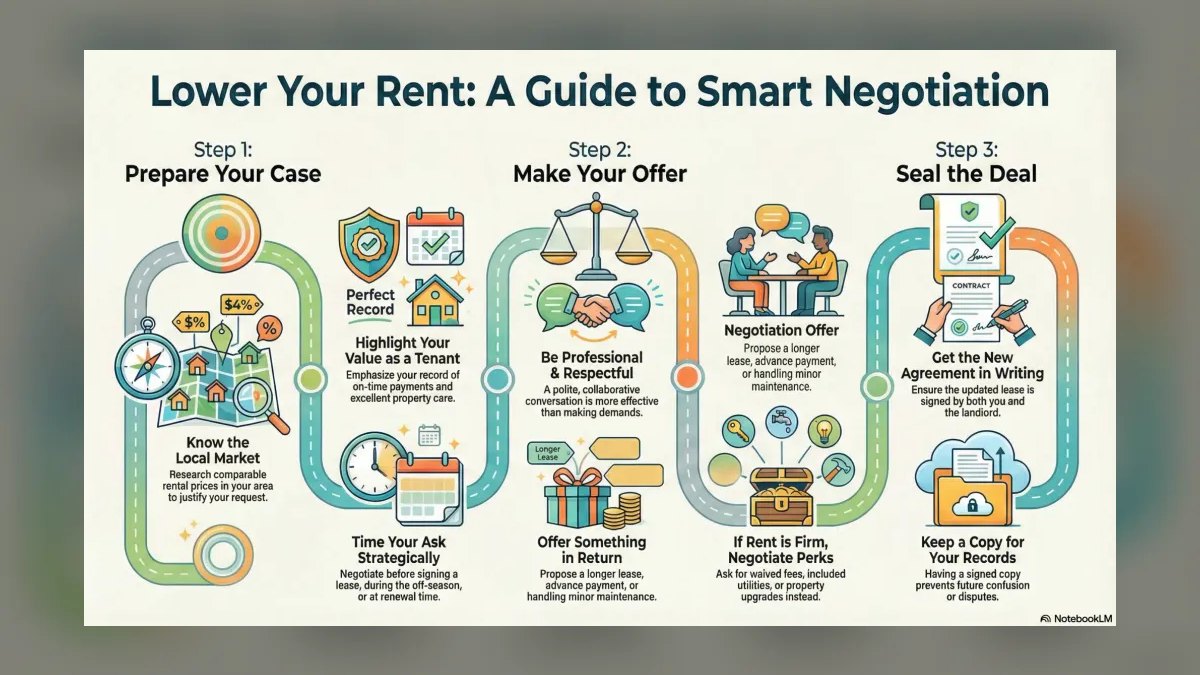
Walk a simplified example on a 10,000-square-foot, 10-year (120-month) deal.
- Option A — non-interest-bearing loan. Base rent is held lower, say $30/SF/year. The landlord advances a $400,000 TI loan you repay over the term. Your gross base rent is $30 × 10,000 × 10 = $3,000,000. You also repay the $400,000, but that repayment simply returns borrowed money you already spent on the build. Your net occupancy cost is driven by the lower base rent you locked in.
- Option B — grant with higher rent. The landlord grants the same $400,000 but sets base rent at $34/SF/year to recover it plus a margin. Gross rent is $34 × 10,000 × 10 = $3,400,000, and you repay nothing. Net outlay is the full $3,400,000.

In this stylized case the grant costs $400,000 more in rent to deliver $400,000 in "free" money—a wash on principal, except the landlord's higher rate usually bakes in an implicit interest margin and compounds through annual escalations, tilting the math toward the loan. Your real deal will differ, so run it with actual figures and include operating expenses (NNN/CAM), annual rent escalations, free-rent periods, and parking charges, because those swing NER more than the TI line itself. A competent tenant-rep broker will build a lease-abstraction model that discounts the cash flows to present value and shows you the true winner—not just the nominal total, which ignores the time value of money.
The negotiation levers that decide whether it's a good deal
Whether a non-interest-bearing TI loan helps or quietly hurts you comes down to a handful of terms you must pin down in the letter of intent (LOI), before the lease is drafted and your leverage evaporates. Win them at the proposal stage or lose them permanently.

- Principal and rate. State the exact dollar figure or per-square-foot amount and write "0% interest" explicitly. Spelling out the rate blocks a later claim of imputed or market-rate interest sneaking into the promissory note.
- Repayment term. Match it to the full lease term rather than a compressed window. Amortizing $400,000 over 120 months instead of 60 halves your monthly burden and dramatically eases cash flow in the early, fragile years.
- Deferred start. Push repayment to begin after rent commencement and after your buildout is complete and you have opened—never during construction or a free-rent period, when you have no revenue and maximum burn.
- Recourse vs. non-recourse. Fight for non-recourse language so the loan is secured only by the leasehold improvements, not your operating entity's broader assets or a personal guaranty. This is the single most important protection in the entire structure.
- Prepayment without penalty. Preserve the right to retire the balance early if you sell the business, refinance, or assign the lease to a buyer who wants a clean cap table.
- Assignability. Ensure a qualified successor tenant can assume the remaining balance, so you are not personally chained to a space you have exited through an assignment or sublease.
- Subordination. The loan should sit subordinate to any senior mortgage so it does not create a cross-default trap that lets the lender reach past the improvements.
Your broker should press these in the proposal, and your attorney should confirm they survived into the executed lease. Once the lease is signed, the landlord has almost no incentive to reopen the terms—the moment to win them is while they still want your signature and your rent stream.
Risks and how to mitigate each one
Personal liability is the largest exposure. If the loan is recourse and you have personally guaranteed the lease, a default can reach your personal assets—home, savings, everything. The mitigant is non-recourse drafting plus, where a full carve-out is impossible, a "good-guy guaranty" that caps personal exposure once you surrender the space in good condition and current on rent. That structure limits your downside to walking away cleanly rather than facing an open-ended judgment.
Accelerated repayment on early exit is the second trap. Break the lease early and the unamortized balance can come due immediately as a lump sum—a potentially crushing hit precisely when the business is already struggling. Negotiate a sliding scale so the amount owed declines as the term runs, and tie any acceleration to a genuine cure period of 30–60 days rather than an instant demand on the first missed payment.
Disguised interest is the quiet one. A landlord can call the loan "non-interest-bearing" and then raise base rent by a percentage that recovers the same money with margin, or slip in a "loan origination fee" or "administrative charge." Demand a zero-fee clause and always compare the loan-plus-lower-rent NER against a straight grant-plus-higher-rent NER. The headline "0%" means nothing if the rent line silently absorbs the cost with a spread on top.

Balloon structures deserve scrutiny. Some loans back-load a large payment to lease end—a cash-flow disaster right when you may be trying to renew, relocate, or sell. Insist on level, straight-line amortization across the full term so no single period carries an outsized obligation.
Construction overruns can leave you short of the loan amount when bids come in high or the building surprises you behind the walls. Negotiate a contingency mechanism whereby the landlord advances additional funds on the same non-interest-bearing terms rather than forcing you into a higher-cost bridge loan mid-project.

Finally, tax treatment differs between structures. A loan repayment is not income to you, whereas a TI grant can, depending on structure and jurisdiction, create taxable income or interact with the Section 110 short-term-lease safe harbor for retail tenants. Below-market or interest-free loans can also raise imputed-interest questions under the tax code. None of this is a reason to avoid the structure—it is a reason to have a tax advisor confirm the treatment for your entity and jurisdiction before you sign.
When to walk away from the loan and take something else
The structure is not always the winner, and discipline means knowing when to pivot. Walk away—or move to an alternative—under these conditions.

If the landlord uses the loan as a smokescreen to inflate base rent beyond market, kill it. Pull market comparables for similar space in the building and submarket; if comparable rents sit meaningfully below the landlord's proposed rate, the "free" financing is just repackaged overpayment wearing a bow.
If the terms demand an unlimited personal guaranty, it is often cheaper and safer to fund the buildout with an SBA 504 or 7(a) loan at a transparent rate, where liability, amortization, and default terms are standardized and disclosed, than to accept an opaque landlord loan that reaches your personal balance sheet on the landlord's terms.
If the lease term is too short to amortize comfortably, a large loan on a three-year term produces punishing monthly payments that strain cash flow—the very problem the structure was supposed to solve. A $300,000 loan over 36 months is $8,333 a month before rent, which can sink a young operation.

If the landlord refuses to put the loan in writing as a separate exhibit, treat that as disqualifying. Verbal promises about repayment schedules and recourse carve-outs are worthless in a dispute and unenforceable when a property changes hands to a new owner who never made them.
And if your revenue is genuinely uncertain, weigh a grant even at higher rent. The premium you pay buys the absence of an accelerating fixed debt, and in a downturn that optionality can be the difference between an orderly restructuring and insolvency. Sometimes the more expensive deal is the safer deal.
Related questions
Is a TI grant always better than a non-interest-bearing loan?
Not always. A grant means no repayment, which is ideal on its face, but landlords recover its cost through higher base rent. If that rent premium exceeds the grant's value in present-value terms, a 0% loan with lower base rent can leave you paying less over the full lease.
Can I get this structure with weak credit?
It is harder. Landlords prefer strong-credit tenants for loans because they carry the default risk. With weaker credit you may need a larger security deposit, a personal or good-guy guaranty, or a shorter repayment period to make the landlord comfortable enough to advance the funds.
What happens to the loan if I assign or sublease?
Negotiate assignability upfront so a qualified successor tenant assumes the remaining balance. Without that clause, you can remain personally on the hook for a space you have left. Recourse and assignment language should be settled in the LOI, not discovered painfully at exit.
How is a non-interest-bearing TI loan taxed?
A loan repayment is generally not income to you because you are obligated to repay it. Grants can create taxable income depending on structure, and below-market loans may raise imputed-interest questions. Confirm treatment with a tax advisor for your entity and jurisdiction before signing.
Does the loan affect my ability to get other financing?
Yes—it is a fixed obligation lenders may treat as debt when assessing your business. Disclose it and factor the monthly repayment into your debt-service coverage ratio, so a future SBA or bank application isn't undercut by an unrecorded, lease-linked liability the underwriter discovers later.
FAQ
What's the difference between a TI grant and a non-interest-bearing loan? A grant is money you never repay directly, but its cost is typically baked into a higher base rent. A non-interest-bearing loan is an advance you repay over the lease term at 0% interest, which usually lets you hold base rent lower. Which one wins depends entirely on the net effective rent math.
Does the IRS tax a non-interest-bearing TI loan as income? Generally no, because it is a loan you are obligated to repay rather than income received. However, below-market or interest-free loans can raise imputed-interest questions, and grants are treated differently, so confirm the specifics with a tax professional for your situation and jurisdiction before you sign.
Can I negotiate this if my credit is weak? It is more difficult because landlords bear the repayment risk and favor strong-credit tenants for loans. You may need to offer a larger security deposit, accept a personal or good-guy guaranty, or take a shorter repayment window to get the landlord comfortable enough to advance the funds.
What happens if I break the lease early—do I still owe the balance? Typically the unamortized balance accelerates and becomes due as a lump sum. Negotiate a sliding-scale payoff that shrinks as the term runs, plus a 30–60 day cure period, so an early exit doesn't trigger an immediate, oversized demand you cannot absorb when you're already exiting.
Is a landlord's non-interest-bearing loan better than a bank loan for buildout? Usually yes. Bank and SBA loans charge interest—often 8–11%—and may require collateral and guaranties. A 0% landlord loan secured only by the leasehold improvements avoids that interest entirely, provided you negotiate non-recourse terms and keep the rent line from quietly recovering the cost with margin.
How should the loan be documented in the lease? As a separate exhibit or promissory note stating the principal, the explicit 0% rate, the amortization schedule, the repayment start date, default and cure provisions, recourse status, prepayment rights, and assignability. Have a commercial real estate attorney review the full package before you sign anything.
Sources
- https://www.boma.org
- https://www.nar.realtor
- https://www.corenetglobal.org
- https://www.sior.com
- https://www.irem.org
- https://www.sba.gov/funding-programs/loans/504-loans
- https://www.sba.gov/funding-programs/loans/7a-loans
- https://www.irs.gov
Related on PULSE
- [How Do I Finance a Buildout: TI Loan vs Landlord vs Cash?](/knowledge/bo0185)
- [What Is a Tenant Improvement Loan and Should I Use One?](/knowledge/bo0091)
- [SBA 504 vs Conventional Loan: How Do I Pay Less to Buy My Building?](/knowledge/bo0036)
- [How do I finance a buildout if the landlord offers zero TI allowance in 2027?](/knowledge/bo0336)
- [Can I require the landlord to escrow my TI allowance before construction begins?](/knowledge/bo0307)
- [What happens to unused TI allowance if I spend less than the landlord agreed to?](/knowledge/bo0237)
This page will be disappearing soon. Save it to your device for $1 — or read it free while it is here.
@Kory-White- · if Venmo asks, the last 4 of my number are 2012
 boCan I get the landlord to reimburse my moving and storage costs during the buildout
 boShould I hire an architect before or after I sign the lease for a buildout?
 boCan I get a landlord contribution for my move costs after the buildout finishes
 boHow do I negotiate a co-tenancy clause that triggers reduced rent if my buildout is delayed?
 boWhat happens to my deposit if the buildout runs past the rent commencement date
 boWhat’s the cheapest way to add a kitchenette to a raw shell office without triggering new fire sprinklers
 boCan I require the landlord to use my preferred subcontractors for the buildout?
 boCan I sublease a space mid-buildout and recover my construction costs?
 boHow do I handle asbestos or mold discovered midway through a landlord’s warm shell delivery
 pulse-buildoutsHow much does Buildouts cost in 2027?