


The Only Sales Guide You'll Ever Need by Anthony Iannarino — Cliff Notes Summary & Key Takeaways
Quality
Certified

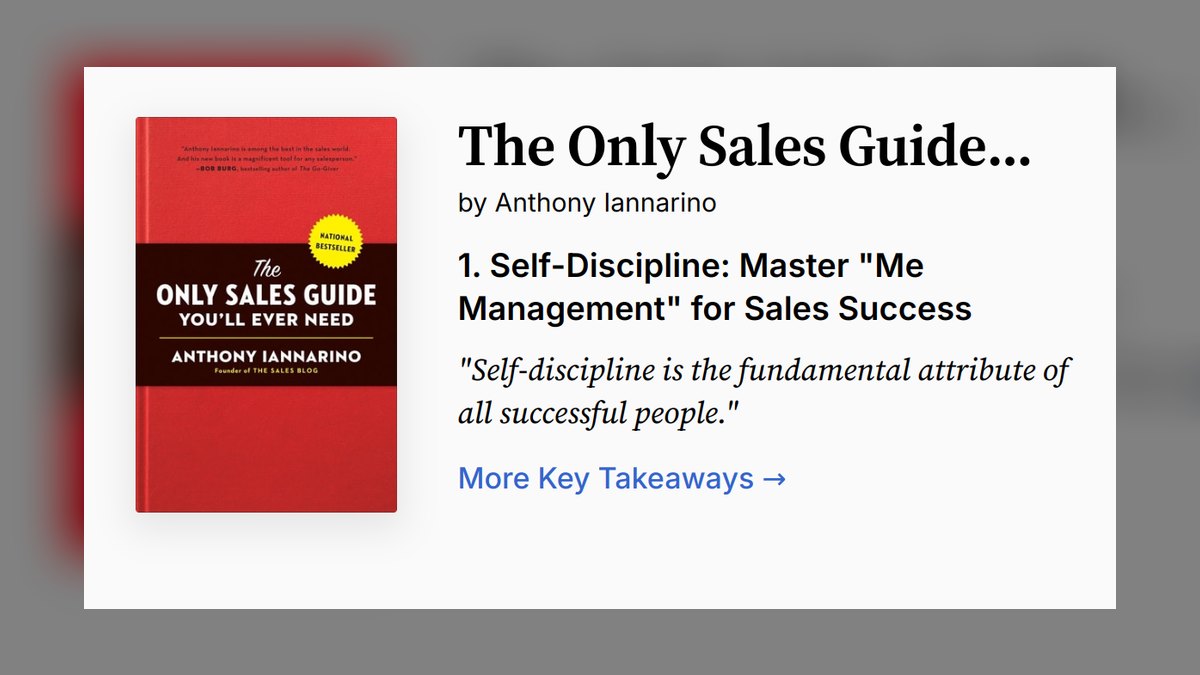
*The Only Sales Guide You'll Ever Need* (Portfolio, 2016) is Anthony Iannarino's self-development manual for B2B sellers. Its core claim: elite performance comes from 17 attributes — nine internal Mindset traits and eight external Skillset traits. The operating instrument is a weekly 1-10 self-score; drill your two lowest attributes, re-rate Monday, repeat.
What the book actually is, and why it still matters
Most sales books sell you a process. Iannarino sells you a mirror. That distinction is the whole reason this book survived a decade of methodology churn — MEDDIC, Challenger, Gap Selling, Command of the Message — while staying on practitioner reading lists.
The book's origin story is a confession. Anthony Iannarino spent his early career selling staffing services with no marketing support and no inbound leads, chasing tactics: better scripts, sharper closing lines, tighter decks. The needle barely moved. His conclusion was that he had been optimizing the *what* instead of rebuilding the *who*. The mantra he built the book around — "selling is a discipline, not a department" — is the compressed version of that lesson.
Structurally, the book splits into two halves. The nine Mindset attributes are self-discipline, optimism, caring, competitiveness, resourcefulness, initiative, persistence, communication, and accountability. The eight Skillset attributes are closing, prospecting, storytelling, diagnosing, negotiating, business acumen, change management, and leadership. The split is not cosmetic. Mindset attributes are *choices* — free, unblocked by any manager, compounding daily. Skillset attributes are *practices* — they require deliberate reps, coaching, and measurement, and they cost time and often money.
Iannarino's sharpest argument is the asymmetry between the two halves. A rep with strong Mindset and weak Skillset teaches themselves the skills; a rep with strong Skillset and weak Mindset plateaus and eventually leaves. That claim is directionally consistent with the broader self-development literature the book sits alongside — Carol Dweck's *Mindset* (2006) on growth orientation, Angela Duckworth's *Grit* (2016) on sustained effort, Martin Seligman's *Learned Optimism* (1990) on explanatory style. Iannarino cites Seligman explicitly in the optimism chapter, and the debt is obvious throughout.
Why it matters for a RevOps or enablement audience specifically: this is one of the few sales books whose central artifact is a measurement instrument rather than a conversation script. A 17-row scorecard is something an enablement team can standardize, log, and trend across a roster. Most sales books resist that treatment. This one invites it — which is precisely why it shows up in 1:1 templates and ramp plans rather than only in the "recommended reading" appendix.
The adjacent read matters too. Iannarino's later books — *The Lost Art of Closing* (2017), *Eat Their Lunch* (2018), *Elite Sales Strategies* (2022) — each expand one attribute from this book into a full volume. *The Only Sales Guide* is the index; the others are the chapters written long.
The nine Mindset attributes, unpacked
Self-discipline is first on purpose. Iannarino defines it as making yourself do what you should do, when you should do it, whether you feel like it or not. He anchors it to prospecting hours specifically — blocking 90 minutes for outbound at 8 AM Monday is the single highest-leverage habit a seller fully controls. The chapter's tactics are unglamorous: time-blocking, the Pomodoro technique, phone in a drawer during the block.

Optimism borrows Seligman's framework directly. It is not cheerfulness; it is explanatory style under setback. When a deal dies, the pessimistic rep narrates it as personal, permanent, and pervasive — *I'm bad at this, this always happens, my whole pipeline is cursed*. The optimistic rep narrates it as specific, temporary, and contained — *this deal died for this reason, and that reason is fixable*. In a job that is a long sequence of small losses, explanatory style is the difference between a rep who is still dialing in month nine and one who isn't.
Caring is the book's quiet bombshell. Iannarino argues the elite seller genuinely wants the buyer to win — not as a manipulation, but as the operating principle that determines which deals to walk away from. Caring is what stops you from forcing a bad-fit logo into a contract that churns in nine months. It anticipates Daniel Pink's *To Sell Is Human* (2012) framing and pre-figures Jeb Blount's *Sales EQ* (2017).
Competitiveness gets reframed inward: compete against last quarter's version of yourself, not the rep at the next desk. External competitiveness produces burnout and a toxic floor; internal competitiveness compounds.
Resourcefulness is "make it happen with what you have." The unresourceful rep blames marketing for lead quality, product for the missing feature, and finance for the comp plan. The resourceful rep writes their own sequences, builds their own case studies out of existing customers, and renegotiates their own territory.
Initiative is moving without permission — emailing the prospect's CFO, building a custom ROI model overnight, booking the trip before T&E approval lands. Iannarino's coaching line is blunt: sell now, apologize later.
Persistence is explicitly not stubbornness. The persistent rep knows which deals to keep working and which to release. The chapter argues for long multi-touch sequences on top-tier accounts — the same cadence math Jeb Blount's *Fanatical Prospecting* (2015) made famous — while insisting that persistence on the wrong deal is just delusion with a calendar reminder.
Communication is, per Iannarino, the most under-developed Mindset attribute. It spans verbal, written, and visual clarity. His prescriptions: a daily writing practice (his own blog at TheSalesBlog.com has run daily since 2009), structured presentation training, and ruthless editing of customer-facing email down to a fraction of the first draft.
Accountability is the capstone. Own the outcome without excuse. When the quarter misses, the accountable rep isolates what they personally controlled, what they'd do differently, and what changes Monday.
The eight Skillset attributes and the weekly loop
Closing comes first, against convention. The argument: a seller uncomfortable asking for a commitment at *every* stage — the next meeting, the discovery, the demo, the proposal, the signature — bleeds deals at every gate. Closing is a per-conversation skill, not a per-deal event. That thesis became the whole of *The Lost Art of Closing*, which expands it into a specific ordered set of commitments a seller must earn across a deal.
Prospecting is where Iannarino is least forgiving. His position is that the overwhelming majority of sales failures trace back to insufficient top-of-funnel, and that the only sustainable fix is the seller's own outbound discipline — not a marketing SLA, not an SDR reorg. Recommended shape: dedicated prospecting hours, five days a week, *before* email.
Storytelling is making the buyer feel something before they think something. The prescription is concrete: build a library of five to seven named customer stories, each with a before state, an inflection moment, the action taken, and a measurable after state. Modern conversation-intelligence tooling makes this dramatically cheaper than it was in 2016 — call-recording platforms surface verbatim customer language you can lift straight into a story skeleton.
Diagnosing is discovery beyond features. The unskilled rep asks what the buyer is looking for in a solution. The diagnostic rep asks what the problem costs if nothing changes for another twelve months. The chapter teaches layered open-ended questioning, root-cause laddering, and the underrated discipline of silence after a question.
Negotiating runs on one principle: trade, never give. Every concession the seller makes is matched by a buyer concession — a longer term, case-study rights, expanded scope, a named executive sponsor. It's a more commercial posture than Chris Voss's *Never Split the Difference* (2016), which emphasizes labeling and tactical empathy; the two are complementary rather than competing.
Business acumen has gained the most weight since publication. Read the buyer's 10-K before the first meeting. Understand their margin trajectory. Be able to describe the CFO's working-capital pressure in plain English. Sellers without acumen get routed to procurement; sellers with it earn the executive seat.
Change management is the underrated one. Selling a B2B solution is selling a change project to a buyer who dislikes change. The seller has to help with internal politics, the rollout plan, executive air cover, and post-purchase enablement — or the deal stalls in committee even after a strong demo and a competitive price.
Leadership is the capstone: the elite seller leads two teams without authority over either — the buyer's internal coalition and their own delivery bench of sales engineer, CS, legal, and finance. Prescriptions include recurring executive briefings, deliberate champion development, and a written 30-60-90 plan delivered *before* signature, not after.
The loop is deliberately small. Two attributes per week, never more. Sellers who try to fix five at once fix none — the discipline lives in the constraint, not the ambition. A useful daily sub-loop sits underneath it: write yesterday's wins and misses, pick one behavior to change today, execute, repeat.
What it costs in time, and what a realistic ramp looks like
This is a cheap book with an expensive practice, and the gap between those two facts is where most readers fail.
Reading cost. The book runs roughly 240 pages in the hardcover — call it five to seven hours of focused reading, or eight-ish hours on audio. Most readers finish in a week of commutes. That's the trivial part.
The scorecard cost. The instrument itself is fast: rating 17 attributes honestly takes ten to fifteen minutes the first time, five minutes on subsequent Mondays once you have a baseline to compare against. Over a year that's a few hours total. Also trivial.
The drilling cost is the real number. Two attributes a week, worked seriously, means roughly two to four hours of deliberate practice per week on top of the day job — a prospecting block you'd have skipped, a call recording you actually re-listen to, a 10-K you actually read before the meeting. At two attributes per week you cycle all 17 in roughly eight to nine weeks, which means you get five or six full passes through the framework in a year.
Timeline to visible change. Be honest about the sequencing. Mindset attributes show behavioral change fast — a self-discipline drill produces a visibly different calendar within a week or two. Skillset attributes lag badly, because they're gated by deal cycles. If your average sales cycle is 90 days, a diagnosing improvement made in January doesn't show up in closed-won until Q2 at the earliest. Reps who quit the practice usually quit in week four, when Mindset gains have plateaued and Skillset gains haven't landed yet. Plan for a full sales cycle plus a quarter — call it six months — before you judge the practice on pipeline outcomes rather than behavior outcomes.
What it costs a team to run. For an enablement leader standardizing this across a roster, the incremental cost is small but not zero: ten minutes of every weekly 1:1 given over to the two-attribute review, plus a shared sheet to trend scores. The risk is that the score becomes a performance metric rather than a development tool — the moment a rep believes their self-rating feeds a PIP, the scores inflate and the instrument dies. Keep it in the coaching lane and out of the comp and review lanes.
Where the book fits in a reading budget. If you're building a sequence, a reasonable ordering is Dweck's *Mindset* → Iannarino's *Only Sales Guide* → Blount's *Fanatical Prospecting* for the top-of-funnel half → Iannarino's *The Lost Art of Closing* for the commitment ladder. That's four books and roughly 25-30 hours of reading — an entire foundational curriculum for under a hundred dollars.
Where teams get this wrong
They read it as a methodology. It isn't one. There's no qualification framework, no stage-exit criteria, no deal-review template. Dropping this book into a team that actually needs MEDDIC or a defined discovery motion will disappoint everyone. Run it *alongside* your methodology as the individual-development layer, not instead of it.
They score aspirationally. The single most common failure: reps rate themselves on the attribute they wish they had rather than the one the evidence supports. Iannarino is emphatic that you work the lowest score, not the most interesting one. A useful counter is to require one piece of evidence per rating — "I rated persistence a 4 because I released three accounts after two touches last month." Evidence-backed scores drift far less.
They drill too many attributes at once. An eager rep circles five gaps and works none of them. The two-per-week constraint is the mechanism, not a suggestion.
Managers weaponize the scorecard. The instrument is a self-assessment. The moment it's used as a performance input, honest low scores become career risk and every rep on the floor becomes a 7 on everything. Keep it self-owned, keep it out of the HR system.
They ignore role weighting. The 17 attributes are constant, but the weighting is not. SDRs live on prospecting, persistence, and self-discipline. AEs live on diagnosing, closing, business acumen, and change management. Sales leaders live on leadership, communication, and accountability. Applying a flat weighting produces drills that don't match the job.
They skip the exercises. Each chapter ends with self-assessment exercises, and those exercises are the part that changes behavior. A summary — including this one — captures the model. It cannot make you sit with the question of why your last three deals stalled at legal.
They treat the 2016 framing as current. Two gaps have opened. First, the book largely assumes the seller is in the room early; a substantial portion of the modern B2B buying journey happens before a vendor is contacted, which shifts weight toward prospecting and toward being discoverable at all. Second, the communication chapter predates asynchronous video as a primary seller-to-buyer medium — a good Loom or Vidyard walkthrough is now a legitimate communication rep, and the book won't tell you that.
Choosing what to drill: a decision framework
The scorecard tells you *what* is lowest. It doesn't tell you what's *binding*. Those are different questions, and the second one is more useful.
Start from where deals actually die, then check whether your lowest scores line up with that constraint. If your pipeline is thin, no amount of negotiating skill will help — prospecting and self-discipline are binding. If your pipeline is healthy but deals stall between demo and proposal, diagnosing and change management are binding. If you win the technical evaluation and lose on price, negotiating and business acumen are binding. If deals die in legal or procurement after verbal agreement, closing (the commitment ladder) and leadership are binding.
When the constraint and the low score disagree, trust the constraint and re-examine the score — a mismatch usually means you rated something generously. And if you genuinely can't tell where deals die, that's its own diagnosis: your first drill is pipeline hygiene, not an attribute at all.
One adjacent note for anyone running this across a team: the framework composes cleanly with call-recording data. Diagnosing and storytelling are both directly observable in recorded calls, which means those two attributes can be scored by a coach against evidence rather than by the rep against memory. That hybrid — self-score the nine Mindset attributes, coach-score the observable Skillset ones — is a stronger instrument than either half alone, and it's the most common productive modification teams make to the book's original design.
Related questions
Is the book worth reading if I've already read the summary?
Yes, for the end-of-chapter self-assessment exercises. The summary conveys the model; the exercises are what force behavior change. If you only want the framework, a summary suffices. If you want the practice, buy the book.
How does it compare to Jeb Blount's Sales EQ?
Iannarino's is the broader self-development framework across 17 attributes; Blount's goes deeper on the emotional-intelligence subset. They're complementary. Read Iannarino first for the map, Blount second for the terrain.
Does the framework work for sales leaders, not just reps?
Yes, with reweighting. Leaders over-index on leadership, communication, and accountability, and increasingly use the scorecard as a coaching structure for their team rather than only a self-assessment.
Which Iannarino book should I read after this one?
*The Lost Art of Closing* (2017) if commitments and deal progression are your gap; *Eat Their Lunch* (2018) if you sell in a displacement market against entrenched incumbents; *Elite Sales Strategies* (2022) for the consultative-authority angle.
FAQ
Who is Anthony Iannarino?
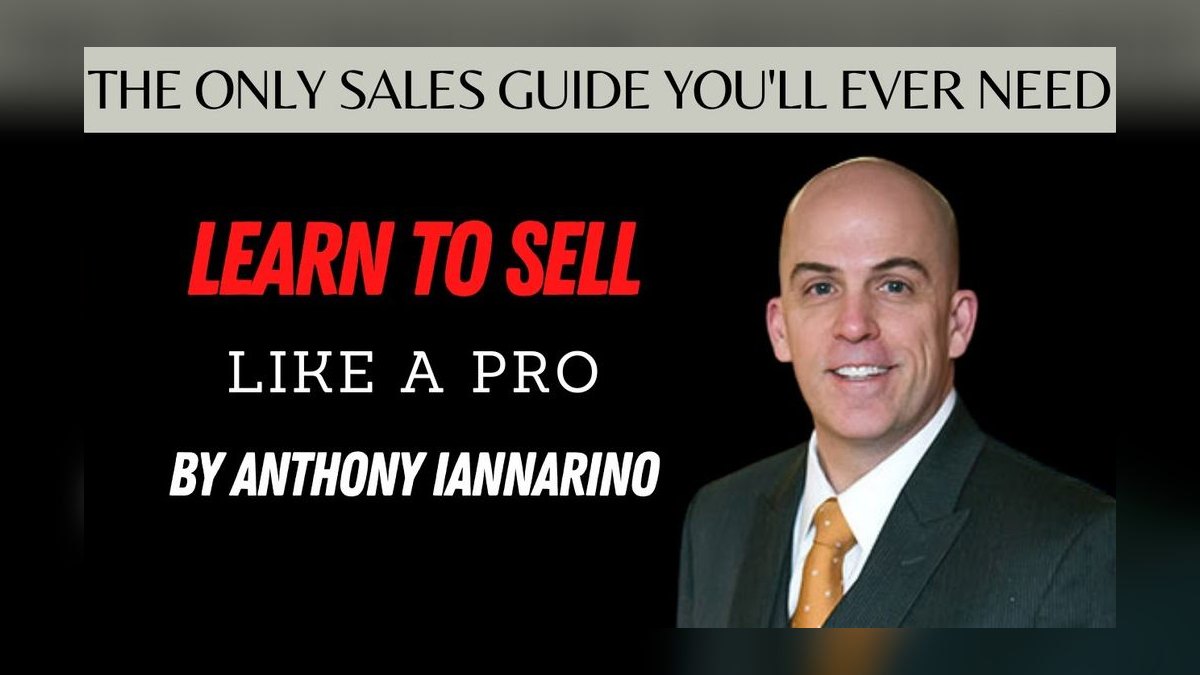
A sales coach, speaker, and author who ran the family staffing business before turning to writing and consulting. He has published daily at TheSalesBlog.com since 2009, and has written four books: *The Only Sales Guide You'll Ever Need* (2016), *The Lost Art of Closing* (2017), *Eat Their Lunch* (2018), and *Elite Sales Strategies* (2022).

Is the 17-attribute scorecard actually in the book, or is it marketing?
It's real and operational. The attributes are the book's chapter structure, and each chapter ends with self-assessment work. The weekly rating cadence is Iannarino's recommended practice built on top of that structure — it's the part that converts a book into a habit.
Which attribute should I work on first?
The lowest one on your first honest self-assessment, cross-checked against where your deals actually die. Don't pick the attribute you find most interesting; pick the one your evidence says you lack. If the score and the constraint disagree, work the constraint.
Does this replace a sales methodology like MEDDIC or Challenger?
No. Methodologies govern how a deal is qualified and progressed; this book governs how a seller is built. Teams get the best result running both layers — a methodology for deal mechanics, the 17 attributes for individual development.
How long before I see results?
Behavior changes within one to two weeks on Mindset attributes. Pipeline results lag by at least one full sales cycle, so on a 90-day cycle plan for roughly six months before judging outcomes. Most people who abandon the practice quit around week four, in the gap between the two.
What's the single biggest takeaway?
That the constraint on most sellers' performance is internal and self-owned rather than external. The territory, the comp plan, and the product are real variables, but they're not the ones you control weekly. The scorecard exists to keep attention on the ones you do.
Sources
- https://thesalesblog.com/
- https://www.penguinrandomhouse.com/books/536896/the-only-sales-guide-youll-ever-need-by-anthony-iannarino/
- https://www.goodreads.com/book/show/29502354-the-only-sales-guide-you-ll-ever-need
- https://www.wiley.com/en-us/Elite+Sales+Strategies%3A+A+Guide+to+Being+One+Up%2C+Creating+Value%2C+and+Becoming+Truly+Consultative-p-9781119858942
- https://ppc.sas.upenn.edu/
- https://mindsetonline.com/
- https://angeladuckworth.com/grit-book/
- https://www.gartner.com/en/sales/insights/b2b-buying-journey
- https://hbr.org/2012/07/the-end-of-solution-sales
Related on PULSE
- Eat Their Lunch by Anthony Iannarino — Cliff Notes Summary & Key Takeaways
- The Lost Art of Closing by Anthony Iannarino — Cliff Notes Summary & Key Takeaways
- Selling to VITO by Anthony Parinello — Cliff Notes Summary
- Major Account Sales Strategy by Neil Rackham: Summary, Key Lessons, and RevOps Takeaways
- Demand-Side Sales 101 by Bob Moesta: Summary, Key Lessons, and RevOps Takeaways
- Only the Paranoid Survive by Andy Grove — Cliff Notes Summary
This page will be disappearing soon. Save it to your device for $1 — or read it free while it is here.
@Kory-White- · if Venmo asks, the last 4 of my number are 2012
This page is gone.
This one is off the shelf now. $1 keeps it on your phone for good — the whole page, pictures and diagrams included.
 pulse-booksRework by Jason Fried and David Heinemeier Hansson — Cliff Notes Summary
 pulse-recentCrossing the Chasm by Geoffrey Moore — Top 10 Key Takeaways for Sales Leaders in 2027
 pulse-recentHow do you implement the Sandler Rules in your first 30 days as a new sales rep in 2027?
 pulse-recentThe Sales Manager’s Guide to Greatness by Kevin Davis — Top 10 Key Takeaways for Sales Leaders in 2027
 pulse-recentBlue Ocean Strategy by W. Chan Kim and Renee Mauborgne — Top 10 Key Takeaways for Sales Leaders in 2027
 pulse-recentNever Lose a Customer Again by Joey Coleman — Top 10 Key Takeaways for Sales Leaders in 2027
 pulse-recentThe Closer’s Survival Guide by Grant Cardone — Top 10 Key Takeaways for Sales Leaders in 2027
 pulse-recentGetting to Yes by Roger Fisher and William Ury — Top 10 Key Takeaways for Sales Leaders in 2027
 pulse-recentHow do you implement the Sandler Rules by David Mattson in your first 30 days as a new sales manager in 2027?
 pulse-recentSPIN Selling by Neil Rackham — Top 10 Key Takeaways for Sales Leaders in 2027