


The Closer’s Survival Guide by Grant Cardone — Top 10 Key Takeaways for Sales Leaders in 2027
Quality
Certified
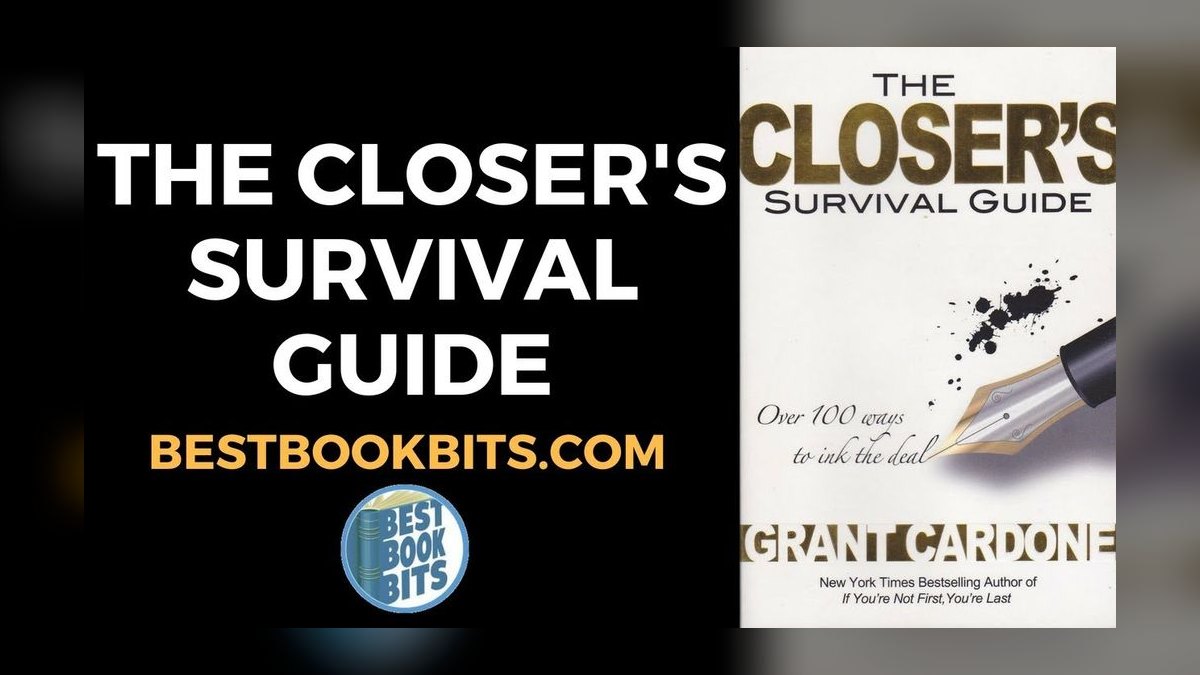
Grant Cardone's *The Closer's Survival Guide* teaches sales leaders that closing is a trainable, scriptable skill, not a personality trait — the book's core takeaways for 2027 are: stockpile multiple closing sequences per objection, treat "no" as an unfinished conversation, drill scripts until delivery is automatic, and build a team-wide closing strategy so revenue doesn't depend on your one best rep.
A rep who freezes at the finish line
Picture a mid-market SaaS team where the pipeline is full, demos are booked, and reps can recite every feature — but deals stall at the same three points: price, timing, and "I need to check with my team." The sales leader has trained discovery and demo skills for months, yet close rates haven't moved. This is precisely the gap Cardone's book targets: most sales training stops at building rapport and presenting value, then leaves the rep improvising the hardest five minutes of the call. Cardone's argument, distilled for a 2027 sales floor, is that closing failure is a preparation failure. A rep who has only one way to handle a price objection will freeze, hedge, or discount the moment that single script fails — because they have nothing else to reach for. The book's fix is volume and variety: dozens of pre-built closes organized by objection type (price, need, authority, timing, trust), so a rep facing resistance simply pivots to the next applicable close instead of inventing one live, under pressure, with the prospect listening to the silence. For a sales leader in 2027, the practical takeaway is to stop treating "objection handling" as a single training module and start treating it as a library the rep can draw from in real time — the same way a pilot doesn't invent a checklist mid-flight.
How the closing-library mechanism actually works
The mechanical idea underneath *The Closer's Survival Guide* is simple to state and hard to execute: separate the *skill of closing* from the *content of any one close*. Cardone structures the book as a reference catalog rather than a narrative — each entry is a short, memorizable script tied to a specific stall (budget, competitor comparison, "send me something in writing," "I'll think about it"), and the leader's job is to make sure every rep on the team has internalized enough of these that they never run out of options inside a single conversation. The mechanism works in three stages. First, exposure: reps read and role-play the closes until the language stops sounding like a script and starts sounding like their own voice — Cardone is explicit that a close read verbatim sounds robotic and kills trust, so the memorization step must end in adaptation, not recitation. Second, sequencing: when the first close fails, the rep doesn't repeat it louder, they escalate to a structurally different close (e.g., moving from an assumptive close to a takeaway close), because repeating the same appeal after a rejection reads as pressure, while a different angle reads as flexibility. Third, drilling under simulated resistance: managers run live objection drills in team meetings, playing the difficult prospect, so the rep's first real exposure to a tough stall isn't with a paying account on the line. The flow below shows how a single objection moves through that library instead of dead-ending.
For a sales leader, the operational takeaway is that this library has to be built and maintained at the team level, not left to individual reps to assemble on their own. That means a shared, versioned document of closes mapped to your actual objections (not Cardone's generic ones verbatim), reviewed and updated quarterly as competitors and pricing change.
Real numbers, ranges, and benchmarks for applying it
Cardone's own framing leans on his "10X" philosophy — the idea that most salespeople under-estimate the volume of both effort and attempts required to hit a target, and compensate by giving up after one or two closing attempts on a stalled deal. Applied literally to a 2027 sales floor, a reasonable benchmark drawn from standard sales-methodology practice (not a specific study, since none is cited in the book) is that most reps abandon a deal after the *first* objection, while top closers typically work through three to five distinct closing attempts, each addressing a different underlying concern, before either winning the deal or disqualifying it. A sales leader building a scorecard around this book's ideas should track close-attempts-per-deal as a coachable metric, not just win rate — a rep who closes at attempt one occasionally isn't necessarily strong; a rep who *only* has attempt one is fragile the moment a prospect pushes back. Training cadence matters too: role-play and objection drills are most effective as a short, frequent ritual — 10 to 15 minutes at the start of a weekly team meeting — rather than a one-time onboarding session, because closing language decays if it isn't rehearsed. On script count, a workable starting library for a mid-size B2B team is 3 to 5 distinct closes per major objection category (price, timing, authority, trust, competitor), which is enough variety to avoid repetition without becoming unmanageable to train. Finally, on adoption timelines: expect 60 to 90 days from introducing a structured closing library to seeing it show up in close-rate data, since reps need real rehearsal reps before the scripts stop sounding foreign on a live call.
Trade-offs between scripted closing and consultative selling
The most important trade-off a sales leader has to reckon with is that Cardone's script-heavy approach sits in tension with the consultative, discovery-led selling that dominates modern B2B methodology (MEDDIC, Challenger, Sandler). Heavy scripting can accelerate a team that struggles to ask for the close at all — many reps do brilliant discovery and demo work, then go quiet exactly when they need to ask for the business, and a library of closes solves that specific failure. But scripting carries real risk if applied without judgment: prospects in complex, multi-stakeholder B2B deals can detect canned language quickly, and a rep who reaches for a generic "assumptive close" on a $200K enterprise deal where the buyer is still genuinely evaluating options will damage trust rather than build urgency. The alternative approach — pure consultative selling, where the "close" is simply the natural next step after a well-run discovery and mutual-action-plan process — reduces the risk of feeling pushy but leaves inexperienced reps without a fallback when a deal stalls for reasons discovery didn't surface. The practical resolution most sales leaders land on is a blend: use Cardone-style structured closes as a *safety net skill* for handling stalls and objections, while keeping the primary sales motion consultative and discovery-driven. The decision tree below frames how a leader should choose which mode to lean on for a given deal.

Sales leaders should also weigh team composition: newer reps generally benefit more from Cardone's structured approach because it gives them concrete language to reach for, while tenured reps with strong instincts may find rigid scripts constraining and perform better with looser guardrails plus the same underlying objection-category framework.
Common pitfalls and how to avoid them
The most common pitfall teams hit when adopting *The Closer's Survival Guide* is verbatim recitation — a rep who memorizes a close word-for-word and delivers it exactly as written sounds scripted, and modern buyers, especially technical and enterprise buyers, disengage the moment they sense a canned line. The fix is to require reps to rewrite each close in their own words during training before it's approved for live calls, so the underlying structure survives but the delivery sounds native. A second pitfall is closing too early or too often on a deal that isn't actually ready, mistaking Cardone's "always be closing" philosophy for permission to pressure every prospect at every touchpoint; this burns trust and inflates a false sense of pipeline momentum. The fix is to pair the closing library with clear qualification criteria, so closes are only attempted once a deal has passed real buying-stage gates, not on every call regardless of readiness. A third pitfall is leaders rolling out the book's content as generic material without adapting it to their actual product, pricing, and objections — reps sense the mismatch immediately and the library goes unused. The fix is a mandatory customization pass: for every close in the book, the sales leader and a top rep rewrite it against the team's real objections before it enters the shared library. Finally, teams often treat this as a one-time training event rather than an ongoing coaching strategy, so the skill decays within a quarter. The fix is folding closing drills into the recurring cadence of team meetings and 1:1 coaching, with managers actively listening to call recordings for objection handling specifically, not just discovery quality.
Related questions
Is Grant Cardone's closing style outdated for enterprise SaaS selling?
Not outdated, but it needs adaptation — the underlying discipline (multiple closes per objection, rehearsal, resilience after "no") transfers well; the specific scripted language often needs softening for sophisticated, multi-stakeholder enterprise buyers.
How many closing attempts should a rep make before disqualifying a deal?

There's no universal number, but three to five distinct attempts addressing different objections is a common practitioner benchmark before a leader should question whether the deal is real or the timing is wrong.
What's the difference between Cardone's approach and the Challenger Sale?
Challenger emphasizes reframing the customer's thinking through insight before the close; Cardone emphasizes having a deep library of tactical closes ready once resistance appears — they address different stages of the same deal.
Should new reps memorize scripts verbatim when starting out?
Memorize as a starting point only — verbatim delivery sounds robotic to prospects, so the goal is internalizing the structure and objection-category logic, then adapting the wording to the rep's own voice within weeks.
FAQ
**What is *The Closer's Survival Guide* by Grant Cardone actually about?** It's a reference-style sales book organized around dozens of specific closing scripts and techniques, grouped by the type of objection they address (price, timing, authority, trust), meant to be used as a working manual rather than read cover to cover once.
Who should read this book — reps, managers, or both? Both, but for different reasons: reps use it as a script library to pull from during live calls, while sales leaders use it as a training and coaching curriculum, selecting and adapting the closes most relevant to their team's actual deal patterns.
Does the book work for B2B software sales or just high-pressure retail/finance sales? The specific scripts lean toward transactional and relationship-based selling, but the underlying strategy — categorize objections, prepare multiple responses per category, drill them regularly — applies directly to B2B software sales once the language is adapted to a longer, multi-stakeholder cycle.
What's the single biggest takeaway for a sales leader building a 2027 training plan? Stop treating objection handling as one training session; build and maintain a living, team-specific library of closes per objection type, and drill it on a recurring cadence rather than a one-time onboarding.
Can over-relying on scripted closes hurt trust with prospects? Yes — verbatim or overly aggressive scripted closing is the most common failure mode, especially with sophisticated buyers, so leaders should pair the library with strong qualification and require reps to adapt language into their own voice.
How long does it take a team to see results after adopting this approach? Most teams need roughly 60 to 90 days of consistent rehearsal and live application before structured closing shows up clearly in close-rate data, since the language needs repetition before it stops sounding foreign on real calls.
Sources
- https://grantcardone.com/
- https://www.amazon.com/Closers-Survival-Guide-Grant-Cardone/dp/0578140723
- https://www.goodreads.com/book/show/20758331-the-closer-s-survival-guide
- https://www.audible.com/pd/The-Closers-Survival-Guide-Audiobook
- https://www.barnesandnoble.com/w/the-closers-survival-guide-grant-cardone/1121052527
- https://www.forbes.com/sites/forbescoachescouncil/
- https://www.linkedin.com/in/grantcardone/
- https://www.salesforce.com/resources/articles/sales-closing-techniques/
Related on PULSE
- How does the Challenger Sale methodology compare to traditional closing techniques?
- What are the most effective objection-handling frameworks for enterprise B2B sales teams?
- How should sales leaders structure weekly role-play and coaching cadences?
- What metrics best predict close-rate improvement after sales training?
- How does MEDDIC qualification interact with late-stage deal closing strategy?
This page will be disappearing soon. Save it to your device for $1 — or read it free while it is here.
@Kory-White- · if Venmo asks, the last 4 of my number are 2012
This page is gone.
This one is off the shelf now. $1 keeps it on your phone for good — the whole page, pictures and diagrams included.
 pulse-recentNever Split the Difference by Chris Voss — Top 10 Key Takeaways for Sales Leaders in 2027
 pulse-recentHow to Apply Strategic Selling — Step-by-Step Playbook in 2027
 pulse-booksWhat are the most common mistakes in Book Summaries in 2027?
 book-summarySPIN Selling by Neil Rackham — Cliff Notes Summary
 pulse-recentNever Lose a Customer Again by Joey Coleman — Top 10 Key Takeaways for Sales Leaders in 2027
 pulse-recentMonetizing Innovation by Madhavan Ramanujam — Top 10 Key Takeaways for Sales Leaders in 2027
 pulse-recentWhat is the first concrete step in the Sandler Selling System for handling a prospect's initial brush-off in 2027?
 pulse-recentWhat is the first concrete step in The Sandler Rules by David Mattson for building a sales plan in 2027?
 pulse-recentWhat is the first concrete step in Sandler Rule #4 for a sales leader to implement in 2027?
 pulse-recentThe Sales Acceleration Formula by Mark Roberge — Top 10 Key Takeaways for Sales Leaders in 2027