


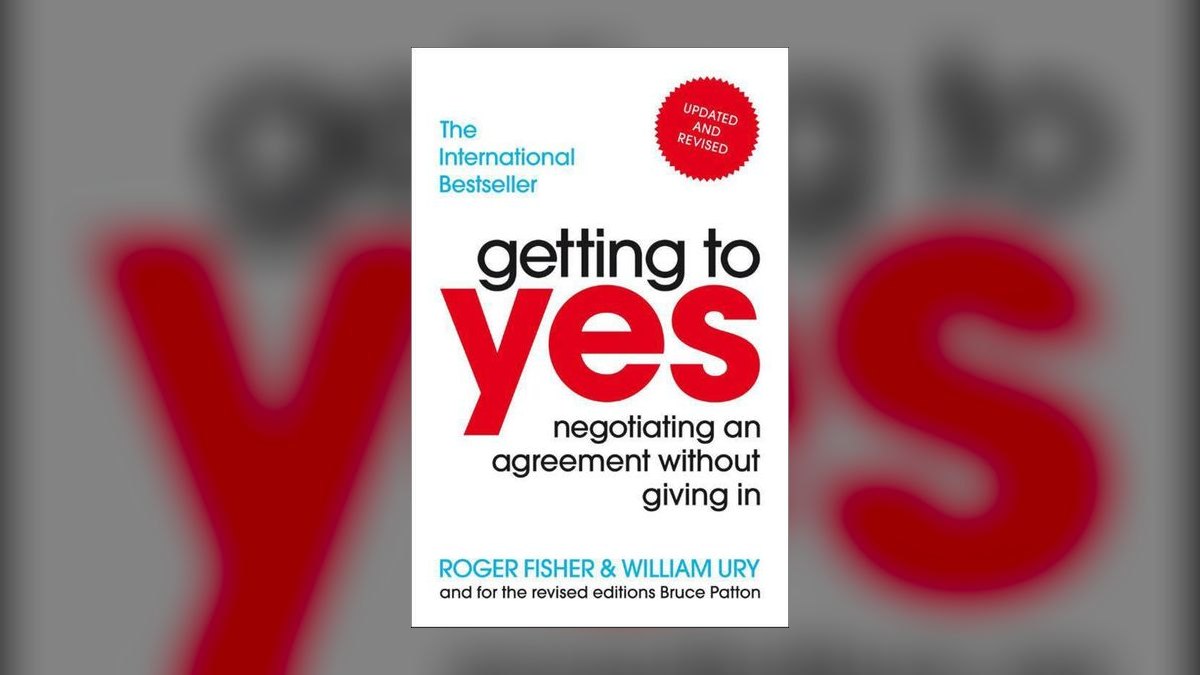
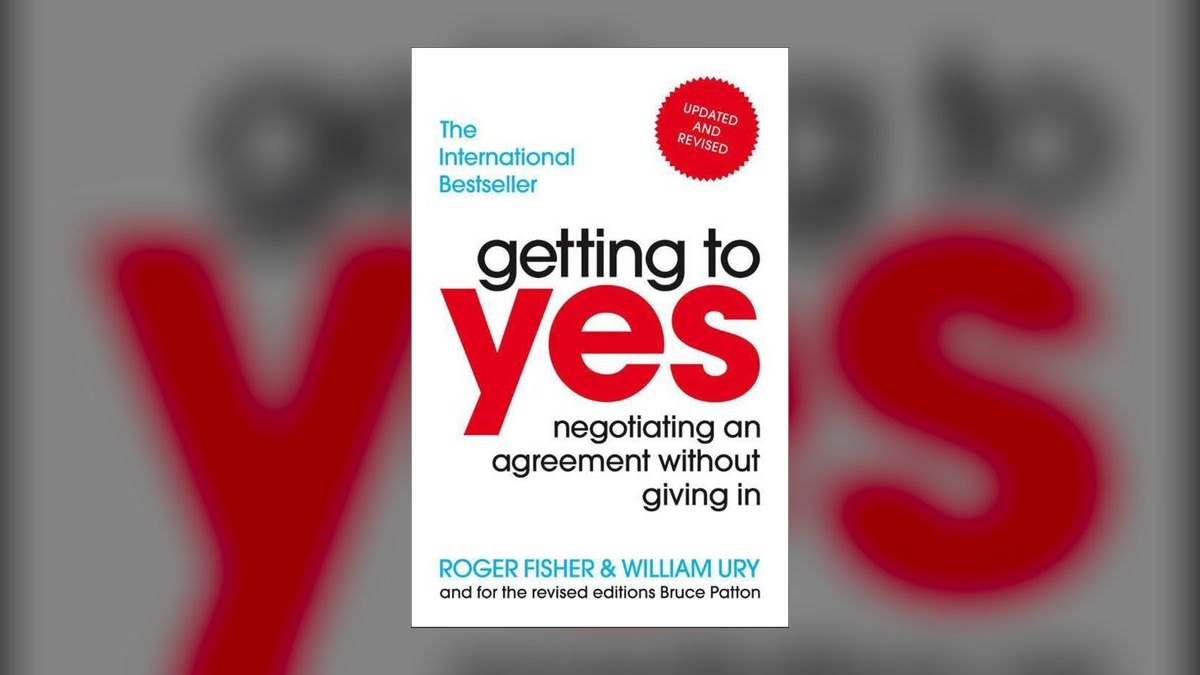
Getting to Yes by Roger Fisher and William Ury — Top 10 Key Takeaways for Sales Leaders in 2027
Quality
Certified

The core Getting to Yes takeaways for sales leaders: separate the person from the problem, negotiate on interests instead of stated positions, invent multiple options before committing to one, insist on objective pricing criteria, and know your BATNA (best alternative to a negotiated agreement) before you ever open your mouth. William Ury and Roger Fisher's principled-negotiation framework turns discount-driven deal-making into a repeatable strategy reps can run without gutting margin.
A stalled discount negotiation that never needed to happen
Picture a mid-market SaaS deal at $84,000 ARR, quarter-end, procurement holding at a 22% discount against the rep's approved ceiling of 12%. The rep escalates to their manager, who does what most untrained sales leaders do under pressure: splits the difference and approves 17%. The deal closes, but the account team has taught that buyer's organization a lesson — every future renewal negotiation starts with a lowball anchor, because it worked. This is positional bargaining, the exact failure mode Getting to Yes was written to fix in 1981, and it is still the default operating mode in most sales orgs headed into 2027.
Fisher and Ury, negotiating out of the Harvard Negotiation Project, observed that positional bargaining — each side stakes out a number and grinds toward a midpoint — produces agreements that satisfy neither party's actual needs and quietly damages the relationship needed for renewal, expansion, and referral. The procurement lead in the scenario above didn't actually need a 22% discount; they needed to show their VP of Finance a defensible number and needed budget certainty for the fiscal year. The rep didn't actually need to protect 12%; they needed the deal to hit a specific margin threshold their finance team modeled for the account's expected lifetime value. Neither side ever said this out loud, because the negotiation was conducted entirely in positions (percentages) rather than interests (what the percentage was supposed to protect).
Getting to Yes reframes this as a solvable problem rather than a tug-of-war. Instead of asking "how do we get from 22% to 12%," a sales leader trained in the book's method asks the rep to surface what's actually driving the ask: Is it a hard budget ceiling this fiscal year? Is it an internal benchmark against a competitor's list price? Is it a signaling exercise for the buyer's own boss? Each of those interests has a different, often non-price, solution — payment terms stretched across two budget cycles, a multi-year commitment that lowers effective annual cost without touching the headline discount, or a case-study commitment that gives the buyer's champion political cover internally. This is the shift sales leaders need to internalize first: a negotiation stuck on price is almost always a negotiation that never got past positions to reach interests.
How principled negotiation actually works
The book's four-part method translates directly into a sales negotiation workflow, and it's worth mapping the mechanism explicitly so reps can run it under real deal pressure rather than reciting it as theory.
Step one, separating people from the problem, means the rep treats the buyer's toughness as a negotiating stance, not a personal attack, and resists the instinct to get defensive or cave emotionally. In practice this looks like a rep saying "help me understand what that 22% needs to accomplish for you" rather than "I can't do that" — the first keeps the conversation collaborative, the second turns it adversarial.
Step two, interests over positions, is the diagnostic work described above. Sales leaders should train reps to ask "why" at least twice on any hard number before responding with a counter-number. The first "why" usually gets a restated position; the second usually gets the real interest.

Step three, inventing options before deciding, is where most sales orgs skip a step. Fisher and Ury's insistence on brainstorming multiple possible agreements before selecting one prevents the single-track "discount or no deal" framing that traps reps into a binary. A trained rep should walk into a renegotiation with three or four packaged options ready — different combinations of term length, payment cadence, feature bundling, and price — rather than one number to defend.
Step four, objective criteria, replaces "because my manager said so" with externally verifiable anchors: published list pricing, third-party benchmark data, cost-to-serve analysis, or comparable deal size in the same vertical. Objective criteria give both sides a face-saving way to land on a number that isn't purely a function of who blinked first.
Real numbers: BATNA math, discount ranges, and win rates
Getting to Yes's most operationally useful concept for sales leaders is BATNA — your best alternative if this specific deal falls through. A rep or sales leader who has not calculated their BATNA before a negotiation is, by definition, negotiating blind, because they have no benchmark for when walking away beats accepting a bad deal.

Concretely, this means before any renewal or competitive negotiation a sales leader should have the rep quantify: pipeline coverage without this deal (is there 3x pipeline to replace it if lost, or is this 40% of the quarter?), the account's actual lifetime value versus the deal-in-front-of-you value, and the cost of setting a discount precedent that will recur at every renewal. A $50,000 deal that requires a 30% discount to close, renewing annually, effectively sets a five-year discount precedent worth $75,000 in foregone margin if the account renews at the same rate — the negotiation isn't about this quarter's number, it's about the multi-year strategy the discount encodes.
On discount ranges specifically: sales organizations that train reps in interest-based negotiation typically see initial ask-to-close discount compression of roughly 5-10 percentage points versus untrained reps splitting the difference by default — a rep who holds firm on interests rather than immediately countering position-to-position tends to land in the 8-15% discount band on enterprise deals where untrained counterparts land at 18-25%. These are directional ranges from negotiation-training outcomes broadly, not guarantees, but the pattern is consistent enough that sales leaders should treat "what's our average realized discount by rep" as a coachable metric tied directly to whether that rep is negotiating positions or interests.
Win-rate impact is the second lever. Deals negotiated on objective criteria (comparable pricing, published benchmarks, cost data) close at meaningfully higher rates in competitive procurement processes than deals negotiated purely on relationship or pressure, because procurement teams need defensible paperwork to take to their own finance leadership — giving them that objective anchor is a gift, not a concession.
Trade-offs: principled negotiation vs. hard bargaining vs. soft accommodation

Fisher and Ury frame their method as an explicit alternative to two failure modes, and sales leaders should understand exactly what they're trading away with each approach.
Soft bargaining — the relationship-first approach many sales cultures default to — trades margin for warmth. It closes deals fast and keeps buyers happy short-term, but it systematically trains the account base that pressure gets results, compounding discount erosion deal after deal. Hard bargaining — anchoring aggressively and refusing to move — protects margin on individual deals but burns the relationship capital needed for expansion revenue and reference customers, and it performs worst in competitive multi-vendor evaluations where the buyer has genuine alternatives.

Principled negotiation's real cost is upfront: it requires reps who can diagnose interests in real time, hold a collaborative tone under pressure, and walk in with pre-built option sets rather than a single number — that's a training and coaching investment, not a script. Sales leaders adopting this as organizational strategy in 2027 should expect a 60-90 day ramp where reps are visibly slower and more hesitant in negotiation conversations before the interest-based habits become fluent. The trade-off is real: teams that skip the training layer and just tell reps to "focus on interests" without practice tend to regress to soft bargaining under quota pressure, because interest-based negotiation is a skill, not a mindset switch.
The alternative some sales orgs try — BATNA-only training without the full framework — captures some walk-away discipline but misses the collaborative option-generation that actually produces better deals for both sides; it's a partial adoption that leaves value on the table Fisher and Ury's full method would have captured.
Common pitfalls and how to avoid them
The most frequent failure sales leaders hit rolling this out is treating "separate people from the problem" as an instruction to be nicer, rather than a discipline about staying issue-focused when the other side gets personal or aggressive — reps need scripted language ("let's get back to what would actually solve this for both of us") rather than a vague reminder to stay calm.

The second pitfall is skipping the BATNA calculation because it feels like extra prep work under deal-close pressure. A rep who hasn't quantified their walk-away alternative will almost always cave to a bad number in the room, because they have no comparison point. This should be a mandatory pre-negotiation checklist item, not optional.
The third is confusing "objective criteria" with "whatever number makes our case." Objective criteria only work as a persuasion tool if they're genuinely external and verifiable — a rep quoting an internal price floor as if it were market data will get caught by a sophisticated procurement team and lose credibility for the rest of the negotiation.
The fourth pitfall is applying the framework only to price and missing that it applies to internal negotiations too — territory disputes, comp plan pushback, cross-functional resourcing asks. Sales leaders who train the whole framework once, for pricing only, leave most of its value on the table; the same interest-diagnosis and options-generation process resolves internal friction that otherwise burns manager time every quarter.
Related questions

What is a BATNA in sales negotiation?
Best Alternative To a Negotiated Agreement — the outcome you'd get if this specific deal fell through. Calculating it before a negotiation tells you your real walk-away point, preventing reps from caving to bad terms out of pressure rather than analysis.
How is principled negotiation different from win-win negotiating?
Principled negotiation is the specific mechanism (interests, options, objective criteria, separating people from problem) that produces win-win outcomes — "win-win" is the goal description; Fisher and Ury's method is the repeatable process for getting there.
Should sales reps read Getting to Yes directly, or just get the training?
Both work, but direct reading gives reps the reasoning behind each step, which improves real-time adaptation during live negotiations versus reps who only memorized a script without understanding the underlying interest-diagnosis logic.
Does this framework work in aggressive, price-only procurement processes?

Yes, though it requires holding firm — introducing objective criteria and alternative structures even when procurement insists on a single-issue price conversation, since a single-issue frame is itself a positional-bargaining tactic worth naming and redirecting.
FAQ
What are the main takeaways from Getting to Yes for sales leaders? Separate the person from the problem, negotiate interests instead of positions, generate multiple options before choosing one, insist on objective criteria for pricing decisions, and know your BATNA before every negotiation. Together these replace ad hoc discounting with a repeatable strategy.
Who wrote Getting to Yes? Roger Fisher and William Ury, both associated with the Harvard Negotiation Project, first published the book in 1981; it remains one of the most widely taught negotiation frameworks in business and sales training programs.
What is the single biggest mistake sales leaders make applying this book?

Treating the framework as relationship-softening advice rather than a structured process — skipping the BATNA calculation and jumping straight to "find common ground" without first quantifying the walk-away alternative, which leaves reps negotiating from a weaker, undefined position.
Does principled negotiation mean giving up more to keep the buyer happy? No — it's the opposite. Interest-based negotiation and objective criteria are specifically designed to protect value for both sides simultaneously; sales leaders who train it correctly typically see less average discount erosion than teams doing relationship-first soft bargaining.
How long does it take to train a sales team on this method? Expect a 60-90 day ramp for reps to move from scripted, hesitant application to fluent real-time use — the framework requires practiced skill in diagnosing interests under pressure, not a one-time workshop.
Can this framework be used outside of pricing negotiations? Yes — the same interest-diagnosis and options-generation process applies to internal negotiations like territory disputes, resourcing conflicts, and comp plan discussions, and sales leaders who train it broadly get more organizational value than those who apply it to pricing only.
Sources
- https://www.pon.harvard.edu/tag/getting-to-yes/
- https://en.wikipedia.org/wiki/Getting_to_Yes
- https://www.harvardnegotiation.org
- https://hbr.org/1997/03/getting-past-yes-negotiating-as-if-implementation-mattered
- https://www.goodreads.com/book/show/313605.Getting_to_Yes
- https://www.penguinrandomhouse.com/books/291913/getting-to-yes-by-roger-fisher-william-ury-and-bruce-patton/
- https://www.mediate.com/articles/getting-to-yes.cfm
Related on PULSE
- How to calculate your BATNA before a high-stakes renewal negotiation
- Objective pricing criteria: building a defensible discount framework for procurement
- Positional bargaining vs. interest-based negotiation in enterprise sales
- Coaching reps to separate people from the problem under deal pressure
- Multi-year contract structuring as a discount alternative
This page will be disappearing soon. Save it to your device for $1 — or read it free while it is here.
@Kory-White- · if Venmo asks, the last 4 of my number are 2012
This page is gone.
This one is off the shelf now. $1 keeps it on your phone for good — the whole page, pictures and diagrams included.
 pulse-recentSell or Be Sold by Grant Cardone — Top 10 Key Takeaways for Sales Leaders in 2027
 pulse-recentSales Engagement by Manny Medina — Top 10 Key Takeaways for Sales Leaders in 2027
 pulse-recentWhat is the second concrete step in Strategic Selling by Miller Heiman for identifying a sales coach in 2027?
 pulse-recentNever Lose a Customer Again by Joey Coleman — Top 10 Key Takeaways for Sales Leaders in 2027
 pulse-recentTraction by Gabriel Weinberg and Justin Mares — Top 10 Key Takeaways for Sales Leaders in 2027
 pulse-recentConceptual Selling by Robert Miller and Stephen Heiman — Top 10 Key Takeaways for Sales Leaders in 2027
 pulse-recentProActive Selling by Skip Miller — Top 10 Key Takeaways for Sales Leaders in 2027
 book-summarySales EQ by Jeb Blount — Cliff Notes Summary & Key Takeaways
 book-summaryInfluence (New and Expanded) by Robert Cialdini — Cliff Notes Summary
 pulse-recentThe Sales Acceleration Formula by Mark Roberge — Top 10 Key Takeaways for Sales Leaders in 2027