


Nudge by Thaler and Sunstein — Cliff Notes Summary for Sellers
Quality
Certified
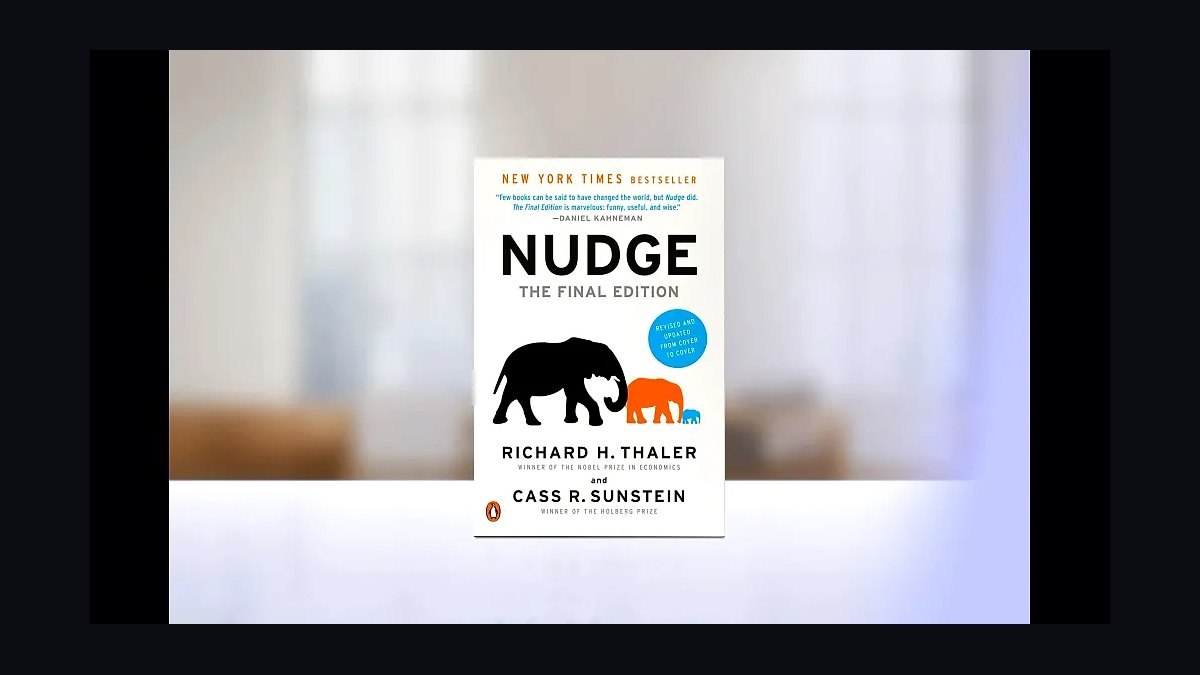
*Nudge* argues that every choice is presented inside a "choice architecture" — the default, the order, the friction, the salience — and someone always designs it, deliberately or not. Thaler and Sunstein call the fix libertarian paternalism: steer people toward better outcomes while preserving easy opt-out. For sellers, pricing pages and renewal flows are choice architectures.
The outcome you should expect from reading it this way
Most sellers who pick up *Nudge* read it as popular science and put it down without changing anything. That is a waste. The book is not a curiosity cabinet of clever experiments; it is an operating manual for the part of revenue work nobody assigns an owner to — the shape of the menu you hand a buyer. Read it as an operator and the expected outcome is narrow but real: you stop treating your pricing page, your trial flow, your order form, and your renewal notice as neutral containers and start treating them as designed instruments that produce measurable behavior.
The concrete shift is a reframe. Classical economics models a buyer as an "Econ" — a perfectly rational agent who reads all four tiers, computes expected value, and picks optimally. Thaler's whole career is a demonstration that your buyer is a "Human," running fast, automatic System 1 thinking most of the time, anchoring on the first number they see, avoiding losses roughly twice as hard as they chase equivalent gains, and defaulting to whatever requires no decision at all. Nearly every pricing page in B2B software is designed for the Econ. That mismatch is the arbitrage.
What you should expect in practice: a handful of structural changes that don't touch price, product, or headcount, and that show up in conversion, contract length, and expansion rate rather than in top-of-funnel volume. Set a default on your pricing page instead of presenting four coequal columns. Move the annual-billing toggle from off to on. Pre-fill the multi-year option on the order form with a modest escalator rather than asking the buyer to actively choose a longer term. Convert trials by notification-plus-easy-exit rather than by asking for an active upgrade decision from a user who is busy. None of these are new ideas to a good growth team, but *Nudge* gives you the underlying mechanism, which is what lets you generalize rather than copy.

You should also expect to lose some arguments internally. "Set a default" reads to a lot of people as "trick the customer," and the honest answer to that objection is the book's central move, which we'll get to in the failure-modes section. The short version: there is no neutral menu. Presenting four tiers in a random order with no recommendation is not the absence of a nudge; it is a nudge toward inertia, confusion, and the cheapest option — and inertia is a choice you made by not making one.
Adjacent to selling, the same lens pays off in places sellers touch but don't own. Onboarding flows, in-product upgrade prompts, CS renewal outreach, partner-portal registration, RFP response templates, and even your internal comp plan are all choice architectures. A quota plan is literally an incentive design problem — the first letter of the book's own acronym. Teams that read *Nudge* as a strategy document rather than a book review tend to end up auditing four or five surfaces, not one.
What actually drives the outcome
The engine of the book is a six-part checklist Thaler and Sunstein compress into the acronym NUDGES. It is worth memorizing because it works as an audit rubric on any flow you own.

iNcentives. Align the reward with the behavior you want, and ask who actually notices the incentive. The book's recurring point is that incentives fail not because they're too small but because the person making the decision isn't the person feeling the consequence. In B2B this is constant: the end user feels the pain, the manager holds the budget, procurement is graded on discount extracted, and the champion is graded on nothing. If your business case is written for the CFO but delivered to a director, the incentive is invisible at the point of decision.
Understand mappings. Show how each option maps to a real-world outcome. "10,000 API calls per month" is not a mapping; "enough for a 200-person support team at current ticket volume" is. Buyers cannot compute the translation from feature to consequence, and when they can't, they retreat to price — which is the only dimension they can compare. Bad mappings are why deals commoditize.
Defaults. The most powerful and most robust of the six. Whatever is pre-selected wins, by margins that embarrass every other lever.
Give feedback. Show progress and consequence as the decision unfolds. Usage dashboards, seat-utilization emails, and "you've used 40% of your credits" notices are feedback nudges, and they drive expansion without a rep touching the account.
Expect error. Design for the mistake the user will definitely make. Undo buttons, grace periods, confirmation screens on destructive actions, and pro-rated refunds after an accidental annual upgrade all belong here. Expecting error is also what separates a legitimate default from a dark pattern.
Structure complex choices. Cap the option set before paralysis sets in. Iyengar and Lepper's jam study is the canonical evidence — a display of 24 varieties drew more browsers but far fewer buyers than a display of 6. The book extends this to Medicare Part D, where seniors faced dozens of prescription drug plans with no default and systematically chose worse than they would have with a recommendation, and to Sweden's privatized pension rollout, which put hundreds of funds in front of citizens and produced a lot of bad active picks relative to the default fund.

Underneath the six principles sit three biases doing most of the work. Status-quo bias is why "do nothing" beats every competitor you'll ever face. Loss aversion is why churn-risk framing outperforms upside framing — telling a buyer what they'll lose by leaving lands harder than telling them what they'd gain by expanding. Anchoring is why the first number in a proposal sets the frame for every number after it, and why sellers who lead with the smallest package are negotiating against themselves before the call starts.
Benchmarks and realistic ranges
The book's headline numbers are worth knowing precisely, because they are the ones people misquote.
Organ donation defaults. Johnson and Goldstein's 2003 *Science* paper compared European countries with opt-in versus opt-out donor registration. Opt-in countries clustered around low double-digit consent rates; opt-out countries clustered above 90%. Same continent, comparable cultures, and the difference traced to which box was pre-checked. Important caveat that the book itself makes: registered consent is not the same as actual donation rates, which depend on hospital infrastructure and family override. The lesson is about the size of the default effect, not about a one-to-one transfer to transplant volume.
Save More Tomorrow. Thaler and Benartzi's 2004 program let employees commit *future* raises to retirement savings rather than cutting current take-home pay. Across roughly three and a half years, participants' savings rates rose from about 3.5% to about 13.6%, and participation in the plan far exceeded what advisors achieved by asking people to save more today. The mechanism is present bias plus loss aversion: nothing leaves the current paycheck, so nothing feels like a loss. The 401(k) auto-enrollment logic this line of work supported was later written into US law via the Pension Protection Act of 2006.

Feedback on consumption. Real-time energy feedback — smart meters, in-home displays, and neighbor-comparison bill inserts — has repeatedly produced modest but durable reductions in household electricity use, typically in the low single digits to low double digits depending on the intervention. The commercial proof point is that a company built on neighbor-comparison utility reports was acquired by Oracle in 2016; the effect was small per household and enormous at scale.
Choice overload. The jam study's numbers are the ones everyone cites, and the honest framing is that the effect exists but is contingent — later meta-analytic work found choice overload appears reliably under some conditions (unclear preferences, high complexity, no default) and vanishes under others. For a pricing page, the practical translation is not "fewer is always better" but "past three or four comparable options with no recommendation, you are shifting work onto the buyer that they will not do."
For sellers, the honest benchmark statement is this: do not promise your exec team a 6x lift from moving a toggle. Default effects in consumer registration flows with near-zero switching cost are the upper bound of what defaults can do. B2B purchases have committees, procurement, security review, and budget cycles, and the default is only one input among many. What you can reasonably expect from a well-run choice-architecture pass on a pricing or checkout surface is a meaningful single-digit to low-double-digit relative improvement in the step you changed, plus mix shift toward the defaulted tier or term. Mix shift is often the bigger prize — moving 15% of new logos from monthly to annual billing changes cash collection and churn math more than a conversion bump does.
Two measurement notes. First, instrument the *step*, not the funnel — a default change on the term selector should be judged on term mix, not on overall win rate, which is too noisy to attribute. Second, watch downstream. A default that lifts conversion and raises 90-day churn is a loss; the entire point of libertarian paternalism is that the nudge should be good for the person being nudged, and refund rate is the cleanest empirical test of whether it was.
Risks, edge cases, and failure modes

The manipulation objection, taken seriously. Sunstein spends real pages on this and the answer holds up: neutral choice architecture does not exist. Options must appear in some order, something must be pre-selected or nothing must be, and each of those is a design that produces predictable behavior. Given that, the ethical question is not "should I nudge" but "toward what, and can they easily get out." The test the book supplies is publicity — would you be comfortable if the buyer knew exactly what you did and why? A defaulted annual term with a visible monthly toggle passes. A pre-checked add-on buried under a fold does not.
Dark patterns are the failure mode, and they're the same mechanics. Pre-checked upsells, cancel flows requiring a phone call, "confirmshaming" decline buttons, and auto-renewal with no advance notice all use the same levers this book describes. The distinguishing feature is reversibility. If opting out is one click and clearly labeled, you're in libertarian paternalism. If opting out costs a support ticket, you've crossed into a pattern that regulators in multiple jurisdictions now police, and that will cost you more in chargebacks and reviews than the nudge earned.
The replication crisis is real and partially applies. A large body of behavioral-science findings from the 2000s and early 2010s failed to replicate at original effect sizes — social priming took the worst of it. The 2021 Final Edition of *Nudge* is notable precisely because the authors revisited weak claims rather than defending them, and the update is the version worth reading. What survived best is the field-tested, large-N, default-and-structure work. What you should treat with suspicion is any small-N lab result about subtle framing that someone is selling you as a conversion tactic. Field-tested defaults: strong. Cute priming tricks: assume nothing.

Nudges are weakest where the decision is deliberate and expensive. The book itself says nudges matter most for infrequent decisions with delayed feedback and opaque mappings. B2B software fits that profile, which is the good news — but the corollary is that a seven-figure enterprise deal with a formal evaluation committee is the least nudge-responsive purchase in your portfolio. Committee purchases replace individual System 1 shortcuts with process. Put your choice-architecture effort into self-serve, PLG, mid-market, renewals, and expansion, where a single human is actually making a fast decision.
Defaults can be actively harmful when preferences are heterogeneous. If half your buyers genuinely need the cheap tier and half genuinely need the expensive one, defaulting everyone to the middle serves neither and generates refund friction. Defaults work when there is a clear "what most people should pick." When there isn't, the right move is a short qualifying question that routes to a segment-appropriate default — a personalized default rather than a universal one.
Escalating from nudge to shove. Sunstein has written separately about sludge — friction that impedes good decisions — and about mandates versus nudges. Sales orgs drift toward shoving: the "recommended" tier becomes the only visible tier, the downgrade path disappears, the cancel button moves. Set an internal rule early — reversibility is non-negotiable — because the drift is gradual and nobody notices the day you crossed the line.
Legal and procurement blowback. Auto-renewal clauses with automatic uplift are legitimate and common, and they are also increasingly regulated for consumer contracts and increasingly scrutinized by B2B procurement. Disclose the escalator on the order form in plain language, at the same visual weight as the price. A default that surprises someone at renewal produces exactly the loss-aversion reaction the book describes — and it will be aimed at you.
A practical rollout plan

Treat this as a four-week audit rather than a redesign. The point is to find where inertia is currently designing your menus and take the pen back.
Week one — inventory the menus. List every surface where a buyer or user makes a selection: pricing page, plan selector, billing-term toggle, trial signup, in-app upgrade modal, order form, renewal notice, cancellation flow, seat-management screen. For each, write down three things in a spreadsheet: what is currently defaulted, how many clicks the best path takes, and how many options are presented. Most teams discover between eight and fifteen surfaces and find that nobody has explicitly owned five of them.
Week two — score each surface against NUDGES. Six columns, pass or fail per surface. Is there a default, and is it the option most buyers should pick? Do the option labels map to outcomes rather than to internal feature names? Is the recommended option visually salient? Is there feedback during and after the decision? Is there a reversal path for the obvious mistake? Are there more than four comparable options with no guidance? Fails cluster, and the cluster tells you where to start.
Week three — pick one change, run it properly. One surface, one variable. Resist the urge to redesign the pricing page and change the default and rewrite the copy in the same release, because you will learn nothing. Define the metric before you ship — term mix, tier mix, step conversion — and define the guardrail metric too: refund rate, 90-day churn, support-ticket volume on that flow. Run long enough to clear your sales cycle, which for anything above self-serve means the test is longer than a growth team's usual patience.

Week four — read the guardrails first. If the primary metric improved and refunds and early churn are flat, keep it and move to the next surface. If the primary improved and the guardrail moved against you, you built a dark pattern, and the correct response is to roll it back rather than to argue about attribution.
Where this spreads next: the same audit works on internal surfaces. Comp plans are incentive design with terrible mappings — most reps cannot compute what a given deal pays them, which is a Understand-Mappings failure that costs you behavior change. CRM hygiene is a friction problem, not a discipline problem; required fields that nobody fills are an Expect-Error failure. Enablement content nobody reads is a salience problem. If you want a second book to pair with this one, Cialdini's *Influence* covers what you say and Kahneman's *Thinking, Fast and Slow* covers why the shortcuts exist; *Nudge* is the one about how you arrange the room before anyone speaks.
Related questions
Should I read the 2008 original or the 2021 Final Edition?
The Final Edition. It drops weaker material, reflects post-replication-crisis evidence, and updates the policy examples. If you've read the original, the Final Edition is still worth a skim for what the authors chose to retract.
Is a defaulted annual billing toggle a dark pattern?
No, provided the monthly option is visible at equal weight, the switch is one click, and the term is stated plainly at checkout. It becomes a dark pattern when the alternative is hidden or reversal requires contacting support.
Does any of this work on enterprise committee deals?

Less than you'd like. Committees substitute process for individual snap judgment. Choice architecture pays best in self-serve, PLG, mid-market, renewals, and expansion motions where one person decides quickly.
What's the single highest-ROI change for most B2B teams?
Setting an explicit, well-labeled recommended tier on the pricing page — a default plus salience plus outcome mapping in one edit. It's cheap, reversible, and it's the surface with the most traffic.
How is this different from Cialdini's persuasion principles?
Cialdini describes triggers that move an individual decision — reciprocity, social proof, scarcity. *Nudge* describes the structure of the decision itself: the default, the friction, the option set. One is what you say; the other is the room.
FAQ
Who wrote Nudge and what are their credentials?
Richard H. Thaler is an economist at the University of Chicago Booth School of Business and received the 2017 Nobel Memorial Prize in Economic Sciences for his work in behavioral economics. Cass R. Sunstein is a legal scholar at Harvard Law School who served as administrator of the White House Office of Information and Regulatory Affairs during the Obama administration. The book was first published by Yale University Press in 2008, with a substantially revised Final Edition in 2021.
What does "libertarian paternalism" actually mean?
It's the authors' deliberately provocative label for designing choices that steer people toward outcomes they'd endorse on reflection, while keeping the alternatives genuinely available at low cost. The libertarian half is the easy opt-out; the paternalist half is that the designer has a view about what's good. The authors argue it isn't an oxymoron because a menu has to be arranged somehow, and refusing to think about the arrangement doesn't make it neutral.

Is nudging just manipulation with better branding?
The book's answer is a publicity test: if you'd be uncomfortable explaining the nudge to the person you nudged, it's manipulation. Reversibility is the practical line. A pre-selected option with a clearly visible alternative is choice architecture; a pre-selected option that's hard to undo is a dark pattern, and it will show up in your refund and churn numbers.
Did the replication crisis invalidate the book?
It invalidated parts of the surrounding literature more than the core. Social-priming results took heavy damage; large-scale field findings about defaults, auto-enrollment, and structure of choice held up much better. The 2021 Final Edition is the authors' own accounting of what they no longer stand behind, which is a reason to read that version rather than a reason to skip the book.
Where does a seller apply this first?
Three places, in order of expected return: the pricing page, where a recommended default plus outcome-mapped labels does the most work; the billing-term selector, where defaulting to annual shifts cash and retention; and the renewal flow, where a pre-filled multi-year option with a disclosed escalator converts far better than asking for an active upgrade decision.
How does this connect to the rest of the behavioral-economics shelf?
Kahneman's *Thinking, Fast and Slow* supplies the System 1 / System 2 model the book leans on. Cialdini's *Influence* covers interpersonal persuasion levers. Ariely's *Predictably Irrational* documents the biases in consumer settings. Thaler's own *Misbehaving* is the field's origin story and the best companion read if you want the intellectual history behind this Summary for Sellers.
Sources
- https://yalebooks.yale.edu/book/9780300262285/nudge/
- https://www.nobelprize.org/prizes/economic-sciences/2017/thaler/facts/
- https://www.science.org/doi/10.1126/science.1091721
- https://www.journals.uchicago.edu/doi/10.1086/380085
- https://www.chicagobooth.edu/faculty/directory/t/richard-h-thaler
- https://hls.harvard.edu/faculty/cass-r-sunstein/
- https://www.bi.team/
- https://www.congress.gov/bill/109th-congress/house-bill/4
- https://www.apa.org/pubs/journals/releases/psp79-6-995.pdf
Related on PULSE
- Misbehaving by Richard Thaler — Cliff Notes Summary for Sellers
- Thinking Fast and Slow by Daniel Kahneman — Cliff Notes Summary for Sellers
- Contagious by Jonah Berger — Cliff Notes Summary for Sellers
- The Tipping Point by Malcolm Gladwell — Cliff Notes Summary for Sellers
- Exactly What to Say by Phil M. Jones — Cliff Notes Summary for Sellers
- Antifragile by Nassim Taleb — Cliff Notes Summary for Sellers
This page will be disappearing soon. Save it to your device for $1 — or read it free while it is here.
@Kory-White- · if Venmo asks, the last 4 of my number are 2012
This page is gone.
This one is off the shelf now. $1 keeps it on your phone for good — the whole page, pictures and diagrams included.
 pulse-recentWhat is the first concrete step in SPIN Selling by Neil Rackham for structuring a discovery call in 2027?
 pulse-recentHow I Raised Myself from Failure to Success in Selling by Frank Bettger — Top 10 Key Takeaways for Sales Leaders in 2027
 pulse-recentTraction by Gabriel Weinberg and Justin Mares — Top 10 Key Takeaways for Sales Leaders in 2027
 pulse-recentThe Sales Acceleration Formula by Mark Roberge — Top 10 Key Takeaways for Sales Leaders in 2027
 pulse-recentHow to Apply Strategic Selling — Step-by-Step Playbook in 2027
 pulse-recentNever Lose a Customer Again by Joey Coleman — Top 10 Key Takeaways for Sales Leaders in 2027
 pulse-booksTop 10 practical takeaways from Atomic Habits for building a new routine in 2027.
 pulse-recentMonetizing Innovation by Madhavan Ramanujam — Top 10 Key Takeaways for Sales Leaders in 2027
 pulse-recentThe Transparency Sale by Todd Caponi — Top 10 Key Takeaways for Sales Leaders in 2027
 pulse-recentWhat are the concrete steps to implement the Sandler Rules for Sales Leaders by David Mattson in 2027?