


Mastering the Complex Sale by Jeff Thull — Cliff Notes Summary
Quality
Certified
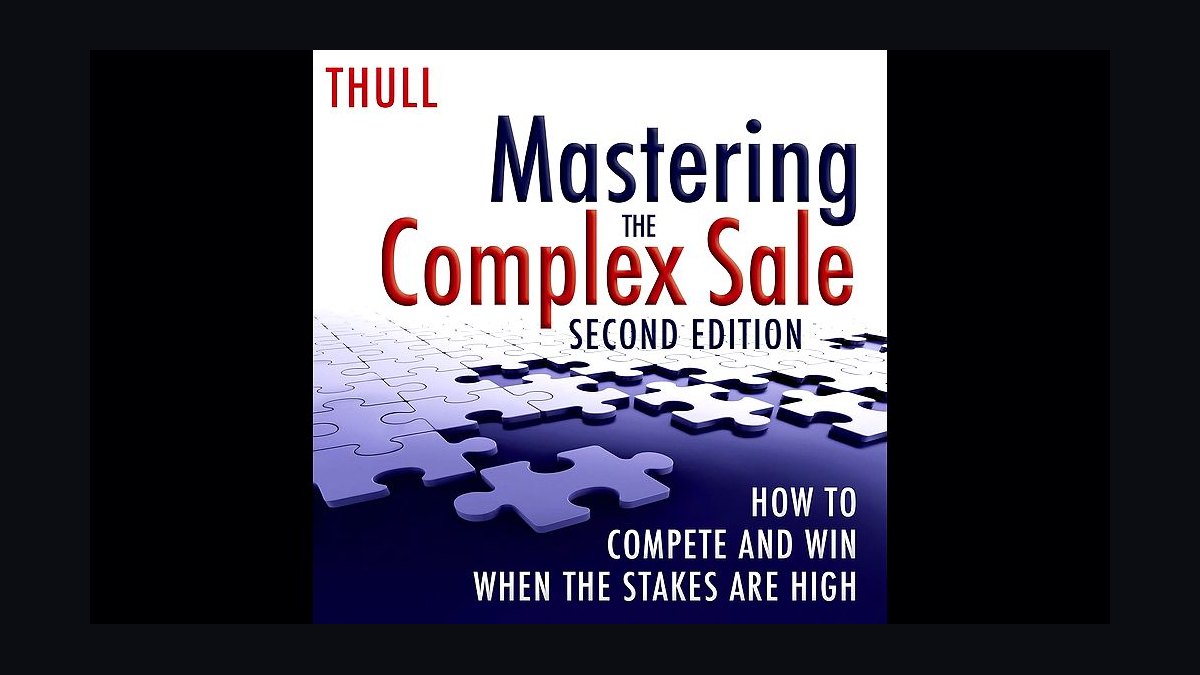
*Mastering the Complex Sale* by Jeff Thull (Wiley, 2003; second edition 2010) argues that high-stakes, multi-stakeholder B2B deals fail because sellers pitch before they diagnose. Thull's Diagnostic Business Development method — Discover, Diagnose, Design, Deliver — makes the buyer articulate their own problem and its cost, defeating no-decision rather than the competitor.
The outcome you should expect from reading it
Most sales books hand you a technique. Thull hands you a reclassification problem. His opening claim is that a complex sale is not a large simple sale — it is a different species, and applying simple-sale reflexes to it produces predictable, expensive failure. Once you accept that reframe, the book's practical payoff shows up in three places.
The first is your loss taxonomy. Teams that read this book properly stop reporting losses as "lost to Competitor X" and start reporting them as "died at the Investigation stage," "never quantified cost of inaction," "no executive sponsor recognized the problem." That is a change in measurement before it is a change in behavior, and it is the single highest-leverage thing the book produces. You cannot fix what your CRM records as a coin flip against a rival when the real cause was a buying committee that got overwhelmed and did nothing.
The second is call structure. Reps who internalize the Diagnostic Conversation stop opening with capability slides. They open with a hypothesis drawn from pre-call research, they let the prospect supply the data, and they refuse to price anything until the gap is quantified. This feels slower in week one and materially faster by week six, because deals that were never going to close get disqualified early instead of consuming three months of forecast oxygen.

The third is artifact quality. The Value Confirmation Document replaces the vendor proposal, and because the prospect co-authors it, it survives executive review in a way a deck never does. When the CFO asks "where did this number come from," the answer is "your own operations lead, in the working session on the 14th" — not "the vendor's ROI calculator."
What you should *not* expect is a plug-and-play playbook. The prose is dense and the examples lean industrial — manufacturing, telecom, energy, capital equipment — because that was Thull's consulting world. Translating it to a SaaS motion is your work, not his. Expect a mental model, a vocabulary, and two or three tools you will actually use, rather than a script.
There is also a scope boundary worth stating up front. This method earns its overhead on deals with genuine consequence: many stakeholders, long cycles, real switching cost, a decision that is career-relevant for the buyer. On a self-serve or low-ACV motion, running a full diagnostic sequence is malpractice in the other direction — you will burn margin conducting an examination on a patient who wanted a bandage. Know which sale you are in before you pick the strategy.
What actually drives the outcome
The engine underneath the book is a claim about buyer psychology that Thull calls the Self-Discovery Principle: people commit to conclusions they reach themselves far more durably than to conclusions they are handed. Everything structural in the method exists to serve that one idea.

That is why the Doctor-Patient analogy carries so much weight. A credible physician does not walk in and recommend surgery; they ask, examine, test, and only then prescribe — and the prescription lands because the examination earned it. A seller who leads with features is, in Thull's framing, a doctor prescribing before examining. Buyers do not trust them, and correctly so. Diagnostic credibility, in this model, comes from the quality of your questions, the rigor of your examination, and — crucially — your visible willingness to disqualify when the diagnosis does not warrant the cure. That last one is what makes the first two believable. A seller who has never walked away from a deal is not a diagnostician; they are a salesperson with better questions.
The four phases each serve a specific function in that chain. Discover is pre-call work: industry economics, recent earnings or funding language, executive statements, competitive position, and the names and roles inside the buying group. Thull recommends a one-page Discovery Brief covering industry pressure, the company's measurable performance gap, and three hypotheses about root cause. Reps who skip it arrive at the first meeting with no hypotheses and burn the prospect's goodwill on generic questions any intern could ask.
Diagnose is the structured conversation where the prospect uncovers the depth and cost of their own problem. Three outputs: the gap between current and desired state expressed in data, the root cause behind that gap, and the quantified cost of inaction. No product is pitched during Diagnose. At all. That prohibition is the part most teams violate within ninety seconds of the first call.
Design is co-architecture. Rep and prospect jointly build the solution and write it down as a Value Confirmation Document. Deliver is treated as a selling phase rather than a handoff, because expansion, renewal, and reference revenue all depend on the customer actually hitting the success criteria agreed in Design.

The mirror of the seller's four phases is Thull's four-stage buyer decision model: Recognition, Investigation, Commitment, Execution. The seller's job is to shepherd the buyer through all four, not to sprint to a signature at the end of Investigation. Most pipeline hygiene problems are a mismatch between where the seller thinks the deal is and which of those four stages the buyer is actually in.
And this is where the Cost of Inaction concept does its real work. Most reps anchor the conversation on the cost of their solution — price, implementation, training, change-management risk. Diagnostic sellers invert it and quantify the cost of *not* acting: lost revenue, missed market opportunity, compounding operational drag, competitive erosion, attrition, regulatory exposure. When the cost of inaction visibly exceeds the cost of action, the seller's job shifts from persuasion to facilitation. The prospect supplies their own urgency.
Thull's quantification mechanic is deliberately simple: identify a measurable gap, multiply by frequency of occurrence, multiply by duration the gap persists untreated, then add a compounding factor for opportunity cost and competitive penalty. A gap running $50,000 a month for twenty-four months is nominally a $1.2M problem — add compounding and it lands meaningfully higher. The exact multiplier matters less than who does the arithmetic. If the rep does the math, it is a vendor claim. If the prospect does the math out loud, it is a finding.
Benchmarks and realistic ranges
Be careful with numbers here, because this is where summaries of the book tend to invent precision that Thull never claimed. What is well-established is directional, and it is still useful.

Thull's central empirical claim, made in 2003, is that a large share of qualified complex-sales pipeline dies without any decision at all — not lost to a competitor, just abandoned. He treated this as the dominant loss category rather than a rounding error, and he was roughly two decades ahead of the research consensus in saying so. Matt Dixon and Ted McKenna's *The JOLT Effect* (2022), built on a large corpus of recorded sales conversations, reached the same conclusion from a completely different methodological direction: customer indecision, not competitive preference, is what kills most enterprise deals. Two independent paths, one destination. That convergence is the strongest reason to take the 2003 book seriously in the present tense.
For your own benchmarking, the practical move is to stop trusting industry averages and instrument your own funnel. Three numbers are worth pulling this quarter:
No-decision rate. Of everything that reached a stage you consider genuinely qualified, what percentage closed-lost with no competitor named? In most enterprise orgs that have never measured it, the number is uncomfortably large and has been hiding inside a generic "lost" bucket. This is your baseline. Every diagnostic intervention should move this one first.
Time-to-disqualification. How many days elapse between first meeting and a clean no? A healthy diagnostic motion shortens this substantially, because the cost-of-inaction question surfaces non-problems early. If your average disqualification happens after four months of forecast inclusion, you do not have a closing problem — you have a diagnosis problem.
Stage of death. Map each loss onto Recognition, Investigation, Commitment, or Execution. Deals dying at Recognition mean your targeting or your insight is wrong. Deals dying at Investigation mean your diagnosis never got deep enough to make the status quo untenable. Deals dying at Commitment usually mean no executive sponsor ever owned the problem internally. Each failure mode has a different fix, and averaging them into one win-rate number destroys the signal.

On cycle length, expect the diagnostic approach to *lengthen* early-stage time and *shorten* late-stage time. More work happens before the proposal; less thrash happens after it. The net is usually neutral-to-favorable on total cycle and clearly favorable on forecast accuracy, which is often the more valuable outcome for a revenue leader. A pipeline where 60% of committed deals close is worth more operationally than a larger pipeline where 30% do.
One caution on the deal-size threshold. The overhead of a full diagnostic sequence — pre-call research, multi-session diagnosis, co-authored documentation — is real. Teams typically find a floor below which it does not pay, and that floor is specific to your gross margin, your rep cost, and your buying-committee size. Find yours empirically rather than importing someone else's number.
Risks, edge cases, and failure modes
The most common way teams break this method is by performing it. Reps learn the vocabulary, run what looks like a diagnostic conversation, and then pivot into the demo at minute twenty. Buyers read that instantly. A diagnostic opening followed by a product pitch is worse than an honest pitch, because it adds a layer of manipulation to the same underlying transaction. If your team cannot commit to a genuine no-pitch Diagnose phase, do not half-adopt it.
The second failure mode is interrogation. Thull's question architecture moves from broad industry context to specific operational pain to financial consequence to executive priority — in that order, deliberately. Reps who jump straight to "what is this costing you annually" in the first ten minutes come across as intrusive, and the conversation closes. You earn the right to ask the cost question by first demonstrating you understand the prospect's world better than most of their internal peers do. Patience is the discipline, and it is the hardest one to coach because it looks like passivity on a call recording.

Third: fabricated cost-of-inaction math. If the seller builds the model in a spreadsheet and presents it, the prospect's internal finance function will shred it — and rightly, because a vendor's estimate of your operational losses is a marketing artifact. The number has to come from inside the account, sourced to a named person, with assumptions the prospect stated. A defensible $400K figure the buyer computed beats an aggressive $2M figure the vendor computed, every single time, at every executive review.
Fourth: the Value Confirmation Document degenerating into a proposal with a new name. If your "joint" document was written by the rep on Thursday and emailed for approval on Friday, it is a proposal. The co-authorship is not a courtesy — it is the entire mechanism. Joint authorship is what makes the prospect defend the document internally when you are not in the room, which is where enterprise deals are actually won or lost.
Fifth, and less discussed: organizational mismatch. This method requires reps to disqualify, and disqualification collides directly with activity-based quotas, stuffed-pipeline coverage targets, and managers who grade on opportunity count. If your comp plan and your pipeline-coverage ratio reward keeping dead deals alive, no methodology training will survive contact with the forecast call. Fix the incentive before you fund the training, or you will have bought vocabulary.
There are also legitimate cases where the method simply does not fit. Product-led and self-serve motions — where users adopt first and buy later — do not have a diagnostic entry point, because there is no examination room. Renewals of a commodity contract do not need it. Highly regulated procurements run through a formal RFP, where the diagnosis had to happen months before the document was published, and if you arrive at RFP without having shaped it, no amount of diagnostic technique recovers the deal. Recognize these situations early rather than forcing the framework onto them.

Finally, a durability risk: methodology decay. Diagnostic skill is perishable and invisible in CRM. Without call review, deal inspection against the four stages, and manager coaching on question quality rather than activity volume, teams revert to pitching within about two quarters. The books that stick are the ones wired into inspection cadence, not the ones read on a plane.
A practical rollout plan
If you are a revenue leader deciding how to actually operationalize this, do not run a two-day workshop and call it adoption. Sequence it.
Start with the audit, not the training. Pull your last twenty-five closed-lost enterprise deals and re-code them: competitor loss, no-decision, budget pull, or internal-build. Then map the no-decisions onto Recognition, Investigation, Commitment, Execution. You will finish this exercise with a concrete number that makes the case for change far better than any book summary. Do this before anyone reads a chapter, so the training lands on evidence rather than enthusiasm.
Build one artifact before you teach the philosophy. The Cost-of-Inaction worksheet is the right first tool: one page, gap × frequency × duration, plus a compounding line, with fields for the named person inside the account who supplied each input. Requiring an attribution for every number is what prevents rep-invented math. Test it on three live deals with your best reps before it goes anywhere near the full team.
Pilot narrowly. Take four to six reps on genuinely complex deals, run the full sequence for a quarter, and inspect weekly. Small enough that you can coach every call, big enough that the results are not one person's talent. Do not roll out company-wide off a pilot you have not yet inspected.

Change the inspection questions. This is the actual lever. Instead of "what's the close date," managers ask: what is the quantified cost of inaction, who inside the account supplied that number, which of the four buyer stages are they in, and what evidence do you have that they are there. Deals without answers do not go on the forecast. This single change to the pipeline review does more for adoption than any amount of enablement content.
Replace proposals last. The Value Confirmation Document is the highest-value artifact and the hardest cultural shift, because it requires the prospect to spend working time with you. Only reps who have run credible diagnostic conversations have earned that ask. Sequencing it last is deliberate.
Read alongside it, if you want the surrounding canon: Neil Rackham's *SPIN Selling* (1988) for the research foundation on question sequencing, Michael Bosworth's *Solution Selling* (1994) for the pain-development lineage, Dixon and Adamson's *The Challenger Sale* (2011) for the teaching-and-tailoring layer that pairs well with Thull's credibility opener, and *The JOLT Effect* (2022) for the modern empirical treatment of indecision. Thull's own *Exceptional Selling* (2006) is the conversation-level companion — read *Mastering the Complex Sale* for the framework, *Exceptional Selling* for the tactics that operationalize it.
Related questions
Is this book still relevant for modern SaaS selling?
Yes, for the enterprise tier. Deals with six-plus stakeholders, long cycles, and real switching cost behave exactly as Thull described, and no-decision remains the dominant loss mode. It is a poor fit for self-serve, PLG, or low-ACV transactional motions.
How is it different from SPIN Selling?

SPIN researches question sequencing within a call. Thull operates a level up: an end-to-end deal strategy where the diagnostic conversation is one component alongside pre-call research, co-designed solutions, and delivery against agreed criteria. They are complementary, not competing.
What is the single most actionable idea?
Quantified cost of inaction, computed by the prospect rather than the vendor. Build a one-page worksheet, require a named internal source for every input, and use it on every active deal. It changes which deals you keep on the forecast within a quarter.
Does this replace MEDDPICC?
No. MEDDPICC is a qualification checklist — it tells you what you know about a deal. Thull's method is an execution strategy — it tells you what to do next. Many enterprise teams run both, using MEDDPICC for inspection and diagnostic sequencing for the actual customer conversations.
Should I read the 2003 or 2010 edition?
The 2010 second edition. It refreshes examples and language while leaving the framework intact. Neither edition covers product-led growth or modern conversation-intelligence tooling, so expect to translate the industrial examples yourself.
FAQ
What exactly is a "complex sale" in Thull's definition?
A purchase involving multiple stakeholders with differing priorities, significant financial or operational consequence, a long evaluation cycle, and a decision that carries career risk for the buyer. The defining feature is not deal size but consequence — a mid-sized purchase that reorganizes how a department works is complex; a large purchase of a familiar commodity often is not.
Why does Thull say diagnosing beats presenting?

Because of the Self-Discovery Principle: buyers commit durably to conclusions they reach themselves and only weakly to conclusions they are told. A presentation transfers information; a diagnosis transfers ownership. The prospect who says the diagnosis out loud will defend it in the internal meetings you are not invited to.
What goes into a Value Confirmation Document?
Five parts: the diagnosed problem stated in the prospect's own language, the financial impact including quantified cost of inaction, the proposed solution and scope, the success criteria both sides will measure against, and the mutual commitments with owners and dates. Its power comes from joint authorship — a version the vendor wrote alone is just a proposal.
How does this relate to Mutual Action Plans?
The Value Confirmation Document is the conceptual ancestor of the modern MAP. Both encode joint authorship, written success criteria, and mutual commitments with named owners. The tooling around MAPs is newer; the underlying principle Thull described has not changed.
Can a small team adopt this without formal training?
Yes, and starting small is usually better. Two moves get most of the value: institute a no-pitch first meeting, and require a prospect-computed cost-of-inaction figure before any deal enters the forecast. Both are policy changes, not curriculum, and you can implement them this week.
What is the fastest way to tell if my team already has this problem?
Look at how losses are coded in your CRM. If nearly everything is attributed to a competitor and almost nothing to no-decision, your data is wrong, not your pipeline. Genuine complex-sales funnels always carry a substantial abandonment rate, and a team that cannot see it cannot fix it.
Sources
- https://www.wiley.com/en-us/Mastering+the+Complex+Sale%3A+How+to+Compete+and+Win+When+the+Stakes+Are+High%21%2C+2nd+Edition-p-9780470533116
- https://www.primeresource.com/
- https://hbr.org/2012/07/the-end-of-solution-sales
- https://www.mheducation.com/highered/product/spin-selling-rackham/M9780070511132.html
- https://www.penguinrandomhouse.com/books/309687/the-challenger-sale-by-matthew-dixon-and-brent-adamson/
- https://www.penguinrandomhouse.com/books/704573/the-jolt-effect-by-matthew-dixon-and-ted-mckenna/
- https://www.gartner.com/en/sales/insights/b2b-buying-journey
- https://www.mckinsey.com/capabilities/growth-marketing-and-sales/our-insights
- https://www.salesforce.com/resources/research-reports/state-of-sales/
Related on PULSE
- Conversations That Win the Complex Sale by Erik Peterson and Tim Riesterer — Cliff Notes Summary
- Lead Generation for the Complex Sale by Brian Carroll — Cliff Notes Summary
- The Challenger Sale by Matthew Dixon & Brent Adamson — Cliff Notes & Chapter Summary
- The Transparency Sale by Todd Caponi: Summary, Key Lessons, and RevOps Takeaways
- Secrets of Closing the Sale by Zig Ziglar — Cliff Notes Summary & Key Takeaways
This page will be disappearing soon. Save it to your device for $1 — or read it free while it is here.
@Kory-White- · if Venmo asks, the last 4 of my number are 2012
This page is gone.
This one is off the shelf now. $1 keeps it on your phone for good — the whole page, pictures and diagrams included.
 pulse-recentHow does *The New Strategic Selling* define the first step in qualifying an opportunity in 2027?
 pulse-recentWhat is the Blue Sheet from Strategic Selling by Miller Heiman and how do you fill it out in 2027?
 pulse-recentStrategic Selling by Robert Miller and Stephen Heiman — Top 10 Key Takeaways for Sales Leaders in 2027
 pulse-recent$100M Offers by Alex Hormozi — Top 10 Key Takeaways for Sales Leaders in 2027
 pulse-recentWhat is the most actionable step in The Sandler Rules for Sales Leaders by David Mattson to improve discovery in 2027?
 pulse-recentWhat is the first concrete step in The Sandler Rules by David Mattson for a sales leader to implement the system in 2027?
 pulse-recentHow I Raised Myself from Failure to Success in Selling by Frank Bettger — Top 10 Key Takeaways for Sales Leaders in 2027
 pulse-recentWhat are the first three concrete steps in Sandler Rule #1 for a new sales rep in 2027?
 pulse-recentBlueprints for a SaaS Sales Organization by Jacco van der Kooij — Top 10 Key Takeaways for Sales Leaders in 2027
 pulse-recentCoaching Salespeople into Sales Champions by Keith Rosen — Top 10 Key Takeaways for Sales Leaders in 2027