


Topgrading by Brad Smart — Cliff Notes Summary for Sales Hiring
Quality
Certified
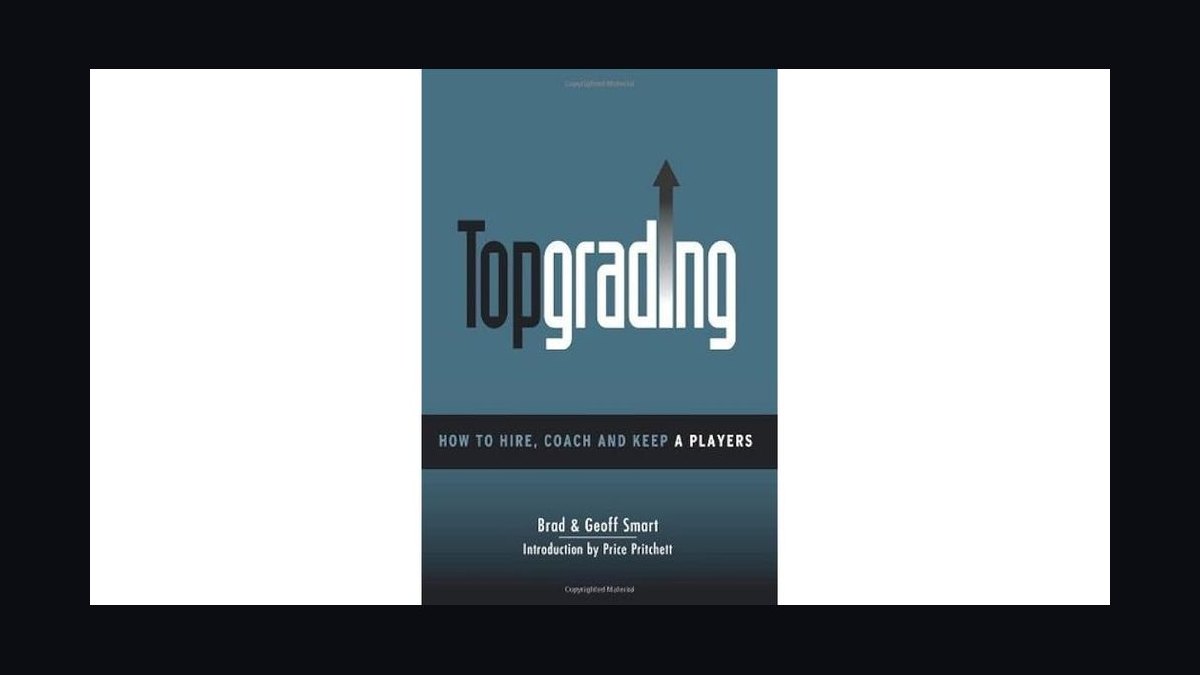
Topgrading, by industrial psychologist Brad Smart, is a hiring method built on one claim: A-Players — the top 10% of talent available at your salary range — outperform everyone else so dramatically that a long, chronological, reference-backed interview pays for itself. For sales hiring, it replaces charm-based judgment with a scorecard, a career history form, and past-boss verification.
The outcome you should expect
The honest promise of Topgrading is not that you will hire perfectly. It is that you will stop making the same mis-hire repeatedly, and that the mistakes you do make will surface in weeks rather than quarters. Smart's central arithmetic — developed across a research base he describes as 6,500-plus senior executive interviews — is that a mis-hire costs somewhere between five and fifteen times the role's annual salary once you count severance, recruiting fees paid twice, the pipeline that went cold while the seat sat empty, the customer relationships that quietly decayed, and the morale tax on the reps who had to cover. Applied to a $200,000 VP of Sales, that is a decision worth $1M to $3M, not $200K. Applied to a $75,000 AE with a $150,000 OTE, it is still a $375,000 to $1.1M decision.
What changes when a sales org actually adopts the method is less dramatic than the book's rhetoric suggests, and more useful. Three things reliably move.
First, time-to-decision gets longer and time-to-productivity gets shorter. You will spend three to four hours per finalist instead of four forty-five-minute panel conversations, so your process calendar stretches. But because the interview surfaces exactly what the candidate is weak at — and because Smart's method requires you to write a 90-day coaching plan from those findings before the person starts — the ramp is deliberate instead of sink-or-swim. In a sales context this matters enormously: a new AE's first ninety days are almost entirely determined by whether their manager knows what to coach.

Second, your bad hires self-select out before you meet them. The Career History Form is a 25-to-40-page document the candidate completes before any substantive interview, walking through every job since college with starting salary, ending salary, accomplishments, mistakes, the supervisor's name, and — the killer field — what that supervisor would likely say about their performance. Smart's observation, which practitioners consistently confirm, is that the form itself is the filter. Candidates who are coasting, who are papering over a termination, or who simply want a job rather than *this* job, abandon it. That is a feature.
Third, your hiring conversations become evidence-based instead of impression-based. Two interviewers who have walked a candidate through eleven years of career chronology are arguing about specific claims — "he said he grew the mid-market team from four to eleven but the headcount math in year three doesn't work" — not about whether someone seemed sharp. In sales hiring, where charisma is both a genuine job skill and the single most misleading interview signal, separating the two is the whole game.
What you should *not* expect is a bias-free process, a fast process, or a process that works unchanged for volume SDR hiring. Those limits are real and covered below.
What drives that outcome
Four mechanisms do the actual work. Understanding which one is failing is how you debug a Topgrading rollout that isn't producing results.

The Job Scorecard is the upstream cause of most mis-hires. Before sourcing begins, the hiring manager writes a one-page document: the role's mission in a sentence, five to seven measurable outcomes for year one, and the competencies required to deliver them. For a sales leadership role that reads like "grow ARR from $40M to $58M," "reduce ramp time from seven months to four," "build an enterprise segment from zero to $6M booked." Smart requires the hiring manager *and* their boss to sign it before a single resume is reviewed. The reason is diagnostic: most organizations that complain a hire "didn't work out" cannot produce a written statement of what working out would have meant. You cannot fail a test nobody wrote.
The chronological structure is what defeats the curated narrative. A conventional interview lets the candidate pick their evidence. A chronological one does not — you start at their first job out of school and walk forward, job by job, asking the same five or six questions each time: What were you hired to do? What did you accomplish? What were your mistakes and failures? Who was your boss, and what would they say your performance rating was? Why did you leave? The repetition is the mechanism. By hour three, a candidate maintaining an invented story has to keep it consistent across a decade of detail while tired, and inconsistencies surface on their own. Someone who was a "top performer" at Company X but left "due to restructuring" while their peers stayed has a gap to explain — and you find it because the timeline is in front of you, not because you were clever.
TORC — the Threat of Reference Check — is the honesty forcing function. Smart's most-copied technique is a single sentence delivered at the start of the interview: at the end of this process, we will ask *you* to arrange calls with the past bosses you just listed, and we will ask them these same questions. That framing does two things at once. It makes exaggeration expensive in real time, and it puts the scheduling burden on the candidate, which is itself a test — a candidate who cannot produce three of their last five direct supervisors is telling you something. Note the asymmetry with a standard reference check, where the company calls a list of friendly names the candidate curated. Here the names came from the Career History Form, before the candidate knew which ones you'd want.

The unanimity rule is what stops pipeline pressure from making the decision. Two interviewers write independent assessments against the scorecard, then meet and argue. Smart's operating rule is that both must independently rate the candidate an A-Player. A B rating is a pass — even with the territory open, even with the board asking, even in month four of the search. This is the rule that organizations abandon first and that most determines whether the rest of the method produces anything.
Benchmarks and realistic ranges
Numbers matter here because the method's cost is concrete and its benefit is probabilistic. Use these ranges to size the decision rather than to quote in a deck.
Definitional benchmark. An A-Player, in Smart's construction, is the top 10% of talent *available at the salary range you are willing to pay*. B-Players are roughly the next 25%; C-Players the remaining 65%. The market-relative framing is the part people misread. A $95K sales manager in Columbus and a $340K CRO in the Bay Area can both be A-Players. This also means the fastest way to expand your A-Player pool is to change the range, not to interview harder — a genuinely useful strategy implication that gets lost in the book's emphasis on process rigor.
Process cost. Budget three to four hours for the tandem chronological interview, plus roughly an hour of write-up per interviewer, plus thirty to sixty minutes per reference call across three to five past bosses. Realistically that is eight to twelve person-hours per finalist. Run two finalists per role and you are at sixteen to twenty-four hours. That is why the method is defensible for a VP of Sales and indefensible, unmodified, for a class of six SDRs.

Where the numbers get soft. Smart's headline claims — A-Players outperforming B-Players by 50-100% and C-Players by several multiples, mis-hires costing 5-15x salary, sustained topgraded organizations reaching dramatically better peer-relative profitability — come from his own research base and his consulting practice, not from independent replication. Treat them as directionally credible and specifically unverified. The 5-15x mis-hire figure in particular is a modeled estimate whose upper end assumes heavy customer and opportunity-cost attribution. You can build the same case for your own org with less hand-waving: take one real mis-hire from last year, add up severance, agency fee, the quota that went unattributed, and the months the seat was empty, and you will typically land somewhere in the low-to-mid single-digit multiple of salary. That number is more persuasive internally than anything from a 1999 book.
Volume-hiring reality. Smart wrote a sales-specific follow-on, *Topgrading for Sales* (2008), precisely because the executive-length process does not survive contact with rep hiring. The practical compromise most sales orgs land on: full chronological treatment for anyone managing people or carrying an enterprise number, and an abbreviated version — scorecard, shortened career history form covering the last three roles, ninety-minute chronological interview, two past-boss references — for individual-contributor hiring. That trims the per-candidate cost to roughly three to four hours while keeping the two mechanisms that do most of the work: chronology and past-boss verification.
Adjacent benchmark worth holding. Whatever process you run, the meaningful scoreboard is not offer-acceptance rate or time-to-fill. It is the percentage of hires still in seat and hitting plan at twelve months, and the percentage of hires you would enthusiastically rehire at eighteen months. Track those two by hiring manager, and you will learn more about your hiring quality in a year than any methodology debate will tell you.
Risks, edge cases, and failure modes

The bias problem is the most serious critique and the book does not resolve it. A four-hour verbal interview rewards verbal fluency, comfort in extended professional conversation, and career narratives that read as linear. Candidates with non-traditional paths, career gaps for caregiving, immigration-related employment interruptions, or English as a second language are structurally disadvantaged by a format that treats narrative smoothness as a signal of competence. The past-boss requirement compounds it — anyone who left a role because of a bad manager, a harassment situation, or a company that no longer exists faces a filter that has nothing to do with their ability. Mitigations exist and should be non-optional: score against a written rubric rather than overall impression, use blind or structured initial screens, add a work-sample component (for sales, a live discovery-call simulation against a real persona is worth more than an hour of the chronology), and treat an unavailable reference as a neutral fact requiring an alternative, not a disqualification.
The unanimity rule collapses under pipeline pressure. This is the most common practical failure. Month four of a CRO search, the board is asking, and a strong-B candidate is in front of you. The method says pass. Organizations that override this once tend to override it always, and within two cycles they are running four expensive hours of theater and hiring the same way they always did. If you cannot commit to the pass, do not adopt the method — you will spend the cost and get none of the benefit.
TORC can be applied coercively. The technique is legitimate when it means "we will verify what you tell us, so tell us accurately." It becomes something else when interviewers use it to pressure candidates into disclosing terminations, health issues, or conflicts they are under no obligation to discuss, or when a company implies it will contact a *current* employer. Contacting a current employer without explicit permission can cost a candidate their job and is an obvious line not to cross. Keep the reference scope to prior employment, get written consent, and never use the phrasing as leverage in negotiation.

The Career History Form is a genuine burden and a real drop-off risk in a tight market. Smart frames abandonment as useful filtering. In a candidate-favorable market for a mid-level sales role, it can just as easily filter out the best people, who have three other processes running and no reason to spend four hours on paperwork for a company they have not decided they want. The fix is sequencing: run a real conversation first so the candidate wants the job, then send the form to finalists only. Sending a 30-page form as an application step is the fastest way to convert a strong pipeline into no pipeline.
Annual A/B/C talent reviews on the existing team carry the most organizational risk. The book extends the framework to incumbents — rate every report annually, give B-Players a coaching window, move C-Players out within twelve months. Done well, this is ordinary performance management with unusual candor and generous exits. Done badly, it becomes stack-ranking, and stack-ranking has a well-documented track record of encouraging internal competition, discouraging risk-taking, and creating legal exposure around protected classes. It also breaks down in sales specifically, where a rep's number is a function of territory, inherited pipeline, and product-market fit as much as effort. Rate against the scorecard, adjust for territory quality honestly, and never let a forced distribution do the thinking.
Legal and documentation exposure. Extensive documented assessment of protected-class-adjacent details, salary history questions in the Career History Form, and reference practices all carry jurisdictional constraints. Salary history inquiries are restricted or banned in a number of U.S. states and cities — that field in the original form is not universally lawful. Have counsel review the form and the reference script before rolling it out; this is cheap and prevents a category of problem the book, written in 1999, does not address.

One under-discussed edge case: hiring for a role you have never had. The scorecard depends on knowing what good looks like. A founder hiring their first VP of Sales frequently writes outcomes that are fantasy — "$0 to $10M in year one" — and then runs a rigorous process against an incoherent target. Rigor downstream of a bad scorecard produces confident bad decisions. If you cannot write plausible year-one outcomes, borrow judgment from two operators who have run the role at your stage before you start.
A practical rollout plan
Do not adopt all thirteen chapters at once. The compounding value comes from three components; add the rest only after those hold.
Weeks one and two — scorecard only. Take your next open sales role and write the one-page scorecard: mission, five to seven measurable year-one outcomes, and the four or five competencies that produce them. Get your own manager to sign it. Do nothing else differently. This alone changes the interview loop, because every interviewer now knows what they are assessing against. It costs about ninety minutes and is the highest-return single change in the entire method.
Weeks three through six — add chronology and past-boss references. Introduce a ninety-minute to three-hour chronological interview for finalists, run by two people together. State TORC up front, in plain language, and mean it. Require the candidate to arrange calls with three past direct supervisors. Ask those bosses the same questions you asked the candidate, then compare. If you add nothing else, this is where the mis-hire prevention actually comes from.

Weeks seven through twelve — enforce the decision rule and write the coaching plan. Two independent write-ups, a real debate, and a genuine willingness to pass. Then, for whoever you hire, convert the weaknesses the interview surfaced into a written 90-day plan with named owners and check-in dates. This last step is quietly the highest-leverage part for sales specifically — you have just spent hours learning exactly how this person fails, and most companies throw that away the moment the offer is signed.
Month four onward — instrument it. Start tracking twelve-month retention-and-attainment by hiring manager and eighteen-month would-rehire rate. Compare cohorts hired before and after. Only extend to incumbent talent reviews once the hiring side is producing evidence, because internal ratings are far more politically costly than external ones and deserve a track record first.
Where it plugs into adjacent systems. Topgrading sits upstream of the rest of the sales-hiring stack rather than replacing it. The scorecard feeds directly into onboarding and ramp plans. The competency list is what a structured assessment tool should be validated against, if you use one — assessments are a complement to the interview, never a substitute, and any vendor claiming otherwise is selling. The interview findings feed the coaching plan, which feeds the first quarterly review. Downstream, the same scorecard becomes the basis for the comp plan design and for the internal promotion bar. Geoff Smart and Randy Street's *Who* (2008) is the shorter, more accessible descendant of the same method and is often the easier book to hand a hiring manager who will never read the 1999 original; Lou Adler's performance-based hiring work runs parallel with a heavier emphasis on defining the role in outcome terms. If your team will read one thing, *Who* gets you eighty percent of the operational value in a fifth of the pages.
Related questions
Is Topgrading worth it for hiring SDRs and AEs?
Not in its full four-hour form. Use the scorecard, a shortened career history covering the last three roles, a ninety-minute chronological interview, and two past-boss references. That keeps the mechanisms that matter — chronology and verification — at roughly a quarter of the cost.
What is the single highest-return piece to steal?

The past-boss reference call, where the candidate schedules it and you ask the boss the same questions you asked the candidate. It requires no methodology adoption, takes thirty minutes, and catches the majority of narrative inflation.
How does Topgrading differ from *Who* by Geoff Smart?
*Who* is the same method compressed and generalized — scorecard, sourcing, a shorter chronological "Who interview," and reference calls. It is faster to teach and easier to sell internally. Topgrading is the deeper, more demanding original, aimed squarely at executive hiring.
Does the A/B/C framework mean firing the bottom 65%?
No. C-Player is defined relative to a specific role's scorecard, not as a global verdict on a person. Someone who is a C in an enterprise closing seat may be an A in mid-market or in sales engineering. Reassignment is the first option, not the last.
Can assessment tools replace the interview?
No. Structured assessments add a consistent signal on traits and can reduce interviewer variance, but they do not verify claims about past performance. The reference call does that, and nothing else in the stack substitutes for it.
FAQ
What exactly is an A-Player in Topgrading?
The top 10% of talent *available at the salary range you are willing to pay* — a market-relative definition, not an absolute one. This is the most frequently misquoted idea in the book. It also implies a lever most teams ignore: if your A-Player pool is genuinely empty, the constraint is often the range or the role design, not the search.

Why does the interview need to be three to four hours?
Because the value comes from chronological completeness, and you cannot walk a fifteen-year career job by job in ninety minutes. The pattern recognition — repeated conflicts with bosses, salary plateaus, a pattern of leaving right before results were measured — only appears when the whole timeline is in front of you.
What does TORC actually change?
It moves verification from the end of the process to the beginning, psychologically. Telling a candidate up front that their named past bosses will be asked the same questions makes exaggeration costly in the moment. Some candidates self-deselect at that sentence, which is information you would otherwise have paid to learn later.
Are the 5-15x mis-hire cost numbers reliable?
They come from Smart's own research and consulting practice rather than independent replication, and the upper end assumes aggressive attribution of lost opportunity and customer damage. Directionally sound, specifically unverified. Build the case from one of your own real mis-hires instead — it will be lower, defensible, and far more persuasive internally.
What is the biggest reason Topgrading rollouts fail?
Abandoning the pass. The method's entire value rests on being willing to reject a strong-B candidate with the seat open and pressure mounting. Organizations that break that rule keep the cost of the process and lose the benefit.
How should this interact with a structured assessment platform?
As a complement. Validate any assessment against the competencies on your scorecard, use it to reduce interviewer variance early in the funnel, and never let a score override the reference calls. Assessments predict traits; references verify behavior. You need both, and only one of them is evidence about what the person actually did.
Sources
- https://www.penguinrandomhouse.com/books/298833/topgrading-3rd-edition-by-bradford-d-smart-phd/
- https://topgrading.com/
- https://www.ghsmart.com/who-the-a-method-for-hiring/
- https://hbr.org/2009/05/the-definitive-guide-to-recruiting-in-good-times-and-bad
- https://www.shrm.org/topics-tools/topics/talent-acquisition
- https://www.eeoc.gov/laws/guidance/employment-tests-and-selection-procedures
- https://www.dol.gov/agencies/ofccp/faqs/employee-selection-procedures
- https://www.apa.org/education-career/guide/subfields/organizational
- https://www.gartner.com/en/human-resources/topics/talent-acquisition
Related on PULSE
This page will be disappearing soon. Save it to your device for $1 — or read it free while it is here.
@Kory-White- · if Venmo asks, the last 4 of my number are 2012
This page is gone.
This one is off the shelf now. $1 keeps it on your phone for good — the whole page, pictures and diagrams included.
 pulse-recentSelling Above and Below the Line by Skip Miller — Top 10 Key Takeaways for Sales Leaders in 2027
 pulse-recentHow to Apply Strategic Selling — Step-by-Step Playbook in 2027
 pulse-recentThe Collaborative Sale by Keith Eades — Top 10 Key Takeaways for Sales Leaders in 2027
 pulse-recentThe Sandler Rules by David Sandler — Top 10 Key Takeaways for Sales Leaders in 2027
 pulse-recentWhat is the first concrete step in Sandler Rule #4 for a sales leader to implement in 2027?
 pulse-recentThe Greatest Salesman in the World by Og Mandino — Top 10 Key Takeaways for Sales Leaders in 2027
 pulse-recentSales EQ by Jeb Blount — Top 10 Key Takeaways for Sales Leaders in 2027
 pulse-recentHow do you implement the Sandler Rules in your first 30 days as a new sales rep in 2027?
 pulse-recentBlue Ocean Strategy by W. Chan Kim and Renee Mauborgne — Top 10 Key Takeaways for Sales Leaders in 2027
 pulse-recentCrossing the Chasm by Geoffrey Moore — Top 10 Key Takeaways for Sales Leaders in 2027