


Transformed by Marty Cagan — Cliff Notes Summary
Quality
Certified
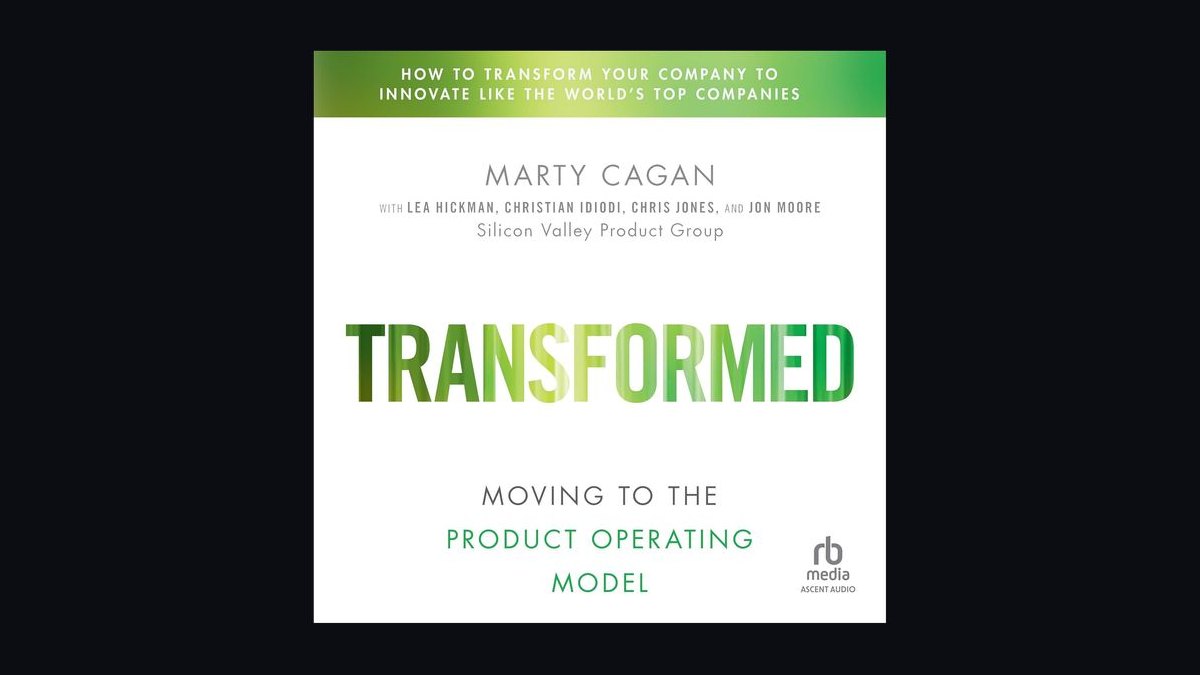
*Transformed: Moving to the Product Operating Model* (Wiley, 2024) by Marty Cagan with Chris Jones, Lea Hickman, and Jon Moore is the org-wide migration playbook that closes the trilogy after *Inspired* and *Empowered*. Its thesis: most companies remain feature factories, and escaping requires a CEO-mandated, multi-year shift across four competencies — strategy, discovery, delivery, and culture.
The Tuesday morning that makes the book necessary
Picture a $180M ARR B2B software company. It is Tuesday. The VP of Product walks into a quarterly business review holding a roadmap spreadsheet with forty-one line items on it. Thirty-four of those line items trace back to a specific deal: a logo the sales team is trying to close, a renewal at risk, a customer who threatened escalation on a call in March. Seven of them came from an executive who saw a competitor demo at a conference. Zero of them came from a product manager talking to a customer and forming an independent view of what would actually move the business.
That room is the exact scene Marty Cagan wrote *Transformed* to address. The company in that scene has product managers — real ones, with the title on their badge and a seat in the QBR. It has a design team. It has sprints and standups and a backlog groomed to two decimal places of story-point precision. On paper it looks like a modern product organization. In practice it is a very expensive order-taking service, and every incentive in the building reinforces that. The PM is measured on whether the roadmap shipped on time. Engineering is measured on velocity. Sales is measured on bookings, which means sales is measured on its ability to promise things, which means sales is structurally rewarded for putting items on the roadmap. Nobody in that room is measured on whether the customer's problem got solved.

Cagan's uncomfortable observation, the one that opens the book, is that this scene persists at companies that have read his earlier work and believe they already made the change. *Inspired* came out in 2008 and defined what a strong product manager actually does. *Empowered*, co-written with Chris Jones in 2020, defined what strong product leadership looks like. And yet after years of consulting through Silicon Valley Product Group, Cagan kept walking into rooms exactly like the one described above — companies that had adopted the vocabulary without adopting the model. He names the failure mode directly: the "product manager in name only," a person doing project management with a product title, collecting requests upstream and routing them downstream.
What makes the scene worth dissecting is that nobody in it is behaving irrationally. The sales leader promising a feature to close a deal is doing exactly what the comp plan rewards. The PM writing that feature into the roadmap is protecting a relationship they depend on for information and political cover. The engineer building it is doing what the ticket says. The CEO approving the roadmap is looking at a document that appears to represent customer demand, because in a literal sense it does — every item came from a customer conversation. The system is coherent. It is also, in Cagan's framing, structurally incapable of producing products people love, because it never asks whether the requested feature is the best available way to solve the underlying problem. It only asks whether the feature was requested loudly enough.
The frame matters for anyone in a revenue role, because the feature-factory pattern is not a product-org pathology that sales observes from outside. Sales is a load-bearing wall of it. The book's most quoted claim among commercial leaders is that the sales-to-product relationship is where transformations most reliably stall, and the reason is straightforward: a discovery-driven product organization cannot make the promises a feature-factory product organization made freely. If the rest of the go-to-market motion is built on those promises, removing them without a replacement leaves reps holding a bag.
How the four competencies actually fit together
The spine of the book is a set of four competencies that Cagan argues must be adopted together rather than à la carte. Product strategy is the decision about where to focus — driven by insight and articulated through outcome-based objectives rather than a dated feature list. Product discovery is the work of determining what to build before committing engineering capacity to building it. Product delivery is the capability to ship reliably and at quality, frequently enough that discovery findings can actually be acted on. Product culture is the connective tissue: empowered teams, real coaching, a vision people can repeat without reading it off a slide.
The reason the four have to move together is mechanical, not philosophical. Consider what happens when a company adopts discovery in isolation. Teams start running interviews and prototype tests, they generate genuine insight about what customers need — and then that insight collides with a roadmap that was already committed to sales and the board. Discovery becomes theater: expensive research that produces findings nobody is permitted to act on, which teaches the organization that discovery is a tax rather than a tool. Adopt strategy without delivery and you get beautifully articulated objectives that the engineering organization cannot ship against, because releases are quarterly and every change requires a six-week regression cycle. Adopt culture language — "empowered teams" — without strategy, and teams are empowered to do what, exactly? Autonomy without a strategic frame produces forty teams optimizing forty local metrics in forty directions.
The delivery competency deserves more attention than it typically gets in summaries of this material, because it is the one that most often silently blocks everything else. Discovery only pays off if the loop closes fast enough to learn. If a validated solution takes five months to reach a customer, the feedback arrives after the team has moved on, the market has shifted, and the person who ran the discovery has changed roles. Practically this means the delivery competency is largely an engineering-practice question — deployment frequency, test automation coverage, the ability to release to a subset of users, instrumentation good enough that you can tell whether the thing worked. Companies that try to install the model without doing this plumbing find that everything else runs at the speed of their slowest release train.
Culture is where the trilogy's continuity shows most clearly. *Empowered* argued that the binding constraint on product organizations is leadership quality — specifically the willingness of leaders to coach rather than direct. *Transformed* carries that forward as an operational requirement: without a functioning coaching relationship, product managers handed autonomy for the first time will do one of two things. They will freeze, because nobody has ever asked them to form an independent strategic view and they have no method for it. Or they will overcorrect into unilateral decision-making that ignores commercial reality, which hands the feature-factory faction all the ammunition it needs to argue the whole experiment was a mistake.
What the numbers and timelines actually look like
The headline figure from the book is the transformation window: roughly twelve to twenty-four months for a company-wide shift. That range deserves interpretation rather than repetition, because the two ends describe genuinely different situations. The lower end applies to companies that already have decent delivery engineering, a CEO who was personally the driving force, and a product leadership bench that mostly needs permission rather than replacement. The upper end — and in practice the overrun beyond it — applies to larger enterprises with entrenched governance, annual budget cycles that lock scope twelve months ahead, and executives whose entire career capital is invested in the current operating model.
Cagan is explicit that transformation runs as a CEO mandate rather than a product-led initiative, and that bottom-up attempts stall. The reason is a budgeting reality more than a motivational one. Moving to outcome-based objectives means the company stops committing to a dated feature list a year in advance. But the annual planning process, the sales compensation design, the board reporting package, and often the enterprise contract language all assume that dated list exists. A VP of Product cannot unilaterally change any of those four things. Only the CEO can, and only the CEO can protect the budget through the period where the old measurement system says things are getting worse — because it will say that. Output metrics dip when a team stops shipping requested features and starts testing whether those features were worth building.
The book uses a memorable framing for organizational resistance: antibodies. Long-tenured executives who built the feature factory, and who are genuinely good at operating it, will move to neutralize the change — usually not through open opposition but through the ordinary machinery of a large company. A governance review that adds two weeks to every discovery cycle. A request for "just a bit more detail" in the roadmap that quietly restores the feature list. An escalation path that lets any large customer bypass the product process. The estimate that this pressure kills an unprotected transformation within roughly half a year is a rule of thumb rather than a measured constant, but it matches the pattern the case studies describe.
On the commercial side, the number worth knowing is the lag. Sales organizations moving off feature promises tend to feel worse before they feel better, and the recovery period in the book's examples runs on the order of six to nine months. Early in that window, reps lose a tool they relied on — the ability to unblock a stalled deal by committing to a roadmap item — and win rates in specific competitive situations can genuinely suffer. What replaces it takes longer to compound: a product that solves the problem well enough to shorten evaluation cycles, produce reference customers, and reduce the volume of "we bought it for X and X never worked" churn. Any CRO planning this transition should budget for a measurable trough and communicate it upward before it appears in a board deck, because an unexplained dip in quarter two is how transformations get cancelled in quarter three.
The case studies carry names — Trainline in UK rail booking, Datasite in M&A software, Almosafer in Saudi travel, plus larger enterprises including Adobe, CarMax, Kaiser Permanente, and Gympass. Each follows a consistent template: starting state, the CEO's specific action, where sales resisted, how discovery was installed, and what changed roughly eighteen months later. The consistency of that template across wildly different industries — a rail ticketing app and a health system have almost nothing in common operationally — is the closest thing the book offers to empirical proof. It is worth reading them as pattern illustrations rather than as controlled evidence; these are consulting engagements described by the consultant, and the selection is not random.
Trade-offs, and the alternatives people actually choose
The honest version of this material acknowledges that the product operating model is not free and is not universally correct. It trades predictability for effectiveness. A feature factory can tell a customer, a board, and a sales team precisely what will exist in nine months. A discovery-driven organization can tell them what problem it intends to solve and roughly when, but not the specific shape of the solution — because determining the shape is the work. For a company whose commercial model depends on committed roadmaps, that trade is expensive. Government contracts, regulated industries with certification timelines, hardware-coupled software, and large enterprise deals with contractual feature commitments all have real reasons to preserve some forward commitment.
The practical resolution most companies land on is a portfolio split rather than a binary. Some surface area of the product — compliance work, platform migrations, contractual obligations, integrations a partner requires by a date — is run as committed delivery with dates. The rest is run against outcomes. The split is negotiated openly rather than smuggled in, and the ratio is a strategy decision the CEO owns. That is not the pure model, and Cagan would likely call an organization that puts eighty percent of capacity into the committed bucket a feature factory wearing new vocabulary. But it is what functioning transformations in constrained industries tend to look like.
The main alternatives worth comparing are the ones companies pick instead. Scaled agile frameworks solve a real coordination problem — how do forty teams plan together — but they largely preserve the feature-list-as-input structure; the list gets planned more rigorously, not questioned more rigorously. Continuous discovery practice, as developed by Teresa Torres in *Continuous Discovery Habits*, is complementary rather than competing: it supplies the team-level habit (regular customer contact, opportunity mapping, small assumption tests) that the discovery competency requires, but it does not address the executive and budgeting layer that Cagan argues is decisive. A team can run excellent continuous discovery inside a company that will never act on it. Lean startup practice shares the validation instinct but was written for a zero-to-one context; applying it wholesale to a large installed base with enterprise contracts produces different failure modes.
There is also a cost question that gets underplayed. The model is coaching-intensive, and coaching capacity is the scarcest resource in most product organizations. If a company has thirty product managers and four people capable of coaching them on strategy and discovery technique, the constraint is not the framework — it is that ratio. The realistic options are to hire experienced product leaders into coaching-heavy roles, to shrink the number of teams so the existing leaders can cover them, or to accept a slower transformation. Companies that skip this arithmetic and simply declare teams empowered are the ones that produce the freeze-or-overcorrect pattern described earlier.
The sales–product treaty, and how it breaks
The chapter sequence most relevant to revenue leaders is the one on the sales-product relationship, and its prescription is narrower than it first appears. The instruction is not that sales stops talking to product, or that customer requests become inadmissible. It is a change in the unit of exchange. Sales stops handing product a feature and starts handing product an outcome — the customer needs onboarding to drop from ninety days to thirty, the customer needs to close their books three days faster, the customer needs to cut manual reconciliation time in half. Product then runs discovery on the best route to that outcome, which may be the feature sales imagined, a smaller version of it, a configuration change, or something structurally different.
The mechanism works because it moves the conversation to ground where both functions have genuine authority. A sales leader arguing for a specific feature is arguing about implementation, where product has more information and will usually win the argument or lose it resentfully. A sales leader articulating a customer outcome is contributing the one input product cannot generate on its own — direct, high-volume, commercially-consequential exposure to what customers are trying to accomplish. In organizations where this works, sales becomes the highest-value input into strategy rather than an interruption to it, which is the inversion the book is aiming at.

The failure modes are specific and worth naming. First, outcome-washing: a rep translates "they want a bulk export button" into "they need to reduce manual data handling," which is technically an outcome but is really the same feature request wearing a costume. The tell is that the stated outcome admits exactly one solution. Second, the escalation bypass: everything runs through the outcome process except the top ten accounts, whose requests go directly to engineering through a side channel. If that channel exists, the model is decorative, because the accounts using it are the ones that set the culture. Third, the missing referee: the CRO and the product leader agree to the treaty in principle, then hit a live deal where a commitment would close it, and there is no one with authority to make the call in the moment. The book is direct that the CEO has to referee early friction personally; delegating it means the loudest quarterly pressure wins by default.
There is a fourth failure that shows up downstream in customer success and support rather than in sales. When a feature factory stops promising features, the promises already made do not disappear. There is typically a backlog of commitments — some in writing, some in a rep's notes, some only in a customer's memory of a call — that were made under the old model. Transformations that ignore this inheritance generate a churn event around month nine, when customers who bought on a promise discover the promise has quietly been reprioritized. The workable move is an explicit audit: enumerate outstanding commitments, decide deliberately which to honor and which to renegotiate, and have those renegotiation conversations proactively rather than at renewal.
Pitfalls that kill transformations, and what prevents them
The most common way this fails is partial adoption dressed as full adoption. A company runs discovery workshops, renames its roadmap an outcome roadmap, adds a "customer problem" column to the intake form, and declares the operating model installed. Six months later the intake form has forty-one rows again, each with a problem statement written backward from a predetermined feature. The prevention is measurement: track what fraction of shipped work was validated through discovery before commitment, and track whether any team ever killed a planned item because discovery said it would not work. If the kill rate is zero, discovery is not running — it is documenting.
The second pitfall is regression under pressure, which the book treats as a permanent condition rather than a phase. A major account threatens to churn, a board member demands a specific capability after a competitor briefing, a quarter comes in soft — and the organization reaches for the tool it knows. What sustains the model through these moments is unglamorous: the CEO continuing to attend product reviews long after the interesting part is over, coaching cadence that survives the first busy quarter, and leadership continuity in the roles that hold the line. Cagan is blunt that some executives will not make the transition and will need to leave, which is the least comfortable claim in the book and the one most often skipped in summaries of it.

The third is timeline dishonesty. Announcing an eighteen-month transformation and then reporting progress against output metrics for the first two quarters guarantees a bad story, because output is exactly what dips. Organizations that survive this define what leading indicators look like in months one through six — discovery cycles run, assumptions tested and disproven, deployment frequency, the number of planned items killed on evidence — and report against those explicitly, with the outcome metrics arriving later. Reporting the right metric at the wrong time is how a working transformation gets killed for looking like a failing one.
A fourth pitfall sits in the AI-tooling era and is genuinely new since the book's publication. Modern coding and research assistants compress the cost of building, which tempts organizations to conclude that discovery matters less — if a prototype takes an afternoon, why validate first? The inference runs backward. When building gets cheap, the constraint moves entirely to deciding what is worth building, which is precisely the strategy and discovery competency. Cheap building without strategic discipline produces a larger feature factory, faster. The right use of the tooling is to shorten the discovery loop itself: more prototypes tested against real users per week, faster synthesis of research, quicker instrumentation of live experiments.
Finally, there is the pitfall of importing the model without the context. The named case studies span rail booking, M&A software, travel, retail, and healthcare, and the specifics differ enormously — a health system's discovery process runs into clinical governance that a travel app never encounters. Reading the case studies as templates to copy produces cargo-cult implementations. Reading them as illustrations of the same four competencies adapting to different constraints is the intended use, and it is why the book reads as a set of principles with worked examples rather than a checklist. Anyone treating this Cliff Notes summary as a substitute for the primary text should at minimum read the sales-product chapters directly, since that is where the specific negotiation language lives.
Related questions

Do I need to read *Inspired* and *Empowered* first?
Not strictly. *Transformed* stands alone as the org-level playbook. *Inspired* is most useful for individual product managers learning the craft, and *Empowered* for people managing product managers. Read *Transformed* first if your question is organizational rather than personal.
What does this mean for a sales leader specifically?
Stop letting reps close on feature commitments, and build a repeatable way to translate deals into customer outcomes that product can run discovery against. Expect a win-rate trough of roughly six to nine months, and communicate that upward before it appears in a board review.
Can a transformation work without the CEO?
Cagan's position is no — bottom-up attempts stall because compensation design, planning cycles, board reporting, and contract language all sit above the product organization. A determined product leader can improve one team's practice, but the operating-model change requires authority over those four systems.
How does this relate to continuous discovery?
They complement rather than compete. Continuous discovery supplies the team-level habits — regular customer contact, opportunity mapping, small assumption tests. *Transformed* supplies the executive, budgeting, and organizational layer that determines whether those habits are allowed to change what gets built.
Is any of this different in the AI era?
The building half got dramatically cheaper; the deciding half did not. That shifts more weight onto strategy and discovery, not less. Use AI tooling to shorten the discovery loop — faster prototypes, faster synthesis — rather than to skip it.
FAQ
What is the product operating model in one sentence?
It is a way of working in which empowered teams are given customer or business problems to solve rather than features to build, supported by four interlocking competencies — product strategy, product discovery, product delivery, and product culture — and measured on outcomes rather than shipped output.
**How is *Transformed* different from Cagan's earlier books?**
*Inspired* (2008) described what a strong product manager does. *Empowered* (2020, with Chris Jones) described what strong product leadership does. *Transformed* (2024, with Jones, Lea Hickman, and Jon Moore) describes how to move an entire company from a feature-factory operating model to the product operating model, which is a change that reaches finance, sales, and the board rather than staying inside the product function.
Why does Cagan single out the sales relationship as the hardest block?
Because sales organizations have been trained and compensated to close deals by promising specific capabilities, and a discovery-driven product organization cannot make those promises. Removing the tool without replacing it leaves reps exposed. The prescribed replacement is customer-outcome alignment: sales contributes the outcome a customer needs, product determines the best route to it, and the CEO referees the friction that follows.
How long does the transformation take, realistically?
The book's range is twelve to twenty-four months, with the low end applying to companies that already have solid delivery engineering and a personally committed CEO. Larger enterprises with annual scope-locked budgets, contractual feature commitments, and entrenched leadership routinely run longer. Treat the range as a planning input, not a promise.
Is this book only useful for product managers?
No. It is written for the executive team — CEOs, CTOs, and commercial leaders in particular — because the changes it prescribes span compensation design, planning cadence, and board reporting. A revenue leader gets the most value from the chapters on the sales-product relationship and customer-outcome alignment.
What is the fastest way to tell whether a company has actually adopted the model?
Ask how many planned items were killed in the last two quarters because discovery showed they would not work. If the answer is zero, the company is running discovery as documentation rather than as a decision process, and the roadmap is still the real operating system.
Sources
- Transformed: Moving to the Product Operating Model — Wiley
- Silicon Valley Product Group — articles and the product operating model
- Marty Cagan — author page, Wiley
- Inspired: How to Create Tech Products Customers Love — Wiley
- Empowered: Ordinary People, Extraordinary Products — Wiley
- Teresa Torres — Product Talk, continuous discovery
- Andy Grove — High Output Management (Penguin Random House)
- Harvard Business Review — product management and organization topics
- McKinsey — product management and digital transformation insights
Related on PULSE
This page will be disappearing soon. Save it to your device for $1 — or read it free while it is here.
@Kory-White- · if Venmo asks, the last 4 of my number are 2012
This page is gone.
This one is off the shelf now. $1 keeps it on your phone for good — the whole page, pictures and diagrams included.
 pulse-recentWhat is the Blue Sheet from Strategic Selling by Miller Heiman and how do you fill it out in 2027?
 pulse-recentBlue Ocean Strategy by W. Chan Kim and Renee Mauborgne — Top 10 Key Takeaways for Sales Leaders in 2027
 book-summaryLittle Red Book of Selling by Jeffrey Gitomer — Cliff Notes Summary
 pulse-recentBlueprints for a SaaS Sales Organization by Jacco van der Kooij — Top 10 Key Takeaways for Sales Leaders in 2027
 pulse-recentWhat are the concrete steps in Strategic Selling for building a sales plan in 2027?
 pulse-recentSandler Rule #1: What is the first concrete step to build a prospect's trust in a sales conversation in 2027?
 pulse-recent$100M Offers by Alex Hormozi — Top 10 Key Takeaways for Sales Leaders in 2027
 pulse-recentWhat is the step-by-step process for Strategic Selling by Miller Heiman in 2027?
 pulse-booksWhat are the most common mistakes in Book Summaries in 2027?
 pulse-recentSales Engagement by Manny Medina — Top 10 Key Takeaways for Sales Leaders in 2027