


Hacking Growth by Ellis and Brown — Cliff Notes Summary
Quality
Certified
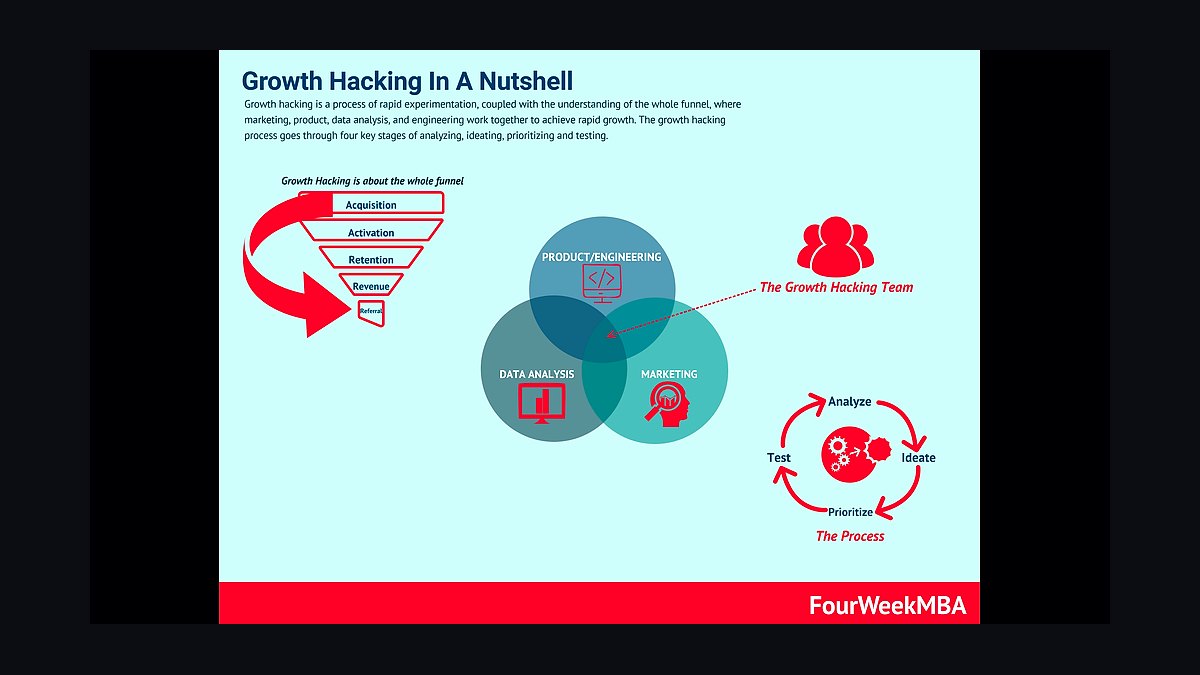
Sean Ellis and Morgan Brown's *Hacking Growth* (2017) codifies a repeatable, cross-functional experimentation system for driving sustainable growth: a small pod running weekly experiments across the Pirate Metrics funnel, guided by a North Star Metric, an engineered Aha Moment, and ICE prioritization, replacing traditional quarterly marketing campaigns with rapid, data-driven hypothesis sprints.
What it is and why it matters
*Hacking Growth* is not a tactics book; it is an operating manual for a cross-functional growth team. The canonical team comprises five people: a Growth Lead (often a senior PM), a dedicated engineer, a product designer, a data analyst, and a product marketer. This squad runs rapid experiments across the entire customer journey — from acquisition through referral — in weekly cycles. Ellis coined the term "growth hacker" in a 2010 blog post after observing that traditional marketing could not keep pace with the product-led companies he advised. The book distills seven years of running that model inside high-growth companies like Dropbox, LogMeIn, and Eventbrite into a structured methodology.
Why this matters for RevOps and sales leaders: the operating model applies one-for-one outside of product. A sales team that runs weekly outbound cadence experiments, ICE-scored against pipeline impact, with instrumentation to measure results, is operating the Ellis/Brown system. The book provides the cleanest argument anywhere for why revenue teams should operate like product squads — with hypothesis sprints, metric-driven prioritization, and cross-functional ownership. The strategy is industry-agnostic: any team that owns a funnel can adopt the cadence.
The book sits in the modern growth canon between Eric Ries's *Lean Startup* (2011), which introduced the build-measure-learn loop, and Wes Bush's *Product-Led Growth* (2019), which extended the model into a full business model. Ellis and Brown's contribution is the tactical layer — the weekly sprint, the ICE score, the team composition — that makes the Lean Startup abstract actionable for a growth team.

The step-by-step process
The Ellis/Brown system follows a repeatable weekly cycle that compounds over time. The process has six phases, each gated by a specific diagnostic:
Phase 1 — Verify product-market fit. Before any growth spending, the team runs the Must-Have Survey. Ellis asks every new user one question: "How would you feel if you could no longer use this product?" with four answer choices (Very disappointed / Somewhat disappointed / Not disappointed / N/A). The threshold is 40% or more "very disappointed." Below 40%, growth spending is wasted; the team's job is fixing the product, not acquiring more users. Ellis's verbatim formulation in the book: "40% must-have = product-market fit — anything below is delusion."
Phase 2 — Choose the North Star Metric. Once the product clears the must-have bar, the team selects a single metric that captures core delivered value. The canonical examples from the book: Spotify — time spent listening; Facebook — monthly active users; Airbnb — nights booked; WhatsApp — messages sent; Slack — 2,000+ messages within a team. The North Star is not revenue, because revenue is downstream of value delivery. Choosing a North Star that conflates the two is the most common mistake.

Phase 3 — Engineer the Aha Moment. The Aha Moment is the specific in-product behavior that correlates with long-term retention. Ellis's foundational claim, repeated throughout the book: "the Aha Moment is engineered, not discovered." The team identifies the behavior through retention-curve analysis — segmenting users by whether they performed a specific action in their first session, then comparing retention curves. The named cases: Facebook — 7 friends in 10 days; Twitter — follow 30 accounts; Slack — 2,000 messages in a team; Dropbox — install on a second device. Each was discovered through data, not opinion.
Phase 4 — Decompose the North Star into a growth equation. The team maps the multiplicative chain of inputs: new users × activation rate × retention × revenue per user × referral coefficient. Every experiment is mapped to a specific lever in the equation. This prevents the team from running random tests and ensures every experiment has a clear hypothesis about which input it moves.
Phase 5 — Run weekly experiment sprints. The cadence is weekly. Every Tuesday: review last week's experiment results, prioritize next week's tests using ICE scoring (Impact, Confidence, Ease, each 1–10), ship by Friday. Ellis's verbatim instruction: "a team running fewer than three experiments per week is not a growth team — it is a marketing team with a new name." The compounding logic: a team running ten experiments per week with a 20% win rate ships twice as many wins per month as a team running three experiments.
Phase 6 — Synthesize and iterate. The team documents every experiment — hypothesis, result, learning — in a shared backlog. Failed experiments are celebrated as long as the learning was clean. The team uses the synthesis to generate new hypotheses for the next cycle.
Costs, timelines, and typical ranges

The book does not provide exact dollar figures for running a growth team, but it gives clear ranges for team size, experiment velocity, and time horizons.
Team size and cost. The canonical growth team is five people: Growth Lead (senior PM-level), engineer, designer, analyst, and product marketer. At 2025 market rates in the US, this team costs approximately $600,000–$900,000 annually in fully loaded compensation. The book warns against the "team-bloat trap" — a 20-person growth org that ships slower than the original five because coordination overhead kills velocity. The optimal range is 3–7 people for most companies.
Experiment velocity. The book's minimum bar is three experiments per week. High-performing teams run 10–15 per week. At a 20% win rate, a team running 10 experiments per week ships 8 wins per month; a team running 3 experiments per week ships 2.4 wins per month. The compounding effect over a quarter is dramatic: 24 wins vs. 7 wins.
Time to first Aha Moment. Identifying the Aha Moment typically takes 4–6 weeks of retention-curve analysis. The team segments new users by first-session behavior, builds retention curves for each segment, and identifies the behavior that separates high-retention users from low-retention users. Once identified, redesigning onboarding to push every user across that line takes another 2–4 weeks of experimentation.

Time to North Star impact. The book suggests that a well-functioning growth team begins moving the North Star Metric within 6–8 weeks. The first 4 weeks are diagnostic — running the Must-Have Survey, identifying the Aha Moment, setting up instrumentation. Weeks 5–8 are the first wave of experiments. By week 8, the team should have at least one statistically significant win.
Retention stages and timelines. The book prescribes a three-stage retention model: Initial Retention (week 1), Medium Retention (months 1–3), Long-Term Retention (months 3+). Each stage has different tactics — onboarding nudges and habit-forming triggers for initial, content and feature depth for medium, community and identity for long-term. The book leans heavily on Nir Eyal's *Hooked* model — Trigger, Action, Variable Reward, Investment — as the canonical retention-engineering framework.
Viral coefficient ranges. The book defines viral growth by the K-factor: the number of new users each existing user invites times the conversion rate of those invites. K above 1.0 is true viral growth (rare). K between 0.3 and 0.7 is "viral assist" (common and valuable). Dropbox's referral program — 500 MB for the inviter and the invitee — drove 60% of signups at peak, with a K-factor estimated at 0.5–0.7.
Where teams get it wrong
The book's Chapter 10 names the failure modes of mature growth teams, and practitioners have observed additional patterns since publication.

The local-maximum trap. The team runs endless small optimizations — button color changes, copy tweaks, layout adjustments — and stops running bold experiments. The ICE scoring system exacerbates this: easy experiments with high confidence always score well, while high-impact but risky experiments score lower. The prescription is a quarterly "big-bet review" where the team allocates 20–30% of capacity to swing-for-the-fences experiments outside the optimization grind.
The metric-gaming trap. The team optimizes a proxy metric that diverges from the North Star. Example: a team optimizing "time on site" runs experiments that make the product harder to use, increasing time on site but decreasing actual value delivery. The North Star Metric concept is designed to prevent this, but teams often choose a North Star that is too easy to measure rather than one that captures true value.
The team-bloat trap. A 20-person growth org that ships slower than the original five because coordination overhead kills velocity. The book warns that growth teams should stay small and focused. The anti-pattern is a growth "function" buried under a CMO, with no engineering capacity, running pseudo-experiments that take six weeks each.
The burnout trap. Weekly cadence without recovery time produces 18-month attrition cycles. Growth team members burn out because the pace is relentless — every week a new set of experiments to ship, every Tuesday a results review. The book's prescription: a deliberate culture of celebrating failed experiments as long as the learning was clean, and periodic "recovery sprints" where the team focuses on documentation and synthesis rather than shipping.

The premature scaling trap. Founders who skip the Must-Have Survey and pour money into paid acquisition before crossing the 40% threshold get a temporary growth curve that collapses six months later, because retention is broken. This is the most expensive mistake in the book — wasted acquisition spend on a product that does not retain users.
The funnel trap. The book uses the funnel as its mental model — Acquisition → Activation → Retention → Revenue → Referral. Modern PLG canon has largely replaced the funnel with the growth loop: Acquisition → Activation → Retention → Referral feeds back into Acquisition compoundingly. Loops compound; funnels leak. Teams that think only in funnels miss the compounding effects of referral and viral loops.
The AI blind spot. The book pre-dates the AI-tool generation. Modern growth teams use ChatGPT, Claude, Lovable, and Cursor to compress experiment design and analysis from days to hours. The five-person pod is now often three people plus AI. Teams that ignore AI tooling are running at 1/3 the velocity of teams that adopt it.
Decision framework: when to choose what
The Ellis/Brown system is not appropriate for every situation. The decision framework below helps teams determine when to use the full growth-hacking methodology versus other approaches.
When to use the full growth hacking system: You have a product that has crossed the 40% must-have threshold. You have engineering capacity dedicated to the growth team. You have instrumentation in place to measure experiments. Your team can commit to a weekly cadence. The book is designed for this scenario.

When to use Lean Startup instead: You do not yet have a product. You are still in the build-measure-learn loop, testing hypotheses about the problem and solution. The growth hacking system assumes a working product; Lean Startup assumes you are still finding it.
When to use traditional marketing instead: Your product has not crossed the 40% must-have threshold. The book is explicit: below 40%, growth spending is wasted. Traditional marketing — brand campaigns, content marketing, demand generation — can build awareness while the product team fixes retention, but the growth hacking system should not be deployed until PMF is confirmed.
When to use PLG instead: Your revenue model is not yet clear. The growth hacking system optimizes within an existing business model; PLG extends the operating model into a full business model where the product itself drives acquisition, retention, and expansion. Wes Bush's *Product-Led Growth* (2019) is the better reference for this scenario.
When to adapt the system for RevOps: The growth hacking system applies one-for-one to outbound cadence design, pricing tests, and deal-velocity work. A RevOps team running weekly hypothesis sprints on email sequences, call scripts, and pricing page variants, ICE-scored against pipeline impact, is operating the Ellis/Brown system. The key adaptation: the North Star Metric becomes pipeline velocity or win rate, and the Aha Moment becomes the specific sales interaction that correlates with closed-won deals.
Related questions
What is the Must-Have Survey and how do I run it?

The Must-Have Survey asks one question: "How would you feel if you could no longer use this product?" with four answer choices. The threshold is 40% or more "very disappointed." Run it on a sample of 100+ active users who have experienced the product's core value.
How do I identify the Aha Moment for my product?
Segment new users by first-session behavior, build retention curves for each segment, and identify the behavior that separates high-retention users from low-retention users. This typically takes 4–6 weeks of cohort analysis.
What is ICE scoring and how do I use it?
ICE stands for Impact, Confidence, and Ease, each scored 1–10. The average gives a priority score. Impact measures how much the experiment moves the metric; Confidence measures how sure you are it will work; Ease measures how quickly you can run it.
Can the growth hacking system work for B2B companies?
Yes. The book's examples include Dropbox and LogMeIn, both B2B. The system works for any team that owns a funnel — including RevOps, sales, and customer success teams.
What is the difference between growth hacking and growth loops?
Growth hacking uses a funnel mental model (Acquisition → Activation → Retention → Revenue → Referral). Growth loops treat the process as a compounding cycle where Referral feeds back into Acquisition. Loops compound; funnels leak.
FAQ

What exactly is a "growth team" and how is it different from a regular marketing team? A growth team is a small, cross-functional squad — typically a product manager, engineer, designer, marketer, and analyst — that runs rapid experiments across the entire customer funnel. Unlike a marketing team that focuses on campaigns or brand, a growth team owns the full journey from acquisition to referral, uses data to prioritize tests, and reports to a single North Star Metric. The key difference is that growth teams are empowered to change the product itself, not just the messaging.
Do I need to be a tech startup or a B2C company to use this framework? No. The book explicitly shows how the growth hacking model applies to B2B, enterprise, and even non-tech companies. The core principles — weekly hypothesis sprints, ICE prioritization, cross-functional ownership — work for RevOps, outbound sales cadences, pricing experiments, and deal-velocity optimization. The examples from Dropbox and LogMeIn are B2B, and the authors argue the method is industry-agnostic.
What is the "Aha Moment" and why is it so important? The Aha Moment is the specific user behavior that predicts long-term retention — the instant a new user realizes the core value of your product. Ellis and Brown argue that you must deliberately engineer this moment into the onboarding flow, not just hope users find it. For Dropbox, it was the first file sync; for Facebook, it was 10 friends in 14 days. Without identifying and optimizing for this moment, retention efforts fail.

How do I prioritize which experiments to run? The book recommends the ICE framework: Impact (how much will this move the metric?), Confidence (how sure are we it will work?), and Ease (how quickly can we run it?). Each factor is scored 1–10, and the average gives a priority score. This forces teams to balance high-impact ideas with quick wins, rather than chasing the most exciting but risky tests. The authors caution against over-engineering the scoring — it's a tool for discussion, not a precise formula.
Can this work for a small company with only a few people? Yes, but you need to adapt the team structure. The core principle is cross-functional ownership, not headcount. Even a two-person startup can assign one person to own experiments and the other to analyze results, as long as they meet weekly to review the funnel and prioritize tests. The book emphasizes that the mindset — rapid, data-driven iteration — matters more than the team size. Many successful growth teams started with just two or three people.
Is "growth hacking" just a fancy term for A/B testing? No. A/B testing is a tool, not the system. Growth hacking is the entire operating model: identifying the North Star Metric, finding the Aha Moment, running weekly hypothesis sprints, using ICE prioritization, and building a cross-functional team. A/B testing is one of many tactics within that system. The book argues that without the overarching framework, isolated A/B tests often lead to local optimizations that don't move the business needle.
Sources
- https://www.goodreads.com/book/show/31623696-hacking-growth
- https://hbr.org/2017/05/the-method-behind-the-madness-of-growth-hacking
- https://www.forbes.com/sites/forbesagencycouncil/2017/05/30/hacking-growth-a-review/
- https://www.amazon.com/Hacking-Growth-Strategies-Successful-Startups/dp/045149721X
- https://www.productplan.com/glossary/north-star-metric/
- https://www.intercom.com/blog/aha-moment/
- https://www.reforge.com/blog/growth-loops
- https://www.lennysnewsletter.com/p/the-must-have-survey
Related on PULSE
- Dare to Lead by Brené Brown — Cliff Notes Summary for Leaders
- Daring Greatly by Brené Brown — Cliff Notes Summary for Sales Leaders
- The Lean Startup by Eric Ries — Cliff Notes Summary for RevOps
- Product-Led Growth by Wes Bush — Cliff Notes Summary
- Hooked by Nir Eyal — Cliff Notes Summary for Product Teams
This page will be disappearing soon. Save it to your device for $1 — or read it free while it is here.
@Kory-White- · if Venmo asks, the last 4 of my number are 2012
This page is gone.
This one is off the shelf now. $1 keeps it on your phone for good — the whole page, pictures and diagrams included.
 pulse-recentThe Sales Acceleration Formula by Mark Roberge — Top 10 Key Takeaways for Sales Leaders in 2027
 pulse-recentCrossing the Chasm by Geoffrey Moore — Top 10 Key Takeaways for Sales Leaders in 2027
 pulse-recentInsight Selling by Mike Schultz and John Doerr — Top 10 Key Takeaways for Sales Leaders in 2027
 pulse-recentWhat is the first concrete step in The Sandler Rules by David Mattson for building a sales plan in 2027?
 pulse-recentSelling Above and Below the Line by Skip Miller — Top 10 Key Takeaways for Sales Leaders in 2027
 pulse-recentHow to Apply Strategic Selling — Step-by-Step Playbook in 2027
 pulse-recentThe Collaborative Sale by Keith Eades — Top 10 Key Takeaways for Sales Leaders in 2027
 pulse-recentWhat are the concrete steps in Sandler Rule #7 for handling a prospect's budget objection in 2027?
 pulse-recentThe Sandler Rules by David Sandler — Top 10 Key Takeaways for Sales Leaders in 2027
 pulse-recentObviously Awesome by April Dunford — Top 10 Key Takeaways for Sales Leaders in 2027