
Fanatical Prospecting by Jeb Blount — Top 10 Key Takeaways for Sales Leaders in 2027
 Curated byKory White · Fractional CRO · Maryland
 PULSEKNOWLEDGE LIBRARY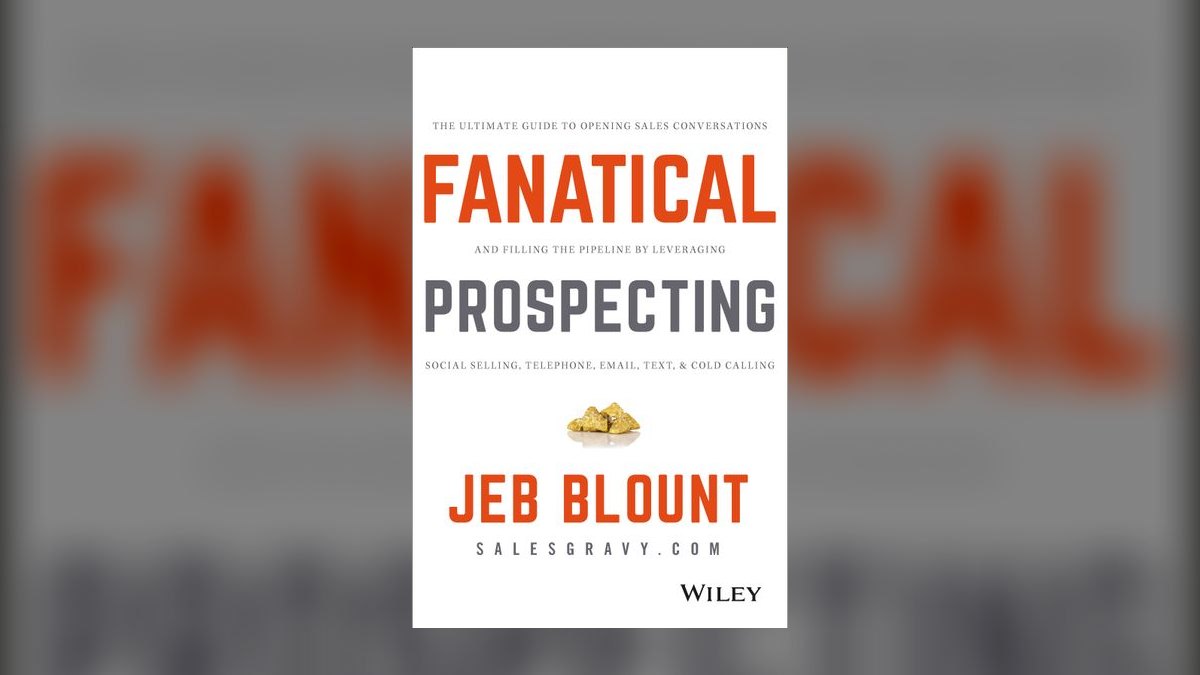
Fanatical Prospecting by Jeb Blount argues that pipeline problems are prospecting problems, not closing problems: sales leaders must build a daily, multichannel prospecting habit — phone, email, social, text, and referrals — governed by the 30-Day Rule and firm objection handling, because activity today determines revenue 90 days from now, and no amount of closing skill fixes an empty pipe.
The two prospecting strategies sales leaders are actually choosing between
Every sales organization heading into 2027 is really picking between two competing models, and Fanatical Prospecting is a hard argument for one of them. The first is what Blount calls a reactive or "hope-based" strategy: reps lean on inbound leads, marketing-qualified leads, and whatever referrals happen to show up, and prospecting becomes something salespeople do only when the pipeline runs dry. Leadership treats prospecting as a background task, not a scheduled discipline, and the team's forecast rises and falls with how many leads marketing happened to generate that quarter. The second model — the one the book is fanatical about — is proactive, disciplined, multichannel prospecting treated as a non-negotiable daily block, independent of how full the pipeline looks today.
The reactive strategy feels safer in the short term because it avoids rejection and doesn't require reps to make cold calls or send cold outreach. But Blount's core argument is that this comfort is exactly what causes the boom-and-bust sales cycles most leaders fight every quarter: pipeline gets full, prospecting stops, deals close or die, pipeline empties, and the team panics into a prospecting sprint that won't pay off for weeks. The fanatical strategy trades short-term comfort for long-term predictability. Reps prospect every single day — even when the pipeline is full — using at least three to four channels in combination: outbound calls, personalized email, social selling touches (primarily LinkedIn), text/SMS where appropriate, and asking for referrals at the close of every meaningful conversation. No single channel is trusted to carry the load alone, because response rates on any one channel degrade as buyers get better at filtering it out.
For sales leaders, the decision isn't philosophical — it's operational. Reactive strategy requires almost no management infrastructure: no daily activity tracking, no coaching cadence, no channel mix targets. Fanatical strategy requires leaders to build and enforce activity metrics, protect prospecting time on calendars, and coach objection handling weekly. The trade-off is real: fanatical prospecting costs more manager attention up front but produces a materially more stable and forecastable pipeline within one to two quarters.
How a sales leader should decide which approach fits their team
The right choice depends on three variables: how much of current revenue already comes from inbound or channel-partner sources, how volatile the current pipeline has been over the last four quarters, and how much manager bandwidth exists to coach a new daily discipline. A team that already generates 70%+ of pipeline from strong inbound demand generation can lean lighter on fanatical outbound discipline and instead layer in referral-asking and light social touches as a supplement rather than a full overhaul. A team seeing wide swings — a great quarter followed by a scramble — is exhibiting exactly the symptom Blount's strategy is built to cure, and needs the full daily-discipline model, not a partial one.

Leaders should also weigh team tenure and skill. Newer reps benefit from the structure of a mandated multichannel cadence because it removes the guesswork of "what do I do with unscheduled time." Veteran reps with strong personal networks sometimes resist a rigid cadence, and the better leadership move is to hold them to the outcome metric — pipeline generated per week — while giving them more latitude on channel mix. The decision, in short, is not "prospecting or no prospecting" but "structured and measured, or informal and hoped-for."
The concrete numbers behind each approach
Numbers make the trade-off tangible. Under a reactive strategy, pipeline coverage — the ratio of open pipeline value to quota — typically swings between 1.5x and 5x across a quarter, because it's driven by inbound volume the sales team doesn't control. Most sales leaders consider anything under 3x coverage a red flag for hitting a quota period, yet reactive teams routinely dip below that after a strong closing month, precisely because prospecting stopped while deals were being worked.

Under a fanatical, daily-discipline strategy, the target is to keep coverage steady in a 3x–4x band throughout the entire quarter, because prospecting never stops long enough to create a trough. Blount's 30-Day Rule quantifies the lag: prospecting activity performed in a given 30-day window shows up as closed revenue roughly 90 days later. That means a rep who stops prospecting for even two to three weeks creates a revenue gap that becomes visible a full quarter after the fact — often mistakenly diagnosed as a "closing problem" when it was actually a prospecting gap three months earlier.
On raw activity: a typical outbound-calling block converts roughly 1 to 3 conversations per 10 dials once voicemail and non-connects are stripped out, and roughly 1 booked meeting per 15 to 25 substantive conversations in a normal B2B environment — ratios that vary heavily by industry and list quality but that give leaders a baseline to coach against. Email outreach in the same environment tends to run 20-35% opens and low single-digit percentage reply rates when the message is personalized, dropping toward zero when it isn't. Social selling touches (commenting, connecting, sharing relevant content before a direct ask) rarely convert alone but measurably lift response rates on the parallel email and call touches for the same prospect — Blount's argument for multichannel over single-channel. Referrals are the highest-converting channel of all: a warm introduction from an existing customer or contact converts to a first meeting at a rate several multiples higher than any cold channel, which is why the book insists every closed deal and every satisfied customer conversation should end with a referral ask, not silence.

On the human side, Blount's numbers around rejection are behavioral, not statistical: he argues most reps quit a prospecting attempt (a call sequence, an email cadence, a follow-up chain) after one or two touches, while buyers in complex B2B sales often need five, six, or more touches across multiple channels before responding — meaning the majority of "no response" outcomes are actually "gave up too early" outcomes, not true rejections.
Implementation details and sequencing for rolling this out
Sales leaders adopting these takeaways should not flip the entire team to fanatical prospecting overnight — the book itself frames this as a habit-and-culture change, and habit changes stick better with a staged rollout. The sequence that tracks closest to the book's own logic starts with calendar protection: before any new tactic is introduced, leadership blocks non-negotiable daily prospecting hours on every rep's calendar — commonly the first 90 minutes of the day, before meetings and internal fires can consume it — and defends that block against internal meeting creep.

Next comes channel-mix definition: leadership specifies, per role, which three to four channels each rep is expected to run in parallel (for example, phone plus personalized email plus LinkedIn plus referral asks), rather than leaving channel choice fully to individual preference. This is followed by objection-handling training, since the single biggest reason reps abandon prospecting is fear of the four broad objection types Blount describes — brush-offs, blocking, condition-based objections, and true objections — and reps who don't have a rehearsed response to each will unconsciously prospect less to avoid the discomfort. Leaders should run weekly role-play sessions specifically on objection response, not general sales training.
Fourth, leadership installs activity tracking that measures leading indicators — dials, conversations, emails sent, social touches, referral asks — not just the lagging indicator of pipeline created, because by the time pipeline visibly drops it's already a quarter too late to fix under the 30-Day Rule. Fifth, and only once the daily habit is running for four to six weeks, leadership introduces the referral-ask discipline formally: a scripted, consistent ask at the close of every customer success conversation and every closed-won deal, since this is the highest-yield channel and the easiest one to let slide once initial enthusiasm fades.

Finally, leadership reviews results on a 90-day cycle, not a 30-day one — because of the lag the 30-Day Rule describes, judging the new strategy after only a few weeks will look like nothing changed, and premature reversal is the most common way teams abandon a fanatical prospecting rollout before it has time to show up in closed revenue.
Related questions
What is the 30-Day Rule in Fanatical Prospecting?
It states that prospecting activity performed in a 30-day window converts into revenue roughly 90 days later — so a lull in prospecting today creates a visible pipeline gap a full quarter from now, often misdiagnosed as a closing problem.
Why does Jeb Blount argue against relying on a single prospecting channel?
Because response rates on any one channel (calls, email, social) decay as buyers get better at filtering it, and combining three to four channels for the same prospect measurably raises total response versus any channel used alone.
How many touches does a prospect typically need before responding?
The book argues most reps give up after one or two attempts, while real buyers in complex B2B sales frequently need five or more touches across multiple channels before engaging — meaning most "no response" outcomes are premature abandonment, not rejection.
What pipeline coverage ratio should sales leaders target?
A commonly used benchmark is 3x to 4x quota in open pipeline value at any point in the quarter; dropping below roughly 3x is treated as an early warning that quota attainment is at risk.
How should referrals fit into a daily prospecting strategy?
Referrals should be asked for consistently at the close of every successful customer interaction, not left informal, because warm introductions convert to first meetings at markedly higher rates than any cold outbound channel.
FAQ
What is Fanatical Prospecting by Jeb Blount actually about? It's a sales methodology book arguing that the root cause of most revenue shortfalls is inconsistent prospecting, not weak closing skills, and it prescribes a daily, multichannel, disciplined prospecting habit as the fix, enforced by sales leaders rather than left to individual motivation.
Are the Top 10 takeaways from this book still relevant for sales leaders in 2027? Yes — the underlying mechanics (buyers ignoring single-channel outreach, pipeline lag between activity and revenue, rejection causing reps to under-prospect) are behavioral and structural rather than tied to any specific tool, so they remain applicable even as the specific channels used continue to shift.
Does fanatical prospecting mean cold calling is still necessary? The book treats the phone as one channel among several rather than the only channel, but it explicitly rejects the idea that phone prospecting is dead — it argues the phone still produces some of the highest-quality conversations, used alongside email, social, text, and referrals rather than replaced by them.
How do sales leaders measure whether the strategy is working? By tracking leading indicators — daily dials, conversations, emails sent, social touches, and referral asks — rather than only pipeline value, since pipeline is a lagging signal that, per the 30-Day Rule, reflects activity from roughly a quarter earlier.
What's the biggest reason sales teams fail to adopt this strategy? Reps and managers judge the new habit too early, before the 90-day lag has played out, and revert to the old reactive approach; the second most common failure is management not protecting the daily prospecting time block against internal meetings.
Is social selling a replacement for traditional prospecting in this framework? No — the book treats social selling as a supporting channel that warms up prospects and lifts response rates on parallel calls and emails, not a standalone replacement for direct outreach or referral asking.
Sources
- https://www.salesgravy.com
- https://hbr.org
- https://www.forbes.com
- https://www.gartner.com
- https://blog.hubspot.com
- https://www.gong.io/blog
- https://business.linkedin.com/sales-solutions/blog
- https://www.rainsalestraining.com
Related on PULSE
- [The 30-Day Rule and why pipeline lags prospecting activity by a quarter](/knowledge/30-day-rule-prospecting-pipeline-lag)
- [How to build a multichannel outbound cadence that doesn't rely on cold calling alone](/knowledge/multichannel-outbound-cadence-strategy)
- [What pipeline coverage ratio should sales leaders target each quarter](/knowledge/pipeline-coverage-ratio-benchmarks)
- [How to train reps on objection handling without killing morale](/knowledge/objection-handling-training-sales-reps)
- [Why referral programs outperform cold outbound and how to formalize the ask](/knowledge/referral-program-conversion-rates-b2b)
- [How sales leaders diagnose a closing problem versus a prospecting problem](/knowledge/closing-problem-vs-prospecting-problem)
 pulse-recentStart with No by Jim Camp — Top 10 Key Takeaways for Sales Leaders in 2027
 pulse-recentBargaining for Advantage by G. Richard Shell — Top 10 Key Takeaways for Sales Leaders in 2027
 pulse-recentInfluence by Robert Cialdini — Top 10 Key Takeaways for Sales Leaders in 2027
 pulse-recentGetting Past No by William Ury — Top 10 Key Takeaways for Sales Leaders in 2027
 pulse-recentGetting to Yes by Roger Fisher and William Ury — Top 10 Key Takeaways for Sales Leaders in 2027
 pulse-recentAligning Strategy and Sales by Frank Cespedes — Top 10 Key Takeaways for Sales Leaders in 2027
 pulse-recentHigh-Profit Prospecting by Mark Hunter — Top 10 Key Takeaways for Sales Leaders in 2027
 pulse-recentThe Sales Acceleration Formula by Mark Roberge — Top 10 Key Takeaways for Sales Leaders in 2027
 pulse-recentHow I Raised Myself from Failure to Success in Selling by Frank Bettger — Top 10 Key Takeaways for Sales Leaders in 2027
 pulse-recentNew Sales Simplified by Mike Weinberg — Top 10 Key Takeaways for Sales Leaders in 2027