 Pulse Reviews and Analysis
Best Subaru Forester Generations (Ranked)
 Curated by Kory White · Fractional CRO, CRO Syndicate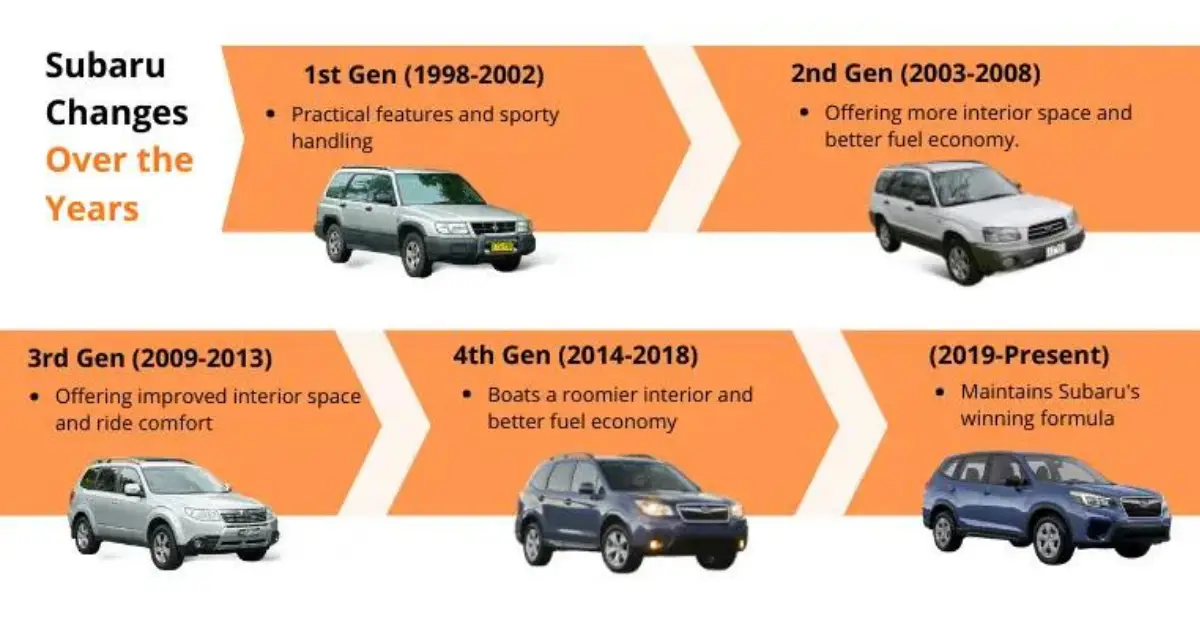
Best Subaru Forester Generations (Ranked)
The Subaru Forester invented the tall-wagon-meets-SUV formula years before "crossover" became a household word, and it has stayed remarkably true to that idea across five generations. Standard symmetrical all-wheel drive, boxer engines, terrific outward visibility, and genuine off-pavement clearance have made the Forester a favorite of rural buyers, dog owners, ski commuters, and anyone who values function over fashion.
But not every Forester generation aged the same way. Some carry the dreaded 2.5L head-gasket reputation; others were the subject of an oil-consumption service campaign; and the best of them are among the most dependable used vehicles you can buy. This ranking sorts Forester generations and standout model years by long-term reliability, ownership costs, used values, and how each holds up against its siblings today.
Whether you want a cheap high-mileage workhorse or a near-new family hauler with modern safety tech, knowing the strong years from the weak ones is the key to buying smart.
Direct Answer
The best overall Subaru Forester is the fourth generation (2014–2018), specifically a 2017 or 2018 2.5i, by which point Subaru had addressed the early FB25 oil-consumption complaints and the CVT was fully mature, all paired with available EyeSight safety tech. The best value is the third generation (2009–2013) 2.5X, which offers a roomy, durable package for $7,000–$12,000 while skipping the worst of the older head-gasket era.
Be cautious with early fourth-gen (2014–2015) cars that have undocumented oil-consumption history, and avoid older EJ25 turbo and DOHC engines unless the head gaskets are documented. As a rule, the third and fourth generations are the value-and-reliability sweet spots.
1. 2018 Forester 2.5i (Fourth Gen) 🏆 BEST OVERALL
The 2018 model year is the high point of the fourth-generation Forester. The 2.5L FB25 boxer four (170 hp) had years of refinement behind it, the early oil-consumption complaints had been resolved through a Subaru service campaign, and the Lineartronic CVT was mature and smooth.
EyeSight driver assistance — adaptive cruise, pre-collision braking, lane keep — was widely available and standard on many trims. The Forester's hallmark 8.7 inches of ground clearance and panoramic greenhouse make it one of the easiest crossovers to place on a trail or in a tight parking lot.
Reliability data ranks these among the strongest Foresters ever. Expect $16,000–$23,000 used for a clean example with full service history.
2. 2017 Forester 2.5i (Fourth Gen)
The 2017 is nearly indistinguishable from the 2018 in everyday use and usually a bit cheaper. It carries the refined FB25 engine, the mature CVT, and available EyeSight, plus the mid-cycle refresh that improved the interior and added a stiffer body structure. Excellent reliability and lower pricing make it a smart alternative to the 2018.
The 2017 also benefits from improved infotainment connectivity over earlier fourth-gen cars. Budget $14,000–$21,000. If you find one with a documented clean oil-consumption record, it delivers virtually everything the 2018 does for a few hundred to a thousand dollars less.
3. 2010 Forester 2.5X (Third Gen) 💎 BEST VALUE
The 2010 model year is the best value Forester on the used market. The third generation grew larger and more comfortable than the boxy second-gen car, and the 2.5X with its naturally aspirated boxer four is durable and cheap to maintain. These cars regularly clear 200,000 miles with basic care.
A clean 2010 runs $7,000–$11,000, delivering generous cargo space, the trademark airy cabin, and real all-weather capability for thousands less than a newer Forester. The third generation also offered a manual transmission, a rarity worth seeking for buyers who want to avoid an automatic entirely.
Confirm timing-belt service history before buying.
4. 2012 Forester 2.5X (Third Gen)
The 2012 is the late-third-gen pick, benefiting from years of running production fixes. The 2.5X four is well understood by independent shops, parts are plentiful, and ownership costs stay low. A clean 2012 runs $8,000–$12,000 and offers strong long-term value with documented maintenance.
By this point in the generation, interior quality had improved and the drivetrain was thoroughly proven. For a buyer who wants genuine Subaru all-wheel-drive capability and cavernous practicality without modern-car prices, the 2012 is one of the smartest used buys in the entire lineup.
It lacks advanced safety tech, but its mechanical simplicity is a virtue for budget owners.
5. 2019 Forester 2.5i (Fifth Gen)
The 2019 launched the fifth generation on Subaru's new global platform, with a roomier interior, better materials, and EyeSight standard across the lineup. The updated 2.5L FB25 made 182 hp and the chassis was stiffer and quieter than before. As a first-year design it had some early infotainment software complaints, which is why it ranks below the proven fourth-gen years, but the underlying mechanicals are sound.
A clean 2019 runs $19,000–$26,000. It's the pick for buyers who want the newest safety tech and the largest, most refined cabin, provided the software has been updated.
6. 2016 Forester 2.5i (Fourth Gen)
The 2016 is a mid-fourth-gen car with available EyeSight and the spacious, easy-to-see-out-of cabin that defines the Forester. It ranks below the 2017–2018 cars because some early FB25 oil-consumption reports still appear in this year, so a documented clean engine matters.
Priced $12,000–$18,000, it's a budget route into the strongest Forester generation if you verify the powertrain. The 2016 also offers the practical roof rails, generous rear-seat room, and excellent winter traction that keep Foresters in high demand among snow-belt buyers. With a clean oil-consumption history, it's a dependable, sensible used choice.
7. 2009 Forester 2.5X (Third Gen)
The 2009 is the first year of the third generation and the value floor among genuinely modern Foresters. The 2.5X boxer is simple and cheap to fix, and the larger third-gen body brought a big jump in interior space and comfort over the second-gen car. For $6,000–$10,000 the 2009 is a sensible high-mileage daily for buyers who want capability without complication.
As a first-year car it's wise to confirm thorough maintenance, especially timing belt and cooling-system service, but a well-kept example is a reliable, no-nonsense all-weather hauler that asks very little in return.
8. 2020 Forester 2.5i (Fifth Gen)
The 2020 addressed many of the 2019's first-year software gremlins and added more standard equipment. The fifth-gen platform is comfortable, quiet, and packed with standard EyeSight safety tech. It ranks here mainly on price and limited long-term data rather than any flaw — newer means pricier and less proven.
Expect $22,000–$29,000. The 2020 is a strong family vehicle with class-leading visibility and generous cargo room, and its standard driver-assistance suite makes it one of the safer used crossovers in its price bracket. Confirm the latest infotainment update is installed before you buy.
9. 2014 Forester 2.5i (Fourth Gen)
The 2014 introduced the fourth generation and the FB25 engine, bringing a bigger cabin and the CVT. It ranks lower because the earliest FB25 units are most associated with the oil-consumption issue Subaru later addressed by service campaign. That makes a documented clean engine essential on a 2014.
Priced $10,000–$15,000, it's affordable, but buy only with proof of oil-consumption checks or a verified repair. For buyers who do their homework, a sorted 2014 offers the roomy fourth-gen package and available EyeSight at a lower entry price than later years.
10. 2008 Forester 2.5X (Second Gen)
The 2008 is the final year of the second generation, the last of the smaller, lighter, more rugged-feeling Foresters. It uses the EJ253 SOHC boxer, which is more head-gasket-resistant than older DOHC units but still warrants a cooling-system inspection. These cars are cheap, simple, and beloved by enthusiasts for their compact dimensions and available manual transmission.
At $4,000–$8,000 the 2008 is the bargain pick for buyers who can wrench or have a trusted Subaru shop. Budget for a head gasket and timing belt if records don't show recent service, and you'll have a tough, capable little all-wheel-drive wagon.
What to Watch For When Buying
The biggest historical concern with the Forester is the 2.5L head gasket on older DOHC EJ25 engines, common through the early-to-mid 2000s. By the second-gen SOHC EJ253 the risk dropped, and the fourth-gen FB25 (2014+) moved to a timing-chain design that largely eliminated the problem — but any car showing a coolant smell, overheating, or unexplained coolant loss should be inspected before purchase.
The second major concern is oil consumption on early FB25 engines, roughly 2014–2016; Subaru ran a service campaign for affected units, and a documented clean oil-consumption history is worth paying extra for. A 2014–2016 Forester without that paperwork is a gamble.
The third item is the Lineartronic CVT on fourth- and fifth-gen cars: it's reliable with regular fluid service but expensive to replace if neglected, so demand fluid-change records. On third-gen cars, confirm the timing belt has been changed on schedule, since these are belt-driven engines that can suffer serious damage if the belt fails.
Across all years, verify all-wheel-drive engagement on a test drive, listen for wheel-bearing rumble, and check that EyeSight (on equipped cars) calibrates and functions. A pre-purchase inspection at an independent Subaru specialist is cheap insurance that routinely uncovers the expensive items.
How to Choose
If you want the lowest-risk daily driver, target a 2017–2018 fourth-gen 2.5i with EyeSight and documented service — it's the best blend of modern safety, proven mechanicals, and fair used pricing. If your budget is tight, a 2009–2012 third-gen 2.5X delivers nearly the same space and all-weather capability for far less, and these cars are simple enough that maintenance stays affordable for years.
Buyers who want the newest tech and the roomiest cabin should look at a 2019–2020 fifth-gen, ideally with the latest software updates installed. And if you can wrench or have a trusted shop, the 2008 second-gen is a cheap, tough, enthusiast-friendly option, provided the head gaskets are sorted.
Match the generation to your budget and risk tolerance, and the Forester rewards you with unmatched visibility, real capability, and the easygoing practicality that has defined it for decades.
FAQ
Which Forester generation is the most reliable? The fourth generation (2017–2018) is widely regarded as the most reliable, with the FB25's oil-consumption issue resolved and a mature CVT. The third generation (2009–2012) is also very dependable when maintained.
Do Subaru Foresters burn oil? Some early FB25 engines (2014–2016) were prone to excessive oil consumption, prompting a Subaru service campaign. Buy these years only with documented oil-consumption checks; later fourth- and fifth-gen cars are far less affected.
Which Forester years should I avoid? Be cautious with 2014–2015 cars lacking oil-consumption documentation, older DOHC EJ25 engines with no head-gasket history, and any first-year fifth-gen (2019) car that hasn't had its infotainment software updated.
Is the turbocharged Forester XT worth it? The older turbo XT models are quick and fun, but they demand strict maintenance and the EJ25 turbo can be costly to repair. For most buyers the naturally aspirated 2.5i / 2.5X is the safer, cheaper-to-own used pick.
Bottom Line
The Subaru Forester's strongest years sit in the fourth generation (2014–2018), with 2017–2018 as the standout for reliability and available safety tech. Budget buyers should hunt a 2009–2012 third-gen 2.5X for outstanding value, while bargain hunters with mechanical skills can grab a 2008 second-gen cheaply.
Across every generation, documented maintenance — head gaskets, CVT fluid, timing belts, and oil-consumption history — is what separates a great Forester from an expensive surprise. Buy on records, not just mileage, and the Forester will serve faithfully for years.
Sources
- Subaru of America — Forester model history and specifications, subaru.com
- Wikipedia — Subaru Forester generations and engine details
- Consumer Reports — Subaru Forester reliability ratings by model year
- Edmunds — Subaru Forester used pricing and ownership reviews
- Kelley Blue Book (kbb.com) — Forester used values by year and trim
- NHTSA — Subaru Forester recalls and service campaigns, nhtsa.gov
- Car and Driver — Subaru Forester generational reviews and specifications