
Should I open or buy a MiniLuxe franchise in 2027?
 Curated byKory White · Fractional CRO · Maryland
 PULSEKNOWLEDGE LIBRARY
Quality
Certified

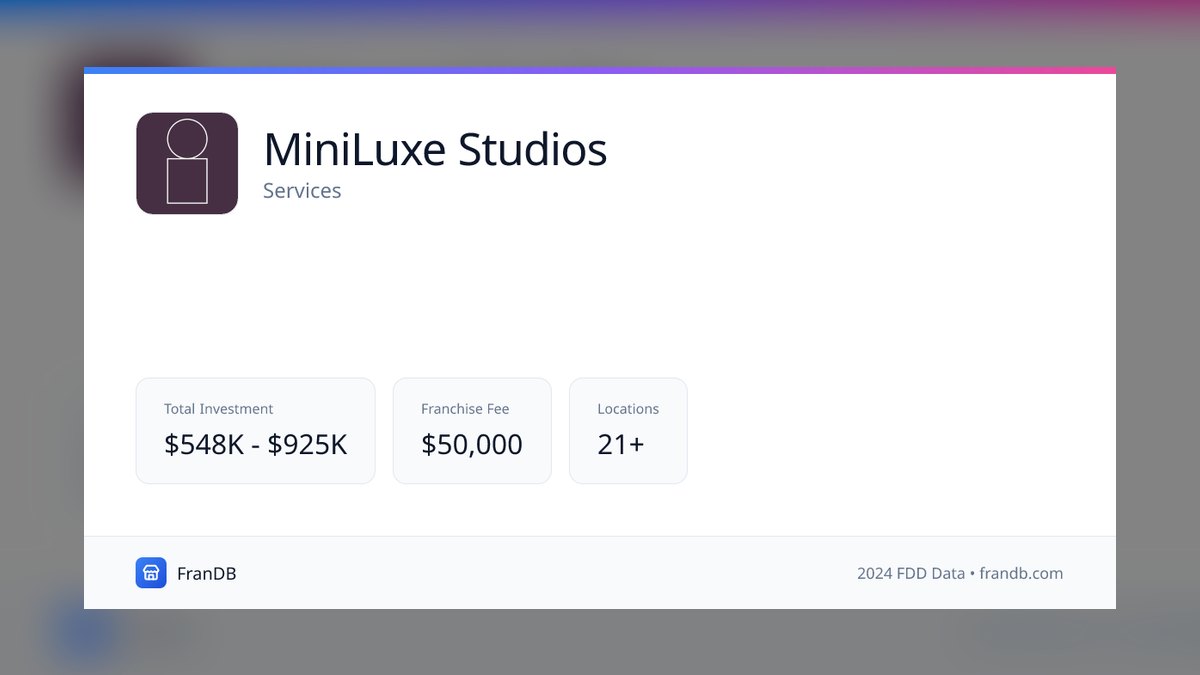
Only if you can recruit and retain nail technicians and your market pays premium prices. MiniLuxe requires roughly $350,000 to $750,000 total investment plus 6-7% royalty and a marketing fee. Mature studios can produce solid owner income, but success depends on membership penetration and staffing, not nail trends.
The operator who almost signed and the one number that stopped her
Picture a candidate who has spent fifteen years in retail district management, has about $400,000 in liquid capital after a home equity line, and lives in an affluent suburb with three lifestyle centers within twelve minutes of her house. She attends a discovery day, falls in love with the hygiene-first positioning, and gets to the point of signing a franchise agreement for a studio in a mixed-use development anchored by a grocery store and a boutique fitness chain. On paper she is exactly the profile the brand wants: management-minded, capitalized, in a market with household incomes well above the national median.
Then she does one piece of homework almost nobody does before signing. She calls seven licensed nail technicians in her metro area — found through state board licensing lookups and a couple of local beauty school placement offices — and asks each one a single question: what would it take to get you to leave your current chair? Five of the seven tell her some version of the same thing. They are booth renters. They keep close to everything above their weekly rent, they set their own hours, and they have a book of clients they have carried for years. Moving to a commission or hourly-plus-tips structure inside a branded studio, with mandated sanitation protocols and a fixed schedule, would need to pay meaningfully more than what they take home now — or offer benefits and stability they cannot get renting a booth.
That is the actual gating factor on this decision, and it sits upstream of every financial model. A nail studio is a labor-throughput business. Your revenue ceiling is the number of technician-hours you can staff times your average ticket times your utilization rate. If you can only fill six of your ten stations reliably, your $900,000 pro forma is a $540,000 reality while your lease, your buildout debt service, and your royalty obligations stay exactly where they were. The rent does not shrink because you are short-staffed.
The candidate in this scenario did eventually move forward, but she changed two things first. She negotiated a longer free-rent period during buildout to extend her runway, and she budgeted an extra $35,000 specifically as a technician signing and retention fund — hiring bonuses paid out at 90 and 180 days, plus a guaranteed minimum weekly floor for the first quarter so techs were not gambling on an unproven location's traffic. That money is not in any franchisor's investment table. It is the cost of solving the constraint that actually determines whether the studio works.

The lesson generalizes. Before you evaluate whether to open or buy a MiniLuxe franchise, run the labor test in your specific ZIP code radius. Pull the state cosmetology board's licensee list, count how many active nail technicians live within a twenty-minute commute, look at how many nail establishments already compete for them, and make ten phone calls. If you cannot find a plausible path to staffing your full station count within ninety days of opening, the rest of the analysis is academic.
How the studio economics actually work, station by station
The mechanism that drives a premium nail studio is simpler than most franchise pro formas make it look, and understanding it lets you sanity-check any projection you are handed.
Start with capacity. A studio with, say, eight to twelve service stations operating roughly seventy hours a week has a theoretical maximum of somewhere between 560 and 840 station-hours weekly. Nobody hits that. Realistic utilization for a mature studio in a good location runs 55-70% during stable months, lower in January and August, higher in the run-up to holidays, proms, and wedding season. So call it 350-550 productive station-hours in a normal week.
Now layer in service duration and ticket. A classic manicure occupies a station for roughly 30-45 minutes; a pedicure runs 45-60; a combination service or gel application pushes past an hour. At premium urban pricing, a manicure sits well above what a discount salon charges — the gap between a $25 walk-in shop and a premium studio charging in the $50-$85 range is the entire business model. Multiply productive hours by average revenue per station-hour, and you land on your service revenue. Add retail attachment (nail care products, polish, hand and foot treatments), which typically contributes 10-15% of total revenue when merchandised well and closer to 5% when nobody is trained to sell it.
The reason the premium price is necessary rather than greedy: technician compensation in a fair-pay model consumes a much larger share of service revenue than in a commission-scraping discount shop. When technicians earn 40-50% of service revenue and you are also carrying payroll taxes, workers' compensation, and any benefits, total labor lands in the low-to-mid fifties as a percentage of service revenue. A discount salon running booth rent or minimal commission carries dramatically less. You cannot charge $25 and pay fair wages under a franchise royalty. The premium ticket is what funds the ethical labor model, and it only works where customers will pay it.
The second mechanism worth internalizing is the membership flywheel. A member paying a fixed monthly fee that covers one service, with discounts on additional services and retail, changes your demand curve in three ways. First, it smooths seasonality — the subscription bills in February the same as it bills in November. Second, it raises visit frequency, because a customer who has already paid for one service is far more likely to book a second in the same month. Third, it pulls retail attachment up, since members who feel they are getting a deal on service are more willing to add product.
The flywheel has a leak, and the leak is churn. Nail service subscriptions churn faster than gym memberships because the value is visible and immediate — a customer who skips two months notices she saved money and cancels. If your monthly churn runs in the high single digits to low teens, a base of 200 members bleeds roughly 16 to 24 people a month. You need continuous acquisition just to hold flat, which means an ongoing local marketing spend on top of whatever the national fund covers. Franchisees who treat membership as a launch promotion rather than a permanent acquisition function watch the base peak in month four and decay from there.
The third mechanism is rebooking. Nail services have a natural cadence — clients return every two to four weeks as growth shows at the cuticle. That cadence is a gift, but only if your front desk converts it. A studio that rebooks 60% of clients at checkout has a fundamentally different revenue profile than one that rebooks 25% and hopes people call. Rebooking rate is the single cheapest lever in the business, and it is entirely an operations and training question.
Real numbers: what you should expect to spend and what you can expect back
Work from the Franchise Disclosure Document, not from marketing materials or from this page. Item 7 is the estimated initial investment table, Item 6 lists ongoing fees, and Item 19 is the financial performance representation — if there is no Item 19, or if it only shows top-quartile studios, that omission is itself information. Item 20 gives you the outlet tables: openings, closures, transfers, and terminations by year, plus the contact list for current and former franchisees. Read Item 20 before Item 19.

Based on publicly discussed figures for the brand, the shape of the investment looks roughly like this:
Initial franchise fee: approximately $45,000 to $55,000, paid at signing and generally non-refundable.
Buildout and leasehold improvements: $180,000 to $400,000. This is the single largest and most variable line. A second-generation space that already has plumbing roughed in for pedicure stations can come in dramatically under a raw shell. Pedicure plumbing is not trivial — you are running dedicated supply and drain to each chair, and in many jurisdictions you need approved backflow prevention and specific ventilation for the service area. A cold dark shell in a new development can blow past the high end of that range once you price out HVAC, electrical, and ADA-compliant restrooms.
Equipment and stations: $60,000 to $150,000. Pedicure chairs are the expensive item, and the sanitation-forward models — pipeless systems that can be fully broken down and disinfected — cost more than the jetted units discount shops use. That is the point of the brand, so do not value-engineer it.

Signage and decor: $20,000 to $55,000, heavily dependent on your landlord's sign criteria and whether you are on a monument, a blade, or a channel-letter storefront.
Opening inventory: $12,000 to $32,000 for clean-formulation product lines, retail stock, and consumables.
Grand opening and initial marketing: $15,000 to $40,000.
Training and travel: $10,000 to $28,000 — this scales with how many people you send and how far.
Additional funds / working capital: $30,000 to $80,000 in the franchisor's table.

That puts total initial investment in the range of roughly $350,000 to $750,000, with liquid capital requirements commonly cited around $120,000 to $220,000. Ongoing, you are paying a royalty in the 6-7% range on gross sales plus a marketing or brand fund contribution around 2%.
Now the honest part about working capital. The franchisor's "additional funds" line covers the initial period specified in the FDD, usually three months. Nail studios do not mature in three months. Realistic ramp for a new premium studio is nine to eighteen months to stabilized volume, because you are simultaneously building a client base, building a technician roster, and building a membership file — three curves that all have to climb together. I would treat the working capital figure in the table as a floor and personally carry closer to $80,000 to $150,000 beyond it, plus whatever your household needs to live on for the first year, because owner draws in year one are unreliable.
On the revenue side, discussion of the brand puts mature studio gross revenue in the range of roughly $600,000 to $1,400,000 or more, with owner earnings commonly described between $70,000 and $220,000. Those are wide bands for a reason — the spread between a well-located, fully-staffed, high-membership studio and a short-staffed one in a mediocre trade area is enormous. Treat the top of the range as what happens when everything goes right, not as a base case.
Here is how the P&L stacks on a hypothetical $900,000 studio, which is a reasonable mid-range target for a mature location:

- Total labor including taxes and workers' comp: roughly 52-58% of service revenue
- Occupancy including CAM and taxes: 5-8% of revenue in a well-negotiated lease, 12%+ in a bad one
- Product COGS and consumables: 8-10%
- Royalty: 6-7%, so $54,000 to $63,000
- Brand fund: ~2%, plus local marketing on top
- Credit card processing: 3-5% of card volume, which in this business is nearly all of it
- Insurance, utilities, repairs, software, professional fees: the remainder
Store-level EBITDA in the 15-22% range is a realistic outcome for a competently run studio, which on $900,000 is roughly $135,000 to $198,000 before royalty, or somewhere in the $70,000 to $135,000 zone after royalty and before you pay yourself. If you install a general manager at market salary so you are not behind the desk sixty hours a week, roughly half of that goes away. That is the semi-absentee tax, and franchise candidates chronically underestimate it.
Two more numbers worth modeling. Membership: at an average monthly fee in the range of $49 to $89, a base of 200 active members produces meaningful predictable revenue before a single walk-in — but at 8-12% monthly churn you must add 20-30 members every month just to hold that base. Budget $500 to $1,500 monthly in local acquisition spend permanently, not just at launch. Second, member lifetime value: a member who stays eighteen months is worth many multiples of a walk-in who visits twice, which is why every operational decision that increases retention beats every decision that increases traffic.
Trade-offs, alternatives, and the honest case for staying independent
The franchise-versus-independent question deserves a real answer rather than a brochure answer, because in nail services the case for going independent is stronger than it is in, say, quick-service restaurants.
What you are buying with the royalty: a brand with an established positioning around hygiene, non-toxic formulations, and fair technician pay; a defined studio design and service menu; vendor relationships and product sourcing; training curriculum and sanitation protocols; a membership platform and the systems around it; site selection support; and — genuinely valuable — the ability to explain to a technician in one sentence why working for you is different from working down the street. That last item is not nothing when labor is your binding constraint.

What the royalty costs you: at 6-7% plus 2%, roughly 8-9% of gross revenue leaves before you cover a single expense. On $900,000 that is $72,000 to $81,000 annually. Over a ten-year agreement on a studio averaging $900,000, you are paying well north of $700,000 for the system. You also give up menu flexibility, pricing latitude in many cases, vendor choice, and the ability to sell without franchisor consent.
The independent path: you keep the 8-9%, you can open in a second-generation space and control every capital decision, and you can adapt pricing to what your specific market actually bears. What you give up is the recruiting story, the systems, and any brand equity at exit — an independent nail salon sells on a lower multiple than a branded franchise unit with clean books, if it sells at all. Many independents are effectively unsellable and the owner just liquidates equipment.
Adjacent franchise concepts worth comparing: Frenchies Modern Nail Care operates in the same premium nail lane and is worth putting side by side on cost and Item 19. If you like the membership-and-recurring-service model but not nails specifically, Heyday and FACE FOUNDRIÉ sit in facials and skincare with similar unit economics and similar labor constraints (licensed estheticians instead of licensed nail technicians). Bishops and Diesel Barbershop are in hair with a different labor pool and generally lower buildout. Do not evaluate any of these on gross revenue alone — evaluate on investment-to-EBITDA ratio and on whether you can staff them in your specific market.
Buying an existing unit versus opening a new one. This is the fork most candidates skip, and it deserves genuine weight.

Buying an existing studio means you inherit revenue on day one, an existing client file, a technician roster, an established location with known traffic, and a track record you can underwrite. You will pay a multiple of EBITDA for it rather than construction cost, and the transfer requires franchisor approval plus a transfer fee. The risks: you inherit the seller's problems, including any technician who is only there because of the seller, any deferred maintenance on chairs and plumbing, any reputation damage in local reviews, and any remaining lease term that is shorter than you want. You also need to know why they are selling. "Retiring" and "the market changed under me" produce very different valuations.
Opening a new unit means you choose your own site, control your buildout quality, hire your own team from scratch, and pay construction cost instead of goodwill. You also eat nine to eighteen months of ramp with full fixed costs and no revenue history. For a first-time franchisee with limited operating reserve, buying an existing profitable unit is usually the lower-variance path even at a higher headline price — you are trading capital for the elimination of ramp risk.
One trade-off that gets ignored: single-unit versus a multi-unit development agreement. Signing for three units locks territory and usually improves your fee economics per unit, but it also obligates you to a development schedule you may not be able to fund or staff. If you miss the schedule, you can lose the territory rights you paid for. A first-time operator should almost always open one, run it for eighteen months, and negotiate expansion rights from a position of proven performance rather than committing at signing.
The pitfalls that kill these units, and the specific counter to each
Signing a lease before you have validated staffing. Covered above, but it bears repeating because it is the most common fatal error and it is entirely preventable. The counter: make ten technician recruiting calls in your target radius before you sign an LOI, and structure the LOI with a contingency period long enough to keep validating.

Underwriting the top of the revenue range. Candidates build a model at $1.2 million because that number appears in the range, then discover their studio is a $700,000 studio. The counter: model three cases. Base case at the low-to-middle of the range, downside at 25% below base, upside at the middle-to-high. If the downside case cannot service your debt and cover a minimum owner draw, the deal is too tight regardless of how good the upside looks.
A bad lease. Occupancy at 5-8% of revenue is workable; at 12% it eats your entire margin. The counter: negotiate a rent structure with free rent covering the entire buildout period plus at least sixty days after opening; push for a tenant improvement allowance, which materially reduces the buildout line in Item 7; get a personal-guaranty burn-off after two or three years of on-time payment; and secure a minimum term with options that total seven to ten years, because a short remaining term destroys your exit valuation. Also read the CAM clause carefully — uncapped CAM in a new development can escalate faster than your revenue.
Treating membership as a launch promotion. The base peaks and decays. The counter: assign membership sales as a permanent, measured responsibility with a specific monthly net-add target, track churn monthly rather than annually, and run win-back campaigns on cancellations at 30 and 90 days. Set a target penetration — a meaningful share of your active client file on membership within eighteen months — and manage to it weekly.
Under-capitalizing the ramp. The FDD's additional-funds figure covers a defined initial period, not the real path to stabilization. The counter: carry meaningful reserve beyond the table, and separately fund your household so you are not forced to take draws that starve the business in month seven.
Losing your opening technician cohort in month five. New studios lose staff right when volume starts to build, because early technicians endure the slow ramp on thin books and then leave just as the schedule fills. The counter: guarantee a weekly minimum for the first quarter so techs are not absorbing your ramp risk, pay retention bonuses at 90 and 180 days rather than signing bonuses at day one, and build a schedule that gives people predictable hours. Turnover costs you far more than the retention budget.

Ignoring the health and licensing layer. Nail establishments are regulated by state cosmetology boards with specific requirements for implement sterilization, pedicure basin disinfection logs, ventilation, and technician licensure. A violation is not just a fine — in a hygiene-first brand, a public health citation is an existential brand contradiction. The counter: assign one person ownership of the sanitation log, audit it weekly yourself, and treat board inspections as pass-with-zero-findings events, not pass-somehow events.
Buying an existing unit without proper diligence. The counter: require three years of tax returns reconciled to the point-of-sale system, pull the membership file and check active-versus-lapsed status yourself, interview technicians privately about whether they intend to stay under new ownership, get an equipment condition assessment on the pedicure chairs and plumbing, and read every online review from the last two years.
Skipping the franchisee calls. Item 20 gives you the list of current and former franchisees. Former franchisees are the more valuable calls and almost nobody makes them. Ask current owners: what is your actual staffing level versus your station count, what percentage of clients are on membership, what did you spend on buildout versus the Item 7 estimate, how long until you took your first real draw, and would you sign again. Ask former owners the only question that matters: what happened.
Assuming the clean-beauty positioning does the selling for you. The positioning is a real differentiator and consumer interest in non-toxic formulations and ethical labor practices is durable. But positioning gets a customer to try you once. Rebooking rate, technician consistency, and appointment availability get her to come back twenty-six times a year. Operators who lean on the brand story instead of on operational discipline underperform.
Related questions
How long before a new MiniLuxe studio breaks even?
Plan for nine to eighteen months to stabilized volume, with cash-flow breakeven somewhere in that window depending on staffing speed and membership ramp. Capital payback on the full $350,000-$750,000 investment realistically takes four to seven years at mid-range performance.
Can I run a MiniLuxe franchise semi-absentee?
Not in year one. Expect owner-operator hours for the first eighteen to twenty-four months. Semi-absentee becomes viable once you have a trained general manager, but that salary consumes roughly half your store-level profit, so model it explicitly.
What is the single biggest predictor of success?
Technician recruiting and retention in your specific trade area. Every other variable — ticket, membership, retail attachment — is downstream of having stations staffed. Validate your local licensed-technician supply before signing anything.
Is it better to buy an existing unit than open a new one?
For a first-time franchisee with limited reserves, usually yes. You pay a multiple of EBITDA instead of construction cost, but you eliminate nine to eighteen months of ramp risk and inherit a client file. Diligence the seller's reason for exiting.
What should I ask for in the lease?
Free rent through buildout plus sixty days, a tenant improvement allowance, capped CAM, a personal-guaranty burn-off after two to three years, and total term plus options of seven to ten years to protect your future resale value.
FAQ
What does it actually cost to open a MiniLuxe franchise?
Total initial investment runs roughly $350,000 to $750,000, including an initial franchise fee of about $45,000 to $55,000, buildout of $180,000 to $400,000, equipment of $60,000 to $150,000, and the remaining lines for signage, inventory, opening marketing, training, and working capital. Liquid capital requirements are commonly cited around $120,000 to $220,000. Confirm every figure against the current Item 7 table in the FDD you receive — these ranges move year to year and vary substantially by market and by whether you take a raw shell or a second-generation space.
What ongoing fees will I pay?
A royalty in the 6-7% range on gross sales plus a marketing or brand fund contribution around 2%. Combined, that is roughly 8-9% of revenue off the top before any operating expense. On a $900,000 studio, that is approximately $72,000 to $81,000 annually. Local marketing spend for membership acquisition sits on top of the brand fund and is your responsibility. Verify current rates in Item 6 of the FDD.
How much do owners actually take home?
Publicly discussed figures put mature studio revenue at roughly $600,000 to $1,400,000 or more, with owner earnings in the $70,000 to $220,000 range. That spread is driven almost entirely by staffing level, membership penetration, and lease quality. If you install a general manager rather than operating the studio yourself, expect roughly half of that profit to go to the salary. Underwrite the bottom of the range, not the top.
Why is the membership program so important?
Because it converts an appointment business with seasonal swings into a subscription business with a predictable base. Members visit more often than non-members and spend more on retail and upgrades. But nail memberships churn in the 8-12% monthly range, so you need continuous acquisition — roughly 20 to 30 new members a month just to hold a 200-member base flat. Treat membership as a permanent function with a monthly net-add target, not a grand-opening promotion.
What is the hardest part of running this business?
Recruiting and retaining licensed nail technicians. Many experienced technicians rent booths and keep most of what they bill, so moving to a structured studio has to offer real economic or stability advantages. Your revenue is capped by staffed station-hours, so an understaffed studio simply cannot reach its pro forma no matter how good the location is. Validate local technician supply before you sign a lease.
Should I buy an existing studio instead of opening a new one?
Often yes, particularly if your reserves are thin. Buying gets you day-one revenue, an existing client file, a staffed roster, and a location with a known track record, at the cost of paying a multiple of EBITDA plus a transfer fee and needing franchisor approval. Do serious diligence: three years of returns reconciled to the POS, the real active membership count, private conversations with technicians about staying, equipment and plumbing condition, and the seller's honest reason for exiting.
Sources
- https://www.ftc.gov/business-guidance/resources/franchise-rule-compliance-guide
- https://www.sba.gov/funding-programs/loans/7a-loans
- https://www.franchise.org/
- https://www.bls.gov/ooh/personal-care-and-service/manicurists-and-pedicurists.htm
- https://www.miniluxe.com/
- https://www.franchisebusinessreview.com/
- https://www.entrepreneur.com/franchises/franchise500
- https://www.bbb.org/
- https://www.irs.gov/businesses/small-businesses-self-employed
Related on PULSE
- Should I open or buy a The Junkluggers franchise in 2027?
- Should I open or buy a Pak Mail franchise in 2027?
- Should I open or buy a PostNet franchise in 2027?
- Should I open or buy a Fish Window Cleaning franchise in 2027?
- Should I open or buy a Shine Window Care franchise in 2027?
- Should I open or buy an Image360 franchise in 2027?
This page will be disappearing soon. Save it to your device for $1 — or read it free while it is here.
@Kory-White- · if Venmo asks, the last 4 of my number are 2012
This page is gone.
This one is off the shelf now. $1 keeps it on your phone for good — the whole page, pictures and diagrams included.
 pulse-qHow Many Employees Should I Schedule Each Shift at My Skate Park in 2026?
 pulse-qWhat Service Fees Should a Junk Removal Company Charge in 2026?
 pulse-qShould I open or buy an Image Studios franchise in 2027?
 pulse-qHow Many Employees Should I Schedule Each Day at My Bookstore in 2026?
 pulse-qShould I open or buy a The Coder School franchise in 2027?
 pulse-qWhat Service Fees Should a Mobile Mechanic Charge in 2026?
 pulse-qWhy Should I Start Charging Service Fees in 2026?
 pulse-qShould I open or buy a CPR Cell Phone Repair franchise in 2027?
 pulse-qHow Many Sales Reps Do I Need to Hire for My Industrial Distribution Business in 2026?
 pulse-qShould I open or buy a Paul Davis Restoration franchise in 2027?