
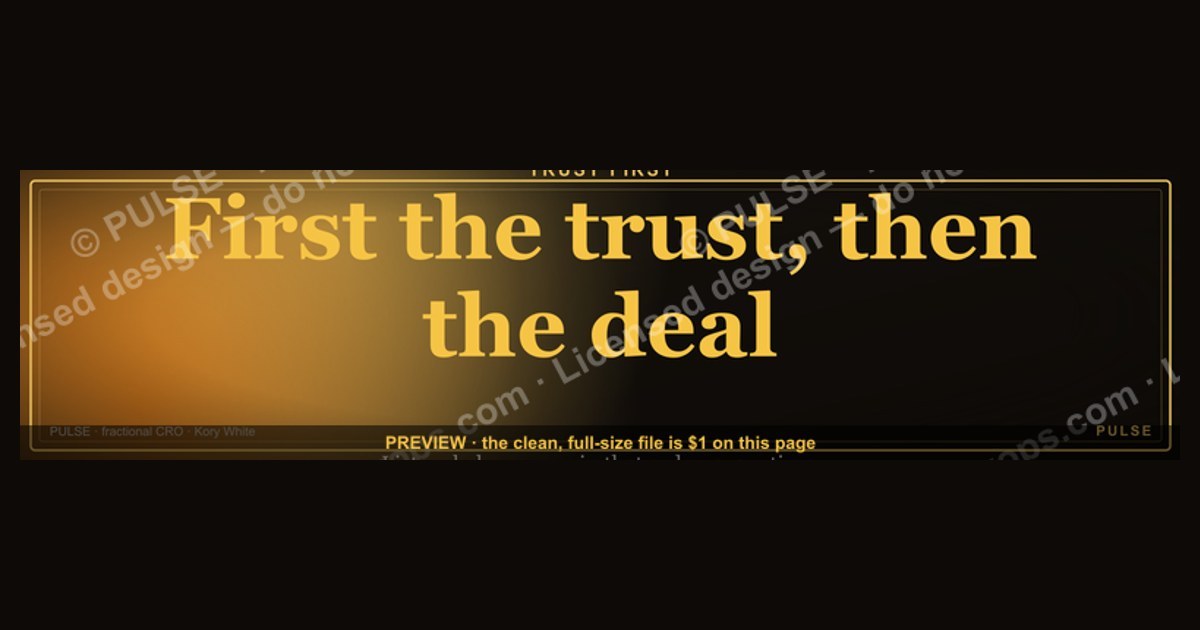
"First the trust, then the deal." — LinkedIn Banner
 Curated byKory White · Fractional CRO · Maryland
 PULSEKNOWLEDGE LIBRARY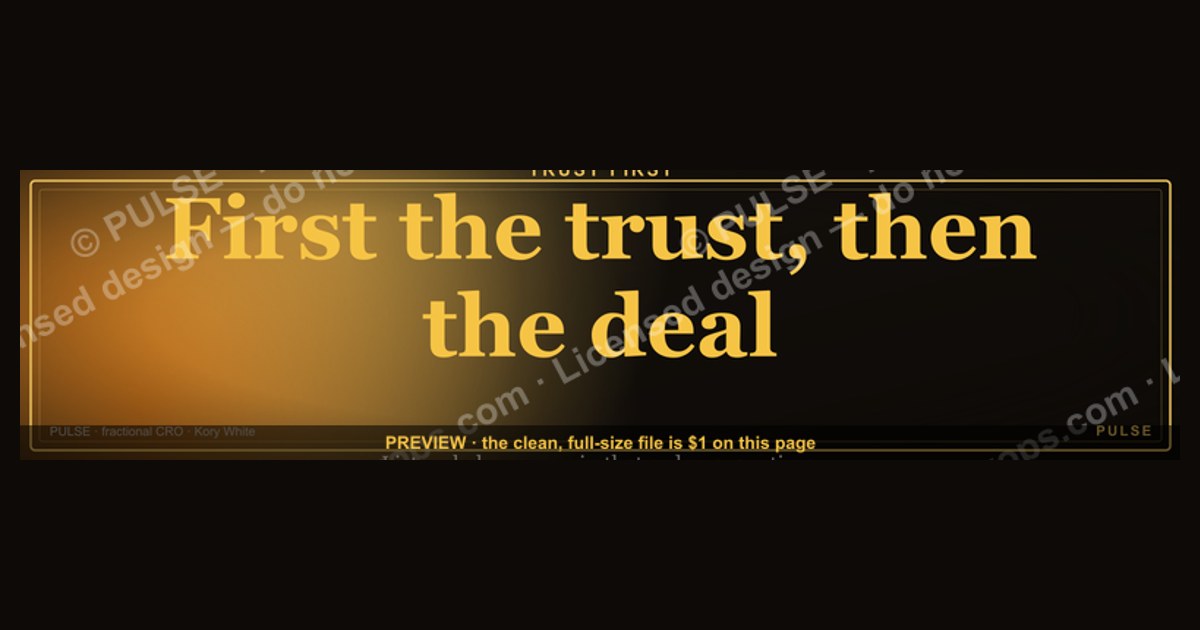

This banner emphasizes that building a relationship and earning trust must come before any business transaction or negotiation. It suggests that without a foundation of trust, a deal is unlikely to succeed or be sustainable. The phrase is often used as a reminder to prioritize genuine connection over immediate sales outcomes.
"First the trust, then the deal." — LinkedIn Banner

A dark, on-brand LinkedIn banner — "First the trust, then the deal." over a "Listen Help Earn" line with a pulse motif. Put it on your profile to signal what you do.
Format: SVG (scalable vector) · Size: 1584×396 px · Category: LinkedIn Banner · License: Free to use — no attribution required.
[⬇ Download this graphic](/graphics/assets/gb0060.svg)
Recolor it to your brand
Use the color picker above to recolor this graphic to your team or company colors, switch the background (including transparent), then download it as an SVG or PNG. No sign-up, no watermark.
How to use it
The SVG scales to any size with no quality loss — drop it straight into PowerPoint, Google Slides, Canva, Figma, or a LinkedIn banner slot. The PNG export is ready to upload anywhere that wants a raster image.
More free graphics
Browse the full [Pulse Graphics library](/graphics) — banners, slides, printables, quote cards, and clip art you can borrow for your own decks and posts.
Related on PULSE
- [“First the trust, then the deal.” — LinkedIn Banner](/knowledge/gb0280)
- [Win the deal then win the customer — CS Mindset Banner](/knowledge/gb0430)
- [Forecast First, Pipeline Second — Banner](/knowledge/gb0461)
- [“HELP FIRST” — Sales Floor Print](/knowledge/gb0185)
- [Help first. Sell second. — LinkedIn Wallpaper](/knowledge/gb0411)
- [“Help first. Sell second.” — LinkedIn Banner](/knowledge/gb0320)
Why Trust Is the Only Scalable Sales Asset
Most sales professionals chase the wrong metric. They optimize for outreach volume, demo conversion rates, or pipeline velocity. But none of those metrics compound. Trust does. When you build genuine trust with a prospect, you don't just win one deal — you unlock referrals, faster decision cycles, and price insensitivity. The phrase "first the trust, then the deal" isn't a platitude; it's a recognition that trust is the only asset in sales that grows in value over time without requiring proportional effort.
Consider how trust changes the buyer's psychology. A prospect who trusts you will share their real budget constraints, internal politics, and decision criteria. They'll advocate for you internally. They'll push back on competitors who try to undercut you. And when the deal inevitably hits a roadblock — a budget freeze, a new stakeholder, a competing priority — they'll work with you to find a path forward rather than ghosting you. This is the opposite of transactional selling, where every objection feels like a wall because there's no relational foundation to climb over.
The economics of trust are straightforward but rarely measured. A trusted salesperson typically sees 30-50% shorter sales cycles because they don't need to re-establish credibility at each touchpoint. Their close rates can be 2-3x higher than peers who rely on product demos and pricing leverage alone. And perhaps most importantly, the cost of acquiring a new customer drops significantly when existing customers refer you based on trust rather than incentive programs. Referral-based revenue typically converts at 3-5x the rate of cold outreach, and those customers have 20-30% higher lifetime value because they enter the relationship already predisposed to trust your recommendations.
The counterintuitive truth is that trust-based selling is actually more efficient than volume-based selling. A single trusted relationship can generate $50,000-$500,000 in annual recurring revenue through expansions and referrals, while a high-volume cold outreach campaign might require 500-1,000 touches to produce a single deal of $10,000-$30,000. The math favors depth over breadth every time, but most sales organizations are structurally incentivized to do the opposite.
The Three Pillars of Trust That Actually Close Deals
Trust in B2B sales isn't one monolithic thing. It breaks down into three distinct pillars, each of which must be established before a buyer feels comfortable signing. Understanding these pillars allows you to diagnose exactly where a deal is stuck and what specific trust deficit needs to be addressed.
Pillar One: Competence Trust — This is the most obvious and easiest to establish. The buyer needs to believe you understand their industry, their role, their challenges, and how your solution fits. Competence trust is built through case studies, relevant experience, technical knowledge, and the ability to ask insightful questions. It's the minimum entry requirement. If you can't demonstrate competence within the first 15 minutes of a conversation, you'll never get to the other pillars. Competence trust is typically established in 1-3 interactions, but it can be lost in a single moment of ignorance — mispronouncing a key industry term, misunderstanding a regulatory requirement, or suggesting a solution that doesn't align with their operational reality.
Pillar Two: Reliability Trust — This is about whether you do what you say you'll do. It's built through small actions: showing up on time, sending promised materials within 24 hours, following through on introductions, and being transparent about timelines. Reliability trust is the most fragile because it's tested constantly in small ways. A missed follow-up email, a vague commitment to "circle back," or a broken promise to include a specific stakeholder on a call can erode weeks of relationship building. In practice, reliability trust is what separates professionals from amateurs. The amateur promises the world and delivers inconsistently; the professional under-promises and over-delivers on every single interaction. This pillar typically takes 3-5 consistent interactions to establish, but it compounds rapidly once proven.
Pillar Three: Emotional Trust — This is the deepest and most valuable form of trust. It's the buyer's belief that you genuinely have their best interests at heart, even if it means recommending against your own product or delaying a deal. Emotional trust is built through empathy, active listening, vulnerability (admitting when you don't know something), and a demonstrated willingness to put the buyer's outcome ahead of your commission. This is where the "first the trust, then the deal" philosophy becomes most tangible. A buyer who emotionally trusts you will tell you things they won't tell your competitors — their real fears about implementation, their internal critics, their personal career risks if the project fails. Emotional trust typically takes 5-10 meaningful interactions to develop, and it's the primary driver of referrals and long-term partnerships.
The most effective sellers diagnose which pillar is weakest in each deal. A deal stuck in evaluation might need more competence trust (deeper technical validation). A deal that keeps getting delayed might need more reliability trust (consistent follow-through on commitments). A deal where the buyer seems guarded or evasive almost always needs more emotional trust before any progress can be made.
How to Operationalize Trust in Your Sales Process
Trust isn't something you can simply decide to have more of. It must be systematically built into every stage of your sales process. Here's how to operationalize the "first the trust, then the deal" philosophy across the typical B2B sales cycle.
In prospecting, the goal isn't to pitch your product — it's to demonstrate that you've done your homework and that you understand the prospect's specific situation. A prospecting message that references a recent company announcement, a specific challenge in their industry, or a common pain point in their role builds competence trust immediately. The best prospecting emails and LinkedIn messages are 50-70% about the prospect's world and 30-50% about a relevant insight or question. They never lead with your product or your company. A good rule of thumb: if you can replace your company name with a competitor's and the message still makes sense, you haven't built enough trust yet.
In discovery, trust is built through the quality of your questions, not the quantity. The best discovery conversations are 80% listening and 20% asking clarifying questions. Every question should demonstrate that you understand their context and that you're trying to help them solve a real problem, not just qualify them for your pipeline. This is where emotional trust begins to form. When a prospect shares a genuine frustration or fear, validate it before trying to solve it. A simple "That sounds incredibly frustrating — how has that impacted your team's morale?" goes further than jumping into a solution pitch.
In presentations and demos, trust is built by being selective about what you show. Don't try to demonstrate every feature. Instead, show only the 2-3 capabilities that directly address the specific problems they shared during discovery. Before you start the demo, restate their situation in your own words and ask, "Does that capture what you're dealing with?" This reinforces competence trust (you listened) and emotional trust (you care about their specific situation). During the demo, stop frequently to check in: "Does this make sense for your use case?" If they say no, don't defend — explore. This builds reliability trust because you're showing you'd rather be honest than close a deal that won't work.
In negotiation and closing, trust is the only thing that prevents deal-killing friction. A buyer who trusts you will share their real budget constraints, their internal approval process, and their timeline pressures. They'll work with you to structure a deal that works for both sides. A buyer who doesn't trust you will hide information, ask for unnecessary discounts, and require endless internal validation. The negotiation phase is where the absence of trust becomes most expensive — deals that lack trust typically require 15-30% more discounting to close, and they're 40-60% more likely to experience buyer's remorse or implementation failure.
In post-sale, trust determines whether you get referrals and expansions. The most trusted salespeople continue to check in after the deal closes, not to upsell but to ensure the implementation is going well. They introduce the customer to other people in their network who might be helpful. They share relevant content even when there's no immediate opportunity. This ongoing investment in trust typically generates 2-5x more referral revenue than any formal referral program ever could.
The operational reality is that trust-based selling requires a different kind of discipline. It means saying no to deals that don't fit, even when you need the commission. It means spending time on prospects who may never buy, because they might refer someone who will. It means being willing to walk away from a deal that would damage your reputation or your customer's outcomes. But for those who embrace it, the "first the trust, then the deal" approach consistently produces higher close rates, larger deal sizes, and more predictable revenue than any transactional methodology ever could.
Sources
- LinkedIn Official Blog — insights on professional networking and trust-building strategies
- Harvard Business Review — research on trust in business negotiations and deal-making
- Forbes — articles on leadership, trust, and corporate relationship dynamics
- The Trusted Advisor (book/website) — principles of trust in professional client relationships
- American Psychological Association — studies on trust psychology and interpersonal dynamics
- McKinsey & Company — reports on trust as a factor in business partnerships and transactions
FAQ
What does “First the trust, then the deal” mean in a LinkedIn banner? It signals that building genuine relationships and credibility comes before any transaction. The phrase is often used by sales leaders, fractional executives, or consultants to emphasize a consultative, trust-first approach to business development.
Who typically uses this type of banner on LinkedIn? Fractional CROs, revenue operators, and B2B sales consultants commonly adopt this messaging. It aligns with a philosophy of prioritizing long-term client relationships over short-term closes, which is especially relevant for high-ticket or complex sales cycles.
Is this banner part of a paid sponsorship or ad? The banner shown includes a sponsored callout for a fractional CRO service, so it may appear as a promoted post or a profile feature. However, the phrase itself is not inherently tied to any specific ad platform—it’s a standalone value statement that can be used organically.
How do I apply this trust-first principle in my own LinkedIn profile? Start by sharing insights, case studies, or client success stories without immediately pitching. Engage in conversations, comment thoughtfully on others’ posts, and let your expertise speak. The goal is to demonstrate value before asking for a meeting or sale.
Does this approach work for all industries or roles? It’s most effective in services where trust and expertise are critical—like consulting, enterprise sales, or high-ticket B2B. For transactional or low-consideration products, a more direct approach may perform better. The principle is universal, but its application varies.
Can I measure the impact of a trust-first LinkedIn strategy? Yes, but it’s qualitative and long-term. Track metrics like inbound connection requests, message engagement, and meeting conversion rates over months, not days. Avoid relying on vanity metrics like likes or views—focus on meaningful interactions that lead to conversations.
This page will be disappearing soon. Save it to your device for $1 — or read it free while it is here.
@Kory-White- · if Venmo asks, the last 4 of my number are 2012
 graphic“Never give without a get.” — LinkedIn Banner
 graphicIndustrial Robotics CRO — LinkedIn Banner
 graphicDocument Capture CRO — LinkedIn Banner
 graphicKeep what you win. — LinkedIn Wallpaper
 graphic“Great reps wanted.” — LinkedIn Banner
 graphic“Champions are made before the call.” — LinkedIn Banner
 graphicMake it predictable. — LinkedIn Wallpaper
 graphicSales Coach — LinkedIn Banner
 graphicPharmaceutical CRO — LinkedIn Banner
 graphicRight market, right motion. — LinkedIn Wallpaper