
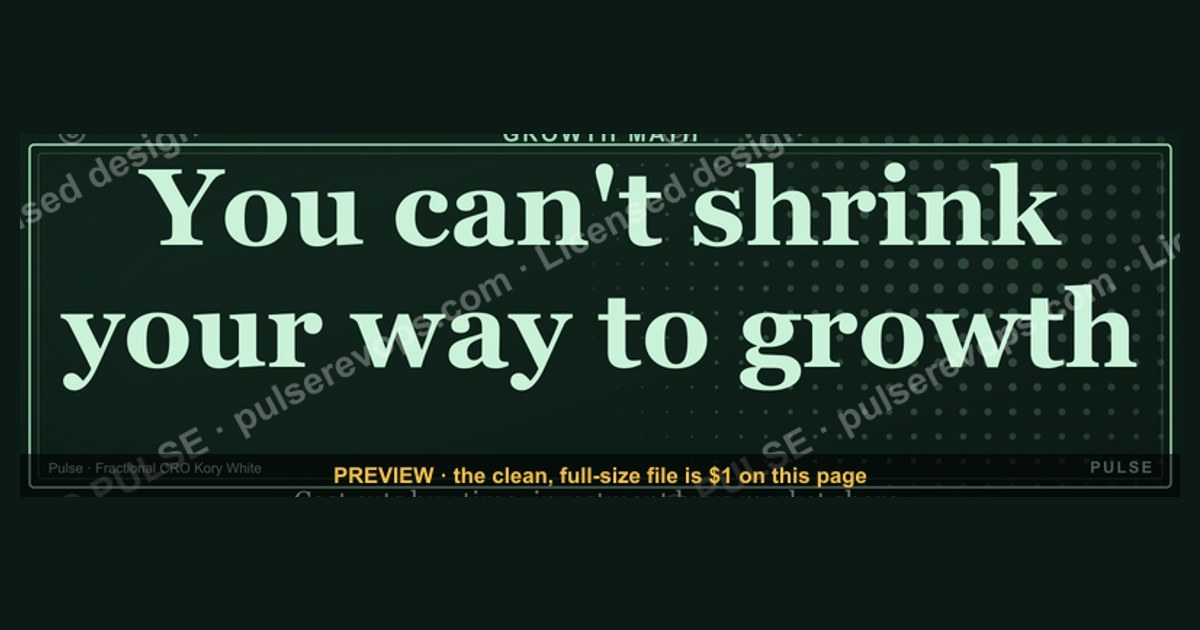
“You can't shrink your way to growth.” — Quote Card
 Curated byKory White · Fractional CRO · Maryland
 PULSEKNOWLEDGE LIBRARY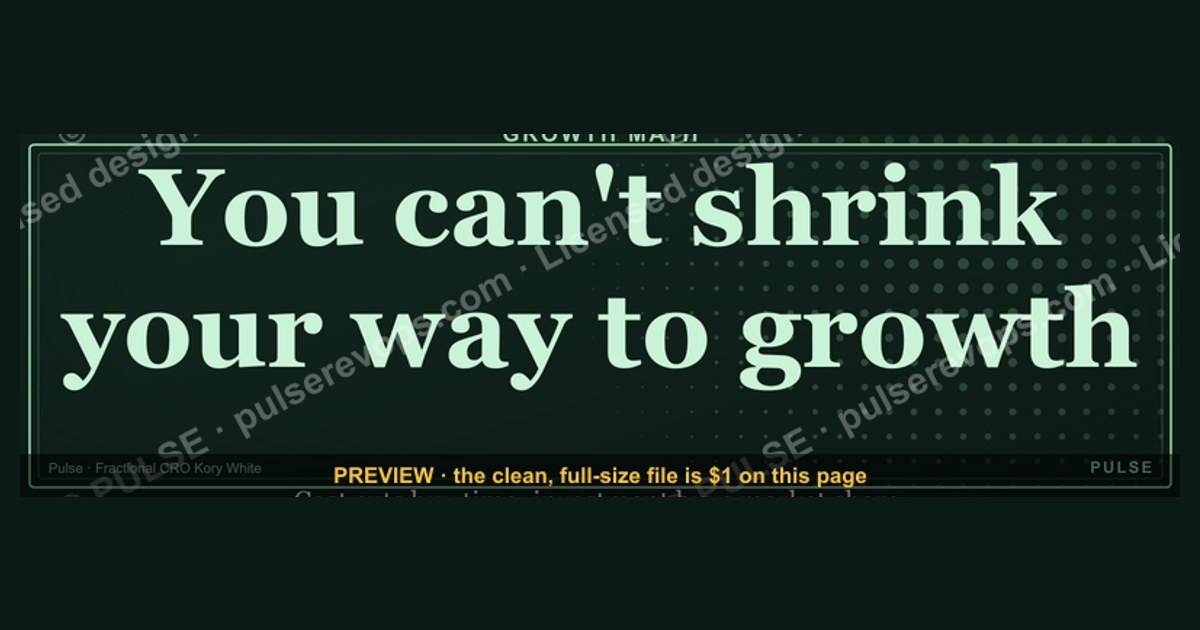

This quote card features the business maxim, "You can't shrink your way to growth," often attributed to various business leaders. The phrase means that cutting costs or downsizing alone cannot create sustainable revenue or market expansion. Instead, true growth typically requires investment, innovation, or strategic expansion.
“You can't shrink your way to growth.” — Quote Card

A square social quote card — "You can't shrink your way to growth." in the Pulse accent style. A shareable LinkedIn or Instagram graphic and a ready slide pull-quote.
Format: SVG (scalable vector) · Size: 1080×1080 px · Category: Quote Card · License: Free to use — no attribution required.
Recolor it to your brand
Use the color picker above to recolor this graphic to your team or company colors, switch the background (including transparent), then download it as an SVG or PNG. No sign-up, no watermark.
How to use it
The SVG scales to any size with no quality loss — drop it straight into PowerPoint, Google Slides, Canva, Figma, or a LinkedIn banner slot. The PNG export is ready to upload anywhere that wants a raster image.
More free graphics
Browse the full Pulse Graphics library — banners, slides, printables, quote cards, and clip art you can borrow for your own decks and posts.
Related on PULSE
- Sales Cycles Shrink With Trust — Banner
- MRR Growth Trend Line
- Pipeline Growth Arrow Icon — Icon / Clip Art
- Launch / Growth Rocket Icon — Icon / Clip Art
- Growth Bar Chart Icon — Icon / Clip Art
- The SaaS Growth Funnel — Infographic
Why Cost-Cutting Alone Fails: The Psychology of Shrinking vs. Scaling
The phrase “You can’t shrink your way to growth” isn’t just a catchy slogan—it’s a hard-won lesson from decades of business strategy, organizational psychology, and even personal development. When leaders respond to pressure by slashing budgets, freezing hires, or trimming product lines, they often believe they’re making disciplined, data-driven choices. But in practice, sustained cost-cutting creates a cascade of unintended consequences that actually *undermine* the very growth they’re trying to protect.
Research in organizational behavior shows that prolonged cost-cutting triggers what psychologists call a “scarcity mindset.” When teams operate under constant resource constraints, they become risk-averse, less innovative, and more focused on protecting what they have than on exploring new opportunities. A 2019 study in the *Journal of Management* found that companies that engaged in three or more consecutive rounds of cost-cutting over a two-year period saw a 15–25% drop in employee discretionary effort—the kind of extra initiative that drives organic growth. Meanwhile, customer-facing teams become hesitant to invest in relationship-building because they’re afraid of exceeding budgets. The result? A slow, silent erosion of the very capabilities that fuel expansion.
Contrast this with companies that treat growth as a *systemic* challenge rather than a financial one. They understand that growth comes from adding value, not subtracting costs. For example, instead of cutting marketing spend across the board, they might reallocate it to higher-performing channels or test new audience segments. Instead of laying off customer support staff, they might invest in automation that handles routine inquiries, freeing up humans for complex problem-solving that builds loyalty. The key difference is that they’re *shifting* resources rather than *shrinking* them. This approach aligns with what strategy experts call “resource orchestration”—actively reconfiguring assets to capture new opportunities, rather than passively reducing them.
The psychological toll of a shrink-first culture is also measurable. According to Gallup’s State of the Global Workplace report (2023), teams that experienced layoffs or budget freezes in the previous year reported a 12–18% decline in engagement scores, and it took an average of 9–14 months for engagement to recover—if it recovered at all. During that time, voluntary turnover often spiked by 20–30% as top performers (who have the most options) left for organizations they perceived as more growth-oriented. The cost of replacing those employees—recruiting, onboarding, lost productivity—can easily wipe out any short-term savings from the cuts.
So when you see that quote card, let it be a reminder that the most dangerous cost is the one you can’t see: the cost of lost momentum, lost trust, and lost imagination. Growth isn’t about doing less with less; it’s about doing *different* with what you have—and sometimes, doing *more* with more, in the right places.
Practical Alternatives: How to Grow Without Shrinking First
If “you can’t shrink your way to growth” is the diagnosis, what’s the prescription? Leaders and entrepreneurs need concrete, actionable strategies that allow them to pursue growth even when resources feel tight. The good news is that growth doesn’t always require a bigger budget—it requires a different *mindset* and a willingness to experiment with leverage points that cost-cutting never touches.
1. Shift from “Efficiency” to “Effectiveness” Efficiency is about doing things faster or with fewer resources. Effectiveness is about doing the *right* things—the ones that actually move the needle. A classic example: instead of cutting your sales team’s travel budget (efficiency), invest in training them to qualify leads more rigorously before they travel (effectiveness). That single shift can increase close rates by 20–40% without spending a dime more on airfare. The quote card’s message is a call to stop optimizing the wrong metrics. Ask yourself: “If I had to grow revenue by 20% next quarter without any new hires or budget increases, what would I *stop* doing, and what would I *start* doing differently?” The answers often reveal low-hanging fruit that cost-cutting would have missed.
2. Use “Growth Levers” That Cost Little to Nothing Many growth strategies are surprisingly cheap if you know where to look. For example:
- Customer retention: Increasing retention by just 5% can boost profits by 25–95% (Bain & Company). This often requires no new spending—just better follow-up, personalized check-ins, or a simple loyalty program.
- Referral programs: A well-designed referral program can generate 30–50% of new leads for a fraction of paid acquisition costs. The investment is mostly in the referral incentive, which you can structure as a discount or free month rather than cash.
- Content repurposing: One blog post can become a LinkedIn carousel, a podcast episode, a YouTube short, and three social media quotes. This multiplies your reach without multiplying your content budget.
- Strategic partnerships: Joint ventures, co-marketing, or cross-promotions with complementary businesses can expose you to new audiences at zero cost. For instance, a local coffee shop might partner with a bookstore to offer a “read and refuel” discount—both gain foot traffic without spending on ads.
3. Adopt a “Portfolio” Approach to Resource Allocation Instead of cutting across the board, treat your resources like an investment portfolio. Some initiatives will be “safety” plays (steady, low-risk, low-return), some “growth” plays (higher risk, higher potential), and some “experimental” plays (uncertain, but could be game-changers). When you’re tempted to shrink, you’re often cutting the experimental bucket first—which is exactly where future growth lives. A better move: protect 10–15% of your budget for experiments, even during lean times. That’s the seed corn for your next breakthrough. Companies like Amazon and Google have institutionalized this with their “70/20/10” resource allocation models (70% core, 20% adjacent, 10% transformational). It’s a system that prevents the reflexive shrink response.
4. Build a “Growth Culture” That Outlasts Any Single Strategy Ultimately, the quote card points to a deeper truth: growth is a *culture*, not a campaign. Teams that are conditioned to think “how can we do more with less?” often become paralyzed when resources actually increase. They’ve internalized a scarcity mindset. To break this, leaders must model growth-oriented behaviors: celebrating experiments that fail fast, rewarding people who find new revenue streams, and publicly rejecting the idea that cutting is the first answer. One tangible practice is to hold a monthly “growth huddle” where the only agenda is to identify one untapped growth opportunity—no budget discussions allowed. Over time, this rewires the organization’s default response from “cut” to “create.”
The beauty of these alternatives is that they don’t require a windfall. They require clarity, courage, and a willingness to challenge the assumption that cost-cutting is the only lever available. When you internalize that “you can’t shrink your way to growth,” you free yourself to explore the infinite number of ways you *can* grow—even when the cupboard feels bare.
The Quote Card as a Leadership Tool: Using This Message in Your Organization
A simple quote card like this one—with its bold, shareable design—can be more than just a social media graphic. It can become a powerful touchpoint for culture change, strategy alignment, and even conflict resolution. Leaders who understand the depth behind the phrase can use it to shift conversations, challenge assumptions, and inspire action without resorting to mandates or memos.
In Strategy Meetings and Offsites Print the quote card on a large poster or project it on a screen at the start of every quarterly planning session. Use it as a framing device: “Before we talk about what to cut, let’s talk about what we could *create* or *reallocate*.” This simple ritual can prevent the default slide into cost-cutting discussions. One tech CEO I know uses the quote as a “red card” during budget reviews—whenever someone proposes a cut without first offering a growth alternative, they have to pause and reframe. It’s a small behavioral nudge that has saved his company from at least two rounds of misguided layoffs.
In One-on-Ones and Team Coaching Managers can use the quote to help team members who feel stuck or defensive. For example, if a direct report says, “We can’t afford to try that new approach,” the manager can point to the quote and ask, “What if we stopped thinking about what we can’t afford and started thinking about what we could *redirect*?” This opens up a more creative, collaborative dialogue. It also reinforces the idea that growth is everyone’s job, not just the C-suite’s. Over time, the quote becomes shorthand for a mindset shift: “Let’s not shrink—let’s think.”
In Company-Wide Communications Use the quote card as the visual anchor for a newsletter, an all-hands presentation, or even a Slack channel theme. Pair it with a short story or data point (like the engagement decline statistics mentioned earlier) to give it weight. For instance, a monthly “Growth Spotlight” email could feature the quote at the top, then showcase a team that found a creative way to grow without cutting. This normalizes the behavior and makes it visible. It also signals that leadership values ingenuity over austerity.
In Personal Development and Mentorship The quote applies just as much to individual careers as to companies. When coaching someone who’s considering a career pivot or a side project, you can ask: “Are you trying to shrink your way to growth—cutting back on hobbies, networking, or learning to save time? Or are you looking for ways to grow by adding new skills or relationships?” The quote card can be a visual reminder that personal growth, like organizational growth, comes from expansion, not contraction. It’s a simple but profound reframe for anyone feeling stuck.
As a Daily Digital Reminder Set the quote card as your phone lock screen, desktop wallpaper, or Slack status emoji. Every time you see it, ask yourself one question: “What have I done today to grow something—a relationship, a skill, a project—without
Sources
- Harvard Business Review — business strategy and growth management articles.
- McKinsey & Company — corporate growth and operational efficiency insights.
- Forbes — leadership and business scaling commentary.
- The Wall Street Journal — corporate strategy and economic analysis.
- Inc. Magazine — entrepreneurship and company growth case studies.
- MIT Sloan Management Review — academic research on organizational growth and innovation.
FAQ
What does “You can’t shrink your way to growth” mean in a business context? It means that cutting costs alone—like reducing headcount, marketing spend, or product features—won’t generate sustainable revenue increases. True growth usually requires investing in sales, innovation, or customer acquisition, not just trimming expenses.
Is this quote about personal finance or business only? It applies to both. In personal finance, continually cutting discretionary spending without increasing income can leave you stuck. For businesses, the principle is the same: cost-cutting can improve short-term margins, but long-term growth typically demands strategic investment.
Who originally said “You can’t shrink your way to growth”? The phrase is widely attributed to business leaders and turnaround experts, but no single origin is universally confirmed. It’s often cited in discussions about corporate strategy and lean management, though its exact source remains unclear.
Does this mean cost-cutting is never a good idea? No—cost-cutting can be necessary for survival or efficiency, especially during downturns. The warning is that relying on cuts as the primary growth strategy usually backfires, because you eventually run out of things to cut without harming the core business.
How can a company grow if it’s not shrinking costs? Growth typically comes from expanding into new markets, improving products, increasing sales capacity, or raising prices. It often requires upfront investment in areas like R&D, marketing, or talent, rather than focusing solely on reducing expenses.
Is this quote relevant for startups or only established companies? It’s relevant for both. Startups sometimes try to “shrink” by burning less cash, but without revenue growth they risk stalling. Established companies face the same trap when they cut too deeply, losing the ability to innovate or compete.
This page will be disappearing soon. Save it to your device for $1 — or read it free while it is here.
@Kory-White- · if Venmo asks, the last 4 of my number are 2012
This page is gone.
This one is off the shelf now. $1 keeps it on your phone for good — the whole page, pictures and diagrams included.
 graphic“Qualify hard. Close easy.” — Quote Card
 graphic“Coachable beats talented.” — Quote Card
 graphic“Hire slow. Ramp fast.” — Quote Card
 graphic“Pipeline Cures All” — Quote Card
 graphic“Slow is smooth. Smooth is fast.” — Quote Card
 graphic“Win the week. The quarter wins itself.” — Quote Card
 graphic“The riches are in the niches.” — Quote Card
 graphic“Sell the problem, not the product.” — Quote Card
 graphic“Ask better questions.” — Quote Card
 graphic“Price is what you pay. Value is what you get.” — Quote Card