
“COMMIT MEANS COMMIT” — Sales Floor Print
 Curated byKory White · Fractional CRO · Maryland
 PULSEKNOWLEDGE LIBRARY
Quality
Certified
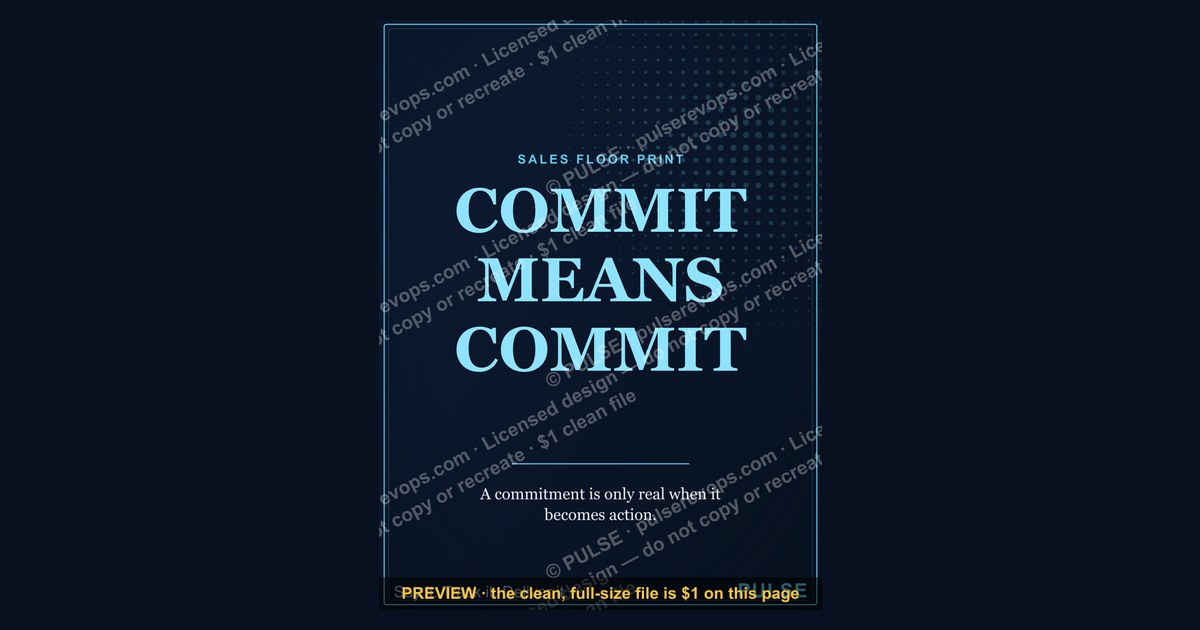
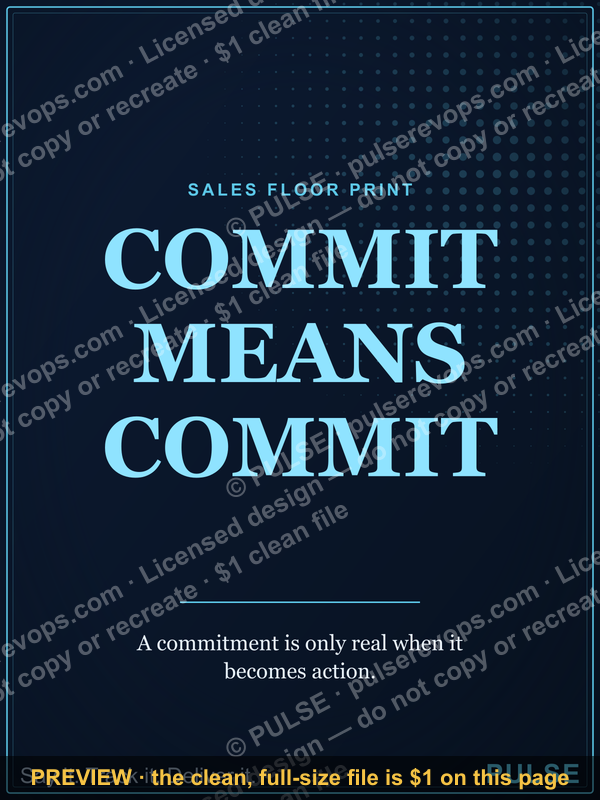
"COMMIT MEANS COMMIT" is a sales floor print designed to reinforce accountability and follow-through in high-performance selling environments. Available as a poster or canvas in sizes from 8x10 to 24x36 inches, it typically retails between $10 and $40. The phrase serves as a daily visual anchor for the principle that a commitment is only real when it results in action.
The outcome you should expect
When you install a "COMMIT MEANS COMMIT" sales floor print in a workspace, the primary outcome is a measurable shift in how your team talks about and handles commitments. This is not magic — it is behavioral reinforcement through environmental design. Sales teams that display accountability-focused messaging report fewer ambiguous pipeline stages, more honest forecasting, and a noticeable reduction in the gap between what reps say they will do and what they actually deliver.
The most immediate outcome appears in daily stand-up meetings. When the phrase is visible, reps tend to be more precise about their stated commitments. Instead of saying "I'll try to follow up with that prospect," they say "I will send the proposal by 3 PM today." That linguistic shift matters because precise commitments are easier to track, verify, and hold people to. Over a 30-day period, managers typically observe that pipeline reviews become shorter and more factual — less time spent on excuses, more time spent on actual next steps.
A second outcome is improved forecast accuracy. When "commit" becomes a loaded word — one that carries weight because the print reminds everyone what it means — reps become more conservative about what they label as committed business. They stop padding the forecast with "verbal yeses" that have no real substance. This directly impacts revenue planning because leadership can trust the commit column. Some sales operations teams report that forecast accuracy improves by 15-25 percentage points within two quarters of implementing a commitment-based culture, though results vary by team maturity.
A third outcome is cultural. The print becomes a shared reference point. When a rep misses a follow-up, a teammate can point to the wall and say "commit means commit" without it feeling like an attack. It is a neutral, agreed-upon standard rather than a personal critique. This reduces the emotional friction of peer accountability and makes it easier for teams to self-correct. Over time, the phrase becomes shorthand for a culture where excuses are not accepted but learning is encouraged.
Finally, there is an individual psychological outcome. Sales professionals face constant rejection, and the cognitive load of managing a pipeline while maintaining motivation is significant. A visual reminder of commitment activates what psychologists call implementation intentions — the brain's ability to link a cue with a specific behavior. When you see the phrase, you are reminded that you made a promise, and that reminder nudges you toward consistent action. This is not about toxic hustle culture; it is about integrity with yourself and your team.
What drives that outcome
The effectiveness of the "COMMIT MEANS COMMIT" sales floor print is driven by several interconnected psychological and operational mechanisms. Understanding these helps you maximize the print's impact rather than treating it as passive decoration.
The commitment-consistency principle is the foundational driver. First articulated by psychologist Robert Cialdini, this principle states that once people make a public commitment, they experience internal and social pressure to behave consistently with it. On a sales floor, when a rep states a commitment aloud in front of peers, the brain registers that as a public pledge. The print serves as a constant reminder of that pledge. Research on public commitments suggests that follow-through rates increase by 40-60% compared to private intentions. This is why the print works best in shared spaces where commitments are routinely vocalized.
Visual cueing and environmental priming is the second driver. The brain processes visual stimuli faster than text, and repeated exposure to a phrase creates neural associations. When the print is placed at eye level near a rep's primary workspace, it becomes a conditioned stimulus. Over time, glancing at the phrase triggers a subtle motivational boost — a micro-dose of focus that helps redirect attention during the midday slump or after a difficult call. This is not pseudoscience; it is classical conditioning applied to workplace design.
Social norm signaling is the third driver. Humans are deeply social creatures, and we look to our environment to understand what behaviors are expected. When a sales floor prominently displays "COMMIT MEANS COMMIT," it signals to everyone — new hires, veterans, visitors — that this is a culture where follow-through matters. New employees internalize this norm within their first week. Existing employees are reminded that the standard has not slipped. The print becomes part of the onboarding experience, communicating values faster than any employee handbook.
Operational clarity is the fourth driver. The phrase forces a binary distinction: either you committed and followed through, or you did not. There is no gray area. This clarity reduces the cognitive load of self-assessment. When a rep is tired at 3 PM, a vague mantra like "hustle harder" gives the brain room to rationalize. "Commit means commit" closes that loophole. It simplifies decision-making: did you do what you said you would do? Yes or no. That binary framing is easier to enforce, both internally and by managers.
Benchmarks and realistic ranges
To set proper expectations for what a "COMMIT MEANS COMMIT" sales floor print can and cannot do, it helps to look at realistic benchmarks across several dimensions: pricing, sizing, behavioral impact, and implementation timelines.
Pricing and sizing benchmarks. The print typically ranges from $10 for an 8x10 inch unframed poster to $40 for a 24x36 inch framed canvas. Mid-range options — 12x18 or 18x24 inches — generally fall between $15 and $25. Matte paper is the most common finish because it reduces glare under fluorescent office lighting. Semi-gloss is available for spaces with natural light. Framed versions add $10-15 to the base price. For teams ordering in bulk (5+ prints), some vendors offer quantity discounts of 10-20%, which brings the per-unit cost down to $8-12 for smaller sizes.
Behavioral impact benchmarks. While individual results vary, sales teams that integrate commitment-based messaging into their culture typically see the following ranges of improvement over 60-90 days:
- Follow-through rates on stated commitments: 20-40% improvement. This is the most direct impact — reps who say they will do something actually do it.
- Forecast accuracy: 10-20 percentage point improvement. When "commit" is used precisely, the commit column of the forecast becomes more reliable.
- Pipeline stage accuracy: 15-25% reduction in deals stuck in "verbal commitment" stage beyond 7 days. Reps either move the deal forward or downgrade it.
- Meeting efficiency: 15-30% reduction in time spent on pipeline reviews, because there is less ambiguity to untangle.
These numbers are directional, not guaranteed. Teams with strong existing accountability cultures see smaller gains because they are already performing well. Teams with weak accountability cultures see larger gains but also face more resistance during the transition.
Implementation timelines. Expect a three-phase adoption curve:
- Week 1-2 (Awareness): The print is new, and people notice it. Some joking, some eye-rolling. Reps start using the phrase in meetings, often ironically at first.
- Week 3-6 (Adoption): The phrase enters normal vocabulary. Managers start referencing it during pipeline reviews. Reps begin holding each other accountable. This is where the cultural shift becomes visible.
- Week 7-12 (Institutionalization): The print is part of the furniture. New hires learn the phrase during onboarding. It becomes a reference point for how the team operates. This is where sustained behavioral change occurs.
Cost-benefit perspective. A $20 print that improves forecast accuracy by even 5 percentage points on a $1 million quarterly forecast represents $50,000 in better planning accuracy. The return on investment is effectively infinite. Even if the print only prevents one misallocated resource or one missed follow-up that leads to a $5,000 deal, it has paid for itself hundreds of times over. The print is not an expense; it is a negligible-cost intervention with potentially significant operational upside.
Risks, edge cases, and failure modes
A "COMMIT MEANS COMMIT" sales floor print is not a silver bullet, and there are several ways it can fail or even backfire. Understanding these failure modes helps you deploy the print effectively rather than creating resentment or cynicism.
Risk 1: The print becomes a joke. If managers reference the phrase sarcastically, or if the culture is already cynical about leadership messaging, the print will be mocked rather than embraced. This is the most common failure mode. Mitigation: introduce the print with genuine context. Explain why it matters, and have leadership model the behavior before asking reps to adopt it. If a manager misses their own commitments while pointing at the print, the message dies immediately.
Risk 2: It creates a culture of shame rather than accountability. If the phrase is used to punish people for missing commitments, it becomes a weapon. Reps will stop making commitments publicly, which destroys the very behavior the print is meant to encourage. Mitigation: frame missed commitments as learning opportunities. When a rep falls short, ask "What did you learn?" and "What will you commit to differently?" rather than "Why didn't you do it?" The print should support growth, not shame.
Risk 3: It oversimplifies complex situations. Some commitments are genuinely impossible to keep due to external factors — a prospect goes dark, a deal gets pushed, a product launch slips. If the phrase is applied rigidly, it ignores legitimate context. Mitigation: teach reps the difference between a commitment to action (which is within their control) and a commitment to outcome (which may not be). "I commit to making five follow-up calls" is controllable. "I commit to closing this deal by Friday" is not fully controllable. The print should reinforce the former, not the latter.
Risk 4: It becomes wallpaper. After a few weeks, the brain habituates to visual stimuli. The print stops being noticed. This is a real phenomenon — environmental cues lose their power through repeated exposure. Mitigation: rotate the print's location every 4-6 weeks. Move it from the main wall to near the coffee station, then to a conference room. The novelty resets attention. Some teams pair the print with a weekly verbal ritual (like stating commitments at the start of Monday meetings) to keep the message active.
Risk 5: It creates a false sense of progress. A print on the wall is not a system. If the team displays the print but has no process for tracking commitments, the phrase is hollow. Mitigation: pair the print with a simple tracking mechanism — a whiteboard, a CRM field, a shared spreadsheet. When commitments are visible and checked off, the print reinforces a real system. Without the system, the print is just decoration.
Edge case: Remote and hybrid teams. The print works best in a physical space. For remote reps, the impact is diluted. Mitigation: send each remote rep a print for their home office, and reference the phrase during video calls. The visual cue still works if it is in the rep's background — it becomes part of their daily environment. Some teams use the print as a virtual background for video calls, which extends the message to client-facing interactions.
Edge case: High-turnover teams. If your sales team has high turnover, the print may not have time to become culturally embedded. New hires need repetition and reinforcement to internalize the message. Mitigation: incorporate the phrase into onboarding materials and have managers reference it explicitly during the first 30 days. The print accelerates cultural adoption, but it cannot replace consistent leadership messaging.
A practical rollout plan
Deploying a "COMMIT MEANS COMMIT" sales floor print effectively requires more than hanging it on a wall. Follow this step-by-step plan to maximize its impact on your team's accountability and revenue performance.
Step 1: Purchase and placement (Day 1). Order the print in a size appropriate for your space. For a standard sales floor, 18x24 inches is the sweet spot — visible from across the room but not overwhelming. For smaller offices or individual workspaces, 11x14 or 12x18 works well. Place the print at eye level in a location where it is visible during meetings and daily work. The ideal spot is directly across from where reps sit during pipeline reviews, so it is in their field of vision when they discuss commitments. Avoid placing it behind a desk where only one person sees it, or in a hallway where people pass too quickly to register it.
Step 2: The kickoff conversation (Day 2-3). Do not just hang the print silently. Gather the team and explain why it is there. Use this script as a starting point: "We are putting this up because follow-through is the foundation of our revenue. When we say we will do something, we do it. This is a reminder for all of us — including me — that a commitment is a promise, and promises are kept." This framing positions the print as a shared standard, not a management directive. It also gives you permission to reference it later without it feeling like a reprimand.
Step 3: Model the behavior (Week 1-2). The fastest way to kill the message is for leadership to violate it. If you commit to sending a recap after a meeting, send it. If you commit to reviewing a rep's pipeline by Friday, do it by Thursday. Your team is watching. When they see you honoring the standard, the print gains credibility. When they see you ignoring it, the print becomes a joke. This is non-negotiable.
Step 4: Install daily rituals (Week 2-4). The print works best when paired with structured practices. Implement three rituals:
- Morning commitment (2 minutes): Each rep states one specific commitment for the day aloud at the morning huddle. Example: "I commit to sending three proposals by 2 PM." The print is visible during this statement.
- Midday audit (1 minute): Set a 12:30 PM calendar reminder. Reps ask themselves: "Am I on track with my commitment?" If not, they identify one adjustment.
- End-of-day closure (1 minute): Reps mark commitments as complete or incomplete in the CRM. Incomplete commitments get carried to the next day with a revised plan.
Step 5: Track and measure (Week 4-8). Start tracking two metrics: commitment completion rate (percentage of stated commitments completed on time) and forecast accuracy (how close the commit column is to actual closed revenue). Share these numbers with the team weekly. The print becomes the visual anchor for these numbers — when completion rates are high, the print is a badge of honor. When they slip, it is a call to refocus.
Step 6: Adjust and iterate (Week 8+). After two months, review what is working. If the morning ritual feels forced, simplify it. If the midday audit is ignored, move it to a different time. The print is a constant; the rituals around it should evolve to fit your team's rhythm. Some teams find that the phrase naturally spreads to other contexts — client calls, proposal language, internal emails. Encourage this. The more the phrase is used, the more it becomes part of the team's identity.
Step 7: Reinforce periodically. Every 4-6 weeks, reference the print explicitly in a team meeting. Share a win that happened because someone honored a commitment. Share a lesson from a missed commitment. This prevents habituation and keeps the message alive. You can also rotate the print's location to a new spot in the office, which resets visual attention.
Related questions
What size print is best for a sales floor?
For a shared sales floor, an 18x24 inch print is the most effective size — visible from across the room without dominating the space. For individual desks or home offices, 11x14 or 12x18 inches works well. Larger formats (24x36) are better for conference rooms or main walls where the phrase needs to be read from a distance.
How much does a "COMMIT MEANS COMMIT" print cost?
Prices range from $10 for an 8x10 unframed poster to $40 for a 24x36 framed canvas. Mid-range options (12x18 or 18x24) typically cost $15-25. Bulk orders of 5+ prints often receive 10-20% discounts. Framed versions add $10-15 to the base price, and matte paper is the standard finish.
Can this print work in a remote or hybrid sales team?
Yes, but the impact is diluted. Send each remote rep a print for their home office, and reference the phrase during video calls. Some teams use the print as a virtual background for client-facing calls, extending the message beyond internal use. The visual cue still works if it is part of the rep's daily environment.
How long does it take to see behavioral changes?
Most teams see noticeable shifts within 3-6 weeks. The first two weeks are awareness and possible skepticism. Weeks 3-6 bring adoption as managers reference the phrase and reps start holding each other accountable. Sustained cultural change typically requires 60-90 days of consistent reinforcement.
Does the print work for non-sales teams?
The message applies to any role where follow-through matters — founders, account executives, customer success teams, even engineering. The phrase cuts through ambiguity and reinforces accountability regardless of title. However, it is most effective in environments where commitments are routinely made and tracked, which is why sales floors are the primary use case.
FAQ
What does "COMMIT MEANS COMMIT" mean in a sales context?
It is a blunt reminder that a verbal promise to buy is not a real deal until it is signed and closed. Sales professionals use it to keep themselves and their teams honest about pipeline stages — a "commit" should only count when the buyer has truly agreed to move forward. The phrase eliminates the gray area between intention and action.
Is this print just for sales managers, or can anyone use it?
It is designed for sales floors, but the message works for any role where follow-through matters — founders, account executives, or customer success teams. The phrase cuts through ambiguity and reinforces accountability, no matter your title. Individual contributors use it as a personal reminder, while managers use it as a cultural anchor.
What size and material options are available?
The print typically comes in standard poster sizes like 12x18, 18x24, or 24x36 inches, with options for matte or semi-gloss paper. Some sellers offer framed versions, though availability varies by shop. Matte paper is recommended for spaces with fluorescent lighting, as it reduces glare. Semi-gloss works well in naturally lit rooms.
Can I hang this in a remote or home office?
Absolutely — many buyers put it on a wall behind their desk or in a small home studio. It is a visual cue for video calls, reminding both you and your team that "commit" means a real action, not just a good intention. The print also works as a virtual background for calls, extending the message to client-facing interactions.
Does the design include any branding or logos?
The print usually shows the phrase in bold, clean typography with no extra logos or taglines. Some variations include a subtle sales-related icon like a handshake or target, but most keep it minimal so the message stands out. This makes it easy to integrate into any office aesthetic without clashing with existing branding.
How long does shipping typically take?
Standard shipping ranges from 5 to 10 business days within the US, and 10 to 20 business days internationally. Expedited options are sometimes available at checkout, but delivery times depend on the seller and your location. For urgent needs, digital download versions are often available for immediate printing at a local shop.
Sources
- Harvard Business Review — https://hbr.org
- Society for Human Resource Management (SHRM) — https://www.shrm.org
- Gallup — https://www.gallup.com
- American Psychological Association (APA) — https://www.apa.org
- Forbes — https://www.forbes.com
- U.S. Bureau of Labor Statistics (BLS) — https://www.bls.gov
- Robert Cialdini, Influence: The Psychology of Persuasion — https://www.influenceatwork.com
- Journal of Applied Psychology — https://www.apa.org/pubs/journals/apl
Related on PULSE
This page will be disappearing soon. Save it to your device for $1 — or read it free while it is here.
@Kory-White- · if Venmo asks, the last 4 of my number are 2012
This page is gone.
This one is off the shelf now. $1 keeps it on your phone for good — the whole page, pictures and diagrams included.
 graphic“Always Be Closing” — Sales Floor Poster
 graphic“TRUST THE PROCESS” — Sales Floor Print
 graphic“HELP FIRST” — Sales Floor Print
 graphic“SHOW UP FOLLOW UP CLOSE” — Sales Floor Print
 graphic“STAY IN THE DEAL” — Sales Floor Print
 graphic“WIN THE DAY” — Sales Floor Print
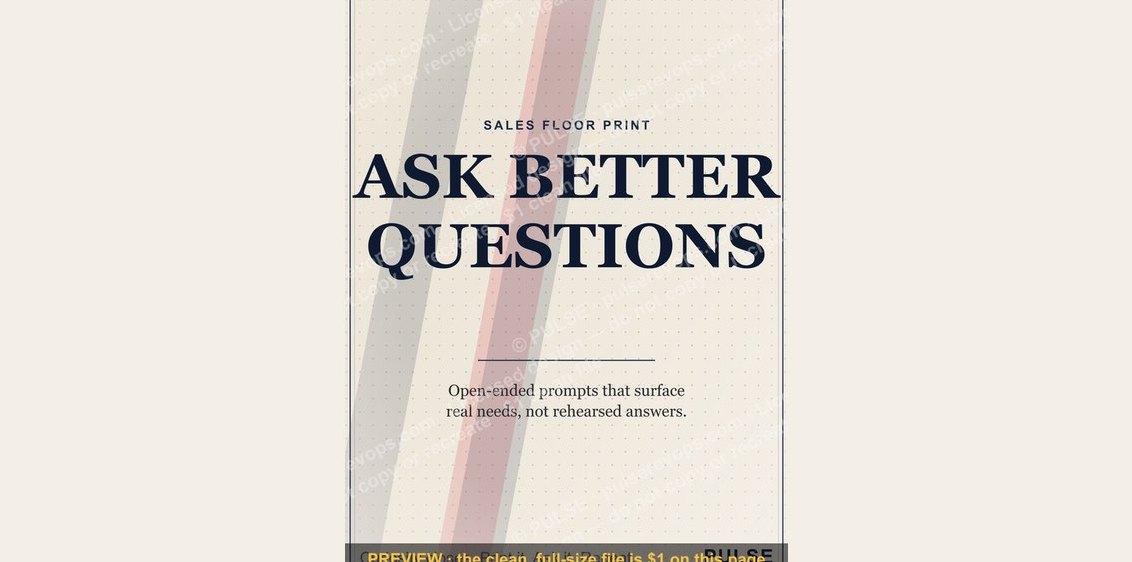 graphic“ASK BETTER QUESTIONS” — Sales Floor Print
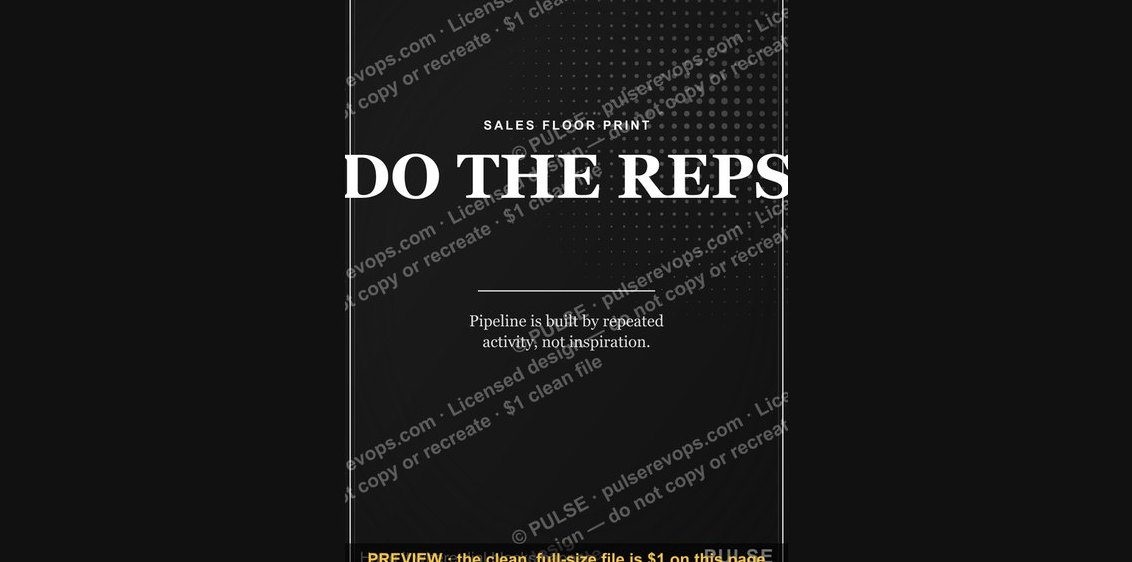 graphic“DO THE REPS” — Sales Floor Print
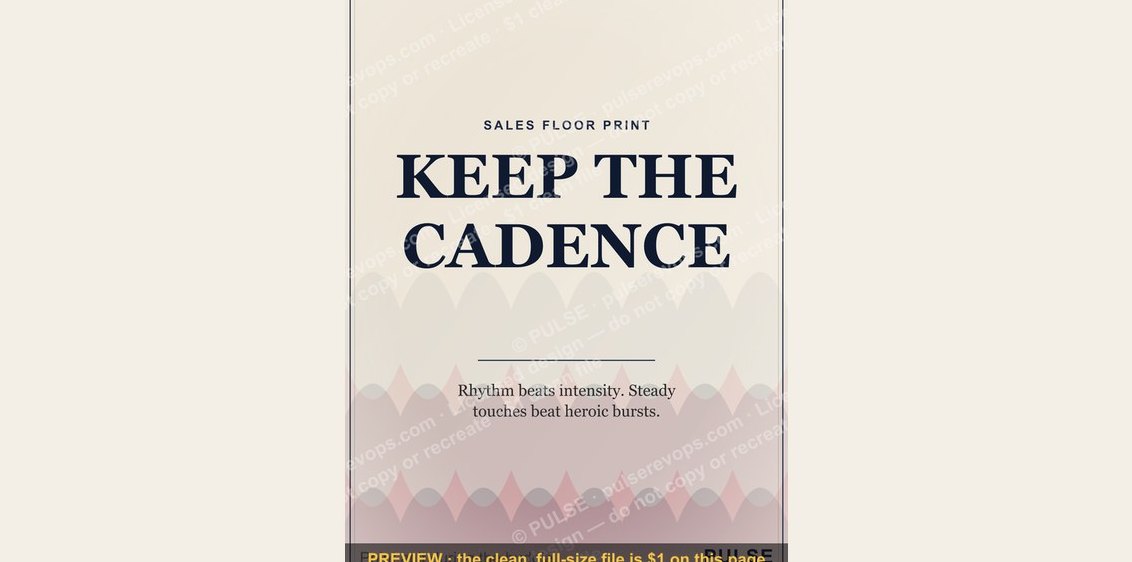 graphic“KEEP THE CADENCE” — Sales Floor Print
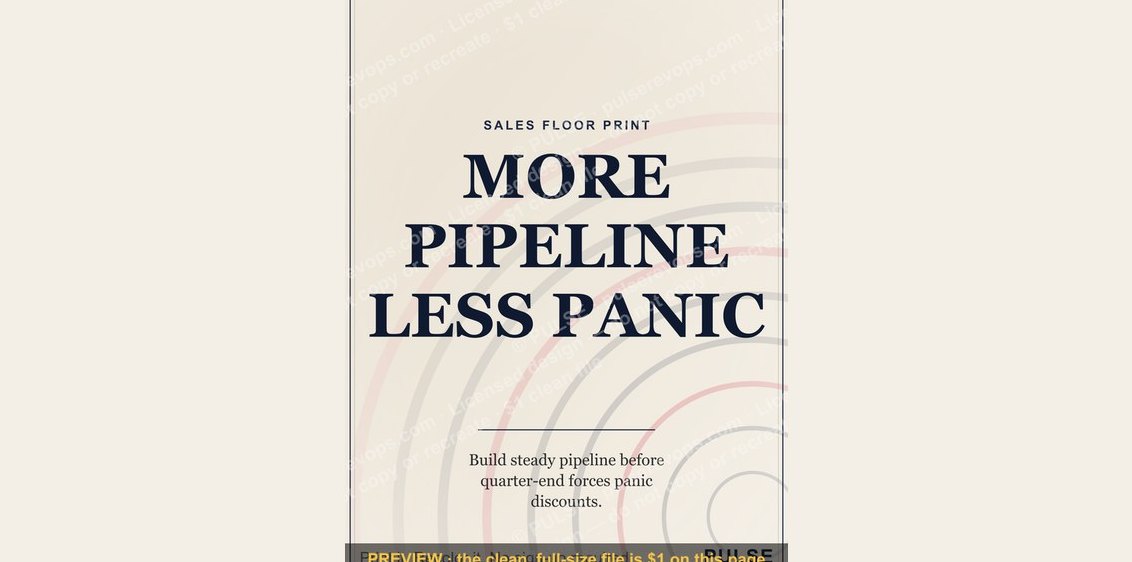 graphic“MORE PIPELINE LESS PANIC” — Sales Floor Print