
“Sell things worth buying.” — LinkedIn Banner
 Curated byKory White · Fractional CRO · Maryland
 PULSEKNOWLEDGE LIBRARY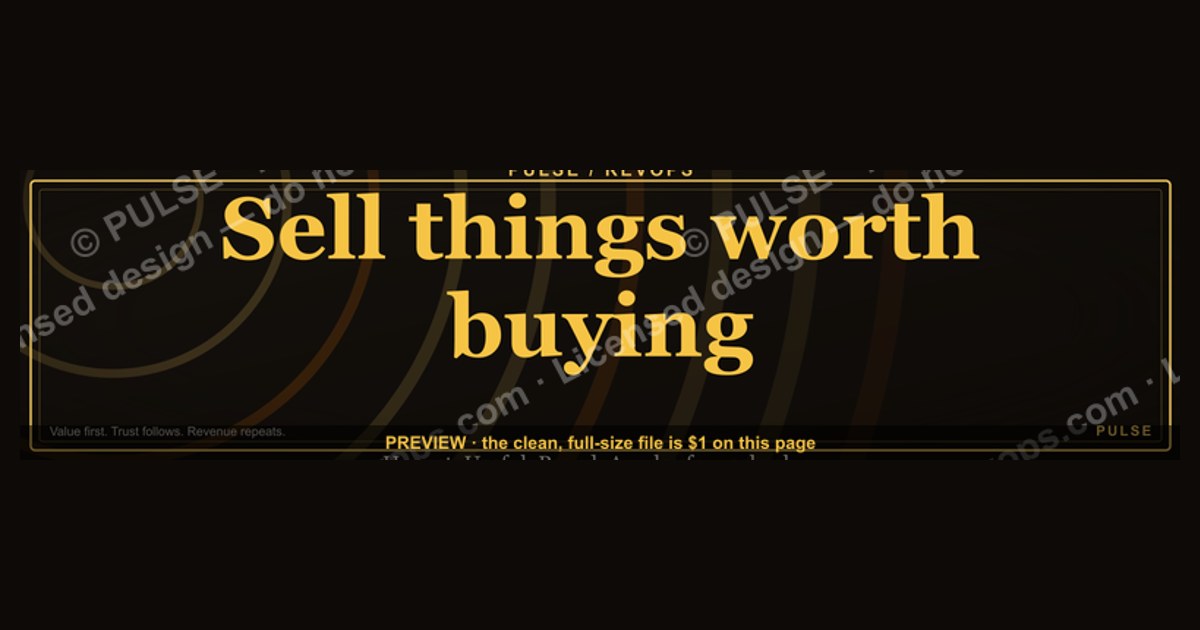
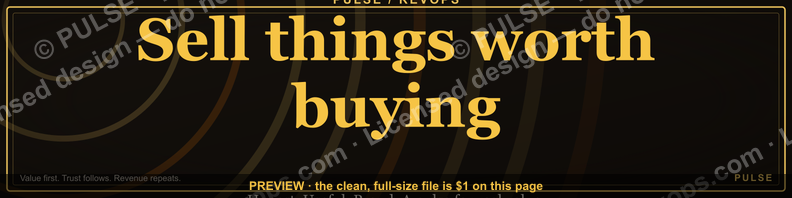
A LinkedIn banner reading “Sell things worth buying” signals a focus on creating genuine value rather than aggressive sales tactics. It suggests that your professional approach prioritizes quality, trust, and solving real problems for your audience. This phrase works best for roles in sales, marketing, or entrepreneurship where authenticity drives long-term relationships.
“Sell things worth buying.” — LinkedIn Banner

A dark, on-brand LinkedIn banner — "Sell things worth buying." over a "Honest Useful Proud" line with a pulse motif. Put it on your profile to signal exactly what you do.
Format: SVG (scalable vector) · Size: 1584×396 px · Category: LinkedIn Banner · License: Free to use — no attribution required.
Recolor it to your brand
Use the color picker above to recolor this banner to your team or company colors, switch the background (including transparent), then download it as an SVG or PNG. No sign-up, no watermark.

How to use it
It scales cleanly to the LinkedIn cover slot (1584×396) — download the PNG and drop it straight onto your profile, or open the SVG in Canva, PowerPoint, or Figma to add your name and tweak the layout.
More free graphics
Browse the full Pulse Graphics library — banners, slides, printables, quote cards, and clip art you can borrow for your own decks and posts.

Related on PULSE
- Sell things worth buying. — LinkedIn Wallpaper
- “Sell the Problem, Not the Product” — Quote Card
- “SELL THE VALUE” — Sales Floor Print
- “Sell like you'd want to be sold to.” — Quote Card
- “Sell the meeting, not the demo.” — Quote Card
- “Champions sell when you're not in the room.” — Quote Card
Why “Worth Buying” Is a Higher Standard Than “Good Enough”
Most products on the market aren’t bad—they’re just forgettable. They function, they solve a basic need, and they get the job done. But “worth buying” implies something different: it means the product creates enough value that the buyer would choose it again, recommend it unprompted, and feel a small pang of regret if it disappeared. That’s a bar most businesses never reach.
Consider the difference between a $15 Amazon Basics cable and a $30 Anker cable. Both charge a phone. Both technically “work.” But the Anker cable has braided nylon, reinforced connectors, a lifetime warranty, and a reputation for surviving years of abuse. When someone buys the Anker, they don’t think “I hope this works.” They think “I’ll never need another cable.” That’s worth buying. The Amazon Basics cable is a commodity—it’s a transaction, not a relationship.
For your LinkedIn banner, “sell things worth buying” isn’t just a nice slogan. It’s a filter for every decision you make: the copy you write, the offers you create, the follow-ups you send. If you wouldn’t fight to keep a customer who’s about to leave, you’re not selling something worth buying. If you wouldn’t use your own product in front of a room of peers, you’re not selling something worth buying. The banner becomes a mirror.
A practical test: ask yourself, “Would I buy this from a stranger with no reviews?” If the answer is no, you have work to do. The gap between “good enough” and “worth buying” is usually in the details—the unboxing experience, the onboarding sequence, the customer support that actually solves problems. These aren’t costs; they’re investments in making the banner true.
How to Audit Your Offer Against the “Worth Buying” Standard
You can’t just declare your product worth buying and hope it’s true. You need a systematic way to check. Here’s a three-part audit you can run in an afternoon, using nothing but honest observation.
Part 1: The Replacement Test Imagine your product disappeared tomorrow. Would your customers scramble to find an alternative, or would they shrug and move on? If it’s the latter, you’re selling convenience, not value. The most “worth buying” products have a high switching cost—not because they lock customers in, but because the alternative feels like a downgrade. For example, a CRM that integrates with every tool a sales team uses isn’t just useful; it’s painful to leave. Your offer should have at least one feature or benefit that makes replacement feel like a hassle.
Part 2: The Referral Gap Ask your last 10 customers one question: “Would you recommend us to a friend who’s exactly like you?” If fewer than 7 say yes without hesitation, you have a gap. The reasons for “no” are your roadmap. Common culprits: price that feels high relative to perceived value, a confusing onboarding process, or a product that only works under ideal conditions. Each “no” is a chance to make the offer more worth buying. Don’t guess—ask.
Part 3: The Emotional Premium “Worth buying” isn’t just rational; it’s emotional. A $200 pair of boots that lasts 10 years is rational. A $200 pair of boots that also makes you feel confident, rugged, and part of a community is emotional. The emotional premium is what turns a purchase into a story. For your LinkedIn banner, think about what feeling you want people to associate with your brand. Is it trust? Excitement? Relief? Then audit every touchpoint—your website copy, your pricing page, your thank-you emails—to see if they reinforce that feeling. If they don’t, you’re leaving money on the table.
A quick exercise: write down the three most common objections you hear from prospects. Then, for each objection, write a counterargument that doesn’t defend the product but instead reframes the value. For example, if someone says “it’s too expensive,” don’t say “but it’s high quality.” Say “it costs more upfront, but it saves you 10 hours a month. That’s $150 an hour for your time.” That’s worth buying.
The Hidden Cost of Selling Things That Aren’t Worth Buying
There’s a reason this banner resonates: most businesses are bleeding money by selling things that barely pass the “worth buying” test. The cost isn’t just lost sales—it’s the hidden damage that compounds over time.
Customer acquisition becomes a treadmill. When your product isn’t worth buying, you have to constantly find new customers to replace the ones who leave. Your ad costs go up, your retention drops, and your team spends energy chasing leads instead of serving clients. The math is brutal: if your churn rate is 5% per month, you need to replace 60% of your customer base every year just to stay flat. That’s like running up a down escalator.
Word-of-mouth becomes a leak. People don’t recommend mediocre products. They might not even complain—they just quietly leave. But every customer who doesn’t refer you is a lost opportunity that compounds. A single customer who loves your product might bring in 3-5 referrals over their lifetime. A customer who merely tolerates you brings zero. Over a decade, that difference can mean millions in revenue.
Your team loses motivation. It’s hard to wake up excited about selling something you know is just okay. When your team doesn’t believe in the product, their energy drops, their creativity stalls, and your culture suffers. The best salespeople leave for companies with products they can stand behind. The best marketers stop innovating. The banner becomes a lie they tell themselves.
The fix is simpler than you think. You don’t need to reinvent your product overnight. Start with one thing: a guarantee that removes risk, a piece of content that educates better than competitors, or a follow-up sequence that actually solves a post-purchase problem. Pick one area where your product falls short of “worth buying” and improve it by 20%. Then do it again. Over six months, you’ll have a product that earns the banner.
The ultimate test: would you put this banner on your profile if your mother, your toughest competitor, and your most critical investor all saw it? If you hesitate, you know where to start.
Why This Phrase Resonates on LinkedIn
The line “Sell things worth buying” cuts through the noise of typical LinkedIn platitudes like “hustle harder” or “grind 24/7.” It reframes sales as a service — you’re not convincing people to buy; you’re offering something so good they’d be worse off without it. This mindset aligns with the platform’s shift toward thought leadership and relationship-building over cold outreach. Profiles using this banner often attract decision-makers who value substance over spin, making it a subtle filter for quality connections. For example, a SaaS consultant using this phrase might see higher engagement from CTOs tired of pushy vendor pitches, while a freelance designer could attract clients who prioritize craftsmanship over cost.
Practical Ways to Live the Message
To make “Sell things worth buying” more than a banner slogan, apply it to your daily LinkedIn activity:
- Audit your content: Before posting, ask “Would I want to see this if I were my ideal client?” If the answer is no, rewrite or scrap it.
- Lead with proof, not promises: Instead of “I help businesses grow,” share a case study showing a 30–50% increase in repeat customers after improving product quality.
- Engage authentically: Comment on posts from peers and prospects with genuine questions or insights — not “Great post!” — to build trust that makes your offerings worth considering.
- Refine your offer: If you’re struggling to get responses, revisit your product or service. Is it truly solving a painful problem? If not, tweak it until you’d buy it yourself.
Pairing It With Other Profile Elements
This banner works best when your headline, about section, and featured posts reinforce the same value-first philosophy. For instance, a headline like “Helping teams build products people love” complements the banner’s message, while an about section starting with “I believe the best sales don’t feel like sales” deepens the narrative. Feature posts that showcase client testimonials, before-and-after results, or behind-the-scenes quality checks — not just promotional links — to prove you practice what you preach. Avoid cluttering your profile with generic endorsements or irrelevant skills; every element should echo the banner’s core idea that what you offer is genuinely worth buying.
Sources
- LinkedIn Official Blog — company culture, professional branding, and content strategy insights
- Harvard Business Review — articles on leadership, marketing, and business ethics
- Forbes — business advice, entrepreneurship, and personal branding trends
- American Marketing Association (AMA) — marketing principles, consumer behavior, and brand strategy
- The Wall Street Journal — business news, economic analysis, and industry case studies
- Nielsen — consumer research, market trends, and advertising effectiveness data
FAQ
What does “sell things worth buying” actually mean? It means your product or service should deliver real, tangible value—something customers would choose again even without a hard sell. If you have to push or trick people into buying, the offer itself probably isn’t strong enough.
Is this just a quote for salespeople? No—it applies to founders, product teams, marketers, and anyone building an offer. The principle is that great sales start with a genuinely useful thing to sell, not just clever closing tactics.
How do I know if my thing is “worth buying”? Look for honest signals: repeat customers, unsolicited referrals, or people who stay engaged without discounts. If you’re unsure, ask a handful of past buyers what specific problem it solved—if they hesitate, the value may not be clear.
Does this mean I shouldn’t do any marketing or persuasion? Not at all—marketing and persuasion are still needed to reach the right people. The point is that your core offer should be strong enough that you don’t have to rely on manipulation or pressure to close a sale.
Can a service business use this idea, or only physical products? It works for any offer—consulting, coaching, software, or physical goods. For a service, “worth buying” means the outcome you deliver is reliably better than what the client could do alone, and the price feels fair for that result.
What if my product is new and I don’t have proof it’s worth buying yet? Start small: sell to a handful of people who know you, and ask for blunt feedback. If they’d buy again or recommend it, you have a signal. If not, iterate the offer before scaling marketing.
This page will be disappearing soon. Save it to your device for $1 — or read it free while it is here.
@Kory-White- · if Venmo asks, the last 4 of my number are 2012
This page is gone.
This one is off the shelf now. $1 keeps it on your phone for good — the whole page, pictures and diagrams included.
 graphicHead of Sales — LinkedIn Banner
 graphic“Join a team that runs on pipeline.” — LinkedIn Banner
 graphic“Clarity closes.” — LinkedIn Banner
 graphicBring the energy. — LinkedIn Wallpaper
 graphicStay in the deal. — LinkedIn Wallpaper
 graphic“Great reps wanted.” — LinkedIn Banner
 graphicHow to build a champion champion plan in 2027?
 graphicCustomer Success — LinkedIn Banner
 graphicWhat do top-performing graphic designers do differently in 2027?
 graphic“Bring the energy every call.” — LinkedIn Banner