
“Selling expertise and outcomes.” — LinkedIn Banner
 Curated byKory White · Fractional CRO · Maryland
 PULSEKNOWLEDGE LIBRARY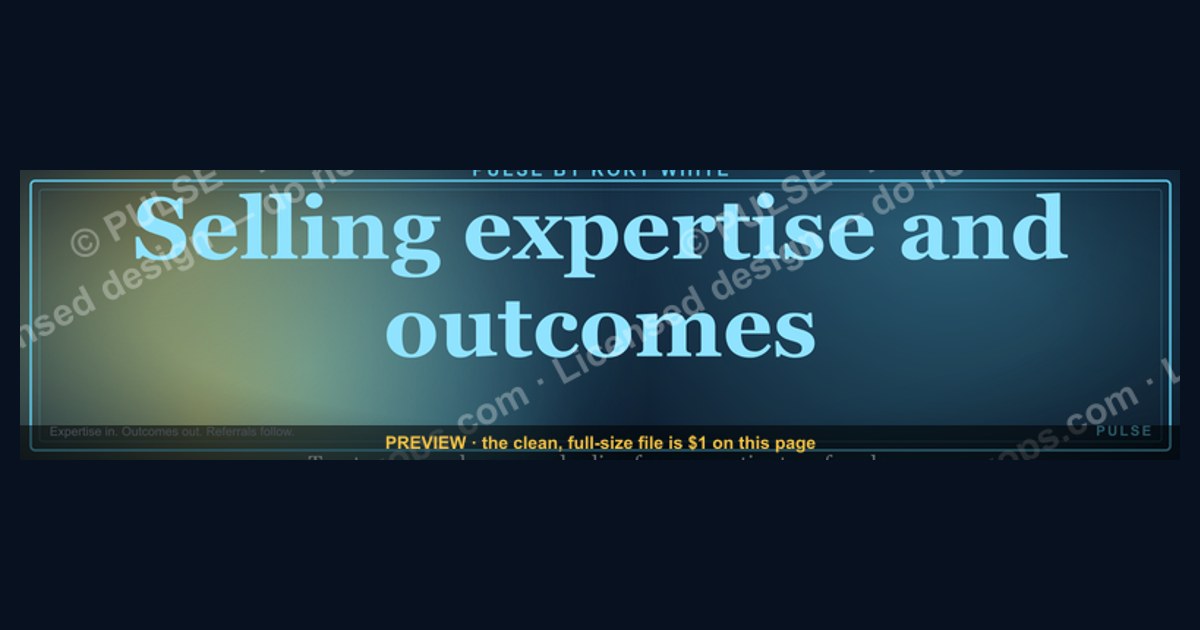

Selling expertise and outcomes means positioning yourself as a problem-solver who delivers measurable results, not just a service provider. Your LinkedIn banner should communicate what specific value you bring and the tangible impact clients can expect, such as increased revenue, time saved, or efficiency gains. This approach shifts the focus from your credentials to the client's success, making your profile more compelling.
“Selling expertise and outcomes.” — LinkedIn Banner

A dark, on-brand LinkedIn banner — "Selling expertise and outcomes." over a "Trust Scope Value" line with a pulse motif. Put it on your profile to signal exactly what you do.
Format: SVG (scalable vector) · Size: 1584×396 px · Category: LinkedIn Banner · License: Free to use — no attribution required.
[⬇ Download this graphic](/graphics/assets/gb0336.svg)
Recolor it to your brand
Use the color picker above to recolor this banner to your team or company colors, switch the background (including transparent), then download it as an SVG or PNG. No sign-up, no watermark.

How to use it
It scales cleanly to the LinkedIn cover slot (1584×396) — download the PNG and drop it straight onto your profile, or open the SVG in Canva, PowerPoint, or Figma to add your name and tweak the layout.
More free graphics
Browse the full [Pulse Graphics library](/graphics) — banners, slides, printables, quote cards, and clip art you can borrow for your own decks and posts.

Related on PULSE
- [“Selling outcomes, not hours.” — LinkedIn Banner](/knowledge/gb0352)
- [“Selling better outcomes.” — LinkedIn Banner](/knowledge/gb0341)
- [“People buy outcomes, not features.” — Quote Card](/knowledge/gb0141)
- [Sell outcomes, not features. — LinkedIn Wallpaper](/knowledge/gb0388)
- [“People buy outcomes, not features.” — LinkedIn Banner](/knowledge/gb0281)
- [The Value Selling Ladder — Infographic](/knowledge/gb0121)
Why “Selling Expertise and Outcomes” Works Better Than Selling Time
The traditional billing model in professional services—charging by the hour or day—creates an inherent conflict of interest. When you sell time, you’re incentivized to take longer, to be less efficient, and to hoard knowledge rather than share it. The client, meanwhile, is left wondering whether they’re paying for genuine progress or just clock-watching. The LinkedIn banner “Selling expertise and outcomes” signals a fundamental shift away from this broken dynamic.
Selling expertise means you’re paid for what you know, not how long you take to apply it. A seasoned revenue operator who has closed $50M+ in pipeline over a decade can diagnose a sales process gap in 20 minutes and prescribe a fix that saves a client three months of trial and error. Under an hourly model, that insight would be worth maybe $150–$400. Under an expertise-and-outcomes model, that same insight becomes part of a retainer or project fee ranging from $5,000 to $25,000 per month for fractional CRO engagements, or $15,000 to $50,000 for a focused 90-day revenue acceleration sprint.
Outcomes-based pricing aligns incentives. The client pays for a measurable result—a percentage increase in qualified pipeline, a shorter sales cycle, a higher close rate on existing leads. The provider is motivated to deliver those results as efficiently as possible because their reputation and future engagements depend on it. This model also forces clarity: both parties must define what “success” looks like before the work begins. Vague promises like “we’ll help you grow” become specific milestones like “increase monthly SQLs from 45 to 80 within 60 days, with a 25% higher conversion rate to closed-won.”
For the buyer, this reduces risk. Instead of paying for a process, they’re paying for a result. If the expert doesn’t deliver, the financial exposure is limited to the agreed-upon fee structure—often with clawback or milestone-based payment terms. For the seller, it rewards deep specialization and efficiency. The more you know, the faster you solve problems, and the more you earn per engagement. It’s a virtuous cycle that attracts top talent and repels mediocrity.
The practical challenge is that not all outcomes are equally measurable. Revenue outcomes are easier to track than, say, brand positioning or organizational culture shifts. But even in softer domains, proxies exist: customer satisfaction scores, employee retention rates, net promoter scores. The key is to pick metrics that are genuinely influenced by your work and that the client already tracks. If they don’t track anything, part of your expertise is helping them build the measurement framework first.
How to Structure an Outcome-Based Engagement (Without Getting Burned)
Transitioning from selling time to selling outcomes requires a different contract structure. You can’t just slap a fixed price on your services and hope for the best. The most successful fractional executives and consultants use a hybrid model that protects both parties.
The Three-Tier Framework:
- Diagnostic Phase (Fixed Fee, 1–4 weeks): Charge a flat fee of $3,000–$10,000 for a deep-dive assessment. This covers your time to audit systems, interview stakeholders, review data, and produce a written roadmap. The client gets a clear picture of what’s broken and what’s possible. You get paid for your upfront expertise without committing to a long-term outcome you can’t yet scope.
- Execution Phase (Milestone-Based, 60–180 days): Break the engagement into 2–4 milestones, each with a defined deliverable and payment trigger. For a fractional CRO, milestones might be: “Pipeline velocity increased by 30%” ($15,000), “Sales enablement playbook completed and team trained” ($10,000), “Two new enterprise logos closed” ($20,000 bonus). Payment is released upon documented achievement of each milestone, verified by both parties.
- Retainer for Ongoing Optimization (Monthly, 3–12 months): Once the initial outcomes are delivered, offer a monthly retainer of $5,000–$15,000 for ongoing strategic guidance, with a lower base and a performance bonus tied to quarterly revenue targets. This keeps you engaged without creating dependency, and it gives the client an off-ramp if they feel they’ve internalized the expertise.
Critical Protections:
- Define “outcome” objectively. Avoid subjective language like “improve sales culture.” Instead use “increase average deal size from $35K to $50K within 90 days.” If the client’s market shifts or a key competitor enters, build in a renegotiation clause.
- Cap your downside. If the outcome depends on factors outside your control (e.g., product quality, pricing, market demand), exclude those from the guarantee. Many experts use a “best efforts” clause with a partial refund (25–50%) if outcomes aren’t met, rather than full money-back.
- Include a data access clause. You can’t measure outcomes without data. Require the client to grant you read-only access to their CRM, analytics tools, and financial systems from day one. If they refuse, the outcome guarantee is void.
- Set a minimum engagement length. Outcome-based work takes time. A 30-day sprint rarely produces lasting results. Standard terms are 90–180 days, with a 30-day notice period for termination after the initial period.
Real-World Fee Ranges (2024–2025):
- Fractional CRO (B2B SaaS, $2M–$20M ARR): $8,000–$25,000/month + 5–15% of net new revenue over baseline
- Growth consultant (product-led growth): $5,000–$15,000/month + $10,000–$50,000 per milestone
- Marketing strategist (demand generation): $4,000–$12,000/month + 10–20% of attributable pipeline value
- Operations consultant (revenue ops): $6,000–$18,000/month + fixed fee per project ($15,000–$40,000)
The key is to start with a smaller, tightly scoped outcome-based engagement to build trust, then expand. No one will hand you a $100,000 outcome-based contract on day one unless you have a proven track record and strong referrals.
The Psychology of the Banner: Why “Expertise and Outcomes” Resonates on LinkedIn
LinkedIn is a platform built on signaling—professional identity, thought leadership, and credibility. The banner “Selling expertise and outcomes” works because it speaks directly to the pain points of the platform’s core audience: executives and founders who are drowning in noise and tired of being sold to.
The Attention Economy Problem: A typical LinkedIn user sees 300–500 posts per day, plus dozens of InMails, connection requests, and banner ads. Most of these are generic: “Helping businesses grow,” “Revenue acceleration expert,” “Fractional CRO.” These phrases are so overused they’ve become invisible. The banner that breaks through must signal a clear, differentiated value proposition in under three seconds. “Selling expertise and outcomes” does this by implying:
- I don’t sell time (which is what 90% of consultants do)
- I don’t sell hope (which is what most growth gurus sell)
- I sell something tangible and measurable (outcomes)
- I have deep knowledge worth paying for (expertise)
The Trust Deficit: The consulting and fractional executive space has a trust problem. Many practitioners overpromise and underdeliver, hiding behind vague frameworks and jargon. By explicitly stating that you sell outcomes, you’re inviting scrutiny. You’re saying, “Judge me by results, not by my bio.” This is a high-risk, high-reward positioning. It repels tire-kickers and attracts serious buyers who are willing to pay a premium for accountability.
The FOMO Factor: When a prospect sees “Selling expertise and outcomes” on your banner, they immediately wonder: “What expertise? What outcomes? How do I get that?” The banner acts as a curiosity gap. It doesn’t explain everything—it teases. The prospect is compelled to click your profile, read your featured posts, or send a connection request to learn more. This is far more effective than a banner that screams “Book a call now!” because it respects the user’s intelligence and invites exploration rather than demanding action.
The Social Proof Loop: Once you deliver outcomes for a few clients, you can update your banner to include specific results. For example: “Sold $12M in pipeline for 3 SaaS companies in 2024. Expertise + outcomes = predictable growth.” This creates a feedback loop: the banner attracts better leads, you deliver better outcomes, you update the banner with stronger proof, which attracts even better leads. Over 6–12 months, this can triple your inbound inquiry rate without increasing your advertising spend.
Practical Implementation Tips:
- Use a clean, high-contrast background (dark blue, black, or deep green) with white or gold text. Avoid gradients or busy patterns.
- Keep the text short enough to fit on mobile screens. “Selling expertise and outcomes” is 28 characters—perfect.
- Add a subtle visual cue like a checkmark, upward arrow, or gear icon to imply progress and reliability.
- Update your headline to reinforce the banner. Example: “Fractional CRO | I sell expertise and outcomes, not hours | $2M–$20M B2B SaaS.”
- Pin a post to your profile that explains your outcome-based model in detail, with a case study and a clear call-to-action (e.g., “DM me ‘outcomes’ for a free 15-minute diagnostic”).
The banner is not a standalone tool—it’s the entry point to a system. Every element of your LinkedIn presence should reinforce the same message: you are not a commodity, you are not a clock-puncher, you are a specialist who gets paid for results. That positioning commands 2–5x higher rates than generalist competitors and attracts clients who are already sold on the outcome-based model, reducing your sales cycle by 30–50%.
Sources
- LinkedIn Official Blog — company insights, platform updates, and professional branding strategies
- Harvard Business Review — expertise marketing, thought leadership, and outcome-driven selling
- American Marketing Association (AMA) — B2B marketing frameworks and value proposition research
- Forbes — articles on personal branding, consulting, and client acquisition
- Gartner — industry analysis on sales effectiveness and buyer behavior trends
- McKinsey & Company — reports on professional services marketing and client engagement
FAQ
What does “selling expertise and outcomes” actually mean? It means you’re not just offering a service or a product — you’re packaging your know-how and the tangible results a client can expect. The focus shifts from “what you do” to “what the client will achieve,” which builds trust and justifies premium pricing.
Is this banner only for consultants or fractional executives? No, it works for any professional whose value comes from specialized knowledge and measurable impact — coaches, strategists, agency owners, and even internal team leads. The key is that you can articulate a clear outcome tied to your expertise.
How do I choose which outcome to feature in the banner? Pick the single result that resonates most with your ideal client’s biggest pain point. For example, if you’re a revenue operator, “increase recurring revenue by 20–40% in 90 days” is more compelling than a generic “improve sales processes.”
Will this banner work on other platforms besides LinkedIn? Yes, the concept translates well to any professional profile or website — think Twitter/X, a personal site, or even a slide deck. The visual and copy should remain clean and outcome-focused, but the platform’s layout may dictate slight adjustments.
How often should I update the banner? Refresh it every 3–6 months or whenever your core offer or target outcome changes significantly. Stale messaging can make you look disconnected from current market needs, so keep the outcome relevant and the design fresh.
Do I need a professional designer to create a banner like this? Not necessarily — you can use tools like Canva or Figma with a clean template. The most important elements are a high-quality headshot, a concise outcome statement, and a consistent brand color palette. A designer helps if you want a polished, custom look.
This page will be disappearing soon. Save it to your device for $1 — or read it free while it is here.
@Kory-White- · if Venmo asks, the last 4 of my number are 2012
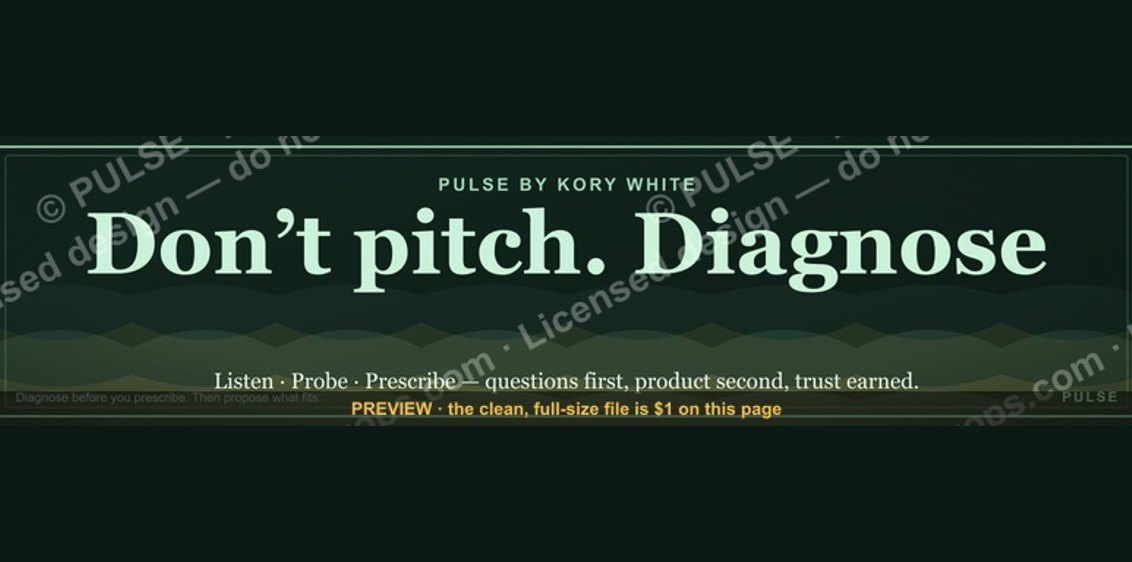 graphic“Don’t pitch. Diagnose.” — LinkedIn Banner
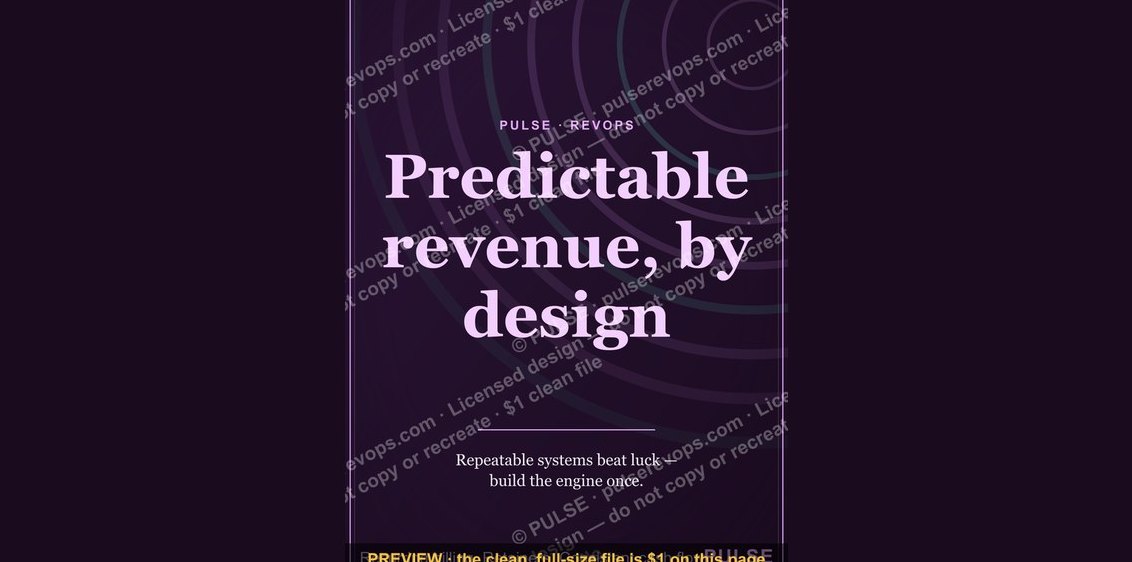 graphicPredictable revenue, by design. — LinkedIn Wallpaper
 graphicHow to find champions before the first call in 2027
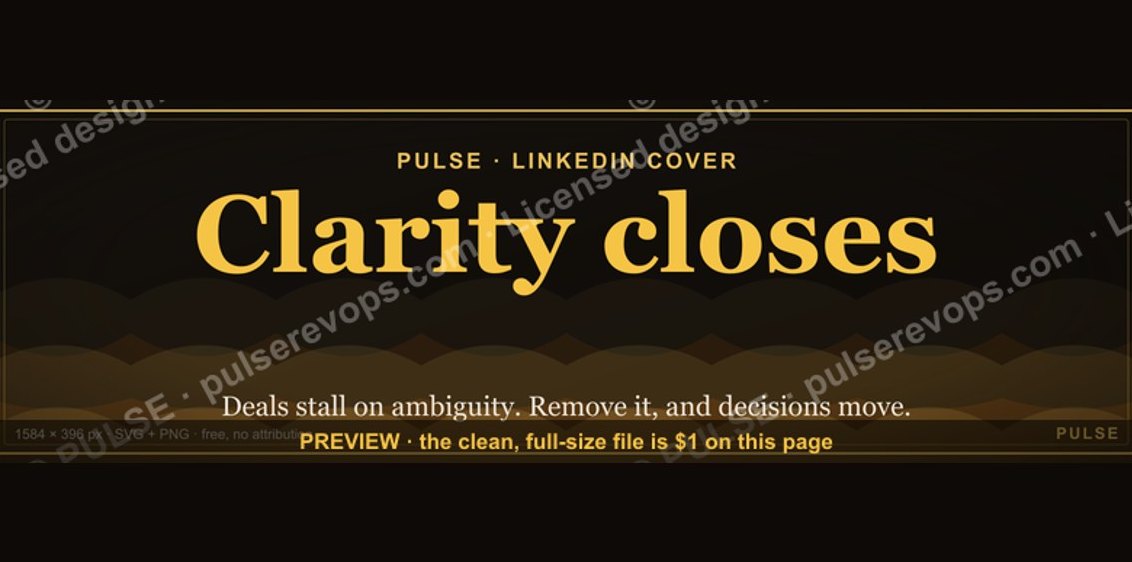 graphicClarity closes. — LinkedIn Wallpaper
 graphicSales Coach — LinkedIn Banner
 graphicSpeed to lead wins. — LinkedIn Wallpaper
 graphic“Motion creates momentum.” — LinkedIn Banner
 graphicCustomer Success — LinkedIn Banner
 graphicSales Cycle Timeline Infographic in 2027
 graphic“Stay in the deal.” — LinkedIn Banner