
ICP Discipline: Say No to Win More — Banner
 Curated byKory White · Fractional CRO · Maryland
 PULSEKNOWLEDGE LIBRARY
Quality
Certified
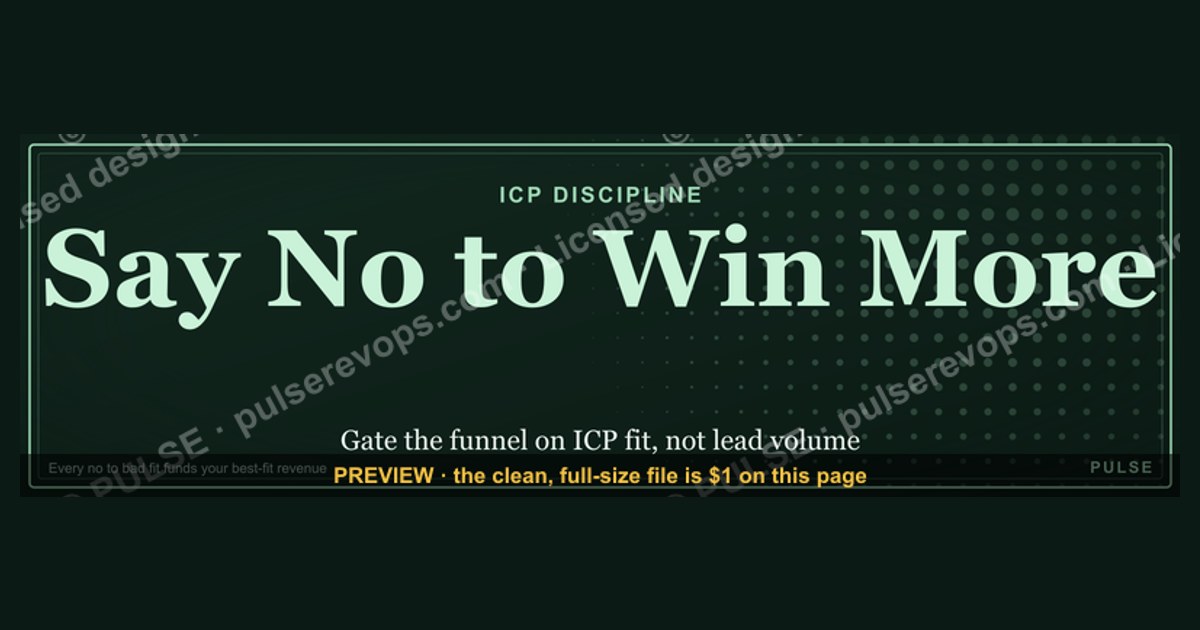

This banner is a 1600x500 px downloadable graphic that reads "Say No to Win More" in gold serif on black, with the subline "ICP Discipline: the deals you decline fund the ones you close." It is a LinkedIn profile banner for sales, marketing, and RevOps leaders who want their feed to signal a sharp, defensible ICP. Download the PNG from this page.
The two options compared
The fork this banner names is real: run a narrow, defensible ICP and decline revenue that sits outside it, or run an open funnel and let reps work anything with a budget. Both have produced durable companies, so the choice is not moral — it is a bet about which machine you are building.
A narrow ICP optimizes for repeatability. When every closed-won deal resembles the last one, onboarding templates compound, discovery questions sharpen, pricing stops being bespoke, and the sales cycle shortens because buyers recognize themselves in your references. The cost is visible and immediate: deals you can see, quote, and lose. A rep watching a $60K opportunity walk out the door because the account has 40 seats instead of 400 feels that loss every week. The benefit is invisible for two or three quarters, then shows up as a win rate that climbs without new headcount.

An open funnel optimizes for learning speed and cash near-term. You find out what the market actually wants by selling into it, you keep the lights on with revenue that a narrow ICP would have refused, and you avoid the failure mode of defining a profile so tight that nobody qualifies. The cost is deferred and compounding: every off-ICP deal drags support load, pulls roadmap in a direction your best customers do not need, and creates a reference you cannot use in your core segment. A customer who bought for the wrong reason churns loudly and takes a logo with them.
There is a third position that most mature teams land on and that this banner implicitly endorses: a disciplined ICP with a documented exception path. You say no by default, and you say yes to outliers only when someone senior signs their name to a written reason — strategic logo, reference value, product gap you need to close, or a segment you are deliberately probing. The banner's job is to make the default visible to the team and to the market.
The important distinction is between discipline and rigidity. Discipline means you have a written profile, you score against it before a rep invests a full cycle, and you review exceptions in a standing meeting. Rigidity means you refuse a deal that would have taught you your pricing model is wrong. The banner argues for the first and is often misread as the second, which is the main risk of putting it on your profile.

How to decide between them (mermaid)
The decision is not a one-time vote. It is a recurring review, and the inputs are measurable. Work through the sequence below with your actual last-eight-quarters data, not with intuition.
The loop matters more than any single answer. Teams that set an ICP once and never re-derive it from closed-won data end up enforcing a profile that describes the company they were three years ago. The quarterly review is where the discipline actually lives — the banner is just the reminder on the wall.

One practical note on the scoring step: tag deals at the account level, not the opportunity level. A single enterprise account can produce an in-ICP expansion and an off-ICP side project in the same quarter, and opportunity-level tagging will show you noise. Account-level tagging shows you whether you are accumulating the right logos.
When you run this loop the first time, expect the in-ICP versus off-ICP gap to be smaller than you hoped. That is normal and it is useful. A two-point win-rate difference with a four-week cycle advantage and a fifteen-point retention advantage is still a decisive argument for discipline, because retention compounds and win rate does not.

Concrete numbers behind each option
Numbers make this argument concrete. The figures below are the ranges practitioners typically observe when they run the tagging exercise; use them as calibration for your own data, not as benchmarks to quote.
Win rate. In-ICP deals commonly close at roughly 1.5x to 2.5x the rate of off-ICP deals for the same rep in the same quarter. If a team closes 20% overall, the split is often closer to 28% in-ICP and 11% off-ICP. That gap is the single strongest argument for the banner's message, because it means the same headcount produces more revenue when pointed at the right accounts.
Sales cycle length. Off-ICP deals run 30% to 70% longer. The mechanism is straightforward: the buyer has no reference customer to call, your case studies do not map to their world, and every objection requires a custom answer. A 60-day in-ICP cycle becoming a 95-day off-ICP cycle is typical, and it consumes the same rep capacity.

Retention. This is where the gap widens most. Twelve-month gross retention for in-ICP accounts often sits in the 85% to 92% range, while off-ICP accounts frequently land between 65% and 78%. The reason is that off-ICP buyers purchased something adjacent to their problem, so the product never becomes load-bearing and renewal becomes a re-evaluation.
Expansion. In-ICP accounts expand at two to three times the rate of off-ICP accounts. Expansion is where SaaS economics actually work, so a 10-point retention gap in year one becomes a 40-point revenue gap by year three.

Cost to serve. Off-ICP accounts consume disproportionate support and success time. A common pattern is 20% of accounts generating 45% of support tickets. That load is invisible in the CRM and very visible in your gross margin.
Exception rate. Healthy teams run exceptions at 10% to 20% of bookings by dollar value. Below 10% suggests the profile is too loose to be meaningful or the exception path is too bureaucratic to use. Above 25% suggests the ICP itself is wrong and the team is routing around it.
The arithmetic that ties these together: if 30% of your bookings are off-ICP, and off-ICP accounts retain 15 points worse and expand at half the rate, then roughly a third of your booked revenue is producing well under half its expected lifetime value. That is the "say no to win more" math in one sentence.

Implementation details and sequencing (mermaid)
Rolling this out badly is worse than not doing it, because a discipline program that gets abandoned in six weeks teaches the team that ICP is a slogan. Sequence it so each step produces an artifact the next step depends on.
Step one is data, not opinion. Pull eight quarters of closed-won and closed-lost accounts with firmographics, deal size, cycle length, source, and current status. Eight quarters is the minimum because four quarters will not separate a segment trend from a seasonal blip.

Step two is tagging. Do it in a spreadsheet before you touch the CRM, because the first pass will reveal that your account data has three different spellings of the same industry and two conflicting employee-count fields. Fix the taxonomy now or every downstream metric will be wrong.
Step three is the one-page definition. It should state, in plain language, the firmographic envelope (industry set, employee range, revenue range, geography), the technical qualifiers (stack, data maturity, integration needs), and the disqualifiers. Disqualifiers are the part teams skip and the part that does the work. Write them explicitly: "under 50 employees," "no dedicated ops function," "requires on-premise deployment."

Step four is the qualifier. Six questions maximum, embedded in the CRM at the point where a rep would otherwise start building a proposal. The qualifier should produce a score, not a yes/no, because a score lets you rank a queue instead of arguing about a binary.
Step five is the exception path. Name one approver, define four or five legitimate exception reasons, and require a two-sentence written justification. The written justification is the whole mechanism — it converts a hallway argument into a reviewable record, and it almost always reduces exception volume on its own.
Step six is the briefing. This is where the banner earns its place. Put the message in front of the team, explain the math from the previous section, and be explicit that the goal is not fewer deals but a higher hit rate on the same pipeline.

Quarters two through four are the maintenance cycle. Review the exception log, track off-ICP revenue share as a single number, and re-derive the profile annually from fresh closed-won data. If off-ICP share climbs above your ceiling, the fix is a tighter score threshold and a second approver, not a new slogan.
Two failure modes to plan for. First, the profile gets written by marketing and never used by sales, because it describes a segment nobody can actually find in the CRM. Prevent this by having the first two reps who will use it co-author the qualifier. Second, the exception path becomes a rubber stamp because the approver is too senior to be in the loop. Prevent this by making the approver a sales manager who sees the deal weekly.
Related questions
What does "say no to win more" actually mean in practice?
It means declining or deprioritizing deals outside your ICP so reps spend their cycles on accounts that close faster, retain longer, and expand. The "more" is not more revenue this quarter — it is a higher win rate and better lifetime value from the same headcount.
Is turning down revenue ever the wrong call?
Yes. In a cash-constrained year, or when you are still discovering product-market fit, off-ICP revenue can fund the search. The rule is to take it deliberately, with a written reason and a named approver, not accidentally because a rep found a budget.
How narrow should an ICP be?
Narrow enough that your best ten customers share obvious traits, wide enough that you can build a pipeline of at least 300 qualified accounts. If you cannot list 300 accounts that fit, the profile is too tight to sustain a quota-carrying team.
Who owns ICP discipline?
RevOps owns the definition, the scoring, and the exception log. Sales leadership owns enforcement in deal reviews. Marketing owns targeting against it. Without a single named owner for the exception log, discipline erodes within two quarters.
How do I measure whether it is working?
Track four numbers by quarter: in-ICP win rate, off-ICP revenue share, twelve-month retention split by tag, and exception volume by reason. If win rate is flat and off-ICP share is climbing, the program is not working and the profile needs rebuilding.
FAQ
What exactly is on this banner?
A 1600x500 px PNG. Black background, gold serif headline reading "Say No to Win More," a smaller subline reading "ICP Discipline: the deals you decline fund the ones you close," and a thin gold rule separating the two lines. No logo, no URL, no stock imagery.
Where do I use a 1600x500 banner?
LinkedIn profile banners render at that aspect ratio on desktop. The same file works as a header on a Substack or newsletter, as the top strip of a Notion or Confluence page, and as a slide header in a 16:5 crop. It is not sized for Twitter/X headers, which use a wider ratio and will crop the subline.
Can I change the wording?
Yes, and you should if your team's language differs. Keep the headline under five words so it stays legible at LinkedIn's mobile crop, which shows roughly the left two-thirds of the image. If you shorten the subline, keep the word "Discipline" in it — that is the load-bearing term.
Why gold serif on black?
The contrast reads at small sizes and the serif signals seriousness rather than hype, which matches the message. If your brand palette is light, invert to dark text on a cream or white ground and keep the same weight relationship between headline and subline.
When does this message backfire?
When the team has no written ICP, no scoring, and no exception path. In that state the banner is a slogan that invites cynicism, because reps are still chasing anything with a budget. Publish the banner in the same week you publish the profile, never before.
How do I swap it into LinkedIn?
Download the PNG, open your LinkedIn profile, click the pencil on the banner area, upload the file, and drag to reposition so the headline sits clear of your profile photo. The photo overlaps the lower-left area, so keep the headline centered or right-of-center.
Sources
- LinkedIn Help — Profile banner and cover image specifications: https://www.linkedin.com/help/linkedin/ask/TSB
- Harvard Business Review — research and articles on segmentation and go-to-market focus: https://hbr.org
- Bain & Company — insights on customer segmentation and retention economics: https://www.bain.com/insights/
- McKinsey & Company — growth and B2B sales research: https://www.mckinsey.com/capabilities/growth-marketing-and-sales/our-insights
- Gartner — B2B buying and revenue operations research: https://www.gartner.com/en/sales
- Forrester — go-to-market and revenue operations research: https://www.forrester.com
- Corporate Finance Institute — gross and net revenue retention definitions: https://corporatefinanceinstitute.com/resources/accounting/revenue-retention/
- Nielsen Norman Group — visual hierarchy and legibility guidance: https://www.nngroup.com/articles/visual-hierarchy-ux-definition/
Related on PULSE
- ICP definition: building the one-page profile your team will actually use
- Exception paths: how to say yes to off-ICP deals without losing discipline
- Win rate vs. deal volume: which metric should drive your pipeline reviews
- Account-level tagging: why opportunity-level data hides your best segments
- Retention economics: how a 10-point churn gap becomes a 40-point revenue gap
- RevOps ownership: who owns the ICP, the scoring, and the exception log
This page will be disappearing soon. Save it to your device for $1 — or read it free while it is here.
@Kory-White- · if Venmo asks, the last 4 of my number are 2012
This page is gone.
This one is off the shelf now. $1 keeps it on your phone for good — the whole page, pictures and diagrams included.
 graphicNRR Beats New Logos — Revenue Law Banner
 graphicBANT is Dead — Banner
 graphicRenewal is the New Sale — Banner
 graphicBuild the system — RevOps Mindset Banner
 graphicDeals Do Not Stall, People Do — Banner
 graphicMEDDPICC Qualification Framework — Banner
 graphicPipeline is oxygen — RevOps Mindset Banner
 graphicWin the deal then win the customer — CS Mindset Banner
 graphicChampions Close Deals — Banner
 graphicInspect with rigor — Sales Management Banner