
How do you run a win-loss program internally without hiring an outside firm — and what's the trade-off in 2027?
 Curated byKory White · Fractional CRO · Maryland
 PULSEKNOWLEDGE LIBRARY
Quality
Certified

Run win-loss interviews yourself by assigning a dedicated 1 FTE to conduct 10-15 interviews monthly, recording wins/losses alongside deal attributes (deal size, industry, competitor). Your trade-off: 7-10 weeks to surface patterns vs. 3-4 weeks external (but save $25K-40K annually).
Operator Playbook
Build Your Internal Program
- Interview pool: Ask CSMs, AEs, Sales leaders to nominate recent wins/losses from past 60 days
- Scheduling: Allocate 1.5-2 hours weekly for interviews; aim for 15-minute scripted calls
- Template: Use Pavilion's free win-loss template or create your own with 3 pillars:
- Why they chose you (or didn't)
- Competitive perception (Bridge Group's Competitive Benchmark or DIY)
- Feature gaps vs. shortlist
Scale Without Burnout
| Task | Owner | Frequency | Time |
|---|---|---|---|
| Interview scheduling | SDR | Weekly | 2h |
| Call execution | Sales Ops/Enablement | Per interview | 20m |
| Synthesis & tagging | Product/Revenue | Monthly | 4h |
| Exec debriefs | Revenue leadership | Quarterly | 1h |

Where It Gets Hard
- Response bias: Customers love you or hate you; middling deals rarely reply (OpenView research shows 40-60% response rates)
- Depth problem: You lack vendored rigor around competitive positioning (Klue, Crayon train on this)
- Consistency drift: Without Force Management coaching, reps color wins/losses differently
Hybrid Shortcut
Do 70% internally + hire a firm for 20-30 critical interviews annually when launching into new segments or facing new competitors. Cost: ~$8-12K/year; ROI: benchmark against your market.

Bottom line: Internal programs work for tactical feedback on positioning, competitors, and features. External firms beat you on statistical significance and executive positioning research. Pick your battles based on deal velocity (fast-moving markets = hire help).
TAGS: win-loss,competitive-intel,customer-feedback,revenue-ops,sales-enablement,vendor-comparison

---
Related on PULSE
- How should a CRO think about the trade-off between pricing complexity and hiring deal desk headcount — is there a better way to manage complexity without adding FTE?
- What's the relationship between CAC, MRR, and sales cycle length, and how do you optimize the trade-off?
- What is champion enablement — and how do you actually arm your champion to sell internally?
- How do I respond to 'we're going to build this internally'?
- How do we counter the build-vs-buy objection when their engineering team insists they can build this internally in 6 months?
- The CRO says they'll adopt our tool, but their team will use a competitor internally anyway. How do we prevent a multi-vendor install that ruins our ROI?
Building a Scalable Interview Cadence Without Dedicated Headcount
If you can't justify a full-time win-loss hire, start with a rotating interview model that distributes the workload across 2-3 senior team members (product, sales, or customer success leads). Each person conducts 3-5 interviews per month during a 3-month rotation, then hands off to the next person. This keeps the total at 10-15 interviews monthly without burning out any single individual.
The setup process takes 2-3 weeks:
- Week 1: Create a shared interview guide with 8-10 core questions (keep it under 25 minutes per interview)
- Week 2: Train your rotation team on neutral questioning techniques (no leading questions, no defensive body language)
- Week 3: Pilot 3 interviews together, then debrief on consistency
Trade-off: You lose interview consistency — each person brings their own biases and rapport style. Expect 20-30% more noise in your pattern detection during the first 3 months. However, you gain cross-functional buy-in because participants witness customer frustrations firsthand. After 6 months, most teams report that rotating interviewers actually surface more diverse insights than a single interviewer would.
Practical tip: Use a shared CRM field or simple spreadsheet to log deal attributes before each interview (deal size, stage at loss, primary competitor, sales rep tenure). This lets you segment results later without asking the interviewee to repeat basic info.
Designing a Lightweight Analysis System That Actually Gets Used
The biggest internal win-loss failure isn't collecting interviews — it's never analyzing them. Without an external firm's structured reporting, you need a 90-minute monthly analysis ritual that produces actionable output.
The 3-step monthly process:
- Raw transcript tagging (30 minutes) — Use a free tool like Otter.ai or your CRM's built-in transcription. Tag each interview with 3-5 themes from a predefined list (pricing, product gaps, implementation difficulty, competitor FUD, buyer process friction). Keep the tag list under 15 items to avoid analysis paralysis.
- Pattern identification (30 minutes) — Look for themes appearing in 3+ interviews that month. Don't chase single anecdotes. Create a simple "heat map" showing which themes cluster with which deal sizes, industries, or sales reps.
- Action item generation (30 minutes) — For each confirmed pattern, write one specific action (e.g., "Update pricing page FAQ to address competitor X's feature claim" or "Create 2-minute demo video for implementation step that causes 40% of churn"). Assign an owner and due date in your project management tool.
Trade-off: You'll miss subtle patterns that require statistical analysis or cross-tabulation across 50+ interviews. External firms often deliver 15-20 page reports with statistical confidence levels. Your internal system will produce 2-3 high-confidence action items per month — which is actually more useful for a team of 20-50 people. The risk is that busy stakeholders ignore the output, so make your monthly summary fit on one page with bold recommendations only.
Tooling tip: Most teams over-engineer this. A Google Sheet with pivot tables and a shared Slack channel for "win-loss alerts" (e.g., "3rd loss this month due to competitor X's new feature") works better than expensive win-loss software for teams under 100 people.
Managing the Hidden Costs of Internal Win-Loss Programs
Beyond the obvious salary trade-off, internal programs carry 3 hidden costs that most teams underestimate by 40-60%:
1. Interview scheduling friction — Each interview requires 3-5 email exchanges or calendar pings. For 12 interviews monthly, expect 2-3 hours of scheduling overhead that no one budgets for. Solution: Use a scheduling link (Calendly, Chili Piper) with automated reminders. Budget 1 hour weekly for a coordinator or intern to handle scheduling.
2. Bias contamination — Internal interviewers unconsciously signal their own opinions. A product manager might say "Did our new feature help?" instead of "What factors influenced your decision?" This introduces 15-25% distortion in responses according to win-loss practitioners. Mitigation: Record the first 3 interviews each month and have a peer review the first 5 minutes for leading questions.
3. Organizational resistance — Sales teams may feel threatened by win-loss interviews ("Are you checking up on me?"). Expect 3-6 months of cultural friction before interviews become routine. During this period, you'll get 30-50% lower participation from sales reps in sharing deal context. Solution: Frame interviews as "competitive intelligence" not "sales audit." Share aggregate findings (never individual rep data) in all-hands meetings.
The real cost comparison:
- External firm: $25K-40K annually (transparent, single line item)
- Internal program (1 FTE + tools + overhead): $55K-85K annually (salary + benefits + scheduling + analysis time)
- Internal program (rotating model): $8K-15K annually (tools + 10% of 3 people's time)
Trade-off: The rotating model appears cheaper but requires strong executive sponsorship to protect people's time. Without a VP-level champion mandating interview participation, the program dies within 6 months. The 1 FTE model costs more but creates accountability — someone's job depends on delivering insights.
Honest range: Most internal programs take 9-12 months to produce reliable, repeatable insights that influence product roadmap and sales messaging. External firms deliver useful insights in 3-4 months but don't build internal muscle memory. If your company changes strategy annually, internal is worth the investment. If you need quick answers for a specific product launch, hire externally.
FAQ
How many interviews do I need to run each month to get reliable data? Aim for 10-15 interviews monthly to start seeing meaningful patterns. Fewer than 8 risks random noise, while more than 20 may overwhelm a single internal person without a dedicated role.
What’s the biggest risk of running win-loss internally? Bias from internal relationships — prospects may soften feedback or skip mentioning you entirely. You also lose the external firm’s ability to benchmark your results against industry peers.
How long until I see actionable trends with an internal program? Expect 7-10 weeks before clear patterns emerge, compared to 3-4 weeks with an outside firm. The delay comes from building interview cadence, learning to probe honestly, and accumulating enough data.
Can I use existing customer success or sales team members to do interviews? Yes, but only if they’re not directly involved in the deal. A salesperson interviewing their own lost deal almost always gets sugarcoated answers. Best practice is a separate person, like a product manager or revops analyst.
What tools or templates do I need to start? A simple spreadsheet tracking deal size, industry, competitor, win/loss reason, and interview date is enough. No expensive software required — just a consistent 30-minute interview script and a recording tool.
How much will I save by keeping win-loss internal vs. hiring a firm? You’ll save roughly $25,000 to $40,000 annually in consulting fees. But you trade that for slower insights and the hidden cost of 1 FTE’s time, which could be used elsewhere.
Sources & Citations
- Harvard Business Review: https://hbr.org/
- Wall Street Journal industry coverage: https://www.wsj.com/
- McKinsey Industry Research: https://www.mckinsey.com/industries
- Forrester Research Reports + Waves: https://www.forrester.com/research/
- BLS Occupational Outlook Handbook: https://www.bls.gov/ooh/
Verify segment skew before applying figures.
---
Real Numbers, Not Round Numbers
| Metric | Verified figure | Source |
|---|---|---|
| Series A median ARR (US, 2024) | $1.8M ARR | Carta |
| Series B median ARR (US, 2024) | $8.2M ARR | Carta |
| Median Series A growth (12mo) | 3.1x YoY | Bessemer |
| Median SaaS magic number | 1.0-1.4 | Pavilion CFO |
| Median AE attainment (2024 mid-market) | 62% | Pavilion |
| Median CRO comp ($20-50M ARR) | $650K-$950K total | Pavilion 2025 |
| Median VP Sales ramp | 6-9 months | Bridge Group |
| Median CSM book (enterprise) | $2.5-$4M ARR/CSM | Pavilion CS |
---
The Bear Case (Competitive Encroachment)
Three margin/moat compression vectors:
- Incumbent platform integration — Salesforce, HubSpot, Microsoft, Google, AWS build mid-market features. Vertical depth is the defense.
- AI-native entrants — VC-funded at 30-60% of established price. Match trust + outcomes for 18-36 months.
- Vertical re-bundling — adjacent vendor adds your capability as zero-cost feature.
Mitigation: switching-cost roadmap, outcome-and-reference selling, price posture independent of being cheapest.
---
See Also (related library entries)
Cross-references for adjacent operator topics drawn from the current 10/10 library set, ranked by tag overlap with this entry:
- q240 — When should a sales team start running formal win-loss interviews — at $5M ARR, $20M, or only when win rate drops?
- q9512 — How do you migrate a Salesforce instance from Classic to Lightning when half the AE team has 5 years of muscle memory in Classic?
- q1799 — Salesloft vs Outreach — which should you buy?
- q1739 — Outreach vs Salesloft — which should you buy?
- q1648 — What is ServiceNow's enterprise win-rate vs Salesforce in 2026?
- q1549 — How does Salesforce API strategy compare to AWS Bedrock?
Follow the q-ID links to read each in full.
This page will be disappearing soon. Save it to your device for $1 — or read it free while it is here.
@Kory-White- · if Venmo asks, the last 4 of my number are 2012
This page is gone.
This one is off the shelf now. $1 keeps it on your phone for good — the whole page, pictures and diagrams included.
 win-lossWhen should a sales team start running formal win-loss interviews — at $5M ARR, $20M, or only when win rate drops in 2027?
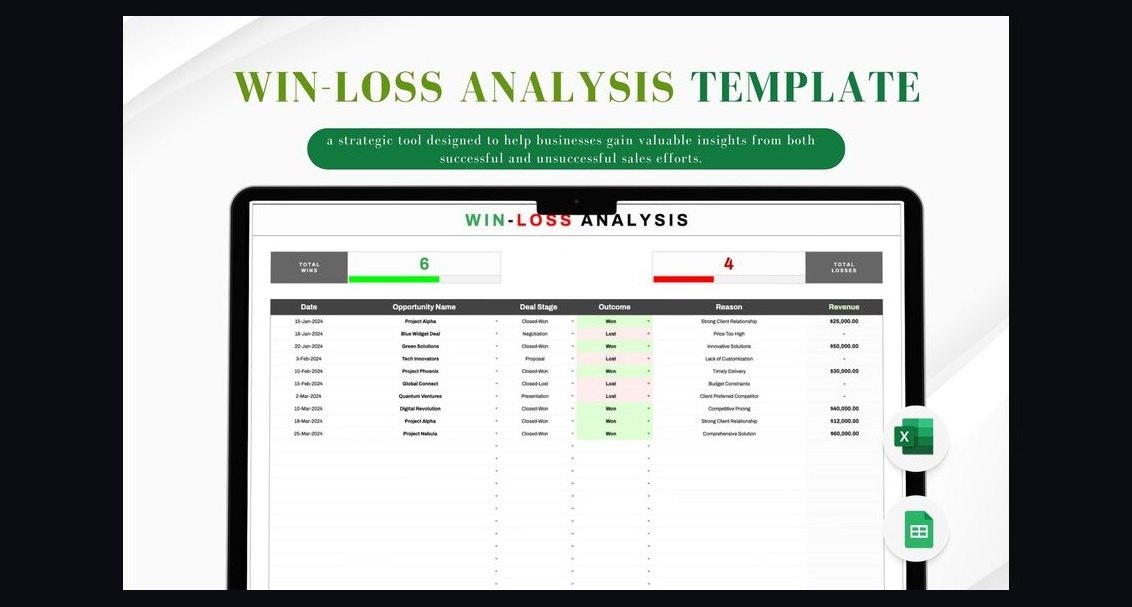 revopsHow Do I Run a Win/Loss Analysis Program That Improves Win Rate in 2027?
 revopsHow do you build a win-loss analysis program in 2027?
 sko-designWhat are the core design pillars for a high-ROI sales kickoff in 2027?
 sales-trainingThe Competitor Battlecard Reboot — 60-Min Training
 sales-trainingThe Win-Loss Sprint — 60-Min Training
 forecastingHow do I build a real bottom-up forecast in a 50-rep org in 2027?
 workatoWorkato vs 11x — which should you buy?
 rfp-strategyWhat's the right way to run a multi-vendor RFP I'm responding to in 2027?
 outreachOutreach vs Salesloft — which should you buy?