

Are 2027 enterprise buyers demanding AI-driven total cost of ownership models?
 Curated byKory White · Fractional CRO · Maryland
Quality
Certified

Yes. By 2027, enterprise buyers are demanding AI-driven total cost of ownership models as a baseline requirement, not a nice-to-have. Static, spreadsheet-based TCO no longer satisfies procurement committees that need real-time usage forecasts, integration-risk modeling, and persona-specific cost views. RevOps teams that can't produce a defensible, dynamic ownership analysis are increasingly disqualified before the buying committee ever convenes.
A Procurement Committee Runs Into a Wall
Picture a mid-market enterprise evaluating a new sales engagement platform. The vendor's rep shows up with the usual one-page TCO summary: per-seat license cost, a flat implementation fee, and a "expected savings" line pulled from a case study. Five years ago, that PDF would have moved the deal forward. In 2027, it stalls the deal on the spot.
The reason is structural, not stylistic. Enterprise software buyers have been burned by AI-feature pricing that looked cheap at pilot scale and became unpredictable at production scale — usage-based compute charges, per-API-call fees, and storage costs that don't show up until month four of a rollout. A flat annual number can no longer represent that reality, so buyers stopped accepting it as sufficient evidence. The economic buyer (often the CFO or a VP of Finance embedded in the deal) now expects a model that ingests the buyer's own usage patterns — seat counts, message volume, historical support ticket load, data storage growth — and projects a cost curve rather than a single number.

This is where the RevOps function becomes the deal's bottleneck or its accelerant. The RevOps team is usually the group asked to defend the vendor's assumptions internally, translate a vendor-supplied model into the company's own financial terms, and answer the inevitable follow-up question: "what if usage doubles?" A static model has no answer to that question. An AI-driven model can rerun the projection in minutes with a new usage assumption, which is exactly the kind of responsiveness a modern buying committee has learned to expect from every other part of the sales process — instant, data-backed, and specific to them rather than generic.
The shift also reflects how consolidated and crowded the vendor landscape has become. Buyers evaluating three or four overlapping tools (a CRM, a conversation intelligence tool, a forecasting layer, a data enrichment service) need a TCO model that can show overlap and redundancy cost, not just the sticker price of each individual tool. A model built only to make one vendor's number look small is worth less to the buyer than one that honestly compares total spend across the stack, including the integration and maintenance burden of running multiple systems side by side. That comparative, consolidated view is very difficult to produce by hand, which is part of why AI modeling has become the expected delivery mechanism rather than an optional add-on.

How an AI-Driven TCO Model Actually Works
The mechanical difference between a static TCO and an AI-driven one comes down to three capabilities: live data ingestion, scenario simulation, and persona-specific output. A static model takes fixed inputs (list price, a flat implementation estimate, a generic savings assumption) and produces one number. An AI-driven model instead connects to the buyer's own systems — CRM activity data, billing history from existing tools, HR headcount data for seat forecasting — and uses that live data as the starting point for the projection.
From there, the model runs the cost forward under multiple assumptions rather than one. Instead of assuming usage stays flat, it simulates a range of growth scenarios (modest growth, aggressive expansion, a renewal-year price increase) and returns a probable cost range rather than a single figure. This is the same logic that has long been used in financial risk modeling, applied here to software spend: instead of "the contract costs $400,000 a year," the output looks more like "the three-year cost is most likely to fall between $1.1M and $1.6M, with the upside driven mainly by API and storage usage growth."

The last capability — persona-specific output — is what makes the model usable inside a real buying committee. A CFO wants a net-present-value view with a risk-adjusted discount rate. A security or compliance stakeholder wants data-residency and audit cost broken out separately. A RevOps or operations leader wants adoption cost: training time, ramp period, and the cost of running two systems in parallel during migration. A single flat PDF cannot serve all three audiences at once, but a model built on live data and a simulation engine can regenerate a different view for each stakeholder from the same underlying dataset, in the same meeting, without the vendor going back to build a new spreadsheet.
The Numbers Buyers Are Now Demanding
The scale of the shift shows up most clearly in how buying committees are structured and how long they take to reach a decision. Enterprise deals that once involved four or five stakeholders now commonly route through ten or more reviewers before signature, spanning finance, security, IT, and the requesting department. Every additional stakeholder adds a new lens the TCO model has to satisfy, and every unanswered "what about" question can add days or weeks to the cycle. A model that can be re-run live in a meeting, rather than requiring a follow-up email and a three-day turnaround, measurably shortens that cycle — vendors who can answer a cost question on the spot are advancing through committee review faster than those who promise to "get back to you."

On the cost side, buyers have learned through direct experience that usage-based AI pricing can scale non-linearly. A tool that looked inexpensive at a fifty-seat pilot can become dramatically more expensive at five hundred seats if the underlying cost driver is API calls or compute-heavy inference rather than a flat per-seat fee. Because of that experience, procurement teams increasingly build in a deliberate buffer — commonly in the range of 20-40% above the vendor's initial quote — specifically to absorb usage growth that a flat quote doesn't capture. An AI-driven TCO model is valuable precisely because it can replace that blunt buffer with an actual projected range, which is more defensible to a CFO than an arbitrary padding number and, in many cases, produces a lower effective total cost estimate than the buffer would have.
Contract terms are adapting in response. It has become more common for enterprise contracts to include a cost-true-up or renegotiation clause tied to actual usage versus the modeled projection — if real costs materially exceed the modeled range in year one, the buyer has a contractual basis to revisit pricing rather than simply absorbing the overage. That clause only works, on either side, if there was a specific, data-backed model to measure actual spend against in the first place, which is another reason AI-driven TCO has moved from a differentiator to a contractual prerequisite in regulated and larger enterprises.

Trade-offs: AI-Driven TCO vs. Traditional Vendor Quotes
An AI-driven model is not free of trade-offs, and RevOps leaders should treat it as a tool with real limitations rather than a magic answer. The biggest trade-off is trust versus convenience: a model built and hosted by the vendor selling the product has an obvious incentive to make that product look favorable, no matter how sophisticated the simulation engine underneath it. Buyers who accept a vendor-generated TCO without an independent check are trusting the vendor's assumptions about their own growth curve, discount rate, and competitive comparison — assumptions the vendor controls.
The alternative — building or commissioning an independent model, either through an internal RevOps or FP&A analyst or a neutral procurement platform — is more defensible but slower and requires clean internal data to begin with. If the buyer's CRM has duplicate records, inconsistent usage logging, or gaps in historical billing data, an AI model built on top of that mess will produce a confident-looking output that is still wrong. Data hygiene is therefore a genuine prerequisite, not a nice-to-have, and RevOps teams sometimes discover mid-evaluation that they need to clean up their own systems before they can trust any model, vendor-supplied or internal.

The practical resolution most enterprise buyers have landed on is running both models side by side rather than picking one. The vendor's model sets a baseline and shows what the vendor believes usage will look like; an internal or third-party model checks that baseline against the buyer's own historical patterns. When the two ranges are close, confidence in the deal goes up. When they diverge significantly, that gap itself becomes a legitimate, useful negotiating point — it forces the vendor to explain exactly which assumption is driving the difference, whether that's seat growth, support volume, or a compute cost per transaction that the buyer's own data doesn't support.
Common Pitfalls and How to Avoid Them
The first and most common mistake is treating the vendor's AI-generated number as the final answer simply because it came from a sophisticated-looking model. A confident output is not the same as an accurate one, and RevOps teams that skip independent validation are the ones most likely to be surprised by cost overruns in year two of a contract. The fix is procedural: build a standing internal practice of re-running any vendor TCO against the company's own twelve months of actual usage data before signature, even if that means a short delay in the buying process.

The second pitfall is assuming costs scale linearly when the underlying driver — API calls, storage, or inference compute — actually scales in steps or exponentially past certain usage thresholds. A model that projects year-three cost by simply multiplying year-one cost by three will systematically understate real spend for any tool with usage-based pricing. Buyers should specifically ask vendors what the cost driver is and whether the model accounts for non-linear scaling at 2x, 5x, and 10x current usage, and reject models that can't answer that question with specifics.
The third pitfall is ignoring the cost of the migration and integration period itself. Enterprise buyers frequently model the steady-state cost of a new tool carefully but underestimate the temporary cost of running old and new systems in parallel, retraining users, and cleaning up data during cutover. A thorough AI-driven TCO model should include a distinct migration-period cost band, not just steady-state ownership cost, because that transition period is often where budget overruns actually originate. Finally, RevOps teams should be wary of models that produce a single confident number rather than a range — a legitimate simulation-based model will always express uncertainty, and a tool that hides that uncertainty behind one clean figure is more likely marketing than modeling.

Related questions
Is a vendor-provided TCO model ever sufficient on its own?
Rarely for large deals. Buyers increasingly pair a vendor's model with an independent or internal check, since the vendor has an incentive to favor assumptions that make their own pricing look better.
What data does a company need before it can trust an AI TCO model?
Clean, consistent historical usage data — CRM activity, billing history, and support volume — free of duplicates and gaps. Without that, even a sophisticated model produces confident but unreliable output.
Does AI-driven TCO modeling apply outside of software purchases?
Yes. Any spend with variable, usage-based costs — cloud compute, hardware-as-a-service, or professional services with hourly billing — is a candidate for the same scenario-based modeling approach.
How does this change the length of enterprise sales cycles?
It can shorten cycles by answering committee cost questions live instead of over days of follow-up, but it can also lengthen cycles when a vendor's model can't withstand independent scrutiny and trust has to be rebuilt.
FAQ
What's the core difference between a traditional TCO and an AI-driven one? A traditional TCO is a fixed document with one number based on static assumptions. An AI-driven TCO connects to real usage data and simulates a range of future costs under different growth scenarios, updating live as assumptions change.
Do RevOps teams need a data science background to use these models? No. Most enterprise procurement and revenue platforms now offer built-in modeling features that connect to existing systems. What RevOps teams need is the judgment to validate the underlying assumptions, not the ability to build the simulation engine itself.
How can a RevOps leader convince a skeptical CFO to trust an AI-generated number? By presenting a range with a stated confidence level rather than a single figure, and by showing the model's assumptions transparently so the CFO can challenge specific inputs rather than the model as a whole.
Can an AI TCO model account for the risk that a vendor gets acquired mid-contract? Some more advanced models incorporate vendor stability signals as a qualitative risk factor, but this remains an emerging and imprecise part of the practice — buyers should treat any specific acquisition-probability number with caution.
What happens if actual costs exceed the model's projection? Enterprise contracts increasingly include a true-up or renegotiation clause triggered when real spend significantly exceeds the modeled range, giving the buyer contractual leverage rather than just an unpleasant surprise at renewal.
Is this trend limited to large enterprises, or does it apply to mid-market buyers too? It started in large, heavily regulated enterprises with formal procurement functions, but mid-market buyers are adopting the same expectations quickly, particularly for any tool with usage-based or AI-compute-driven pricing.
Sources
- Gartner – Procurement and Sourcing Research
- Forrester Research
- McKinsey – Growth, Marketing & Sales Insights
- Gong Labs
- Clari Blog
- Vendr Blog
- SaaStr
- MIT Sloan Management Review
Related on PULSE
- Are vendor consolidation efforts reducing or increasing the total cost of ownership for AI sales stacks in 2027?
- Why are 2027 buyers demanding AI-generated proof-of-concept simulations?
- Why are 2027 B2B buyers demanding AI-generated demo personalization at scale?
- Why are 2027 B2B buyers demanding proof-of-concept before even a discovery call?
- How do I phrase a question that encourages a rep to take ownership of their pipeline hygiene?
- How do you coach reps to take ownership of their numbers?
This page will be disappearing soon. Save it to your device for $1 — or read it free while it is here.
@Kory-White- · if Venmo asks, the last 4 of my number are 2012
This page is gone.
This one is off the shelf now. $1 keeps it on your phone for good — the whole page, pictures and diagrams included.
 revopsWhy Do Buying Committees Now Insist on AI-Generated ROI Proof Before Vendor Demos in 2027?
 revopsWhich RevOps org structures in 2027 best support the shift from outbound-heavy GTM to AI-driven inbound account targeting?
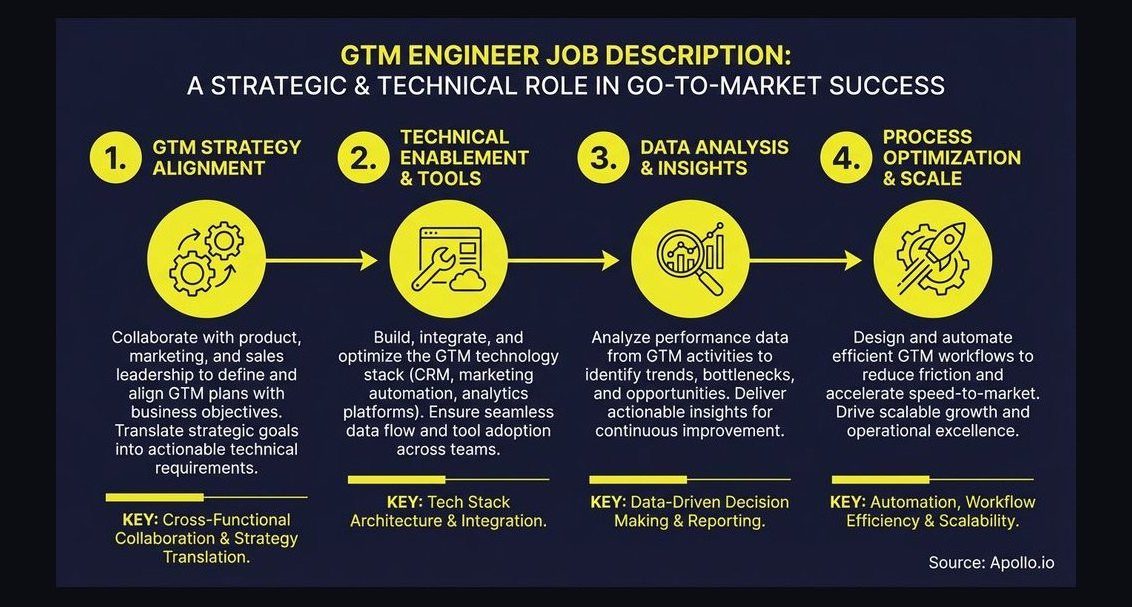 revopsWhat is a GTM engineer and why is the role exploding in 2027?
 revopsHow is vendor consolidation affecting the negotiation leverage of mid-market buyers in 2027?
 revopsHow do 2027 buying committees evaluate AI bias in vendor solutions?
 revopsWhy do 2027 buying committees now demand ROI simulations before demos?
 revopsWhy are sales cycles extending for companies without AI adoption playbooks in 2027?
 revopsWhat Signals Predict a Buying Committee Is Stuck in Analysis Paralysis During Longer Sales Cycles in 2027?
 revopsHow do you transition from sales-led to PLG (product-led growth) in 2027?
 revopsWhat AI-driven signals predict buying committee readiness in longer cycles in 2027?