
Booker T. Washington’s Atlanta Compromise (1895) — Text and Lessons
 Curated byKory White · Fractional CRO · Maryland
 PULSEKNOWLEDGE LIBRARY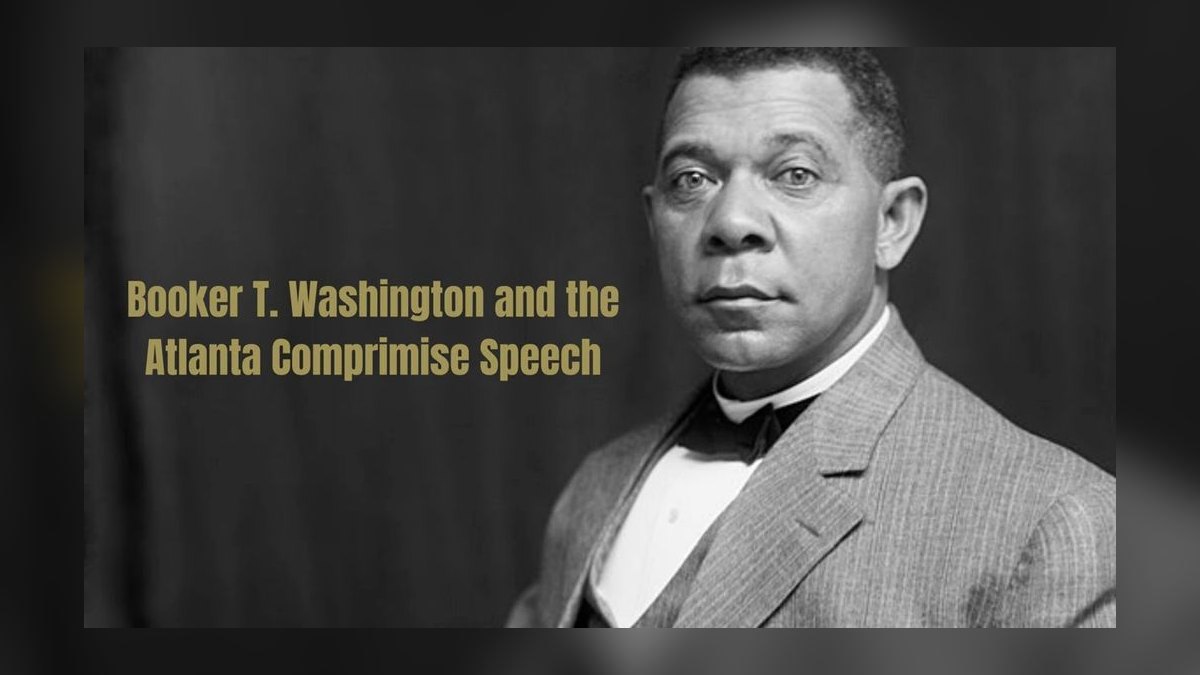
Booker T. Washington's 1895 Atlanta Compromise speech urged Black Americans to accept segregation and disenfranchisement in exchange for economic opportunity and vocational training, famously declaring, “Cast down your bucket where you are.” The address called for racial cooperation in the South while implicitly accepting white supremacy, a strategy that generated both support and sharp criticism from figures like W.E.B. Du Bois. Key lessons include the debate between accommodation and protest, the role of economic self-help in civil rights, and the enduring tension between gradual reform and demands for immediate equality. The speech remains a masterclass in rhetorical strategy and a permanent reference point for understanding how marginalized leaders navigate oppressive systems.
On September 18, 1895, Booker T. Washington delivered a ten-minute address at the Cotton States and International Exposition in Atlanta, Georgia, that would become one of the most consequential and controversial speeches in American history. Standing before a predominantly white audience as the first Black speaker ever to address such a gathering in the postwar South, Washington laid out a program of economic self-reliance and racial accommodation that would define Black political strategy for a generation. The speech earned Washington overnight fame as the most prominent Black leader in America, but it also drew sharp criticism from those who believed he had traded political and civil rights for economic opportunity. Understanding this address requires examining its historical context, its rhetorical craft, and the lasting debates it sparked about how to achieve racial progress.
What Were the Historical Circumstances of the Atlanta Compromise Speech?
The Atlanta Compromise speech emerged from a period of profound crisis for Black Americans in the post-Reconstruction South. By 1895, the promises of Reconstruction had been systematically dismantled: the Compromise of 1877 had withdrawn federal troops from the South, allowing white Democrats to regain control of state governments, and a wave of Jim Crow laws was codifying racial segregation across the region. Black Americans faced widespread disenfranchisement through poll taxes, literacy tests, and grandfather clauses, while racial violence, including lynching, reached epidemic levels—at least 113 Black Americans were lynched in 1895 alone. The Supreme Court had upheld segregation in *Plessy v. Ferguson* (1896) just a year later, and the entire legal and social structure of white supremacy was being rebuilt after the brief experiment of Reconstruction.
Washington chose his moment carefully. The Cotton States Exposition was designed to showcase the South's economic recovery and industrial progress, and organizers wanted a Black speaker to demonstrate racial harmony. Washington understood that his audience included white Southerners who feared Black political power, white Northerners who wanted to invest in the South without racial conflict, and Black Southerners desperate for any path to advancement. His speech needed to reassure each group while advancing the cause of Black education and economic development. The address was a calculated risk: any explicit demand for civil rights would have been met with hostility, but complete silence on political rights would betray Black aspirations for full citizenship. Washington walked this line with extraordinary rhetorical skill, offering a vision of racial progress that white audiences could accept while preserving space for Black agency.

How Did Washington Use Rhetorical Ambiguity to Address Multiple Audiences?
Washington's masterstroke was the use of strategic ambiguity—language that could be interpreted differently by Black and white listeners. His central parable of "casting down your bucket" was drawn from a sailor's story about a ship dying of thirst beside fresh river water, and he applied it to both races simultaneously. When he told Black Americans to "cast down your bucket among your own people," white listeners heard a call for Black workers to stay in the South and accept their subordinate role; Black listeners heard a call to build community wealth through self-reliance and patronage of Black-owned businesses. Similarly, when he addressed white employers with the same phrase, he asked them to rely on Black labor rather than seeking immigrant workers—a message that flattered white Southerners while promoting Black economic opportunity.
The most famous and contested example of this ambiguity was Washington's metaphor: "In all things that are purely social we can be as separate as the fingers, yet one as the hand in all things essential to mutual progress." White audiences interpreted this as a promise to accept segregation without protest, a guarantee that Black Americans would not challenge Jim Crow laws. Black audiences, however, could read the "hand" metaphor as a call for economic cooperation that might eventually erode racial hierarchies—if Black workers and white employers worked together as "one hand," the logic suggested, social separation would become untenable over time. Washington never explicitly endorsed segregation in the speech, nor did he explicitly condemn it; he left the implications ambiguous enough that each audience could hear its preferred meaning.

This deliberate vagueness was not cowardice but survival strategy. Washington, who had spent years fundraising for Tuskegee Institute from both Northern philanthropists and Southern politicians, understood that open demands for equality could result in violent reprisal—not just for himself but for the institutions he had built. By framing Black advancement as a matter of economic development rather than political confrontation, he bought time and resources for Black education and entrepreneurship in an era when the white power structure was actively hostile to Black progress. Modern readers should recognize this as a sophisticated rhetorical choice within a white supremacist system, not necessarily as Washington's personal beliefs about racial equality. For a deeper exploration of how historical speakers have used ambiguity to navigate hostile audiences, see our analysis of Abraham Lincoln's Farewell to Springfield.
What Was the Impact of the Atlanta Compromise on Black Education?
The speech's most tangible legacy was its influence on Black education policy, particularly the debate between industrial training and classical liberal arts. Washington's vision—that Black students should learn practical trades like farming, carpentry, and domestic service—directly shaped the curricula at Tuskegee Institute and dozens of other Black schools founded in the following decades. This approach attracted significant funding from white philanthropists like Andrew Carnegie and John D. Rockefeller, who preferred supporting "useful" education over institutions that might produce political agitators. By 1910, industrial education had become the dominant model for Black schooling in the South, with states allocating more resources to trade schools than to academic programs for Black students.

However, this emphasis came with hidden costs that critics would later identify. The Tuskegee model implicitly accepted that Black workers would remain in subordinate economic roles—farmers, mechanics, servants—rather than entering professions like law, medicine, or academia. W.E.B. Du Bois famously criticized this as a "program of industrial education and submission to white political rule," arguing it would create a permanent underclass. The debate between Washington and Du Bois, often simplified as "industrial vs. classical education," actually reflected deeper disagreements about whether Black progress should prioritize immediate economic survival or long-term political equality. Du Bois argued in his 1903 work *The Souls of Black Folk* that Washington's program demanded that Black Americans "give up, at least for the present, three things—political power, insistence on civil rights, and higher education of Negro youth"—and that this surrender was too high a price to pay.
Historians today offer a more nuanced assessment. Washington's approach was pragmatic for its time—the 1890s saw the systematic disenfranchisement of Black voters across the South, and any institution that openly challenged white supremacy risked destruction. Tuskegee survived and grew because Washington navigated these constraints skillfully. Yet the educational legacy is double-edged: while thousands of Black students gained practical skills that enabled economic survival, the emphasis on industrial education may have inadvertently reinforced the very racial hierarchy it sought to navigate. The debate remains relevant in modern discussions about vocational training, STEM education, and whether schools should prioritize workforce preparation or critical thinking. For more on how historical figures have grappled with educational strategy, see our analysis of Elizabeth Cady Stanton's Declaration of Sentiments.

How Did White and Black Audiences Respond to the Speech in 1895?
The immediate reception of the Atlanta Compromise speech was overwhelmingly positive among white audiences, both Northern and Southern. The speech was met with thunderous applause from the audience at the Cotton States Exposition, and white Southern newspapers praised it as a model of racial harmony. The *Atlanta Constitution* declared that Washington had "made a speech that was a revelation" and that his words "marked a new epoch in the history of the South." Northern philanthropists and politicians also endorsed Washington's approach, seeing it as a practical path to racial peace that would allow economic development to proceed without political conflict. Within weeks, Washington was the most famous Black man in America, invited to speak at white institutions and consulted by white leaders on racial matters.
Black responses were more divided. Many Black Southerners, desperate for any path to advancement in a violently oppressive system, embraced Washington's message of self-help and economic progress. Black newspapers like the *New York Age* and the *Indianapolis Freeman* initially praised the speech, seeing it as a strategic move that secured white support for Black education at a time when open confrontation seemed impossible. However, a significant minority of Black intellectuals and activists immediately recognized the dangers of Washington's bargain. W.E.B. Du Bois, then a young scholar at Harvard, would later write that the speech "surrendered the civil and political rights of the Negro race" and that Washington's program had "practically accepted the alleged inferiority of the Negro."

The division within Black leadership that emerged from this speech would shape civil rights strategy for decades. Washington's network, known as the "Tuskegee Machine," controlled patronage, funding, and media access, effectively silencing many critics during his lifetime. But the Atlanta Compromise also galvanized opposition, leading directly to the formation of the Niagara Movement in 1905 and the NAACP in 1909—organizations that would champion the very political rights Washington had seemed to set aside. The tension between these approaches—economic self-help versus political activism, gradual reform versus immediate demands—has never been fully resolved and continues to structure debates about racial justice today.
What Are the Key Lessons Modern Speakers Can Learn from the Atlanta Compromise?
The Atlanta Compromise speech offers enduring lessons for anyone who must communicate with divided audiences or advocate for change within hostile systems. First, Washington demonstrated the power of a single controlling image. The entire speech hangs on the "cast down your bucket" metaphor, which carries the argument without needing multiple examples or elaborate reasoning. A well-chosen metaphor can do more work than ten arguments and will be remembered long after your points are forgotten. The "separate as the fingers, one as the hand" image is equally effective—it is visually concrete, emotionally resonant, and rhetorically flexible enough to be interpreted differently by different listeners.

Second, Washington understood the importance of speaking to self-interest rather than making demands based on justice or morality. He told white employers that Black labor would lift their economic load, not that they had a moral obligation to treat Black workers fairly. He told Black workers that self-reliance would earn respect, not that they deserved rights simply because they were human. This framing made his message palatable to audiences who would have rejected any appeal to abstract principles. When you must persuade people who do not share your values, finding the intersection between their interests and your goals is often more effective than appealing to their conscience.
Third, the speech teaches the difficult lesson that rhetorical choices have moral consequences. Washington's "separate as the fingers" metaphor won the room and secured funding for Tuskegee, but it also provided cover for segregationists who used his words to justify Jim Crow. The most persuasive line in a speech may also be the one that costs you the most in historical judgment. Before deploying a clever image, ask what it quietly concedes and whether that concession is worth the rhetorical gain. Washington's tradeoff—accepting the appearance of accommodation in exchange for real resources—is a calculation that every leader in a subordinate position must make, and it is never clean.
For a deeper exploration of how historical speeches balance persuasion and principle, see our analysis of George Washington's Farewell Address. For another example of a leader navigating a divided audience, examine Winston Churchill's Blood, Toil, Tears and Sweat.
How Do Modern Scholars Criticize the Atlanta Compromise?
Contemporary historians and activists have offered critiques of the Atlanta Compromise that go beyond the familiar Washington-Du Bois rivalry. One major criticism centers on Washington's silence regarding lynching and racial violence. In 1895, the year of the speech, at least 113 Black Americans were lynched in the United States—a number that would rise to over 150 per year by the early 1900s. Washington's decision not to condemn this violence in his address, and his later behind-the-scenes efforts to fight lynching through private pressure rather than public denunciation, has been seen by some as a moral failure. Critics argue that his emphasis on patience and self-help implicitly blamed Black victims for white violence, a theme that would echo in later "respectability politics" debates about whether marginalized groups must earn their rights through good behavior.
Another contemporary critique examines the speech through the lens of economic justice. Washington's vision of Black capitalism—building businesses, acquiring property, and proving economic worth—assumed that the white power structure would eventually reward Black success with political rights. This did not happen. Instead, Black communities that built thriving commercial districts, like Tulsa's Greenwood neighborhood, became targets of white mob violence. The 1921 Tulsa Race Massacre, which destroyed what was known as "Black Wall Street," demonstrated that economic achievement alone could not protect Black lives or property in a system determined to maintain white supremacy. This historical reality has led some modern scholars to argue that Washington's strategy, however well-intentioned, was ultimately insufficient because it failed to challenge the fundamental political and legal structures of racial oppression.
Some critics also argue that Washington's approach inadvertently strengthened the segregationist movement. By providing a prominent Black voice that seemed to accept Jim Crow, Washington gave white supremacists a powerful rhetorical tool: if the most famous Black leader in America said segregation was acceptable, why should anyone demand change? The Supreme Court cited Washington's philosophy in *Plessy v. Ferguson* to justify "separate but equal" doctrine, and Southern politicians regularly invoked his name to argue that Black Americans were satisfied with their subordinate status. Whether Washington could have avoided this outcome is debatable—any prominent Black leader in 1895 would have faced similar constraints—but the consequences of his rhetorical choices are clear.
Related questions
What was the main argument of Booker T. Washington's Atlanta Compromise speech?
Washington argued that Black Americans should focus on economic self-help and vocational training rather than demanding immediate social equality or political rights, promising that economic progress would eventually earn respect and inclusion from white society.
How did W.E.B. Du Bois respond to the Atlanta Compromise?
Du Bois strongly criticized the speech, calling it the "Atlanta Compromise" for accepting segregation, and argued for immediate civil rights, higher education for a "Talented Tenth" of Black leaders, and political action to challenge white supremacy directly.
What does "cast down your bucket where you are" mean?
The phrase is a metaphor urging Black Americans to build their lives and communities in the South rather than migrating elsewhere, and urging white employers to rely on the existing Black labor force rather than seeking immigrant workers.
How did the Atlanta Compromise affect Black education?
The speech promoted industrial education—teaching practical trades like farming and carpentry—which became the dominant model for Black schooling in the South, attracting white philanthropic funding but limiting access to classical academic education.
Why is the Atlanta Compromise still controversial today?
The speech remains controversial because it raises unresolved questions about whether marginalized groups should prioritize economic advancement or political activism, and whether accommodation or confrontation is more effective in achieving long-term change.
FAQ
What was the Atlanta Compromise speech? It was an 1895 address by Booker T. Washington at the Cotton States and International Exposition in Atlanta, urging Black Americans to focus on economic self-help and vocational training rather than immediate demands for social equality or political rights.
Why is it called a "compromise"? Washington traded an explicit push for full civil rights in exchange for white Southerners' support of Black economic advancement, arguing that Black progress through hard work and industrial education would eventually earn respect and inclusion.
Did all Black leaders agree with Washington? No. W.E.B. Du Bois and others strongly criticized the speech, calling it the "Atlanta Compromise" for accepting segregation, and argued for immediate civil rights, higher education, and political action—leading to a lasting split in Black leadership.
What did Washington say about segregation? He famously stated, "In all things that are purely social we can be as separate as the fingers, yet one as the hand in all things essential to mutual progress," implying acceptance of racial separation as long as economic cooperation continued.
How did white audiences react at the time? The speech was met with thunderous applause from both white and Black attendees, and white Southern newspapers praised it as a model of racial harmony, while Northern philanthropists and politicians endorsed Washington's approach.
Is the Atlanta Compromise still relevant today? Yes, it remains a central case study in debates about gradualism versus immediate demands, economic empowerment versus political rights, and how marginalized groups negotiate within oppressive systems.
What was Washington's educational background? Born into slavery in Virginia in 1856, Washington attended Hampton Institute and later founded Tuskegee Institute in Alabama in 1881, building it into a leading school for Black vocational and teacher training.
How did the speech affect Washington's career? The speech made Washington the most famous Black leader in America overnight, giving him access to white philanthropists and politicians that allowed him to build Tuskegee and influence national racial policy for two decades.
Sources
- National Archives - Booker T. Washington and the Atlanta Compromise
- Library of Congress - Booker T. Washington Papers
- PBS - Booker T. Washington and the Atlanta Compromise
- History.com - Atlanta Compromise Speech
- The Gilder Lehrman Institute of American History - Booker T. Washington's Atlanta Compromise
- Stanford University's Martin Luther King Jr. Research and Education Institute - Washington and Du Bois
- Encyclopedia Britannica - Atlanta Compromise
- Bill of Rights Institute - Booker T. Washington's Atlanta Compromise Speech
- Tuskegee University - History of the Atlanta Compromise Speech
- Zinn Education Project - Teaching the Atlanta Compromise
Related on PULSE
- [Chief Joseph’s I Will Fight No More Forever (1877) — Text and Lessons](/knowledge/sp0024)
- [Patrick Henry’s Give Me Liberty or Give Me Death (1775) — Text and Lessons](/knowledge/sp0007)
- [Abraham Lincoln’s Farewell to Springfield (1861) — Text and Lessons](/knowledge/sp0040)
- [George Washington’s Farewell Address (1796) — Key Passages and Lessons](/knowledge/sp0029)
- [Susan B. Anthony’s On Women’s Right to Vote (1873) — Text, Context, and Lessons](/knowledge/sp0010)
- [Winston Churchill’s Blood, Toil, Tears and Sweat (1940) — Text and Lessons](/knowledge/sp0031)
Recently Added — Related
- [A Motivational Monday Speech to Start the Week](/knowledge/sp0090)
- [A Speech to Thank Volunteers at a Community Event](/knowledge/sp0098)
- [A Speech to Open a Company Offsite](/knowledge/sp0082)
@Kory-White- · if Venmo asks, the last 4 of my number are 2012
 pulse-moviesTop 10 Movies on Netflix 2027
 pulse-moviesTop 10 Movies on Max 2027
 pulse-moviesTop 10 Fantasy Movies of All Time in 2027
 pulse-moviesTop 10 Documentaries of All Time in 2027
 pulse-moviesTop 10 Superhero Movies of All Time in 2027
 pulse-moviesTop 10 Romance Movies of All Time in 2027
 pulse-moviesTop 10 Westerns of All Time in 2027
 pulse-moviesTop 10 Musical Movies of All Time in 2027
 pulse-moviesTop 10 Thriller Movies of All Time in 2027
 pulse-moviesTop 10 Crime Movies of All Time in 2027