
How to Write a Speech in 30 Minutes in 2027
 Curated byKory White · Fractional CRO · Maryland
 PULSEKNOWLEDGE LIBRARY
Quality
Certified

Write a speech in 30 minutes by splitting the clock into three rigid phases: 5 minutes to define your core message and outline three key points, 15 minutes to draft the body with concrete examples, and 10 minutes to craft a powerful opening hook and a call-to-action closing. Prioritize clarity over perfection.
The outcome you should expect
A speech written in 30 minutes will not be a literary masterpiece, but it will be structurally sound, audience-focused, and deliverable with confidence. The primary outcome is a functional script of roughly 750 to 1,000 words, which at an average speaking pace of 125 to 150 words per minute yields a 6- to 8-minute presentation. If you need a full 30-minute speech, you will produce a detailed outline with bullet points for each segment rather than a word-for-word manuscript — that is the realistic trade-off of the time constraint.
The quality you can expect hinges on three variables: how clearly you define your audience and goal in the first 5 minutes, how ruthlessly you cut tangents during the 15-minute body draft, and whether you resist the urge to polish endlessly in the final 10 minutes. A well-executed 30-minute process delivers a speech that hits the core message, uses the rule of three for structure, includes one memorable story or statistic per point, and ends with a specific ask. The delivery will feel natural because you wrote it under pressure — you will remember the logic even if you forget the exact words.

Do not expect a perfectly timed speech. Expect to be 30 to 60 seconds over or under your target. That margin is acceptable. Expect your opening hook to need one or two practice runs before it lands naturally. Expect your transitions between points to be slightly rough. These are not failures — they are the normal output of a compressed writing process. The real measure of success is whether your audience can repeat your core message back to you after you finish speaking. If they can, the 30-minute method worked.
What drives that outcome
The ability to write a speech in 30 minutes is driven by a strict mental framework that replaces perfectionism with rapid decision-making. Every minute you spend debating word choice is a minute you lose on structure. The driving force behind a successful fast-written speech is the "core message first" rule: before you write a single sentence, you must articulate in one declarative sentence what you want your audience to know, feel, or do. That sentence becomes the anchor for every subsequent decision. If a story, statistic, or example does not directly support that core message, you delete it.

The second driver is the rule of three. Human memory and attention are optimized for triads. By forcing yourself to support your core message with exactly three points, you create a scaffold that is easy to build quickly and easy for your audience to follow. Each of those three points needs only two to three sentences of explanation and one concrete illustration — a short anecdote, a number, or a comparison. That is enough depth for a compressed speech. Going beyond three points in a 30-minute write session guarantees that at least one point will be underdeveloped.
The third driver is the separation of drafting from editing. In a normal writing process, people edit as they go, which multiplies the time required. In the 30-minute method, you draft the entire body in one continuous pass without stopping to fix grammar, rephrase sentences, or check word count. You treat the first draft as a "vomit draft" — it will be messy, but it will exist. Only after the body is complete do you switch to editing mode. That single behavioral shift cuts writing time by roughly 60 percent compared to iterative editing.

Benchmarks and realistic ranges
The 30-minute speech writing process produces measurable outputs that vary based on your familiarity with the topic and your typing speed. For a topic you know well — such as a routine sales presentation or a project update — you can expect to produce 800 to 1,000 words in the full half hour. For an unfamiliar topic that requires you to think through arguments as you write, the output drops to 500 to 700 words, which means you will rely more heavily on bullet points and speak extemporaneously from those notes.
Speaking pace benchmarks are critical to calibrate your word count. The average conversational speaking rate is 125 to 150 words per minute. A slower, more deliberate pace with pauses — ideal for persuasive or emotional speeches — runs 110 to 130 words per minute. A faster, energetic pace for a motivational or informational speech can hit 150 to 170 words per minute. If you write a 900-word speech and speak at 140 words per minute, your delivery time will be approximately 6 minutes and 25 seconds. If you need a 30-minute speech, you cannot write every word in 30 minutes — you will produce a structured outline with key phrases and speak the rest.

The rule of thumb for a 30-minute speech is 3,750 to 4,500 words. In 30 minutes of writing, you will produce roughly 20 to 25 percent of that total word count. The remaining 75 to 80 percent must come from your ability to expand on bullet points during delivery. That is not a weakness — it is the intended design of the method. The written portion provides the skeleton; your live knowledge and conversational tone provide the flesh.
Time allocation benchmarks within the 30-minute window are non-negotiable. If you spend more than 7 minutes on the outline phase, you will have less than 8 minutes for the closing, which is the most impactful part of the speech. If you spend more than 18 minutes on the body draft, you will have less than 7 minutes to craft your opening hook and call to action. The most common failure mode is spending 12 minutes on the opening alone, leaving only 3 minutes for the closing. That imbalance produces a speech that starts strong but ends weakly, which is the opposite of what audiences remember.

Risks, edge cases, and failure modes
The most frequent failure in the 30-minute speech writing method is attempting to cover too many points. When you try to support five or six arguments instead of three, each point receives shallow treatment, and the speech becomes a list rather than a narrative. Audiences do not remember lists. They remember one clear idea supported by a story or a number. If you catch yourself adding a fourth point, delete it immediately. If you cannot delete it, merge it into one of the three existing points.
Another common failure is writing the opening first. The opening is the hardest part to write because it must hook attention, state the thesis, and preview the structure — all in under 60 seconds of delivery time. If you start with the opening, you will spend 10 minutes on it, run out of time for the body, and end up with a strong start and an empty middle. Always write the body first. The opening and closing are easier to craft once you know exactly what you are opening and closing for.

Edge cases include writing for a hostile or skeptical audience. In that scenario, your core message must acknowledge the opposition directly. For example, if you are pitching a new revenue strategy to a team that failed at a similar initiative last year, your opening should name that failure and explain what is different this time. The 30-minute method still works, but you must spend the first 2 minutes of the outline phase identifying the audience's primary objection and building your three points as counters to that objection.
Technical glitches during delivery are a risk you cannot write your way out of. If your slides fail, your microphone cuts out, or the room layout changes, your written speech becomes irrelevant. The mitigation is to memorize your opening three sentences and your closing call to action verbatim. Those are the only lines you need to deliver perfectly. Everything else can be paraphrased from your bullet points. This approach reduces the risk of freezing if your notes become unusable.

A final failure mode is writing in a voice that does not match your natural speaking style. If you write formal, academic language but speak conversationally, the speech will sound rehearsed and inauthentic. The fix is to dictate the body of the speech into a voice recorder for 3 minutes, then transcribe it. Dictation produces natural phrasing and conversational rhythm. You lose 3 minutes of writing time but gain a speech that sounds like you.
A practical rollout plan
Implementing the 30-minute speech writing method requires a physical or digital timer, a blank document or index cards, and a commitment to not edit until the body is complete. The rollout plan below assumes you are writing for a specific event with a known audience and a clear goal. If you are practicing the method for general skill-building, use a hypothetical scenario with a 5-minute timebox for each phase until the process becomes automatic.
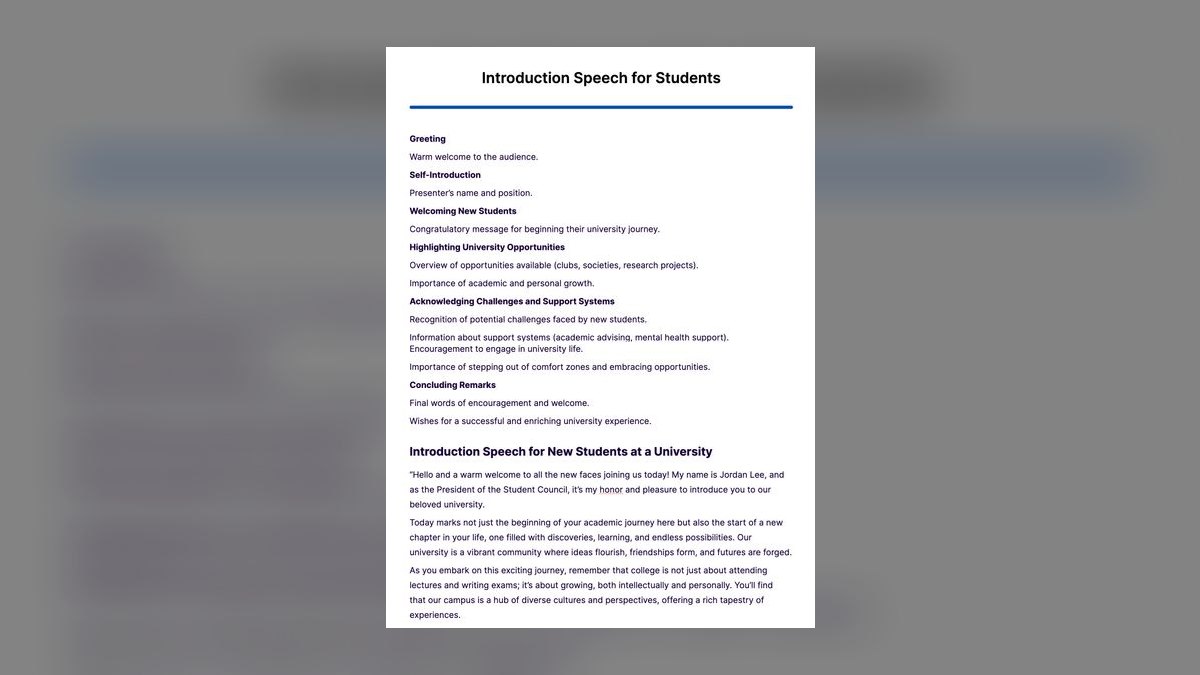
Begin by setting a timer for 5 minutes. During this phase, write your core message in one sentence at the top of the page. Below it, write the name of your audience and the single outcome you want — for example, "Audience: Sales team. Outcome: Approve the new lead scoring model." Then list three points that support that outcome. Each point should be a single phrase: "Point 1: Current model misses 40 percent of qualified leads. Point 2: New model increases conversion by 22 percent. Point 3: Implementation takes two weeks with no additional headcount." Stop when the timer rings, even if the outline feels incomplete.
Reset the timer for 15 minutes. Write the body by expanding each of the three points into two to three sentences of explanation, then add one concrete element per point. For Point 1, you might write: "Our current lead scoring model relies on demographic data only. It misses behavioral signals like website engagement and email opens. Last quarter, we tracked 340 leads that visited the pricing page three times but never received a follow-up because their demographic score was too low." That is a specific, actionable example. Do not stop to rephrase. If you finish all three points before the timer rings, go back and add a second example to the weakest point.

Reset the timer for the final 10 minutes. Write your opening hook in one to two sentences. Choose from four formats: a startling statistic, a provocative question, a short story, or a powerful quote. For the lead scoring example, a startling statistic hook would be: "We are leaving 40 percent of our potential revenue on the table because our lead scoring model is blind to behavior." Then write your call to action in one sentence: "I need your approval to pilot the new model starting next Monday." Finally, write one sentence that summarizes your three points as a recap. Read the entire speech aloud once. Cut any sentence that does not directly serve the core message.
Related questions
What is the rule of three in speech writing?
The rule of three states that information presented in groups of three is more memorable and engaging. Speeches structured with three main points are easier to write quickly and easier for audiences to follow and recall.
How many words is a 30-minute speech?
A 30-minute speech is approximately 3,750 to 4,500 words at a speaking pace of 125 to 150 words per minute. It is better to practice timing than to count words exactly.
Should I memorize my entire speech?
No. Memorize only your opening three sentences and your closing call to action verbatim. For the body, use bullet points or key phrases. This allows natural delivery and reduces the risk of forgetting lines.
What if I have less than 30 minutes to write?
In 10 to 15 minutes, skip the full outline and write only your core message, three single-word point labels, one opening hook sentence, and one call to action sentence. Speak the body from bullet points.
How do I practice a speech written in 30 minutes?
Read the speech aloud once to catch awkward phrasing, then practice your opening and closing two times each. Time yourself to confirm you are within your target duration. That is sufficient for a compressed process.
FAQ
What if I don't know my audience when writing the speech? Make educated assumptions based on the event context — industry, job level, and likely pain points. Use universal themes like challenges, goals, and emotions. Avoid jargon. Your goal is clarity and relatability, not insider credibility.
How do I add humor to a speech written in 30 minutes? Use a short, self-deprecating anecdote or a light observation that is not offensive. Avoid setup-punchline jokes. A smile and a conversational tone are safer and more effective than forced humor.
What if I run out of time during the writing process? Prioritize the opening and closing. Write a strong hook and a specific call to action. For the body, leave your three points as bullet points with no expansion. Speak to them naturally. A strong start and finish matter more than a detailed middle.
How do I handle a technical glitch during delivery? Acknowledge the glitch briefly with a calm, light-hearted comment, then move on. Do not apologize repeatedly. Your ability to adapt impresses more than the technology. Keep focus on your message and your audience.
What is the most common mistake in a 30-minute speech? Trying to cover too much information. This produces a rushed, confusing delivery. Focus on one core message and three supporting points. Less is more. A concise, clear speech delivered with confidence outperforms a dense, hurried one.
Can I use notes during delivery? Yes. Use index cards or a single sheet with your core message, three points, and key phrases. Do not read from a full script. Glance at notes, then look at the audience. This maintains connection and confidence.
How do I use pauses effectively in a short speech? Pause for 2 seconds after your opening hook to let it land. Pause for 1 second between your three points to signal a transition. Pause for 3 seconds before your call to action to build anticipation. Practice these pauses during your brief rehearsal.
Sources
- Toastmasters International - Speech Structure
- Harvard Business Review - How to Give a Killer Presentation
- TED Blog - How to Make Your Speech Memorable
- Forbes - The Secret Structure of Great Talks
- Inc. - 5 Tips for Writing a Speech in 30 Minutes
- Duarte - The Art of the Opening
- American Public Speaking Association - Speech Preparation Tips
- MindTools - Preparing a Speech
Related on PULSE
This page will be disappearing soon. Save it to your device for $1 — or read it free while it is here.
@Kory-White- · if Venmo asks, the last 4 of my number are 2012
This page is gone.
This one is off the shelf now. $1 keeps it on your phone for good — the whole page, pictures and diagrams included.
 pulse-speechesA Toast for a 60th Birthday
 pulse-speechesWhat Makes Susan B. Anthony's "On Women's Right to Vote" a Great Speech in 2027
 pulse-speechesA Speech for a Little League Opening Day
 pulse-speechesHow to Write a Heartfelt Eulogy When You're Grieving in 2027
 pulse-speechesA Wedding Speech for a Small Backyard Wedding
 pulse-speechesA Speech for Accepting an Industry Award
 pulse-speechesA Speech for a Veterans Day Tribute
 pulse-speechesA Retirement Speech for a Doctor
 pulse-speechesA Graduation Speech for a Kindergarten Graduation
 pulse-speechesHow to Keep a Wedding Toast Under Three Minutes in 2027