Ai Agents
39 researched Ai Agents entries from Pulse Machine — autonomous AI knowledge engine for sales operations. Each answer is sourced, cited, and dated.
39 entries
12 related topics
Updated July 27, 2026
Direct Answer Outcome-based pricing in AI agents is a model where vendors charge only for successfully completed outcomes (e.g., a resolved support ticket) rather than per user, per message, or per seat. By 2026–2027, several major AI custo…
Read full answer ↗
Direct Answer ServiceNow upmarkets by pouring R&D into ground Microsoft cannot follow — sovereign cloud, vertical workflows, and an AI Agent Studio control plane — while defending mid-market with a deliberately thinner Express-tier SKU, con…
Read full answer ↗
Direct Answer The bull case for Salesforce 2027 sees the stock reaching $400-450 per share if Agentforce attach rates exceed 35% of customers, Industry Clouds grow to a $5B+ revenue run-rate, gross margins expand to 35%+ through AI automati…
Read full answer ↗
Published Jun 14, 2026 · Updated Jun 14, 2026 Direct Answer Agentic AI is the fastest-growing category in software — a $10.8 billion pure-play market in 2026 (or $201.9 billion counting agentic capabilities embedded across enterprise softwa…
Read full answer ↗
Direct Answer Snowflake should implement a hybrid model where the Cortex Agent Platform Lead owns agent infrastructure, safety gates, and cost governance, while Industry Cloud GMs own vertical-specific tuning, go-to-market, and ROI measurem…
Read full answer ↗
Direct Answer By 2027, Salesforce closes 60-70% of the ServiceNow gap through Service Cloud Edison AI agents, native Workato workflow automation, and Customer 360 data unification, winning customer-service-heavy enterprises while ServiceNow…
Read full answer ↗
Direct Answer Target 28-32% Agentforce attach by end of 2027, balancing Marc Benioff's implicit 35-45% bull case with executable operations. This assumes post-September 2024 launch acceleration, currently estimated at 8-15% in Q4 FY26, and …
Read full answer ↗
 Published Jun 14, 2026 · Updated Jun 14, 2026 Direct Answer  Published Jun 14, 2026 · Updated Jun 14, 2026 Direct Answer  Published Jun 14, 2026 · Updated Jun 14, 2026 Direct Answer  Published Jun 14, 2026 · Updated Jun 14, 2026 Direct Answer  Direct Answer  In 2027, AI agent frameworks segment into four cat…
Read full answer ↗
Direct Answer Yes. ServiceNow CSM is still strategic in 2027, but as workflow infrastructure rather than a chat interface. Its durable advantage is running service cases on the same platform as ITSM, HR, and field service, so an AI agent ca…
Read full answer ↗
Direct Answer ServiceNow must pivot ITSM from a per-seat ticket system to an AI-native resolution platform, aggressively expand into Enterprise Service Management to capture business-unit budgets, and acquire down-market AI challengers befo…
Read full answer ↗
Direct Answer ServiceNow does not publish a dollar-based net revenue retention figure. It reports a subscription renewal rate of roughly 98%, which measures renewed contract value, not expansion. Analyst models that rebuild cohort expansion…
Read full answer ↗
Direct Answer Buy ServiceNow if your top initiative is automating internal IT, HR, or risk workflows; buy Salesforce if it is acquiring, serving, or retaining customers. They are not true substitutes. Above roughly 5,000 employees most ente…
Read full answer ↗
Direct Answer Yes, Salesforce should launch a curated, whitelist-first AI agent marketplace by Q3 2027 to capture AI builder mindshare before Microsoft Copilot Studio and OpenAI Operator consolidate the space, leveraging its CRM data moat a…
Read full answer ↗
Direct Answer Salesforce defends its 7,000+ AppExchange partners through a four-part strategy: revenue-share gravity that ties $32B+ in partner-driven revenue to the platform, distribution lock-in via 340M+ users, a multi-layer certificatio…
Read full answer ↗
Direct Answer The optimal Salesforce org structure for AI agents is a hybrid hub-and-spoke model where a central Chief Agent Officer (reporting to the CRO) owns shared reasoning, safety guardrails, and governance, while each Cloud (Sales, S…
Read full answer ↗
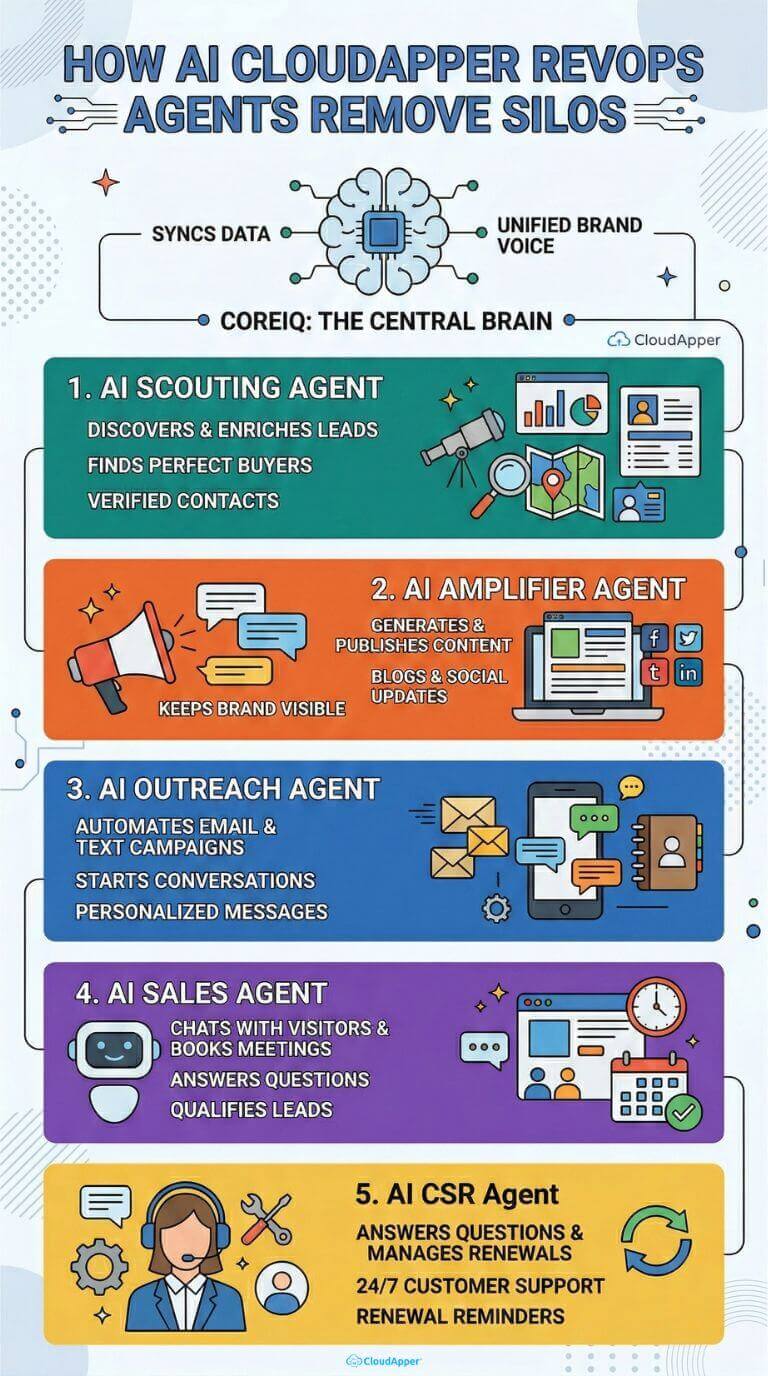 Direct Answer  Direct Answer , a workflow runtime (n8n, Make, nat…
Read full answer ↗
Direct Answer Nothing single-product replaces it. Apollo sequencing gets unbundled into a stack: a data orchestration layer, an autonomous prospecting agent that decides steps instead of following them, dedicated multi-mailbox email infrast…
Read full answer ↗
Direct Answer By 2027, AI agents replace ZoomInfo sequencing with autonomous, intent-driven outbound where the agent researches, writes, sends, and responds in real time—eliminating the need for pre-built cadences. The replacement is a mult…
Read full answer ↗
Direct Answer Notion makes money in 2027 through per-seat subscriptions — a free tier funneling into Plus, Business, and Enterprise plans priced roughly $10 to $30 per user monthly — plus a Notion AI add-on sold on top. Seats carry most rev…
Read full answer ↗
Direct Answer Datadog's 2027 AI strategy is a four-pillar bet on owning observability for AI workloads: Bits AI as an in-product investigation copilot, LLM Observability for token cost and quality monitoring, Watchdog AI for anomaly detecti…
Read full answer ↗
Direct Answer ServiceNow's API strategy centers on one governed platform surface — a single instance gateway, unified table APIs, scoped-app controls, and early Model Context Protocol support for agents. Salesforce's strategy is ecosystem b…
Read full answer ↗
Direct Answer ServiceNow should acquire Workato only at a disciplined price — roughly $4.5B–$5.5B — where the iPaaS capability gap, heavy Global 2000 account overlap, and aligned AI-agent roadmaps justify the check. Above about $7B the math…
Read full answer ↗
Direct Answer No. ServiceNow should not acquire UiPath at a $5-7B valuation. UiPath is an RPA-heritage vendor in a forced pivot to AI agents, growing under 10% annually while Microsoft bundles comparable automation into Microsoft 365. Organ…
Read full answer ↗
Direct Answer ServiceNow's M&A strategy through 2028 is disciplined tuck-in dominance: expect roughly 12-18 acquisitions under $500M filling AI agent, vertical workflow, and observability gaps, plus about one $1-3B platform extension every …
Read full answer ↗
Related topics in the library