


Pitch Anything — Cliff Notes Summary
Quality
Certified

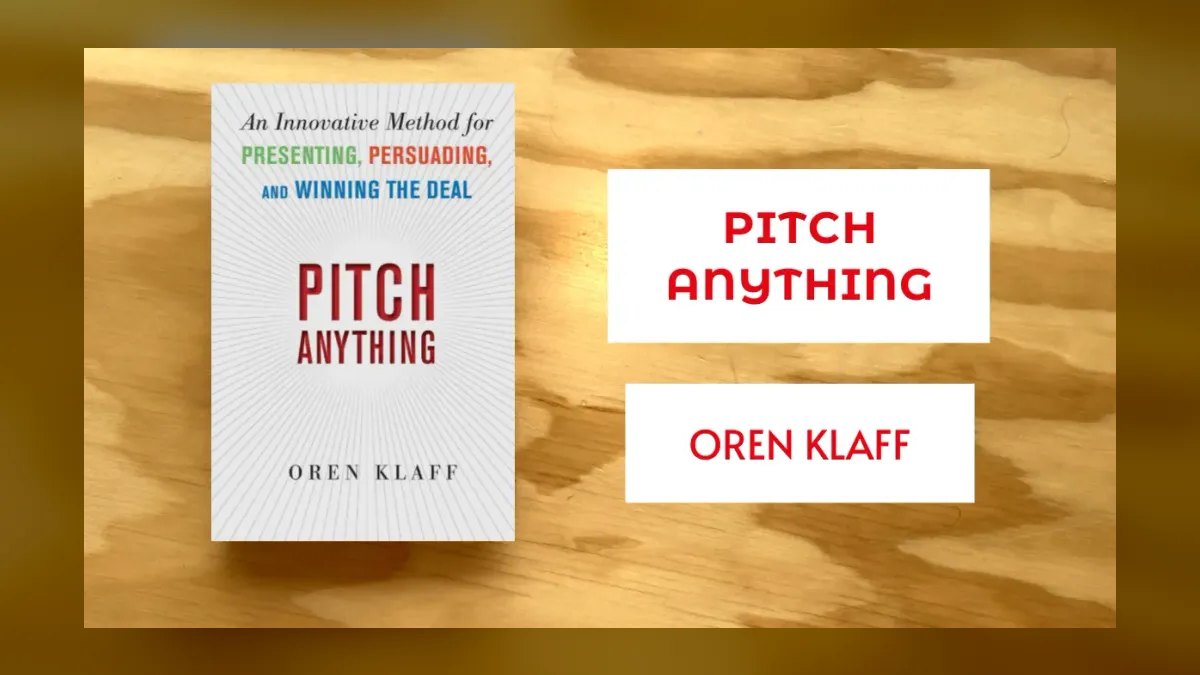
Pitch Anything by Oren Klaff argues that buyers decode every pitch through the primitive "croc brain" before logic engages, so whoever controls the frame wins. Its STRONG method — Set frame, Tell story, Reveal intrigue, Offer prize, Nail hookpoint, Get decision — compresses persuasion into 20 minutes. This Summary covers frames, status, neediness, and where the strategy actually applies.
Klaff's frame-first model versus the consultative playbook most teams already run
The useful way to read *Pitch Anything* is as a competing theory of what a sales meeting *is*. The consultative tradition — SPIN, Challenger, MEDDIC, Sandler in its softer forms — treats the meeting as an information exchange. You ask questions, you surface pain, you quantify impact, you map the buying committee, and the deal advances because the buyer's understanding improved. The seller's job in that model is diagnostic. Ask better questions, get better data, build a better business case, and the logic carries you.
Klaff's model treats the meeting as a status contest that happens to have information in it. His claim is that the buyer's decision — the gut yes-or-no that everything afterward rationalizes — is made in the first 90 seconds to five minutes, long before your discovery questions land or your ROI slide appears. What determines that decision isn't the quality of your questions. It's whether your frame absorbed theirs or theirs absorbed yours. Under Klaff's theory, a beautifully executed discovery call conducted from a beta position is a beautifully executed loss.
These two models disagree about causality, and the disagreement is testable in your own pipeline. If your losses cluster in deals where you did *everything* right — full discovery, multithreaded, quantified business case, executive sponsor identified — and the deal still evaporated into "we're going to hold off," the consultative model has no explanation for you. It says do more discovery. Klaff's model says you were positioned as a vendor from minute one and no amount of downstream rigor recovers that.
The honest read is that neither model is complete and they operate on different layers. Consultative frameworks are process architecture: they tell you what to find out, who to involve, and what has to be true before a deal is real. Klaff is behavioral physics inside a single room: he tells you how to hold attention and status while that process runs. MEDDIC will tell you that you haven't identified the economic buyer. Klaff will tell you that when you finally get in front of that economic buyer, forty minutes of qualification questions asked from a supplicant posture will end the meeting worse than it started.
There's a third comparison worth making because it sharpens what's distinctive here. April Dunford's *Sales Pitch* and Klaff's *Pitch Anything* share a title word and almost nothing else. Dunford is about *content architecture* — how to sequence market context, alternatives, and differentiated value so a buyer understands why your category exists and why you win inside it. Klaff is about *delivery physics* — status, attention, and emotional commitment. A Dunford-structured narrative delivered with Klaff-level frame control is close to the practical ceiling for a high-stakes pitch. Either one alone leaves obvious value on the table: perfect content ignored because the room dismissed you, or commanding presence attached to a story that doesn't explain why you're different.
The trade-off between these approaches is real and it isn't about which is smarter. Consultative selling is *low-variance*. Run it competently and you get predictable, coachable, reviewable outcomes across a large rep population. Klaff's approach is *high-variance*. Executed well it wins deals no amount of discovery could have won. Executed badly — and it is badly executed most of the time by people who read the book once — it reads as arrogance, and it destroys deals that a boring, competent consultative motion would have closed. That variance profile is the single most important thing to understand before you deploy any of this.
What the croc brain claim actually says, and what it doesn't
Klaff builds on Paul MacLean's triune-brain model: a survival-oriented "croc brain" that filters everything first, a midbrain that assigns social meaning, and a neocortex that reasons. His operational claim is that your pitch is constructed in your neocortex and received by their croc brain, and that mismatch is why detailed, well-researched presentations die.
It's worth being precise about the science, because being precise makes the practical advice *more* useful, not less. The strict triune-brain model has been substantially revised by neuroscientists since MacLean proposed it — brain regions aren't the neat evolutionary layers the model implies, and "reptilian brain" is a metaphor rather than an anatomical fact. But the behavioral pattern Klaff is pointing at is well supported from an entirely different direction: dual-process research, most familiar through Daniel Kahneman's System 1 and System 2. Fast, automatic, affect-laden processing runs first and shapes everything downstream; deliberate reasoning arrives late and frequently just builds justification for a conclusion already reached.
So the anatomy is loose and the behavioral prediction holds. That distinction matters because it tells you which parts of the book to take literally. Take literally: novelty beats density, threat cues shut down engagement, complexity gets delegated downward rather than evaluated, emotional commitment precedes analytical validation. Don't take literally: any specific claim about which brain structure does what.
The most actionable consequence is Klaff's inversion of the expertise assumption. The person who knows the most about the product frequently pitches it worst. They present exhaustively because exhaustiveness feels like respect for the buyer's intelligence. What the buyer's fast-processing system registers is volume — undifferentiated, effortful, hard to categorize — and volume without novelty reads as noise. The croc brain's response to noise isn't rejection, which would at least be a decision. It's delegation: "send it to my team and we'll take a look." That's the sound of a deal being routed into a queue where it dies quietly.
Klaff's 20-minute ceiling follows directly. His rule is that a pitch closes in under 20 minutes because sustained novel attention has a hard practical limit. This isn't a claim that meetings must be 20 minutes — it's that the *persuasion arc* has to complete inside that envelope. Everything after is Q&A, negotiation, or logistics, and those run on a different budget. If your core narrative needs 45 minutes, you don't have a long pitch. You have an unedited one.
There's an adjacent implication for how RevOps teams build enablement material. If the persuasion arc has to fit 20 minutes, then the 60-slide "master deck" marketing produces isn't a pitch — it's a content library that a rep must ruthlessly cut from before every meeting. Teams that treat the master deck as the thing to be *delivered* rather than *drawn from* systematically violate the ceiling on every call, and they do it while believing they're being thorough.
Choosing between a frame-led pitch and a discovery-led one
Nothing in *Pitch Anything* says use this everywhere, and the most common failure mode is applying maximum frame control to a meeting that didn't call for it. The decision hinges on four variables: the status gap, the stakes, how many meetings you get, and how differentiated you actually are.
Status gap. Klaff's techniques exist to solve one problem: a structurally higher-status buyer who can dismiss you by default. Pitching a fund's investment committee, a Fortune 100 CRO, a board. When that gap is genuinely wide, frame work is the highest-leverage thing you can do. When it's narrow or reversed — you're the incumbent, the buyer came to you inbound, they're actively trying to solve a problem you obviously solve — deploying prize frames and status reversals is solving a problem you don't have, and it reads as bizarre.
Stakes and meeting count. The method assumes a small number of high-consequence meetings. If a deal is one boardroom hour and there's no second chance, the aggressive version earns its variance. If your motion is six touches over four months with a friendly champion, you have room to build credibility slowly and much less need for a status gambit that could poison a relationship you'll live inside for a quarter.
Differentiation. The prize frame — positioning yourself as the scarce resource the buyer must qualify for — is only credible if it's approximately true. If you're one of five vendors in a commoditized category with a public pricing page, telling a buyer to explain why you should work with them is a bluff any competent procurement lead calls instantly. Prize frames work when there's a real reason you might walk: capacity constraints, a genuinely differentiated capability, a partner-selection process with actual criteria.
The quadrant that trips people up is high-status buyer, many touches. That's most enterprise SaaS. The right answer there isn't full STRONG on every call — it's the *defensive* subset of the book applied constantly and the *offensive* subset held for the one meeting that matters. Defensive subset: don't over-explain, don't seek validation, announce your own time constraint, never look like you need the deal. Offensive subset: prize frames, status reversals, deliberate intrigue loops, time-pressure closes.
The specific frames, the specific counters, and what each one costs
Klaff catalogs the frames sellers walk into and prescribes counters. The counters are where practitioners get hurt, so they deserve concrete treatment alongside their failure modes.
Power frame. The buyer signals you're disposable — keeps you waiting, takes a call mid-meeting, hands you five minutes when you booked thirty. Klaff's counter is defiance with light humor. His famous version: when a buyer compresses him, he compresses back. The mechanism is that the frame only holds if you accept it; refusing pleasantly makes it collapse. The cost is that mistiming this reads as combative, and with a buyer who was simply running late rather than testing you, you've just antagonized someone who was on your side. The safer general-purpose version is to *reprice the meeting rather than fight for it*: "Fifteen minutes isn't enough to do this properly. Let's use it to decide whether the full conversation is worth booking." You've refused the compression without a confrontation.
Time frame. "I've only got five minutes." Klaff says don't apologize and don't rush — rushing signals the pressure worked. The counter that works reliably is to name your own constraint first, before they name theirs. "I've got a hard stop at 11:15" said in your opening minute reverses the direction of time pressure and costs nothing even when the buyer wasn't testing you. This is the single cheapest technique in the entire book.
Analyst frame. The buyer drags the room into technical minutiae — schema questions, integration edge cases, a spec interrogation — and emotional momentum drains out. Klaff's counter is to break the pattern with a vivid, specific anecdote that pulls the room back into narrative. In practice: acknowledge, defer, redirect. "Good question, and it's a real one — let me get you the exact answer after this. It matters less than the thing I'm about to show you, which is what happened when a team your size tried this." The cost of getting this wrong is that a technical buyer asking real technical questions gets stiff-armed and concludes you can't answer. Distinguish genuine evaluation from momentum-draining minutiae by whether the questions ladder toward a decision or wander.
Intrigue frame. The one you deploy. An unfinished story with personal stakes and a deliberately withheld ending. It works because open loops occupy attention involuntarily. It fails when the story is transparently manufactured or when the payoff doesn't justify the buildup — a buyer who feels manipulated by a fake cliffhanger discounts everything after it.
The connective idea Klaff calls situational status: global status is title, net worth, and fame, while situational status is who's alpha in this room right now. A junior person can hold situational status against a far more powerful counterparty by declining the small compressions the environment offers — the lower chair, the small talk on the buyer's terms, the vendor-parade past gatekeepers. Klaff calls those beta traps, and each is individually trivial, which is exactly why they work in aggregate.
Neediness, hot cognition, and the numbers that actually govern the method
The most quoted line in the book — money is attracted to those who don't need it — is also the most operationally useful, because neediness is detectable, coachable, and expensive.

Klaff names three tells. Wanting validation: asking "does that make sense?" repeatedly, which converts every claim into a request for approval. Wanting to be liked: over-laughing, over-agreeing, softening every position into a question. Wanting the deal: any sentence beginning "I really hope we can." These are subconscious signals a buyer registers as weakness without necessarily naming it, and once registered, they reprice you.
The replacement behaviors are behavioral, not attitudinal, which makes them trainable. Want nothing *visibly* — which is far easier when it's true, so keep enough deals in flight that no single one determines your quarter. Focus on doing the work well rather than monitoring the buyer's reaction. Announce your time constraint first. Notice that modern outbound coaching arrives at the same place with different vocabulary — "calm energy," "post-victory tone," "unattached delivery" all describe the identical behavioral set. The language changed; the physics didn't.
The payoff Klaff is chasing is hot cognition: the buyer wants the deal before fully understanding it. Its opposite, cold cognition, is the deck-goes-home death spiral where three deputies review it and the decision freezes into nothing. The tells are behavioral and easy to score in real time. Hot: leaning in, interrupting with "wait, how does that work," asking what *they* need to do next, pulling in a colleague on the spot. Cold: polite nodding, asking for the deck, "let me socialize this internally."
Here are the numbers the method actually runs on, all of them Klaff's own structural rules rather than outcome statistics:

- 20 minutes — the outer bound of the persuasion arc, the envelope everything else fits inside.
- 5 minutes — introduce yourself and the big idea, including the why-now narrative built on converging market forces.
- 10 minutes — budget and secret sauce, with the sauce deliberately incomplete so curiosity survives the room.
- 2 minutes — the offer, named and with terms. Not a price tease. Not a circle-back.
- 3 minutes — frame stacking into the decision ask.
- 4 frames in the closing stack: intrigue, prize, time, moral authority, applied in rapid succession.
- 6 steps in STRONG: Set frame, Tell story, Reveal intrigue, Offer prize, Nail hookpoint, Get decision.
- 3 converging forces in the why-now — economic, social, technological — because a single trend reads as a guess and three reads as a pattern.
- 3 to 6 months of live reps before frame control stops feeling unnatural. Klaff is explicit that you lose deals building this muscle.
That last number is the one teams skip and the reason most rollouts fail. There is no reading-your-way-into-it. The book is roughly an afternoon; the behavior change is a quarter or two of uncomfortable live practice with real stakes, because low-stakes rehearsal doesn't produce the pressure the skill is built to survive.
Klaff's why-now pattern is worth writing out because it's the most portable single artifact in the book: for [target customer] dissatisfied with [current option], my product is a [new category] that provides [key benefit]; unlike [competing option], mine is [key differentiator]. That's an idea-introduction template, and it fits in the five-minute opening slot with room left over.
Sequencing a rollout without wrecking your pipeline
Handing a sales team this book and telling them to control frames produces a predictable disaster: two weeks of reps being rude to buyers, a spike in ghosted deals, and a manager quietly telling everyone to stop. Sequence it in layers instead, gated on evidence.
Layer one — anti-neediness, everyone, immediately. This is pure downside protection with essentially no blast radius. Score calls for the three tells. Ban "does that make sense" as a verbal tic and replace it with a silent beat. Require reps to state their own time constraint in the first two minutes. Nothing here can offend a buyer, and it's the layer with the best ratio of effort to result.
Layer two — compression, everyone, week two. Rebuild the core narrative to fit 20 minutes. Take the master deck and cut it to the five slides that carry the argument. Practice the why-now with three converging forces until it's fluent. This layer forces the content discipline that makes everything downstream possible, and again, no buyer is harmed by a tighter story.

Layer three — defensive frame work, everyone, after layers one and two hold. Recognizing and neutralizing power, time, and analyst frames. Note that this is *recognition and non-acceptance*, not counterattack. A rep who can spot a compression attempt and decline it calmly is already capturing most of the book's value.
Layer four — offensive frame work, selected reps, selected deals. Prize frames, status reversals, engineered intrigue, time-pressure closes. This is the high-variance layer. Gate it on rep judgment, deal profile, and manager review, and hold it for meetings that genuinely warrant it. Not every rep should run this, and saying so out loud is a feature of the rollout, not a failure of it.
Instrument it so you can tell whether it worked. Call-recording platforms give you the raw material: talk-time ratio, monologue length, question rate, and whether the rep or the buyer sets the next step. The specific leading indicators worth tracking are the share of meetings where the *rep* proposes the next step, the share of first meetings that produce a same-call commitment rather than a deck request, and average pitch length. If pitch length is falling and rep-proposed next steps are rising, the training is landing. If ghost rates are climbing, layer four got deployed by someone who wasn't ready and you should pull it back.
One structural caution. The book was written for capital raising, where the pitcher genuinely holds a scarce asset and the meeting genuinely is one shot. Enterprise SaaS is usually neither. Transplanting the aggressive techniques into a motion built on multi-quarter relationships and renewals can win the meeting and cost the account. Klaff's own worked example — the airport financing pitch that runs every technique inside a single hostile boardroom hour — is instructive precisely because those conditions were real. Check whether yours are before you borrow the tactics wholesale.
Related questions
Is Pitch Anything still relevant for remote and video pitches?
Yes. The status and attention dynamics don't depend on being in a room. Video actually amplifies the 20-minute ceiling, since screen fatigue arrives faster, and it removes some beta traps entirely — no lower chair, no gatekeeper parade — while adding new ones like waiting silently in a lobby.
Should I read Pitch Anything or Flip the Script first?
Read *Pitch Anything* first. It establishes frames, status, and the croc-brain model that *Flip the Script* assumes. The follow-up focuses on getting buyers to reach conclusions themselves rather than being pitched, which reads as a refinement once you have the original vocabulary.
Does this work for transactional or product-led sales?
Poorly. The method assumes a high-status buyer, high stakes, and a small number of consequential meetings. In self-serve or low-ticket transactional motions there's no status gap to correct and no boardroom to control, so the overhead buys nothing and the posture reads as strange.
How does STRONG compare to Challenger or MEDDIC?
They operate on different layers. MEDDIC is qualification — what must be true for the deal to be real. Challenger is commercial teaching across a cycle. STRONG is what happens inside one high-stakes room. They compose rather than compete; you can qualify with MEDDIC and deliver with STRONG.
What's the fastest thing to apply from the book?
State your own time constraint in the first two minutes and stop asking "does that make sense." Both take zero preparation, work in any meeting regardless of status gap, and remove the two loudest neediness signals a buyer picks up on.
FAQ
What is the croc brain and why does it matter for a pitch?
It's Klaff's term for fast, pre-rational processing that screens every message before analytical reasoning engages. It filters for threat, novelty, and status, and its response to complexity is delegation rather than evaluation. The anatomy behind the label is a simplification, but the behavioral pattern — emotional commitment first, justification second — matches well-established dual-process research and is what makes the advice work.
How is the STRONG method different from a sales script?

A script prescribes words; STRONG prescribes a sequence of states. Set frame, Tell story, Reveal intrigue, Offer prize, Nail hookpoint, Get decision describes what should be true at each stage — who holds status, whether curiosity is open, whether an offer is on the table — not what to say. Two reps running it well sound nothing alike.
What's the most common mistake people make with frame control?
Confusing frame control with dominance. Arguing, interrupting, and posturing trigger exactly the threat response the book is trying to avoid. Real frame control is usually quiet: declining a compression without commenting on it, naming your own constraint first, redirecting a minutiae spiral back to narrative. If it looks like a power struggle from outside, it isn't working.
Can a junior rep use this against a senior executive?
Yes, and that's the scenario the book is built for. Klaff separates global status from situational status, and situational status is available to anyone willing to decline the small compressions the environment offers. The caveat is that junior reps have the least margin for a mistimed status move, so they should master the defensive layer thoroughly before attempting the offensive one.
How long does it take to get good at this?
Klaff's own estimate is three to six months of live reps, during which you will lose deals. The concepts take an afternoon; the behavior change takes a quarter or two, because the skill is specifically about staying composed under pressure and low-stakes rehearsal doesn't generate the pressure. Teams that budget a week for it get a week's worth of results.
Is any of the neuroscience in the book wrong?
The strict triune-brain framing is outdated — brain regions aren't the clean evolutionary layers MacLean's model implies. The behavioral claims survive that correction intact, supported by dual-process research instead. Read the neuroscience as metaphor and the behavioral prescriptions as the substance, and nothing practical in the book depends on the outdated part.
Sources
- Pitch Anything — McGraw Hill publisher page
- Oren Klaff — official site
- Pitch Anything — Amazon listing
- Personal MBA (Josh Kaufman) — Pitch Anything review
- BrightCarbon — practitioner review of Pitch Anything
- Roger Dooley — interview with Oren Klaff on frame control and persuasion
- The Full Ratchet — Episode 195 with Oren Klaff
- Britannica — Daniel Kahneman
- Britannica — Paul MacLean and the triune brain concept
Related on PULSE
This page will be disappearing soon. Save it to your device for $1 — or read it free while it is here.
@Kory-White- · if Venmo asks, the last 4 of my number are 2012
This page is gone.
This one is off the shelf now. $1 keeps it on your phone for good — the whole page, pictures and diagrams included.
 pulse-recentTraction by Gabriel Weinberg and Justin Mares — Top 10 Key Takeaways for Sales Leaders in 2027
 pulse-recentWhat is the first concrete step in Sandler Rule #4 for a sales leader to implement in 2027?
 book-summaryLittle Red Book of Selling by Jeffrey Gitomer — Cliff Notes Summary
 pulse-recentThe Collaborative Sale by Keith Eades — Top 10 Key Takeaways for Sales Leaders in 2027
 pulse-booksRework by Jason Fried and David Heinemeier Hansson — Cliff Notes Summary
 book-summaryWhat factors drive the price of Book Summaries up or down in 2027?
 pulse-recentHyper Sales Growth by Jack Daly — Top 10 Key Takeaways for Sales Leaders in 2027
 pulse-recentWhat are the concrete steps to implement the Sandler Rules for Sales Leaders by David Mattson in 2027?
 pulse-recentGetting to Yes by Roger Fisher and William Ury — Top 10 Key Takeaways for Sales Leaders in 2027
 pulse-recentWhat are the concrete steps in Sandler Rule #7 for handling a prospect's budget objection in 2027?