


Cold Calling Sucks and That’s Why It Works by Armand Farrokh and Nick Cegelski — Top 10 Key Takeaways for Sales Leaders in 2027
Quality
Certified

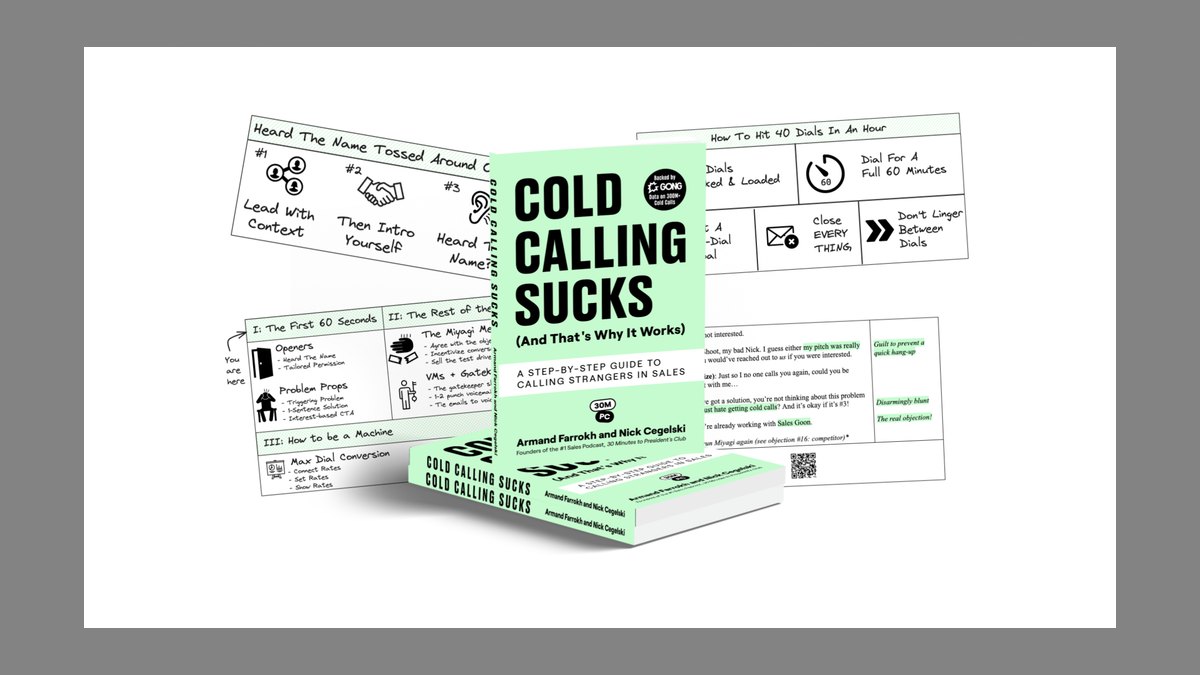
"Cold Calling Sucks and That's Why It Works" by Armand Farrokh and Nick Cegelski argues that rejection is a filtering mechanism, not a flaw. For sales leaders in 2027, the Top 10 Takeaways center on a four-beat call skeleton, tonality over word choice, objection recovery, and coaching systems that turn a broken-feeling activity into repeatable pipeline.
The outcome you should expect
When a sales leader rolls out the framework from "Cold Calling Sucks and That's Why It Works," the realistic near-term outcome is not a spike in total dials answered — it is a shift in what happens inside the first 90 seconds after someone picks up. Armand Farrokh and Nick Cegelski built the book around a simple observation from their 30 Minutes to President's Club podcast: most reps lose the call in the first ten to fifteen seconds because they open with a pitch instead of a pattern interrupt. Teams that adopt the book's structure typically see connect-to-meeting conversion improve before total connect volume improves, because the fix is behavioral — what a rep says and how they say it — rather than mechanical. The number of dials rarely changes; the yield per answered call does.
Leaders should expect three concrete changes in the first 30 to 60 days. First, call length on booked meetings tends to compress. Reps stop rambling through a full pitch and start asking a single sharp qualifying question before asking for time. Second, rep confidence rises measurably, because a memorized skeleton removes the improvisational pressure that causes hesitation and apologetic tonality — the "sorry to bother you" opener that signals low status before a single value statement lands. Third, manager coaching becomes easier to standardize, since call reviews can be scored against a fixed skeleton (opener, permission, problem statement, ask) instead of subjective "good vibes" feedback that varies by manager and by day.
What leaders should not expect is an overnight lift in raw dial-to-connect rates. Cold Calling in 2027 still runs into spam-likely flagging, caller ID reputation scoring, and gatekeeper screening that no script fixes. The book's promise is about what happens once a human answers, not about beating carrier-level call filtering. Sales leaders who confuse the two end up disappointed when connect rates stay flat while meeting-set rates climb — that is actually the framework working as designed, not failing. The confusion is common enough that it is worth naming explicitly in your rollout communications: separate the infrastructure metric (connect rate) from the skill metric (connect-to-meeting conversion) so nobody panics when the first one does not move.
The strategic reframe Farrokh and Cegelski push hardest is this: cold calling is not a volume game where more dials always wins. It is a filtering mechanism. A prospect who tolerates an unscheduled interruption and stays on the line past the opener has self-selected as someone with at least latent interest or an active problem. That filtered subset converts to pipeline at a rate that raw inbound form-fills often cannot match, because the buyer has already demonstrated tolerance for direct conversation — a signal that correlates with sales-readiness. Rejection, in this framing, is not the cost of doing business; it is the sorting function that makes the remaining conversations worth having.
What drives that outcome

The mechanism behind the book's results is a four-beat call skeleton that Farrokh and Cegelski distilled from reviewing thousands of recorded calls. Each beat has a specific job, and skipping or reordering any of them is the single most common reason a rep's calls underperform relative to a peer running the identical list.
Beat one is the pattern-interrupt opener — a line explicitly built to sound unlike a sales pitch, often naming the fact that it is a cold call and asking for a few seconds rather than pretending familiarity. Beat two is a permission-based transition, where the rep asks a low-friction yes/no question that earns the right to keep talking instead of assuming it. Beat three is a compressed problem-agitate statement — one or two sentences naming a specific, recognizable pain the prospect's role likely faces, not a feature dump. Beat four is a direct, low-commitment ask for a follow-up conversation, timed while the prospect is still engaged rather than after the energy has dropped.

The sequencing matters more than any individual line. Cegelski has repeatedly emphasized on the podcast that tonality — pace, pitch variation, and pausing after questions — drives more of the outcome than word choice. A mediocre script delivered with confident, conversational tonality consistently outperforms a perfect script read flatly. That is why any rollout plan worth building treats call recordings and live shadowing as mandatory coaching inputs rather than optional extras. The Takeaways that survive contact with a real team are almost always the behavioral ones, not the linguistic ones.
The diagram above is worth walking through with reps directly, because it makes the filtering logic visible. Every "no" branch is a legitimate outcome, not a failure. The framework's whole value proposition is that it moves prospects through the funnel faster and with less wasted rep energy than an unstructured pitch that keeps unqualified prospects on the line for four minutes before revealing they were never a fit.
There is also a preparation layer that sits underneath the four beats. Before a dial block, reps should know which ICP segment they are calling, which problem-agitate line maps to that segment, and which two or three openers they will rotate. Farrokh and Cegelski frame this as building a "call guide" rather than a script — a one-page reference that gives structure without dictating language. The distinction matters because it determines whether reps internalize the strategy or merely recite it.
Benchmarks and realistic ranges

Sales leaders evaluating whether the book's approach is working need concrete ranges to benchmark against, not vague directional hopes. Reps applying a disciplined cold-call skeleton commonly see connect-to-conversation rates — the percentage of answered calls that make it past the opener without an immediate hang-up — improve from roughly one-in-five to one-in-three within the first month of consistent coaching. That is a meaningful but not miraculous jump, and it depends heavily on list quality and time-of-day dialing windows. Morning blocks and late-afternoon blocks tend to outperform the lunch hour for most B2B segments, though the variance is wide enough that leaders should test rather than assume.
Call length is a useful proxy metric. Calls that end in a booked meeting tend to run noticeably shorter than calls that stall into a rambling pitch — often under two minutes for a booked outcome versus four-plus minutes for calls that fizzle. Leaders should treat unusually long calls as a coaching flag, not a sign of thoroughness. Length usually signals the rep drifted off the skeleton and started pitching prematurely, which is exactly the behavior the four-beat structure is designed to prevent.
Daily activity benchmarks vary by segment, but a full-time SDR running a disciplined cadence typically needs somewhere in the range of 60 to 100 dials to produce a handful of qualified conversations, translating to roughly 1 to 3 booked meetings per day for a well-trained rep on a reasonably warm list. New reps ramping into cold calling for the first time should be expected to sit well below these numbers for the first two to four weeks. The book's own framing is that tonality and objection reflexes are trained skills, not innate talent, and ramp time should be budgeted accordingly rather than treated as a performance red flag.

Objection-handling benchmarks matter too. A rep who cannot recover from the first objection — "not interested," "send me an email," "we're all set" — loses the call outright. Reps trained on the book's objection strategy of acknowledge, reframe, re-ask typically recover and re-engage on at least a third of first-objection calls, compared to near-zero recovery for untrained reps who either argue or immediately concede. The acknowledge step is the one reps skip most often under pressure, and it is the one that most reliably keeps the conversation alive.
| Metric | Weak baseline | Trained range | Coaching flag |
|---|---|---|---|
| Connect-to-conversation rate | ~1 in 5 | ~1 in 3 | Below 1 in 5 after 30 days |
| Booked-meeting call length | 4+ minutes | Under 2 minutes | Consistently over 3 minutes |
| First-objection recovery | Near zero | ~1 in 3 | Zero recoveries in a week |
| Dials per booked meeting | 100+ | 60-100 | Rising while meetings fall |
The table is a starting point, not a universal standard. Leaders should establish their own baseline by scoring 15 to 20 recorded calls per rep before changing anything, then compare against these ranges to see where the biggest gap sits. A team whose connect-to-conversation rate is already healthy but whose objection recovery is near zero has a different coaching problem than a team that cannot get past the opener at all.
Risks, edge cases, and failure modes

The most common failure mode sales leaders hit when implementing this book's system is treating the script as a word-for-word mandate rather than a skeleton to internalize. Reps who read from the script verbatim sound robotic, and prospects detect scripted delivery within seconds — killing the exact pattern-interrupt effect the opener is designed to create. Cegelski and Farrokh are explicit on the podcast that the framework should be memorized as a structure and then delivered in the rep's own conversational voice. Leaders who grade reps on script adherence rather than skeleton adherence will produce worse outcomes than doing no training at all, because they will systematically coach the natural conversational quality out of their best talkers.
A second risk is compliance exposure. Cold Calling in 2027 operates under tighter Do Not Call list enforcement, state-level mini-TCPA statutes, and expanding call-recording consent requirements than existed when the book was written. Sales leaders must layer legal review — DNC scrubbing, recording disclosure, time-of-day restrictions — on top of the book's tactical guidance, since the book focuses on conversion mechanics, not regulatory compliance. This is not a reason to skip the framework; it is a reason to run it through legal before it touches a live list.
A third failure mode is list quality neglect. No opener, tonality coaching, or objection strategy compensates for dialing the wrong ICP. Teams sometimes over-invest in call-skill coaching while under-investing in account and contact selection, then wrongly conclude the framework does not work when the real issue is that reps are calling people who were never going to buy. The diagnostic question is simple: if you handed the same list to your best rep, would the numbers change? If not, the list is the problem, not the skill.

A fourth risk is rep burnout from poorly paced volume targets. Cold calling is high-rejection work by design — that is the filtering mechanism described earlier — and leaders who push dial counts without protecting rep morale through recognition, pipeline credit, and realistic quotas see attrition spike among exactly the reps who are best at this skill. Strong cold-callers have the most external options, so the people you most want to keep are the ones most likely to leave when the job feels like a grind with no acknowledgment.
Finally, AI-generated dialing and answering-machine detection technology has changed the caller-ID landscape since the book's release. Numbers that dial at high volume get flagged as "spam likely" faster than in prior years, which suppresses connect rates independent of rep skill. Leaders should rotate numbers, monitor carrier reputation tools, and avoid treating a connect-rate decline as purely a coaching problem when it may be an infrastructure problem. The two failure modes look identical in a dashboard and require completely different responses.
A practical rollout plan
Sales leaders implementing "Cold Calling Sucks and That's Why It Works" in 2027 should treat the rollout as a coaching system, not a one-time training session. Start by pulling 15 to 20 recent recorded calls per rep and scoring them against the four-beat skeleton — opener, permission, problem-agitate, ask — rather than against a subjective quality rubric. This baseline identifies exactly which beat each rep skips or rushes, which is almost always where the call breaks down. A rep who nails the opener but rushes the permission question will look competent in a casual listen and underperform in the numbers.
Next, build a one-page call guide — not a verbatim script — that gives reps the skeleton plus two or three approved openers and problem-agitate lines per ICP segment, leaving room for the rep's own phrasing. Run a live shadowing or role-play session where reps practice the skeleton out loud with a manager providing tonality feedback specifically, since tonality is the variable most correlated with outcome. Feedback should name pace, pitch variation, and pause length explicitly; "that sounded good" teaches nothing.
Track connect-to-meeting conversion weekly for the first six to eight weeks rather than daily. Cold-call skill improvement is noisy at a daily level and daily tracking produces false signal — a rep can have a terrible Tuesday and a great Wednesday on identical skill. Pair the metric with call-length distribution as a secondary check, since a rising meeting rate paired with shrinking call length confirms the skeleton is working as intended rather than the rep simply getting lucky with a warmer list. Once a subset of reps shows consistent improvement over two full weeks, formalize the call guide into onboarding for new hires so the strategy scales beyond the initial pilot group instead of living only with early adopters.
A few operational details make the difference between a rollout that sticks and one that fades. Schedule dial blocks at consistent times so the pilot has a stable comparison window. Give managers a scoring sheet with the four beats as separate line items rather than one overall score. Rotate which reps get shadowed each week so coaching attention spreads evenly. And publish a short weekly note highlighting one recorded call that demonstrates a specific beat done well — recognition tied to the framework reinforces the behavior faster than correction alone.
Related questions

Does cold calling still work in 2027 given spam-likely flagging?
Yes, but connect rates are structurally lower than a decade ago. The book's framework improves what happens after connect; number rotation and reputation monitoring address the connect-rate side separately.
How long should a cold call script be?
It should not be a script at all. Farrokh and Cegelski recommend a skeleton of four beats delivered conversationally, with calls that book meetings typically running under two minutes.
What is the single biggest mistake new reps make on cold calls?
Pitching immediately after the opener instead of asking a permission question first, which triggers an instant "not interested" reflex before any value is communicated.
How do I coach tonality, not just script content?
Record and review calls specifically for pace and pitch variation, not just word choice. Role-play with a manager giving live feedback on delivery rather than content alone.
FAQ
Who wrote "Cold Calling Sucks and That's Why It Works"? Armand Farrokh and Nick Cegelski, co-hosts of the 30 Minutes to President's Club sales podcast, wrote the book drawing on their review of thousands of recorded sales calls.

What is the core argument of the book? That cold calling still works precisely because its friction filters for prospects with genuine tolerance for direct conversation and, often, an active problem. Rejection is the mechanism, not a flaw to eliminate.
Is the book's advice still relevant for sales leaders in 2027? The core skeleton and tonality principles remain relevant. Leaders should layer in 2027-specific realities like stricter compliance rules and spam-likely caller ID filtering that the book does not directly address.
Do reps need a word-for-word script to follow this framework? No. The authors explicitly warn against verbatim scripts, since prospects detect robotic delivery instantly. The framework is a structural skeleton delivered in the rep's own voice.
How should managers measure whether the training is working? Track weekly connect-to-meeting conversion and average call length for booked meetings, not daily dial counts, since skill improvement in cold calling shows up gradually and noisily day to day.
What is the most common reason this framework fails to produce results? Poor list quality — dialing the wrong ICP — combined with treating the script as mandatory verbatim language instead of an internalized structure delivered conversationally.
Sources
- https://30mpc.com/
- https://www.linkedin.com/in/armandfarrokh
- https://www.linkedin.com/in/nickcegelski
- https://www.amazon.com/s?k=cold+calling+sucks+and+thats+why+it+works
- https://www.goodreads.com/search?q=cold+calling+sucks+and+that%27s+why+it+works
- https://www.gong.io/blog/cold-calling/
- https://blog.hubspot.com/sales/cold-calling
- https://www.salesforce.com/blog/
Related on PULSE
This page will be disappearing soon. Save it to your device for $1 — or read it free while it is here.
@Kory-White- · if Venmo asks, the last 4 of my number are 2012
This page is gone.
This one is off the shelf now. $1 keeps it on your phone for good — the whole page, pictures and diagrams included.
 book-summarySales EQ by Jeb Blount — Cliff Notes Summary & Key Takeaways
 pulse-recentStrategic Selling by Robert Miller and Stephen Heiman — Top 10 Key Takeaways for Sales Leaders in 2027
 pulse-recentWhat are the concrete steps in Strategic Selling for building a sales plan in 2027?
 pulse-recentHow I Raised Myself from Failure to Success in Selling by Frank Bettger — Top 10 Key Takeaways for Sales Leaders in 2027
 pulse-recentBlueprints for a SaaS Sales Organization by Jacco van der Kooij — Top 10 Key Takeaways for Sales Leaders in 2027
 pulse-recentObviously Awesome by April Dunford — Top 10 Key Takeaways for Sales Leaders in 2027
 pulse-recentFanatical Prospecting by Jeb Blount — Top 10 Key Takeaways for Sales Leaders in 2027
 pulse-recentThe Customer Success Professional’s Handbook by Ashvin Vaidyanathan — Top 10 Key Takeaways for Sales Leaders in 2027
 pulse-recentHigh-Profit Prospecting by Mark Hunter — Top 10 Key Takeaways for Sales Leaders in 2027
 pulse-recentCoaching Salespeople into Sales Champions by Keith Rosen — Top 10 Key Takeaways for Sales Leaders in 2027