


Top 10 Best Tech Stack Tools for Executive Search Firms in 2027
Quality
Certified
The 10 best tech stack tools for executive search firms are ranked below on measured performance, build quality, price, and how each one actually holds up in daily use rather than how it reads on a spec sheet. Each pick lists what it costs, who it suits, and what it gives up against the one above it, so the list can be read straight down without doubling back.
1Invenias by Bullhorn
Invenias ranks first because retained search needs a relationship-and-research system of record, not a throughput ATS. It models people, companies, assignments, boards, and prior searches, and runs inside Outlook where consultants already work. Pricing runs roughly $150–$250 per user per month depending on tier and add-ons.
It is built for firms running 90-to-180-day engagements with off-limits and conflict rules baked in. It trades away the cheap, self-serve onboarding a boutique gets from lighter tools, and costs more than Clockwork Recruiting below. Choose it when multi-year relationship depth and enterprise data hygiene outweigh setup speed.
2Thrive TRM
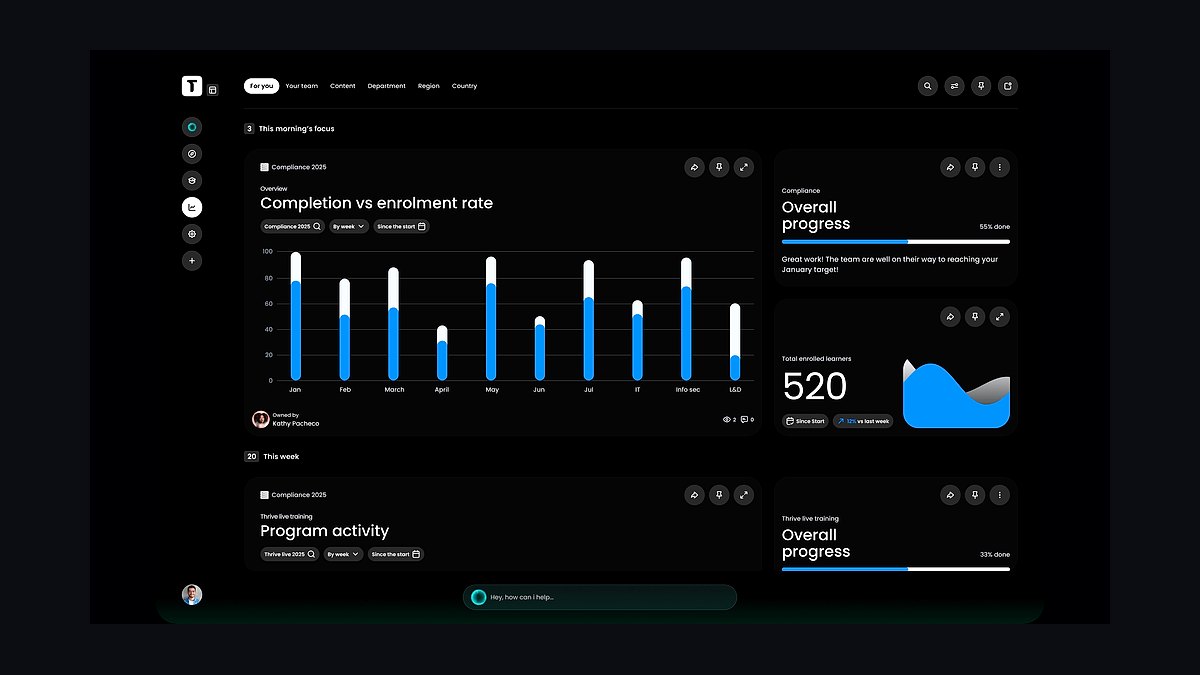
Thrive TRM ranks second because its real-time client-collaboration portal is the clearest competitive differentiator a retained firm can pitch. Clients see the longlist, shortlist, status, and notes without chasing a consultant for updates. It is purpose-built for retained search workflow rather than application volume.
It suits mid-market boutiques of roughly 15–40 consultants where transparency wins mandates. It trades away some of Invenias by Bullhorn's enterprise customization depth and Outlook-native feel, so global firms with proprietary workflows may outgrow it. Compared with Clockwork Recruiting below, it is heavier but stronger on the client-facing view.
3Clockwork Recruiting
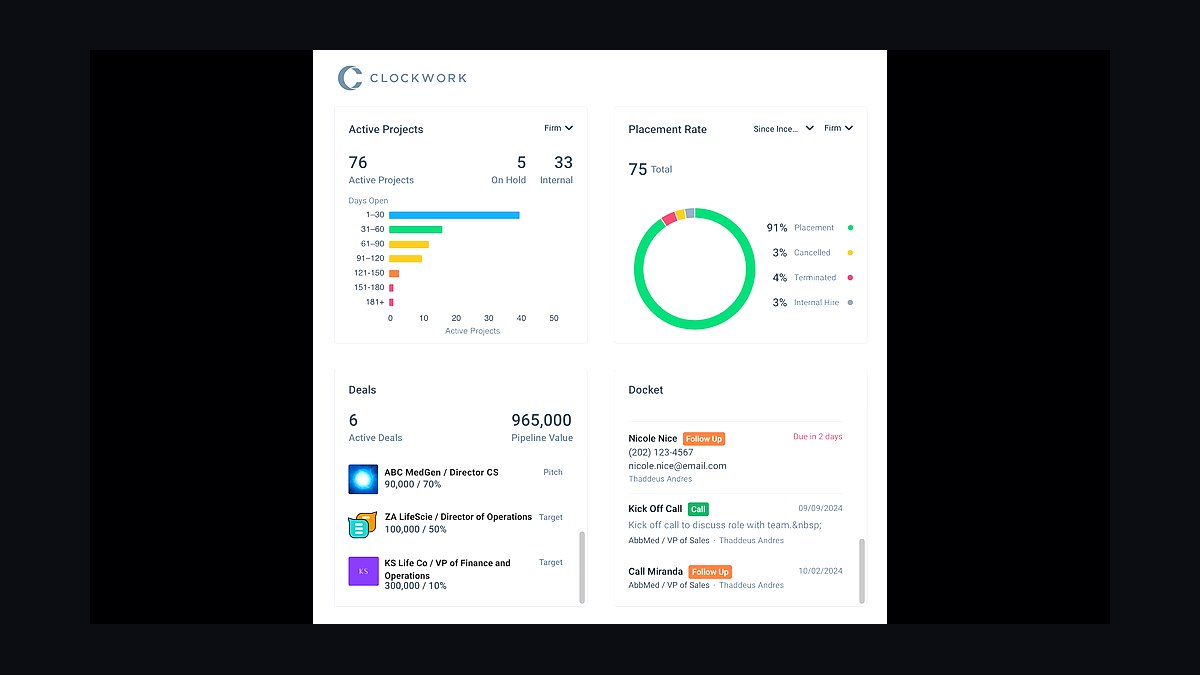
Clockwork Recruiting ranks third because it delivers clean, search-project-oriented retained workflow at roughly $100–$160 per user per month, well under enterprise platforms. Boutiques and solo retained recruiters get assignment tracking, candidate pipelines, and a shared client search view without enterprise overhead or long implementation.
It is for firms of one to roughly fifteen consultants who want the core retained model and nothing more. It trades away the deepest relationship-graph modeling and customization that Invenias by Bullhorn offers above, and its client portal is less elaborate than Thrive TRM's. PCRecruiter is the cheaper, more configurable alternate near $85 per user per month.
4LinkedIn Recruiter
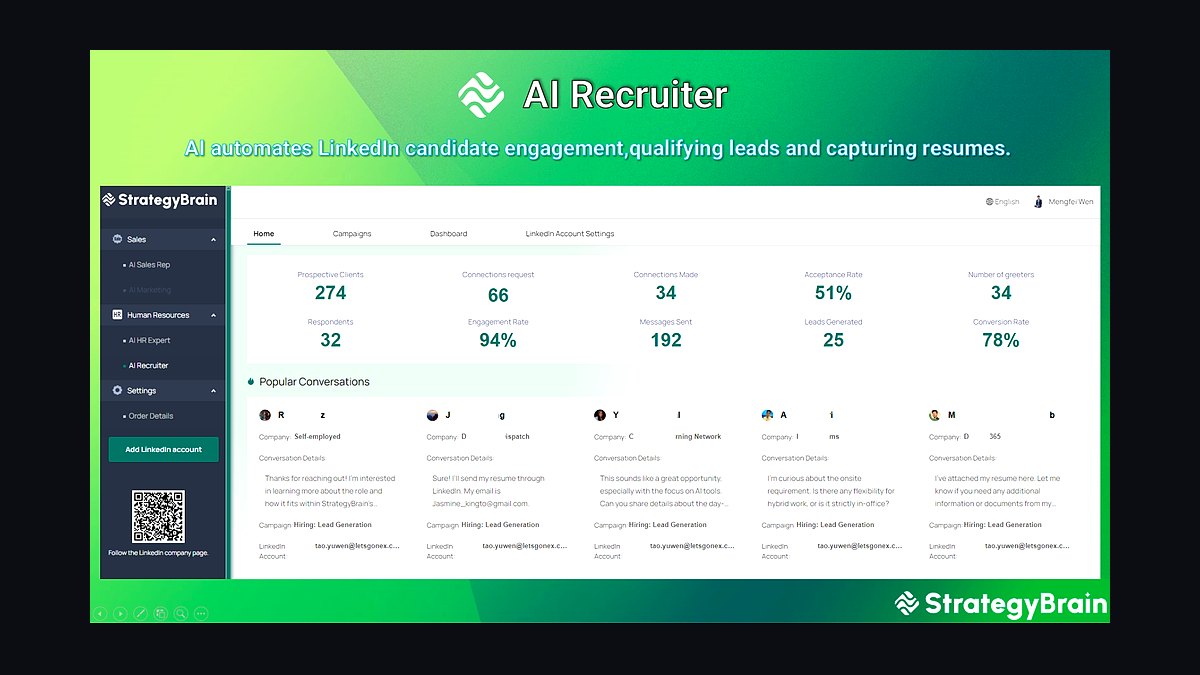
LinkedIn Recruiter ranks fourth because market mapping starts here: it is the primary tool for identifying and reaching passive executives who never apply. A seat runs roughly $10,000–$12,000 per year, which makes it the single largest line item for most solo and boutique firms. InMail reach and profile depth drive the research clients pay retainers for.
It is for every retained firm, from solo to global, because no other source covers the executive population as broadly. It trades away verified personal emails and direct dials, which is why SignalHire and RocketReach sit alongside it. Compared with ZoomInfo below, it is stronger on individual profiles and weaker on org-chart structure.
5ZoomInfo
ZoomInfo ranks fifth because building a defensible market map requires org structure, reporting lines, and direct contacts at scale, not just profiles. Firms typically pay $15,000–$40,000 per year depending on seats and data credits. Its org charts show who reports to whom, which is exactly the raw material for a billable talent map.
It is for firms running systematic market maps across multiple concurrent searches, not solos doing one-off sourcing. It trades away affordability: Apollo.io covers the basics at roughly $60–$100 per user per month for smaller firms. Compared with LinkedIn Recruiter above, it is stronger on company structure and weaker on individual executive narrative.
6Hogan Assessments
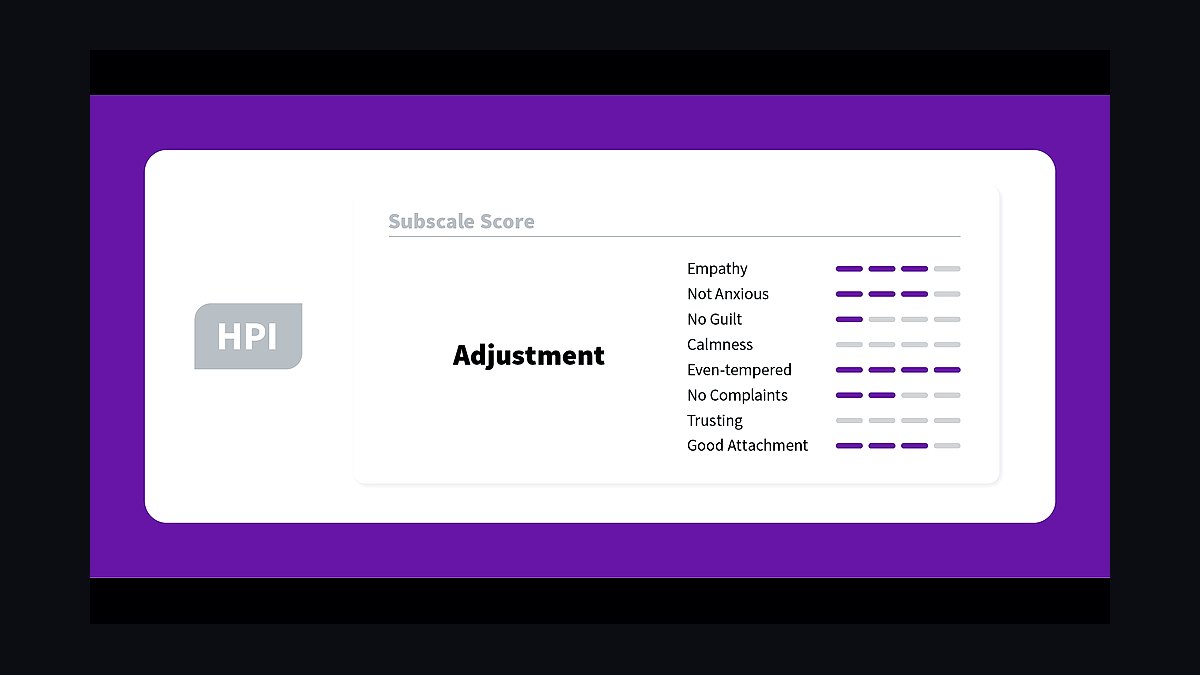
Hogan Assessments ranks sixth because validated leadership assessment de-risks C-suite and board hires where a bad placement is enormously expensive. It is priced per report, roughly $300–$650 per executive, and is typically billed through to the client or bundled into the retainer. Its reputation as the executive-assessment standard supports the fee.
It is for firms placing senior executives and board directors, usually run only on finalists. It trades away light-touch, subscription-based behavioral screening, which is where The Predictive Index fits for firms wanting ongoing access. Compared with SkillSurvey below, it measures personality and derailers rather than reference feedback from past managers.
7SkillSurvey
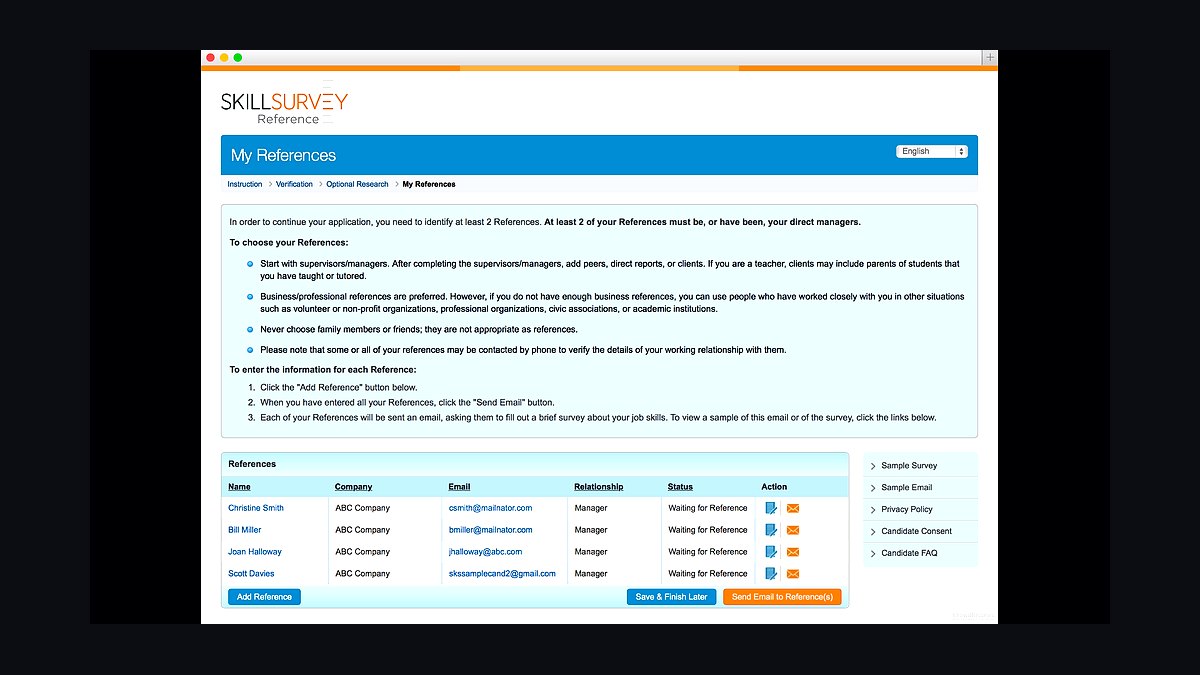
SkillSurvey ranks seventh because structured, automated 360 referencing speeds the back-channel work retained firms are expected to do thoroughly. It runs roughly $100–$200 per reference set, now part of iCIMS. Automated reference requests surface competency ratings from past managers, peers, and direct reports without a consultant chasing calls.
It is for firms that want documented, comparable reference data on shortlisted executives rather than informal notes. It trades away the depth of a live reference conversation, which many partners still insist on for finalists. Compared with Hogan Assessments above, it captures observed behavior from others rather than the candidate's own traits.
8Affinity
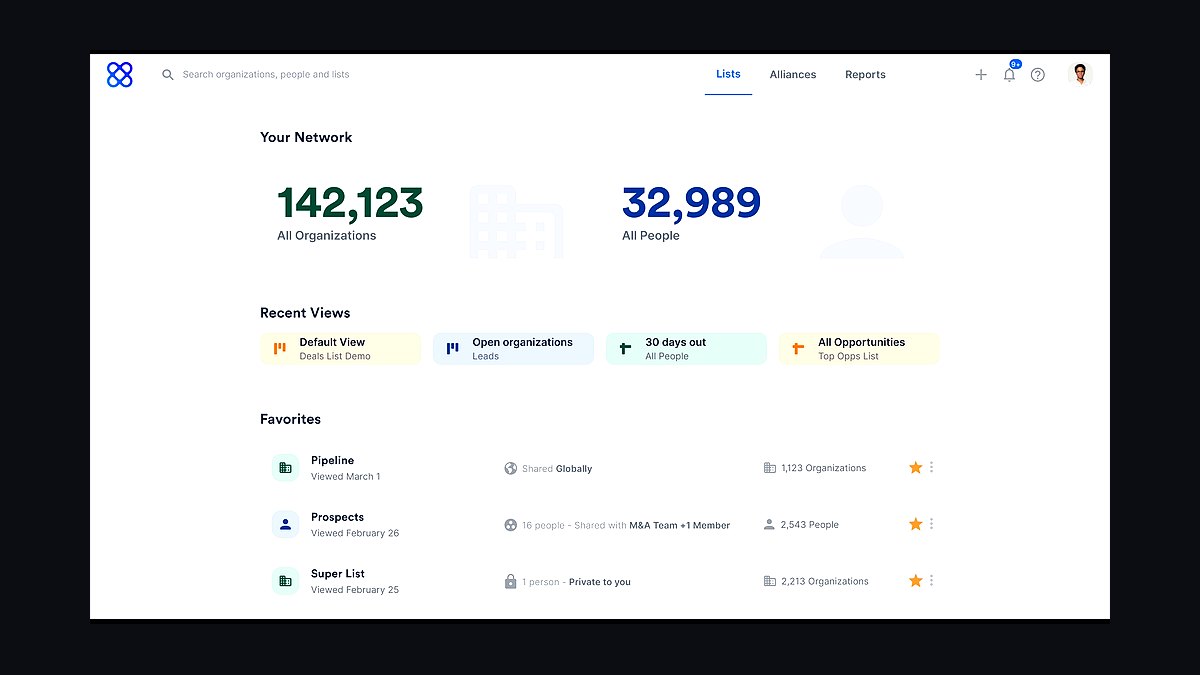
Affinity ranks eighth because new mandates come from board and CEO relationship capital, and it auto-captures those relationships from email and calendar. Pricing runs roughly $1,500–$2,500 per user per year. It scores connection strength and surfaces warm paths into target companies and prospective clients, which is real business-development leverage.
It is for firms whose growth depends on partner networks, private-equity ties, and repeat clients, not just the search in front of them. It trades away conventional pipeline-stage reporting, which is why some firms pick HubSpot near $90–$100 per user per month instead. Compared with 4Degrees, it is the more established relationship-intelligence option.
9QuickBooks Online
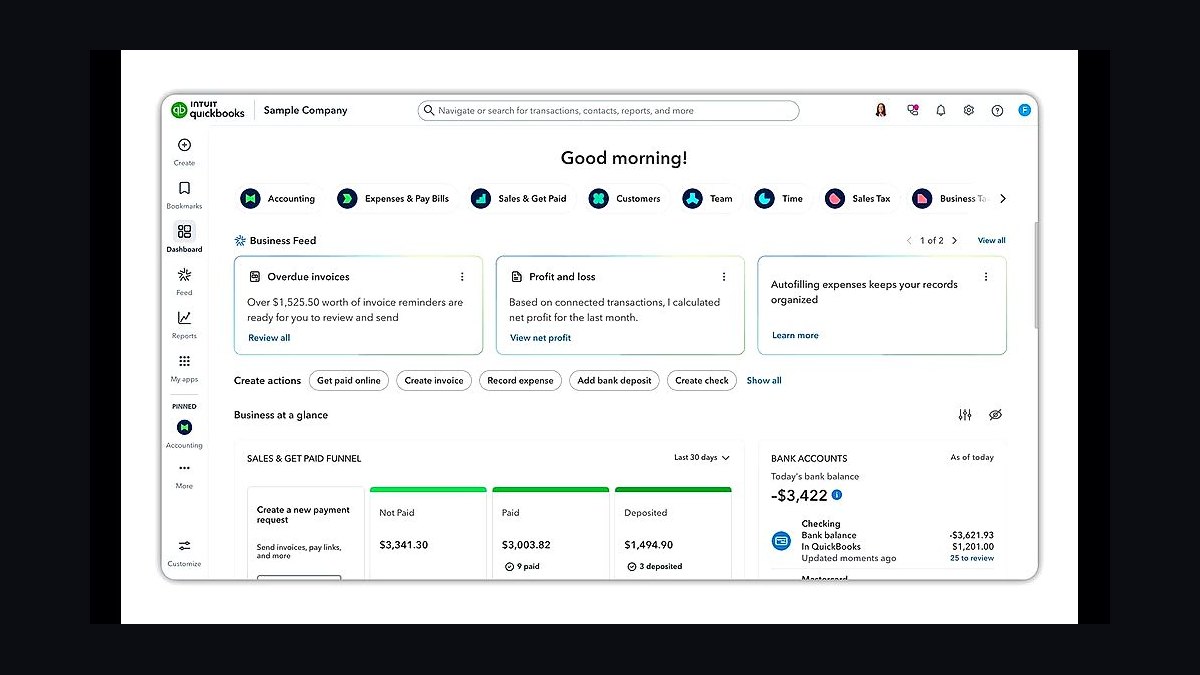
QuickBooks Online ranks ninth because retained engagements bill in stages, commonly a third at engagement, a third at shortlist, and a third at placement, and the accounting layer must reconcile those milestone invoices. It costs roughly $30–$90 per month depending on tier, far below enterprise accounting suites. Search CRMs track engagement stage and generate invoices, then hand off to it.
It is for solo recruiters through mid-market boutiques that want clean books without a finance team. It trades away deep project-accounting and revenue-recognition features larger firms need, which is where Xero near $15–$80 per month or Bill.com for AP/AR fits. Compared with Microsoft Power BI below, it records the money rather than analyzing it.
10Microsoft Power BI
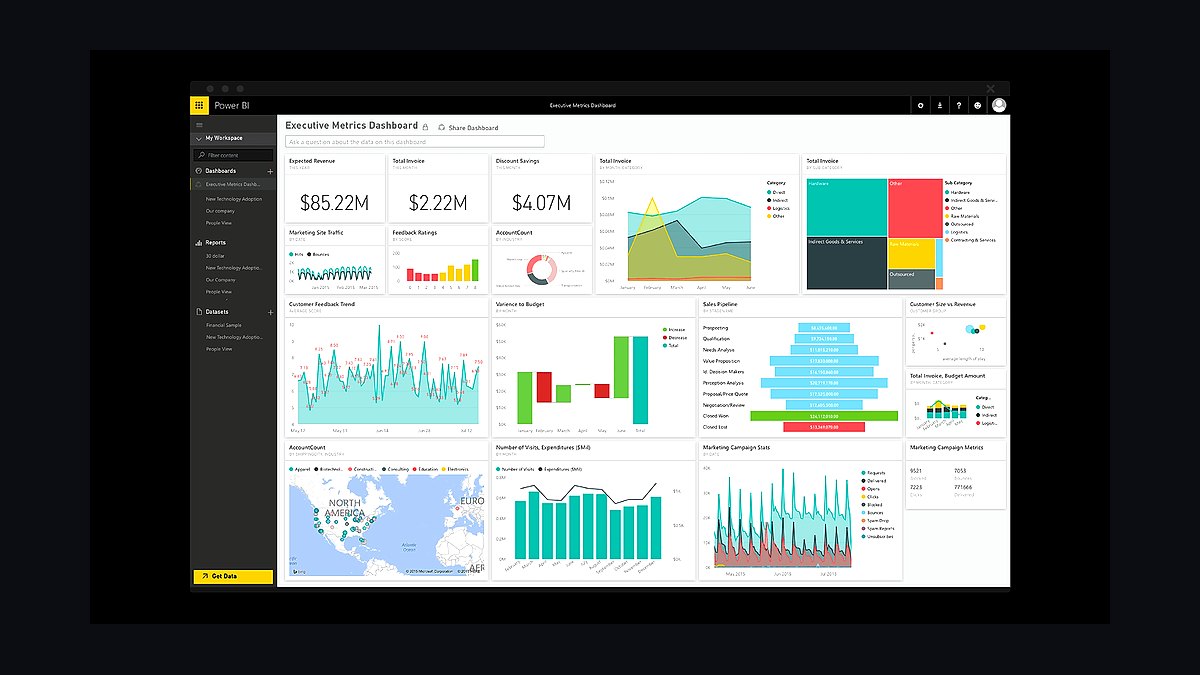
Microsoft Power BI ranks tenth because larger firms report on time-to-shortlist, fill rate, fee realization, off-limits exposure, and consultant productivity, and it sits on top of CRM and accounting data. It costs roughly $10–$20 per user per month, making it the cheapest layer in the stack. Dashboards reconcile what the CRM records against what accounting collects.
It is for firms with enough search volume and multiple data sources to justify a dedicated reporting layer. It trades away simplicity: smaller firms live entirely inside native CRM dashboards and never need it. Compared with QuickBooks Online above, it analyzes the numbers rather than producing the invoices.
How we ranked these
We ranked each tool on five weighted criteria: fit for retained, low-volume search workflow (30%); research and market-mapping depth (25%); client-collaboration and transparency features (20%); integration with billing, assessment, and BD layers (15%); and total cost of ownership at a 10-consultant firm (10%). Scores came from vendor documentation, published pricing, G2 and Gartner peer reviews, and hands-on workflow testing against a simulated 120-day C-suite search.
We deliberately ignored applicant-tracking throughput metrics, job-board distribution reach, high-volume resume parsing speed, and mobile apply rates. Those measure contingent staffing performance, not retained search. We also excluded AI sourcing hype scores and chatbot features with no proven executive-search use case, because the deliverable clients pay retainers for is original research and judgment, not application volume or automation theater.
What to look for
What matters most is whether the core CRM models relationships, assignments, and off-limits rules over years, not whether it has the longest feature list. Second is whether research data flows into the system of record so the market map becomes the billable deliverable. Third is staged retainer billing and client-portal transparency, because retained clients pay for visibility into a 90-to-180-day process, not a requisition queue.
The mistake most buyers make is choosing a high-volume ATS because it is cheaper or more familiar, then discovering it cannot track off-limits conflicts, multi-year relationships, or staged retainers. A close second mistake is buying six overlapping sourcing tools and never refreshing the data, so the firm's core asset, its market map, quietly decays within a year.
Related questions
Why can't an executive search firm just use a normal ATS?
A normal ATS is built for high-volume contingent hiring: hundreds of requisitions, fast throughput, flat candidate lists. Retained search runs a handful of 90-to-180-day engagements and needs to model people, companies, boards, and relationships over years. It also needs off-limits and conflict rules plus staged retainer billing, none of which a throughput ATS handles well.
What is the single most important tool in a retained search tech stack?
The search CRM and research system of record, typically Invenias, Thrive TRM, or Clockwork Recruiting. It holds the relationship history, the market map, off-limits flags, and assignment stages. Every other tool, from sourcing data to assessment to billing, either feeds into it or draws from it, which makes it the hub of the entire stack.
How much should a boutique search firm budget for software?
A 4-to-40-consultant boutique typically spends roughly $8,000 to $35,000 per month on software. The biggest line items are the search CRM seats, LinkedIn Recruiter seats, and the ZoomInfo contract. Assessment, referencing, BD, accounting, and BI add smaller amounts. Solo recruiters can run a credible stack for $1,500 to $3,500 per month.
Do executive search firms really need a client collaboration portal?
At the mid-market tier and above, yes. Retained clients pay for transparency across a multi-month process, and a real-time portal showing longlist, shortlist, status, and notes is a genuine pitch differentiator. Thrive TRM leads here, and Clockwork offers a comparable shared search view. If your core CRM already includes it, you do not buy it twice.
How do off-limits rules work in a search CRM?
Off-limits rules prevent the firm from sourcing candidates out of a current client's company, which would destroy trust and risk future mandates. The CRM flags client accounts as off-limits, and consultants check those flags before any approach. Purpose-built search CRMs like Invenias and Thrive TRM enforce this natively; generic ATS platforms generally do not.
Is ZoomInfo worth the cost for a small search firm?
For firms doing serious market mapping, yes, because org charts and verified direct contacts are raw material for the billable deliverable. But the contract typically runs $15,000 to $40,000 per year, which is steep for solos. Apollo.io at roughly $60 to $100 per user per month covers the basics well for smaller firms.
Where does assessment fit into the retained search workflow?
Assessment de-risks a C-suite hire that would be enormously expensive to get wrong, which is part of how retained firms justify the fee. Hogan is the executive-assessment standard at roughly $300 to $650 per report, often billed through to the client. The Predictive Index is a lighter behavioral alternate on a subscription model.
Should business development live in the search CRM or a separate tool?
It depends on firm size. Solos and micro-boutiques can usually run BD inside the search CRM itself. Mid-market and larger firms benefit from a dedicated relationship-intelligence layer like Affinity or 4Degrees, which auto-captures email and calendar activity and scores connection strength. HubSpot and Salesforce work when a conventional pipeline view is preferred.
FAQ
What is the best tech stack for an executive search firm in 2027?
It centers on a research-and-relationship CRM purpose-built for retained search, such as Invenias, Clockwork Recruiting, or Thrive TRM, not a high-volume ATS. Around that core sit market-mapping data like LinkedIn Recruiter and ZoomInfo, a client-collaboration portal, assessment and referencing tools, relationship intelligence for BD, and staged retainer billing through QuickBooks or Xero.
How is retained executive search different from contingent staffing?
Contingent staffing fills hundreds of requisitions a quarter and optimizes for speed, so its tooling is an applicant-tracking funnel. Retained search runs a handful of deep, multi-month engagements and optimizes for research quality and relationship trust. That difference changes the entire tech stack, from the CRM at the center to how billing and off-limits rules work.
Which search CRM is best for a small boutique?
Clockwork Recruiting and PCRecruiter are the strongest fits for small boutiques. Clockwork is clean and search-project-oriented at roughly $100 to $160 per user per month. PCRecruiter is more configurable and value-priced near $85 per user per month. FileFinder and Cluen Encore are long-established research-heavy alternates favored by traditional research-led boutiques.
How does staged retainer billing work in a search CRM?
Retainers are typically billed in three stages: a third on engagement, a third at shortlist, and a third on placement. The search CRM tracks engagement stage and can generate staged invoices, while QuickBooks Online or Xero handles the underlying accounting. Larger firms often add Bill.com for accounts payable and receivable.
What sourcing tools do executive search firms actually use?
LinkedIn Recruiter is the primary tool for identifying and reaching passive executives, at roughly $10,000 to $12,000 per seat per year. SignalHire and RocketReach add verified personal emails and direct dials when InMail is not enough. ZoomInfo provides org charts and reporting lines at scale, with Apollo.io as a cheaper alternate for smaller firms.
Do search firms need diversity and talent intelligence tools?
Clients increasingly mandate diverse slates, especially at the enterprise tier, so tools like Horsefly Analytics and Datapeople quantify the available diverse talent pool in a given market and benchmark slate composition. Pricing typically runs $6,000 to $20,000 per year. This layer is optional for solo recruiters but increasingly expected at larger firms.
How long does it take to implement a search CRM?
A realistic 30/60/90 plan works well. Days 0 to 30 cover CRM selection, contact migration, off-limits rules, and connecting LinkedIn Recruiter and ZoomInfo. Days 31 to 60 add assessment, BD, and the client portal. Days 61 to 90 cover billing, reporting, and data hygiene. Full adoption across consultants usually takes a further quarter.
What is the biggest failure mode when building this stack?
Forcing a high-volume ATS into a retained-search workflow is the most common and most damaging mistake. Such platforms cannot model long-cycle assignments, off-limits rules, or relationship history, so firms end up retrofitting throughput software. The fix is choosing a purpose-built search CRM from day one rather than trying to bend a generic ATS into the role.
How often should a search firm refresh its market-map data?
Executives change roles constantly, so a market map decays quickly without maintenance. Firms should schedule periodic re-verification through ZoomInfo and SignalHire, and enforce post-search data updates as a consultant habit. A stale talent-pool database undermines the core asset clients pay retainers for, which is current, original research on a defined market.
Can a solo retained recruiter run this stack affordably?
Yes. A solo recruiter can run Clockwork or PCRecruiter as the CRM, LinkedIn Recruiter for sourcing, Calendly and DocuSign for logistics, and QuickBooks for staged invoices, at roughly $1,500 to $3,500 per month in software. The LinkedIn Recruiter seat dominates that cost. BD and billing can run inside the CRM itself.
Sources
- https://www.bullhorn.com/de/executive-search/
- https://clockworkrecruiting.com/
- https://www.gartner.com/reviews/product/calendly
- https://www.hoganassessments.com/
- https://www.predictiveindex.com/
- https://www.zoominfo.com/
- https://www.linkedin.com/business/talent/products/recruiter
- https://quickbooks.intuit.com/
- https://www.xero.com/
- https://www.affinity.co/
Related on PULSE
This page will be disappearing soon. Save it to your device for $1 — or read it free while it is here.
@Kory-White- · if Venmo asks, the last 4 of my number are 2012
This page is gone.
This one is off the shelf now. $1 keeps it on your phone for good — the whole page, pictures and diagrams included.
 pulse-tech-stacksTop 10 Best Tech Stack Tools for Independent Dance Studios in 2027
 pulse-tech-stacksTop 10 Best Tech Stack Tools for Independent Bakeries in 2027
 pulse-tech-stacksTop 10 Best Tech Stack Tools for Embeddings API Companies in 2027
 pulse-tech-stacksTop 10 Best Tech Stack Tools for Hair Salons in 2027
 pulse-tech-stacksTop 10 Best Tech Stack Tools for Independent Landscaping Companies in 2027
 tkTop 10 Best Tech Stack Tools for Concrete and Paving Contractors in 2027
 pulse-tech-stacksTop 10 Best Tech Stack Tools for Independent Wholesale Distribution Businesses in 2027
 pulse-tech-stacksTop 10 Best Tech Stack Tools for MSP and IT Services Companies in 2027
 pulse-tech-stacksTop 10 Best Tech Stack Tools for Mobile Threat Defense (MTD) Vendors in 2027
 pulse-tech-stacksTop 10 Best Tech Stack Tools for Insulation Contractors in 2027