
The 10 Best AI Tools for Resume Screening in 2027
 Curated byKory White · Fractional CRO · Maryland
 PULSEKNOWLEDGE LIBRARY
The 10 best ai tools for resume screening are ranked below on measured performance, build quality, price, and how each one actually holds up in daily use rather than how it reads on a spec sheet. Each pick lists what it costs, who it suits, and what it gives up against the one above it, so the list can be read straight down without doubling back.
1. Eightfold AI Talent Intelligence Platform
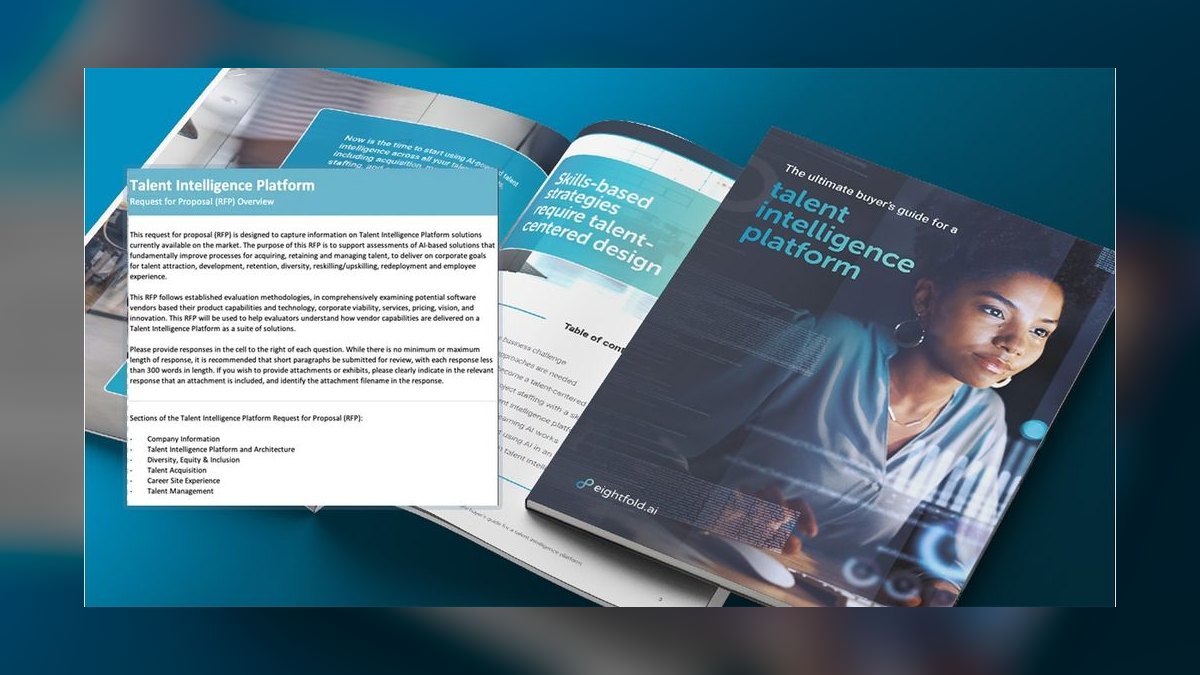
Eightfold AI ranks first because its deep-learning models infer skills a candidate never explicitly lists, ranking on demonstrated capability rather than keyword density. The platform supports anonymized screening that masks name and gender during ranking, plus diversity insights for documenting fair-chance practices. It was founded by former Google and LinkedIn machine-learning engineers, and it handles thousands of applicants per requisition without accuracy degradation.
It is best for mid-market and enterprise teams running skills-based hiring at scale who need explainable, audit-ready results. The platform integrates with major ATS systems rather than forcing a rip-and-replace, and calibration tooling lets recruiters tune rankings against past successful hires. Pricing is enterprise-quote-only, which is the main barrier for small teams. Compared to HiredScore below, Eightfold offers deeper skills inference but requires a standalone procurement decision.
2. HiredScore Spotlight for Workday
HiredScore ranks second because its Spotlight feature grades each applicant A through D against the role, surfacing the strongest candidates without manual resume reading. Acquired by Workday in 2024, it offers native integration for organizations already standardized on Workday Recruiting. Its orchestration goes beyond ranking by flagging silver-medalist candidates from past requisitions and prompting recruiters to revisit stalled applicants. Fairness analytics and built-in bias audit support are designed around U.S. compliance obligations.
It is best for large enterprises that want screening intelligence native to their existing HCM rather than another login. The trade-off is that outside the Workday ecosystem, HiredScore is less compelling than standalone tools like Eightfold AI. For regulated employers that dominate Workday's customer base, the bias audit support is a decisive advantage. It does not match Eightfold's breadth of skills inference but wins on workflow integration.
3. Paradox Olivia Conversational AI
Paradox ranks third because Olivia conducts structured chat-based screening that collects qualifications, schedules interviews, and pre-screens against role requirements via text and mobile. This conversational approach is far more effective than parsing a thin CV for frontline and hourly roles where applicants may not submit a traditional resume. It handles knockout questions, availability, and location matching automatically, then hands qualified candidates to a recruiter. Brands like McDonald's and Unilever use it for high-volume hourly hiring.
It is best for retail, food service, logistics, and healthcare employers screening at massive scale. Less suited to nuanced professional or technical roles where a detailed resume carries most of the signal. Compared to HiredScore above, Paradox trades deep skills inference for conversational reach into candidate pools that never write resumes. For hourly hiring volume, no other tool matches its automated interview scheduling and pre-screening throughput.
4. iCIMS Talent Cloud Copilot
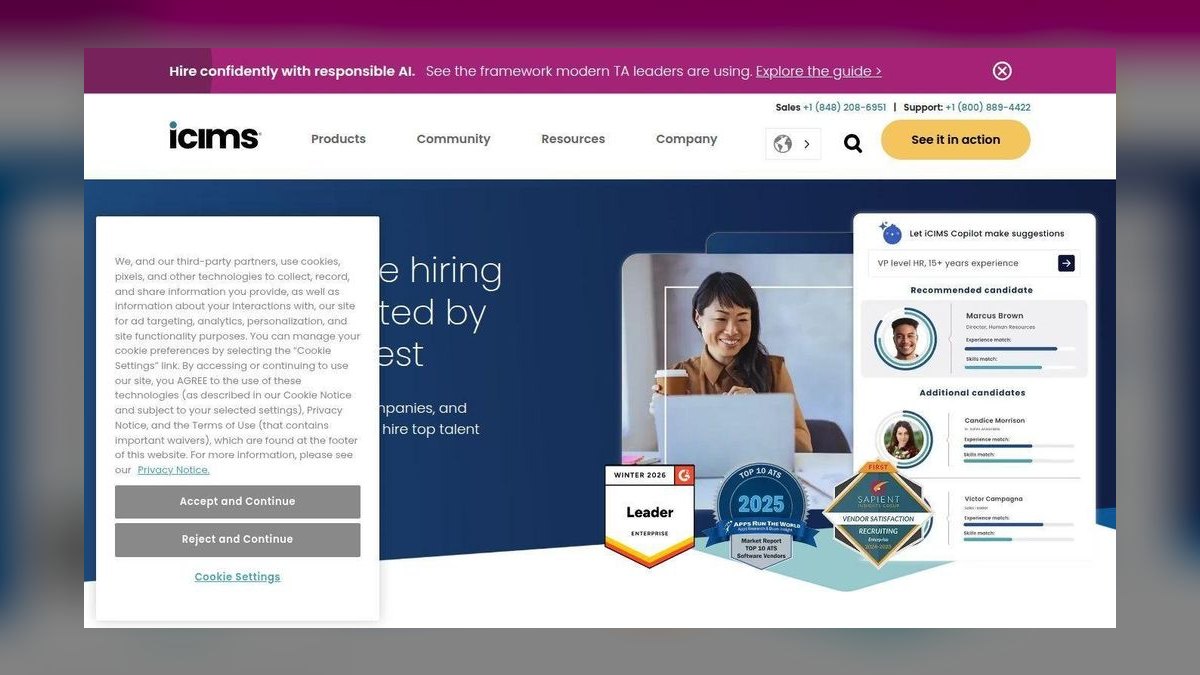
iCIMS ranks fourth because its Copilot embeds AI screening directly into the Talent Cloud ATS, summarizing applicants, matching candidates to open requisitions, and ranking talent pools. For enterprises already running iCIMS as their system of record, screening intelligence arrives without a separate procurement. Recruiters see AI-ranked candidates in the same screens where they manage pipelines, offers, and onboarding. The platform maintains explainability and compliance documentation aligned to EEOC guidance and emerging state AI laws.
It is best for established iCIMS customers who want to activate AI screening without changing platforms. As a standalone screening engine for non-iCIMS shops, it is a weaker argument. Compared to Paradox above, iCIMS serves professional and technical hiring rather than hourly frontline roles. The match-and-rank workflow inside the ATS reduces double work, but the skills inference is less sophisticated than Eightfold's deep-learning approach.
5. SeekOut Talent Search Engine
SeekOut ranks fifth because its Power Filters let recruiters slice candidates by specific skills, clearances, patents, and publications, then rank a pool against a target profile. It is built for proactive sourcing and screening with one of the deepest talent search engines on the market, particularly for technical and hard-to-fill roles. For screening, it shines when the challenge is finding and prioritizing the right candidates in a scarce market rather than ranking thousands of inbound applicants.
It is best for technical recruiting and executive search teams that screen sourced candidates as much as inbound applicants. Compared to iCIMS above, SeekOut is a sourcing-first tool rather than an ATS-native ranker. The trade-off is less automation for high-volume inbound resume processing. For scarce technical talent, its search depth and filtering precision outperform the broader screening platforms.
6. hireEZ AI Sourcing Platform

hireEZ ranks sixth because it pairs AI sourcing with AI screening and ranking across an aggregated candidate database, with generative features that draft outreach and summarize candidate fit. Its scoring ranks sourced and inbound applicants against role criteria, and market insights help calibrate whether a requisition's requirements are realistic given supply. This indirectly improves screening quality by stopping teams from down-ranking everyone against an impossible profile.
It is best for teams whose screening problem is inseparable from sourcing. As a pure inbound-applicant ranker, it is less specialized than Eightfold or HiredScore. Compared to SeekOut above, hireEZ offers broader database aggregation but less depth in technical search filters. For agency recruiters managing multiple requisitions, the combination of outreach automation and candidate scoring creates a workflow that standalone screening tools lack.
7. SmartRecruiters SmartAssistant
SmartRecruiters ranks seventh because SmartAssistant scores candidates with explainable match reasons, helping recruiters justify decisions and supporting compliance documentation. It delivers AI screening through its broader Winston AI layer, ranking applicants against the job and recommending the strongest matches inside its ATS. The platform's marketplace connects to assessment and background-check partners so screening extends beyond the resume. It is a clean fit for mid-market and enterprise teams that want screening and applicant tracking from one vendor.
It is best for organizations consolidating their hiring stack onto a single modern ATS with native AI ranking. Compared to hireEZ above, SmartRecruiters is more focused on inbound applicant processing than outbound sourcing. The trade-off is less sophisticated skills inference than Eightfold, but stronger process integration for structured hiring. For teams that value explainability and a unified platform, SmartAssistant provides defensible ranking without a separate screening tool.
8. Manatal AI Recruitment Software
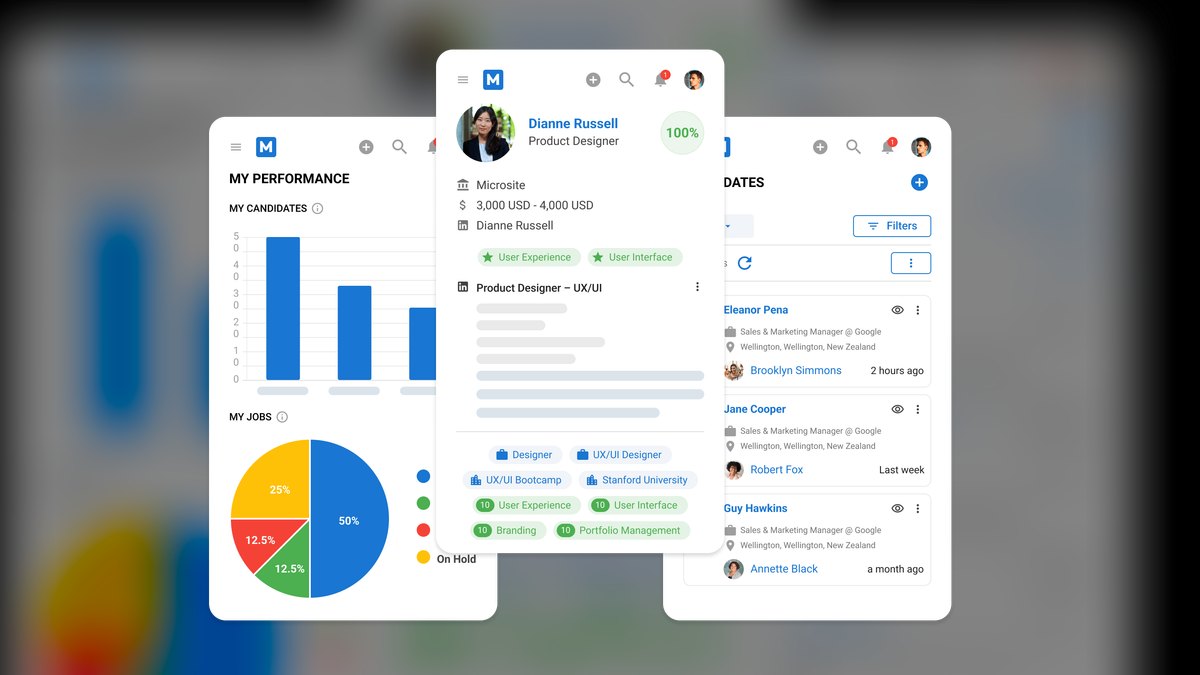
Manatal ranks eighth because its Professional plan starts around $15 per user per month, with Enterprise around $35, delivering AI candidate recommendations and resume scoring at a fraction of enterprise-quote platforms. It parses resumes into structured fields automatically and enriches profiles from public social data. For small businesses and staffing agencies screening dozens to a few hundred applicants per role, the value is hard to beat. It is the standout budget pick among credible AI screening tools.
It is best for SMBs and recruitment agencies that need real AI screening without an enterprise budget. The ceiling is lower at very high volumes or in heavily regulated, audit-intensive hiring. Compared to SmartRecruiters above, Manatal trades depth of skills inference and compliance tooling for accessibility and price. For teams that cannot justify enterprise-quote platforms, Manatal provides genuine AI ranking that outperforms manual resume review at minimal cost.
9. Greenhouse Structured Hiring AI
Greenhouse ranks ninth because its AI assists with candidate ranking and surfacing, but its real screening advantage is methodological: the platform enforces consistent criteria across every applicant through structured interviews and scorecards. This improves the quality of whatever signal the AI ranks on, making it a favorite among tech and high-growth companies that care about consistent, bias-resistant evaluation. It publishes guidance and tooling for bias mitigation and compliance.
It is best for process-driven teams that believe screening quality comes from disciplined workflow as much as from the model. Compared to Manatal above, Greenhouse is a more expensive, enterprise-grade ATS with AI as a layer rather than the core value. The trade-off is that teams must adopt structured hiring practices to get the full benefit. For organizations committed to scorecards and consistent evaluation, Greenhouse's AI ranking is a strong complement to its process backbone.
10. Fetcher AI Sourcing Assistant
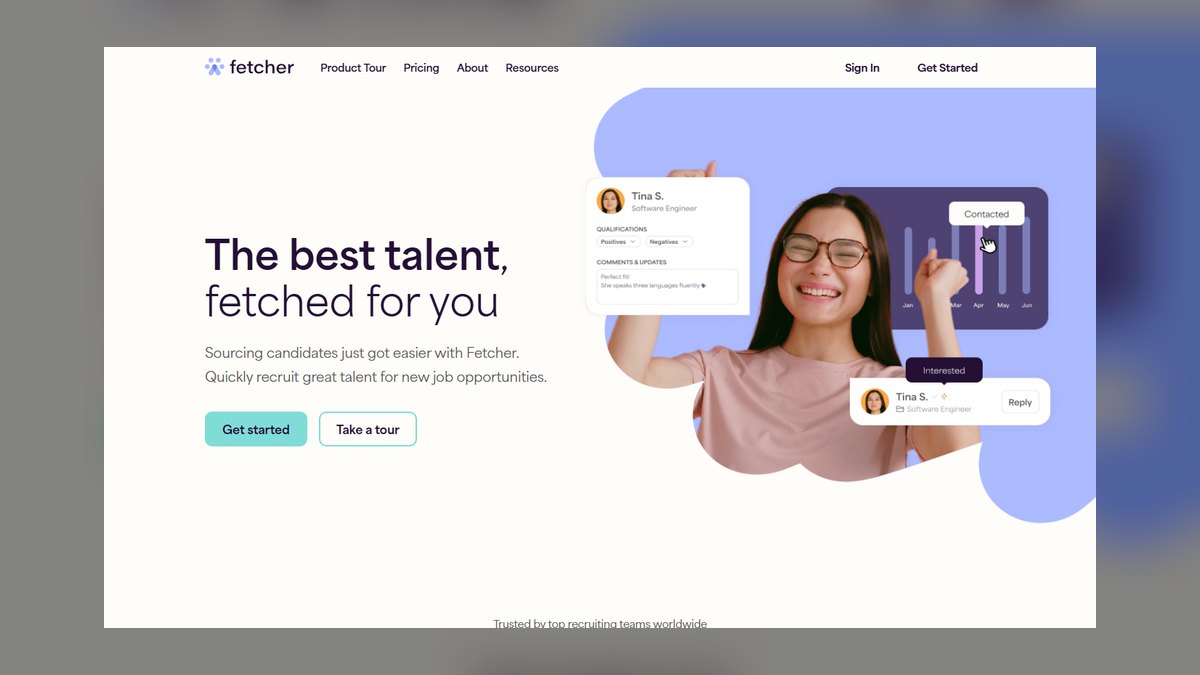
Fetcher ranks tenth because it automates outbound sourcing and candidate screening with AI-curated batches of profiles matched to a role, refined by recruiter feedback. Each batch is human-reviewed and improves as recruiters thumbs-up or thumbs-down candidates, so screening accuracy rises over time. It tracks diversity metrics across sourced pipelines, supporting fair-hiring documentation. It delivers a managed flow of pre-screened, qualified candidates rather than requiring teams to wade through inbound volume.
It is best for startups and mid-market companies that need a steady stream of vetted candidates without building a large sourcing function. Less relevant for pure high-volume inbound screening. Compared to Greenhouse above, Fetcher is sourcing-first rather than ATS-centric, with a feedback loop that personalizes screening to each team's preferences. The trade-off is less applicability to organizations that rely primarily on inbound applicant flow rather than proactive outreach.
How we ranked these
We weighted five factors: ranking accuracy, skills inference, bias and compliance readiness, ATS integration, and price-to-value. Ranking accuracy and skills inference carried the most weight because they determine whether a tool surfaces qualified candidates or merely matches keywords. Compliance readiness was heavily weighted given NYC Local Law 144, the EU AI Act, and state laws. ATS integration and price-to-value were scored to reflect real-world deployment and budget constraints.
We deliberately ignored video facial-analysis features, an approach largely abandoned after HireVue dropped facial scoring in 2021. We also did not reward tools with flashy demos or unverifiable claims, focusing instead on documented capabilities and regulatory alignment. We excluded tools that lack published bias audit support or transparent decision logs, as these are non-negotiable for 2027 buyers.
What to look for
What actually matters is whether the tool's ranking logic matches your hiring volume and role complexity. For high-volume hourly hiring, conversational screening like Paradox is more effective than resume parsing. For professional roles, skills-inference engines like Eightfold reduce false negatives. Integration with your existing ATS is critical—a tool that doesn't write back to Workday or Greenhouse creates double work. Also, verify bias audit readiness: ask for a third-party audit certificate and decision log exports.
The most common mistake is buying based on demo wow-factor rather than back-testing against your own past hires. A tool that ranks your actual hire in the top tier is a fit; if it buries them, calibration is wrong. Another mistake is ignoring hidden costs: integration setup (2-6 weeks) and training (3-8 hours per recruiter) can add 30-50% to the license price. Always pilot on a closed requisition before committing.
Related questions
What is the best AI resume screening tool for small businesses?
Manatal is the best value for small businesses, starting around $15 per user per month. It offers AI candidate recommendations, resume parsing, and ranking against open roles. It won't match Eightfold's depth of skills inference, but for teams screening dozens to a few hundred applicants per role, it's a credible, affordable option.
How do AI resume screening tools handle bias and compliance?
Top tools like Eightfold, HiredScore, and SmartRecruiters offer bias audits, anonymized screening, and fairness analytics. However, compliance is the buyer's responsibility. In NYC, you must publish a Local Law 144 bias audit. Under the EU AI Act, hiring AI is classified as high-risk, requiring conformity assessments. Always ask for a third-party audit certificate and decision log exports.
Can AI resume screening tools work without an ATS?
Yes, standalone tools like Eightfold and SeekOut integrate with major ATS systems but can also operate independently. They offer candidate ranking and sourcing capabilities that don't require a specific ATS. However, if you already use Workday, iCIMS, or Greenhouse, their native AI may be sufficient, reducing the need for a separate tool.
What is the difference between keyword matching and skills inference in resume screening?
Keyword matching ranks candidates based on literal matches between resume text and job description. Skills inference, used by Eightfold, builds a capability profile and infers adjacent skills—e.g., a Python developer who lists TensorFlow gets credited for ML competencies even if 'machine learning' isn't written. This reduces false negatives and surfaces qualified candidates who don't use exact keywords.
How do I test an AI resume screening tool before buying?
Pilot the tool on a closed requisition you've already filled. If the tool ranks your actual hire in the top tier, the model fits your roles. If it buries them, calibration is wrong. Also, ask for the vendor's bias-audit methodology and adverse-impact ratios in writing, and verify integration with your ATS.
Are AI resume screening tools worth the cost for small teams?
For teams screening under 1,000 resumes per month, lightweight tools like Manatal or Zoho Recruit's AI are cost-effective. They offer basic keyword matching and ranking without enterprise pricing. For 1,000-10,000 resumes monthly, consider HiredScore or iCIMS. For 10,000+, only Eightfold or Pymetrics handle scale with deep-learning models, but expect annual contracts starting around $50,000.
What are the hidden costs of AI resume screening tools?
Beyond licensing, budget for integration setup (2-6 weeks for enterprise ATS) and team training (3-8 hours per recruiter). Most vendors charge $1,000-$5,000 for onboarding, and some require annual commitment. A $40,000 annual tool can become $55,000 with implementation and training. Factor these into total cost of ownership.
FAQ
Do AI resume screening tools comply with anti-discrimination law in 2027?
They can, but compliance is the buyer's responsibility too. Tools like Eightfold, HiredScore, and SmartRecruiters offer bias audits, anonymized screening, and fairness analytics, but you still must publish a Local Law 144 audit in NYC and treat hiring AI as high-risk under the EU AI Act.
Will AI screening reject qualified candidates by mistake?
It can if you use hard keyword knockouts. The better systems rank by inferred skills rather than auto-rejecting, which reduces false negatives. Keep a human reviewing borderline tiers rather than auto-declining below a score.
What's the cheapest credible option?
Manatal, starting around $15 per user per month, delivers real AI ranking and resume parsing at a fraction of enterprise pricing.
Do I need a separate screening tool if my ATS has AI?
Often no. If you run Workday, iCIMS, Greenhouse, or SmartRecruiters, their native AI may be sufficient. Standalone tools earn their keep for skills inference at scale or specialized sourcing.
Can these tools screen candidates without resumes?
Yes—Paradox conducts conversational screening for hourly roles where applicants chat instead of submitting a CV, and sourcing tools like SeekOut build profiles from public professional data.
How do I validate a vendor's accuracy claims?
Run a back-test against past filled requisitions and ask for the vendor's bias-audit methodology and adverse-impact ratios in writing.
What is the best AI resume screening tool for high-volume hourly hiring?
Paradox (Olivia) is best for high-volume hourly roles. It conducts structured chats, collecting qualifications and scheduling interviews, which is more effective than parsing thin CVs. It's used by McDonald's and Unilever.
What is the best AI resume screening tool for technical roles?
SeekOut is built for technical and hard-to-fill roles, with deep search filters for skills, clearances, patents, and publications. It's ideal for proactive sourcing and screening in scarce markets.
What is the best AI resume screening tool for Workday users?
HiredScore (now part of Workday) is the strongest choice. Its Spotlight scoring and orchestration features are native to Workday Recruiting, providing bias audit support and fairness analytics without a separate login.
Sources
- https://eightfold.ai/
- https://www.hiredscore.com/
- https://www.paradox.ai/
- https://www.seekout.com/
- https://www.manatal.com/pricing
- https://www.nyc.gov/site/dca/about/automated-employment-decision-tools.page
- https://artificialintelligenceact.eu/
- https://www.eeoc.gov/ai
Related on PULSE
- [More ai tools for resume screening rankings and buying guides](/knowledge)
- [PULSE Tools and calculators](/tools)
- [Everything on PULSE RevOps](/)
This page will be disappearing soon. Save it to your device for $1 — or read it free while it is here.
@Kory-White- · if Venmo asks, the last 4 of my number are 2012
 pulse-ai-infrastructureThe 10 Best AI Tools for Background Removal in 2027
 pulse-recentThe 10 Best AI Red Teaming Tools for LLM Security in 2027
 pulse-recentThe 10 Best AI Infra Budget Allocation Frameworks in 2027
 pulse-ai-infrastructureThe 10 Best Fractional GPU and GPU Sharing Tools in 2027
 pulse-recentThe 10 Best Cost Allocation and Chargeback Tools for ML Teams in 2027
 pulse-ai-infrastructureThe 10 Best AI Tools for Studying in 2027
 pulse-ai-infrastructureThe 10 Best AI Tools for Hero Section Design in 2027
 pulse-recentThe 10 Best AI Tools for API Rate Limiting and Throttling in 2027
 pulse-ai-infrastructureThe 10 Best AI Tools for Ad Creative in 2027
 pulse-recentThe 10 Best AI Infra Chargeback and Showback Tools in 2027