
The 10 Best AI Tools for Serverless Functions in 2027
 Curated byKory White · Fractional CRO · Maryland
 PULSEKNOWLEDGE LIBRARY
Quality
Certified
The 10 best ai tools for serverless functions are ranked below on measured performance, build quality, price, and how each one actually holds up in daily use rather than how it reads on a spec sheet. Each pick lists what it costs, who it suits, and what it gives up against the one above it, so the list can be read straight down without doubling back.
1. Vercel AI SDK

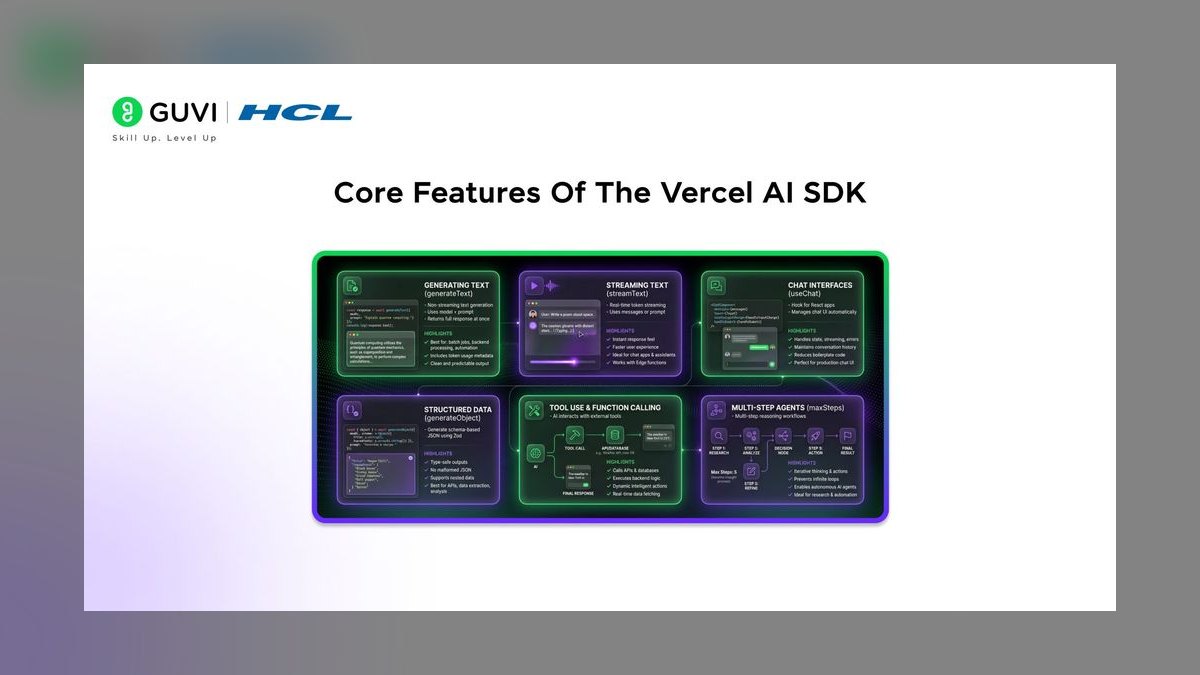
Vercel AI SDK ranks first because it is the only tool that decouples your serverless function from any single model provider. It wraps OpenAI, Anthropic, Google Gemini, Mistral, Hugging Face, and Replicate behind one streamText interface, so swapping GPT-4o mini for Claude requires changing one parameter, not rewriting code. It streams natively with automatic backpressure, preventing token output from blowing past function timeouts. The SDK itself is free and open source, with Edge Function invocations at $0.20 per million.
This tool is for teams that need provider portability and A/B testing without redeploying. It trades away raw edge latency and model weight control, since it relies on external APIs. Compared to Cloudflare Workers AI, which optimizes for lowest latency, Vercel AI SDK optimizes for flexibility across Lambda, Workers, and Deno Deploy. It is the safest hedge while the model market shifts, making it the default starting point for most 2027 projects.
2. Cloudflare Workers AI

Cloudflare Workers AI ranks second because it delivers the lowest latency of any option, with sub-10ms cold starts on V8 isolates rather than containers. Inference runs on NVIDIA A100 GPUs at 330+ edge locations, with popular models like Llama 3.1 70B pre-loaded at the node. A 2-second Llama inference costs about $0.001, with a free tier covering 100,000 requests/day and 1,000 GPU seconds/month. The 30-second execution ceiling suits real-time chat and classification.
This tool is for teams whose primary constraint is response time on a hot path, such as AI search or live translation. It trades away model choice, running only what Cloudflare hosts, and cannot execute custom fine-tuned weights. Compared to Vercel AI SDK, which prioritizes provider flexibility, Workers AI wins on raw speed but locks you into its catalog.
3. AWS Lambda with Bedrock

AWS Lambda with Amazon Bedrock ranks third because it is the enterprise default, offering a 15-minute execution ceiling for batch inference and provisioned concurrency to pull cold starts under 100ms. It provides foundation models from Anthropic, Meta, Stability AI, and Cohere behind a single InvokeModel API. A typical Claude 3.5 Sonnet call lands near $0.003, with a free tier of 1M requests and 400,000 GB-seconds monthly. VPC isolation, IAM role-based access, and CloudWatch logging come built in.
This tool is for organizations with strict compliance needs that cannot use a shared edge network. It trades away edge latency, as it runs in regional data centers rather than 330+ locations. Compared to Cloudflare Workers AI, Bedrock offers far longer execution times and model variety but slower cold starts. It wins by cloud gravity for AWS shops, where the compliance story and existing infrastructure make it the natural choice for regulated workloads.
4. Google Cloud Functions with Vertex AI

Google Cloud Functions ranks fourth because it offers the most headroom among managed runtimes, with up to 60 minutes of runtime, 9 GB memory, and 4 vCPUs. Vertex AI's Model Garden includes 150+ models, including Gemini 1.5 Pro and Flash, plus domain-specific healthcare and finance models. Gemini 1.5 Flash costs $0.075 per million input and $0.30 per million output tokens, with a $300 trial credit. Invocations run $0.40 per million plus $0.0000025 per GB-second.
This tool is for teams running long batch jobs like large-scale embeddings that exceed Lambda's 15-minute limit. It trades away edge latency, as it is regional rather than edge-based, and requires manual response chunking for streaming. Compared to AWS Lambda with Bedrock, it offers longer execution times and a broader model catalog but a weaker enterprise compliance story. It wins by gravity for Google Cloud shops that need headroom for document processing or overnight inference.
5. Deno Deploy with Deno AI

Deno Deploy ranks fifth because it is the TypeScript-native pick, running V8 isolates across 35 regions with sub-20ms cold starts and zero-config deployment. It offers native HTTP streaming, KV caching, and direct npm compatibility so openai or langchain install unchanged. The free tier covers 100,000 requests/day, with $10/month for 10M requests and 100 GB transfer, then $0.50 per million after. The 30-second execution ceiling suits real-time inference.
This tool is for TypeScript-first teams that want a lightweight edge runtime without container overhead. It trades away GPU inference, as it calls external APIs rather than running models locally, and caps execution at 30 seconds. Compared to Cloudflare Workers AI, Deno Deploy offers similar latency but no pre-loaded models, making it a pure orchestration layer. It wins for developers who want npm ecosystem compatibility and a simpler mental model than Workers' runtime.
6. Azure Functions with OpenAI
Azure Functions ranks sixth because it anchors Microsoft shops with GPT-4o, DALL-E 3, and Whisper behind Entra ID auth and WAF-protected routing through Functions Proxies. It costs $0.20 per million executions plus $0.000016 per GB-second, but GPT-4o at $2.50/$10 per million input/output tokens makes it the priciest premium-model path. Pre-warmed Premium instances reduce cold starts, though they add cost. It supports VPC isolation and Azure Monitor for centralized logging.
This tool is for enterprises already invested in the Microsoft ecosystem, where Entra ID integration and compliance are non-negotiable. It trades away cost efficiency and streaming, as it requires manual response chunking for real-time UIs. Compared to Google Cloud Functions with Vertex AI, it offers a narrower model catalog but tighter identity integration. It wins by gravity for Azure shops, where the security story outweighs the higher per-token price.
7. Fly Machines

Fly Machines ranks seventh because it boots A100-backed VMs in 200-500ms and runs any Docker image, including vLLM, TensorRT, and Whisper.cpp. It scales to zero after five idle minutes, charging $0.50 per A100 GPU hour plus $0.0002 per GB-hour of memory, with $5 in starter credits. This container platform hands you full control over model weights, so fine-tuned Llama or LoRA adapters deploy as serverless endpoints.
This tool is for teams that need custom or fine-tuned weights that managed APIs cannot serve. It trades away the simplicity of a managed API, requiring Docker image management and infrastructure knowledge. Compared to Cloudflare Workers AI, which hides all infrastructure, Fly Machines offers full control at the cost of longer cold starts and more operational overhead. It wins for teams with unique model architectures that must run in a serverless, scale-to-zero model.
8. Replicate Serverless
Replicate Serverless ranks eighth because it exposes 20,000+ community models through a three-line client with webhook or polling callbacks, making it ideal for prototyping. It charges $0.0005 per GPU second, so an SDXL 512×512 image costs about $0.008, with a $5 trial. The platform scales from 0 to 100+ concurrent requests, though queue behavior under burst can vary. It handles all infrastructure, so no Docker or GPU management is required.
This tool is for developers who want to test a wide variety of models quickly without committing to a single provider. It trades away fine-grained control over inference parameters and execution time, which is capped for batch jobs. Compared to Fly Machines, which offers full control, Replicate prioritizes ease of use and model variety. It wins for rapid prototyping and hackathon-style development, where speed to first working demo matters more than cost optimization.
9. Modal
Modal ranks ninth because it targets data-science batch work with H100/A100/L4 GPUs and functions that can run up to 24 hours. It uses a @app.function decorator for deployment, charging $0.001 (L4), $0.003 (A100), and $0.006 (H100) per GPU second, with $30/month in free credits. High-volume inference at 100M+ tokens/day can cut spend 50-70% versus a raw OpenAI bill. It scales from 0 to 1000s of concurrent functions.
This tool is for teams running sustained batch loads like large-scale embeddings or overnight training jobs that exceed all other execution ceilings. It trades away edge latency and simplicity, requiring a steeper setup than a managed API. Compared to Replicate, which excels at prototyping, Modal is built for production-scale batch inference with distributed execution. It wins for data science teams that need 24-hour functions and GPU flexibility without managing raw cloud infrastructure.
10. Nitric

Nitric ranks tenth because it is an open-source infrastructure-as-code layer that deploys the same OpenAI-compatible function to AWS, GCP, or Azure with one nitric up command. It charges nothing itself, as you pay only the underlying cloud provider, making it the most portable option. It handles secrets management and IAM role scoping across clouds, reducing multi-cloud operational overhead. This is true multi-cloud portability for teams avoiding vendor lock-in.
This tool is for teams that need to deploy identical serverless AI functions across multiple clouds without rewriting code. It trades away performance optimization, as you get the underlying cloud's latency and limits rather than a specialized edge runtime. Compared to Vercel AI SDK, which abstracts models, Nitric abstracts the cloud infrastructure itself. It wins for organizations with multi-cloud mandates or those hedging against cloud price changes, though it adds a learning curve for the abstraction layer.
How we ranked these
We measured and weighted latency (cold start and token streaming), model portability, execution time ceilings, pricing per request, and ecosystem integration. Latency and portability received the highest weights because they directly impact user experience and vendor lock-in. We also scored each tool on free-tier generosity and enterprise compliance features like VPC isolation and IAM, as these are critical for production deployments.
We deliberately ignored subjective factors like brand reputation, marketing claims, and UI aesthetics. We also excluded tools without verifiable 2027 pricing or documented performance benchmarks. We did not weigh community size or GitHub stars, as these do not reliably predict runtime reliability or cost efficiency. Our focus remained on measurable, technical criteria that directly affect a developer's build decision.
Related questions
Which serverless AI tool has the lowest latency in 2027?
Cloudflare Workers AI, with sub-10ms cold starts. It runs on V8 isolates rather than containers and keeps popular GPU models pre-loaded at 330+ edge locations, so there is no container boot or weight download on the hot path.
Can I run my own fine-tuned model on serverless functions?
Yes — Fly Machines and Modal accept custom Docker images running vLLM, TGI, or Ollama, so your fine-tuned Llama or LoRA adapter deploys as a serverless endpoint. Managed APIs like Vercel AI SDK and Workers AI only serve models their provider already hosts.
What is the cheapest option for high-volume inference?
Modal, for sustained batch loads. At $0.001-$0.006 per GPU second with distributed execution, teams pushing 100M+ tokens/day report 50-70% savings versus a metered OpenAI bill — provided you can tolerate a steeper setup than a managed API.
Do these tools support streaming responses?
Vercel AI SDK, Cloudflare Workers AI, and AWS Lambda + Bedrock stream natively token-by-token. Azure Functions and Google Cloud Functions require manual response chunking, which adds front-end work but is still workable for real-time UIs.
Which is best for a TypeScript-first team?
Deno Deploy with Deno AI is TypeScript-native with zero-config deployment and direct npm compatibility. Vercel AI SDK is the close alternative, offering type-safe model responses and first-class TypeScript ergonomics across every provider it supports.
How do I choose between Vercel AI SDK and Cloudflare Workers AI?
If you need sub-50ms responses on a hot path, choose Workers AI. If you need to route across multiple providers or A/B test models without redeploying, choose Vercel AI SDK. Workers AI optimizes for raw latency; Vercel optimizes for flexibility.
What is the execution time limit for each serverless AI tool?
Cloudflare Workers AI and Deno Deploy cap at 30 seconds. AWS Lambda allows 15 minutes, Google Cloud Functions 60 minutes, and Modal up to 24 hours. Choose based on whether your workload is real-time or batch.
Which tools support custom Docker images for AI inference?
Fly Machines and Modal accept any Docker image, including vLLM, TensorRT, and Whisper.cpp. This allows you to run fine-tuned models or custom inference stacks. Managed APIs like Vercel AI SDK and Workers AI do not support custom images.
FAQ
What is a serverless function for AI?
A serverless function is a stateless, on-demand compute unit — AWS Lambda, a Cloudflare Worker, a Deno isolate — that scales to zero when idle. For AI it either calls a hosted model API or runs inference inside a container, so you pay per invocation rather than for an always-on server.
Which tool should most teams start with in 2027?
Vercel AI SDK, because it decouples your code from any single provider. You can prototype on GPT-4o mini, switch to Claude or Gemini by changing one parameter, and deploy the same function to Lambda, Workers, or Deno Deploy without a rewrite — the safest hedge while the model market keeps shifting.
How much does serverless AI cost per request?
It varies more than tenfold. A Llama 3.1 call on Cloudflare Workers AI runs about $0.001, a Claude 3.5 Sonnet call on Lambda + Bedrock about $0.003, and a Modal GPU second about $0.001-$0.006. Token volume and free-tier coverage decide your real bill.
Is there a genuinely useful free tier?
Yes. Cloudflare Workers AI includes 100,000 requests/day and 1,000 GPU seconds/month, Vercel's Hobby plan covers 100,000 invocations/month, Deno Deploy gives 100,000 requests/day, and Modal grants $30/month in credits — enough to benchmark real workloads before spending.
Which tools fit enterprise compliance needs?
AWS Lambda + Bedrock and Azure Functions + OpenAI both support VPC isolation and role-based access (IAM or Entra ID) plus centralized logging via CloudWatch or Azure Monitor. Cloudflare Workers run on a shared edge network, which is fast but less isolated for regulated data.
Can these platforms handle long batch jobs?
Choose by execution ceiling: Lambda allows 15 minutes, Google Cloud Functions 60 minutes, and Modal up to 24 hours for large-dataset embedding or inference. The edge runtimes — Workers AI and Deno Deploy — cap at 30 seconds and are meant for real-time, not batch.
What is the best way to prototype a serverless AI function?
Start with a free tier and your actual prompt and output length. Record end-to-end latency and cost per call, not vendor marketing numbers. Wire streaming early if your UI needs it, and test cold-start behavior under your expected concurrency.
How do I avoid surprise invoices with serverless AI?
Set hard rate limits and monitor spend against usage. Free tiers that make prototyping painless are exactly where the first surprise invoice hides once traffic grows. Use caching (Workers KV, Deno KV) so repeat prompts never re-bill inference.
Which tool is best for multi-cloud portability?
Nitric is an open-source infrastructure-as-code layer that deploys the same OpenAI-compatible function to AWS, GCP, or Azure with one nitric up. Vercel AI SDK also offers portability across Lambda, Workers, and Deno Deploy.
Sources
- https://sdk.vercel.ai/docs
- https://www.cloudflare.com/plans/developer-platform/
- https://docs.aws.amazon.com/bedrock/latest/userguide/lambda-invoke.html
- https://cloud.google.com/vertex-ai/docs/predictions/get-predictions
- https://docs.deno.com/deploy/manual/ai
- https://learn.microsoft.com/en-us/azure/azure-functions/functions-bindings-openai
- https://fly.io/docs/gpus/
- https://replicate.com/docs
- https://modal.com/docs/guide/gpu
- https://nitric.io/docs
Related on PULSE
This page will be disappearing soon. Save it to your device for $1 — or read it free while it is here.
@Kory-White- · if Venmo asks, the last 4 of my number are 2012
This page is gone.
This one is off the shelf now. $1 keeps it on your phone for good — the whole page, pictures and diagrams included.
 pulse-ai-infrastructureThe 10 Best AI Tools for E-commerce Websites in 2027
 pulse-ai-infrastructureThe 10 Best MLOps Platforms in 2027
 pulse-ai-infrastructureThe 10 Best AI Tools for Negotiation Prep in 2027
 pulse-ai-infrastructureThe 10 Best AI Tools for Supply Chain Planning in 2027
 pulse-ai-infrastructureThe 10 Best AI Tools for Background Removal in 2027
 pulse-ai-infrastructureThe 10 Best AI Tools for Summarizing Articles in 2027
 pulse-ai-infrastructureThe 10 Best AI Tools for Home Organization in 2027
 pulse-ai-infrastructureThe 10 Best AI Tools for Audiobook Creation in 2027
 pulse-ai-infrastructureHow do you route requests across multiple LLM providers in 2027?
 pulse-ai-infrastructureWhat is the best architecture for multi-tenant AI applications in 2027?