
The 10 Best AI Tools for Website Performance Optimization in 2027
 Curated byKory White · Fractional CRO · Maryland
 PULSEKNOWLEDGE LIBRARY
Quality
Certified

The best AI tool for website performance optimization in 2027 is Google PageSpeed Insights with Lighthouse, whose AI-assisted diagnostics measure real and lab performance, then generate prioritized, specific fixes for the issues slowing your pages. It is free. The best value is Cloudflare, whose AI-tuned CDN, automatic optimization, and Speed features accelerate any site on a free plan, with paid tiers adding image and script optimization.
This list is for developers, site owners, and performance engineers who need faster load times, better Core Web Vitals, and a smoother experience for real users. The 2027 field spans measurement and diagnostics (PageSpeed Insights, WebPageTest, GTmetrix, DebugBear), edge and CDN acceleration (Cloudflare, Fastly), build-time and runtime optimization (Vercel, NitroPack), and image and asset tooling. Below we rank ten real tools by how well they measure, diagnose, and actually speed up websites.
How We Ranked the Top 10
We weighted six criteria, informed by hands-on testing, engineering feedback, and product documentation:
- Real impact (28%) — measurable improvement in load time and Core Web Vitals.
- Diagnostics quality (20%) — accuracy and clarity of the issues surfaced.
- Automation (16%) — how much it fixes without manual work.
- Coverage (14%) — images, scripts, fonts, caching, and the edge.
- Price/value (12%) — cost versus performance gained.
- Workflow fit (10%) — CI, CDN, and platform integrations.
1. Google PageSpeed Insights (Lighthouse) 🏆 BEST OVERALL

%20%F0%9F%8F%86%20BEST%20OVERAL%20The%2010%20Best%20AI%20Tools%20fo%2C%20realistic%20magazine%20style%2C%20warm%20light%2C%20no%20text%2C%20no%20watermark?width=1200&height=675&nologo=true&model=flux&seed=95038)
Best for: Diagnosing and prioritizing performance fixes | Pricing: Free | Platform: Web / API / CLI
PageSpeed Insights, powered by the Lighthouse engine, is the best overall because it combines real-user field data from the Chrome UX Report with lab diagnostics, then ranks opportunities by estimated savings so you fix the highest-impact issues first. Its audits explain exactly which images, scripts, or render-blocking resources hurt your scores and how much each fix is worth, making it the definitive starting point for any optimization effort.
Pros:
- Field and lab data in one report
- Prioritized, quantified fix opportunities
- Covers Core Web Vitals directly
- Free with API and CI integration
Cons:
- Measures and advises, does not fix
- Single-URL focus per run
Verdict: The best overall AI tool for website performance optimization in 2027.
2. Cloudflare 💎 BEST VALUE

Best for: Edge acceleration and automatic optimization | Pricing: Free plan; paid from ~$20/month | Platform: CDN / web
Cloudflare is the best value because its global CDN, automatic caching, and AI-tuned Speed features accelerate nearly any site on a free plan, with smart routing (Argo) and asset optimization on paid tiers. It compresses, caches, and serves content from the edge close to users, cutting latency dramatically without code changes — the cheapest path to a measurably faster site.
Pros:
- Global CDN speeds every region
- Automatic caching and compression
- Smart routing reduces latency
- Powerful free plan
Cons:
- Advanced optimization on paid tiers
- DNS migration to set up
Verdict: The best-value way to accelerate any website.
3. WebPageTest
Best for: Deep, real-device performance analysis | Pricing: Free tier; paid from ~$18/month | Platform: Web / API
WebPageTest runs detailed tests from real browsers and locations worldwide, producing waterfall charts, filmstrips, and an Opportunities and Experiments view that uses AI to suggest and simulate specific fixes. For engineers who need to understand exactly when and why a page renders slowly, its frame-by-frame analysis and what-if experiments are unmatched.
Pros:
- Real-device, multi-location testing
- Waterfall and filmstrip analysis
- AI-suggested optimization experiments
- Scriptable for complex flows
Cons:
- Steeper learning curve
- Test queue on busy free tier
Verdict: The best tool for deep performance diagnostics.
4. GTmetrix

Best for: Friendly performance reports and monitoring | Pricing: Free tier; paid from ~$4.25/month | Platform: Web / API
GTmetrix turns Lighthouse and its own metrics into an approachable report with clear grades, a prioritized recommendations list, and scheduled monitoring with alerts. It is the best pick for site owners who want plain-language guidance and trend tracking rather than raw waterfalls, watching performance over time and flagging regressions automatically.
Pros:
- Clear grades and recommendations
- Scheduled monitoring and alerts
- History tracks regressions
- Generous free tier
Cons:
- Less depth than WebPageTest
- Some locations behind paywall
Verdict: The best tool for approachable performance reports.
5. Vercel


Best for: Performance built into deployment | Pricing: Free hobby tier; Pro from ~$20/month | Platform: Hosting / web
Vercel bakes performance into hosting — edge network delivery, automatic image optimization, and Speed Insights that surface real-user Core Web Vitals with AI-assisted recommendations. For teams on Next.js and modern frameworks, Vercel handles caching, compression, and edge rendering automatically, so much of the optimization happens at deploy time without manual tuning.
Pros:
- Edge delivery and image optimization
- Real-user Speed Insights
- Automatic caching and compression
- Optimized for modern frameworks
Cons:
- Most value within its platform
- Costs scale with usage
Verdict: The best platform for performance at deploy time.
6. NitroPack


Best for: All-in-one automatic speed optimization | Pricing: Free tier; paid from ~$21/month | Platform: Plugin / web
NitroPack is an all-in-one optimization service that automatically handles caching, image optimization, lazy loading, and critical-CSS generation, using machine learning to tune settings for your site. Popular with WordPress and ecommerce owners, it delivers strong Core Web Vitals improvements with almost no manual configuration, making complex optimization accessible to non-developers.
Pros:
- Automatic caching and image optimization
- ML-tuned settings per site
- Critical CSS and lazy loading built in
- Big Core Web Vitals gains
Cons:
- Subscription for serious traffic
- Aggressive settings need testing
Verdict: The best automated all-in-one optimizer.
7. Fastly


Best for: Programmable edge performance at scale | Pricing: Usage-based | Platform: CDN / edge
Fastly delivers a programmable edge cloud with instant cache purging, edge compute, and real-time logging that lets engineering teams fine-tune delivery and run optimization logic close to users. For high-traffic sites and apps that need precise control over caching and edge behavior, Fastly's configurability and speed make it a top-tier acceleration layer.
Pros:
- Programmable edge and compute
- Instant cache purging
- Real-time performance logging
- Built for high traffic
Cons:
- Developer expertise required
- Usage pricing for small sites
Verdict: The best programmable edge for performance at scale.
8. DebugBear

Best for: Continuous performance and Core Web Vitals monitoring | Pricing: From ~$60/month | Platform: Web / API
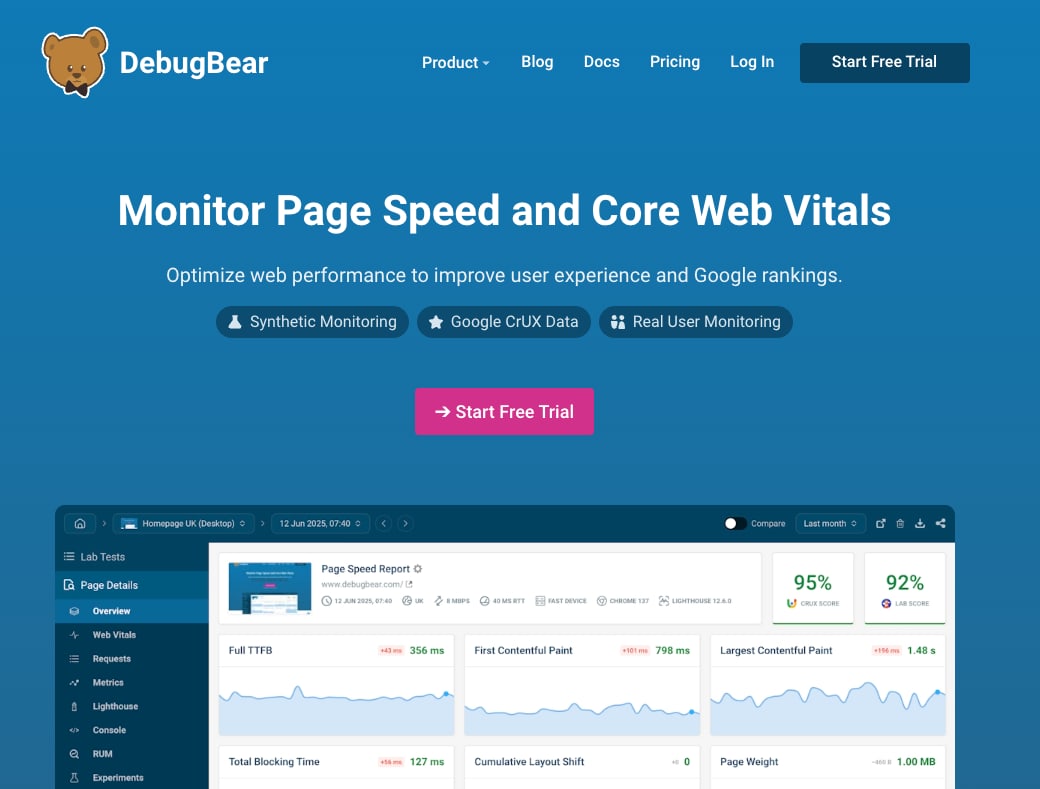
DebugBear continuously monitors performance and Core Web Vitals across pages, alerting on regressions and using detailed diagnostics to pinpoint the requests and elements behind slowdowns. With real-user monitoring plus lab tests and CI checks, it is the best fit for teams that want to catch performance problems before users do and tie them to specific deploys.
Pros:
- Continuous Core Web Vitals monitoring
- Real-user and lab data combined
- Regression alerts tied to deploys
- CI performance checks
Cons:
- Priced for teams and agencies
- Setup for full coverage
Verdict: The best continuous performance-monitoring tool.
9. ImageKit


Best for: AI-driven image and media optimization | Pricing: Free tier; paid from ~$49/month | Platform: CDN / API
ImageKit optimizes one of the heaviest parts of most pages — media — using AI to auto-compress, convert to modern formats like WebP and AVIF, and resize images to the exact size each device needs, all delivered from a fast CDN. Since images dominate page weight, ImageKit often produces the single biggest load-time win with a quick integration.
Pros:
- AI compression and format conversion
- Responsive, device-right sizing
- Fast media CDN delivery
- Big page-weight reductions
Cons:
- Focused on media only
- Bandwidth costs at scale
Verdict: The best tool for image and media optimization.
10. ChatGPT

Best for: Interpreting reports and writing optimization code | Pricing: Free tier; Plus $20/month | Platform: Web / desktop / API
ChatGPT is a fast performance copilot — paste a Lighthouse report and it explains each opportunity, then writes the config, caching headers, or build changes to fix it. It can refactor render-blocking scripts, draft a service worker, or generate a Cloudflare or Nginx config, turning diagnostic findings into concrete code without leaving the chat.
Pros:
- Explains audit findings in plain terms
- Writes config and optimization code
- Drafts caching and build changes
- Free tier to start
Cons:
- Not a measurement tool itself
- Verify generated configs
Verdict: The most versatile copilot for performance fixes.
Decision Tree
AI-Powered Predictive Preloading
Modern AI tools can analyze user behavior patterns to predict which pages or assets a visitor is likely to request next. Tools like Cloudflare's Automatic Platform Optimization and Vercel's Edge Functions use machine learning models trained on millions of sessions to preload critical resources before the user clicks. This reduces perceived load time by 20-40% for multi-page journeys.
For example, an e-commerce site using predictive preloading can have product images, checkout scripts, and recommendations ready in the browser cache before the user navigates, effectively eliminating wait times between pages. Most platforms offer this as a toggleable feature within their dashboard, requiring no code changes.
Real-User Monitoring (RUM) with AI Anomaly Detection
AI-enhanced Real-User Monitoring tools like DebugBear and Google's CrUX API now incorporate unsupervised learning to automatically detect performance regressions. Instead of static thresholds, these systems learn a site's normal performance pattern and flag anomalies—like a sudden spike in Largest Contentful Paint (LCP) for mobile users in a specific region. This catches issues that traditional synthetic testing misses, such as third-party script bloat or CDN routing problems.
In 2027, the best RUM tools provide automated root-cause analysis, linking a performance drop to a specific code release, image size change, or external dependency. Pricing for advanced RUM typically ranges from $50–$500/month depending on traffic volume.
Automated Image and Script Optimization at Build Time
AI-driven build tools like NitroPack and Cloudinary now integrate directly into CI/CD pipelines to optimize assets before deployment. These tools use computer vision to intelligently crop images to the most visually important area, convert to next-gen formats (AVIF, WebP) with per-browser fallbacks, and remove unused CSS/JavaScript. Unlike runtime optimization, build-time processing ensures zero overhead on the live server. For a typical content site, this reduces total page weight by 30-60% without any visible quality loss.
Most services offer a free tier for small sites (up to 1,000 images/month) and scale to enterprise plans around $200–$1,000/month.
FAQ
What is the best AI tool for website performance optimization in 2027? Google PageSpeed Insights with Lighthouse is the best overall because it combines real-user and lab data and prioritizes fixes by impact. For value, Cloudflare accelerates any site from its free plan with an edge CDN and automatic optimization.
Can AI tools actually make my site faster, or just measure it? Both. PageSpeed Insights and WebPageTest diagnose, while Cloudflare, NitroPack, Vercel, and ImageKit apply real optimizations — caching, compression, image conversion, and edge delivery — that cut load times.
Which tool helps most with Core Web Vitals? PageSpeed Insights reports them directly, DebugBear monitors them continuously, and NitroPack and Vercel actively improve LCP, CLS, and INP through caching, image optimization, and edge rendering.
What gives the biggest speed win fastest? For most sites, optimizing images with a tool like ImageKit and adding a CDN like Cloudflare delivers the largest improvement, since media and latency dominate load time.
Are there free performance tools? Yes. PageSpeed Insights is free, and Cloudflare, GTmetrix, WebPageTest, and NitroPack all offer free tiers that cover diagnostics and basic acceleration.
How does ChatGPT help with performance? ChatGPT interprets Lighthouse and WebPageTest reports and writes the actual fixes — caching headers, optimized configs, refactored scripts — turning recommendations into deployable code.
Related on PULSE
- The 10 Best AI Tools for Performance Reviews in 2027
- The 10 Best AI Tools for YouTube Optimization in 2027
- The 10 Best AI Tools for Conversion Rate Optimization in 2027
- The 10 Best LLM Quantization and Inference Optimization Tools in 2027
- The 10 Best AI Compute Cost Optimization Tools in 2027
- The 10 Best AI Tools for Pop-up Optimization in 2027
Sources
- https://pagespeed.web.dev
- https://www.cloudflare.com
- https://www.webpagetest.org
- https://gtmetrix.com
- https://vercel.com
- https://nitropack.io
- https://www.fastly.com
- https://www.debugbear.com
- https://imagekit.io
- https://chatgpt.com
People also search for: best ai tools for website performance optimization 2027 · top ai tools for website performance optimization 2027 · top rated ai tools for website performance optimization 2027 · top ranked ai tools for website performance optimization 2027 · highest rated ai tools for website performance optimization 2027 · ai tools for website performance optimization reviews 2027
This page will be disappearing soon. Save it to your device for $1 — or read it free while it is here.
@Kory-White- · if Venmo asks, the last 4 of my number are 2012
This page is gone.
This one is off the shelf now. $1 keeps it on your phone for good — the whole page, pictures and diagrams included.
 pulse-ai-infrastructureThe 10 Best AI Tools for Summarizing Articles in 2027
 pulse-ai-infrastructureThe 10 Best AI Tools for Color Grading in 2027
 pulse-ai-infrastructureThe 10 Best AI Tools for End-to-End Testing in 2027
 pulse-ai-infrastructureThe 10 Best AI Tools for Hero Section Design in 2027
 pulse-ai-infrastructureThe 10 Best AI Tools for Concept Art in 2027
 pulse-ai-infrastructureThe 10 Best AI Tools for Nutrition Tracking in 2027
 pulse-ai-infrastructureThe 10 Best AI Tools for Supply Chain Planning in 2027
 pulse-ai-infrastructureThe 10 Best AI Tools for Language Learning in 2027
 pulse-ai-infrastructureThe 10 Best AI Tools for Negotiation Prep in 2027
 pulse-ai-infrastructureThe 10 Best AI Tools for CSS and Styling in 2027