 Pulse Reviews and Analysis
How do you prevent prompt injection at the infrastructure layer?
 Curated by Kory White · Fractional CRO, CRO Syndicate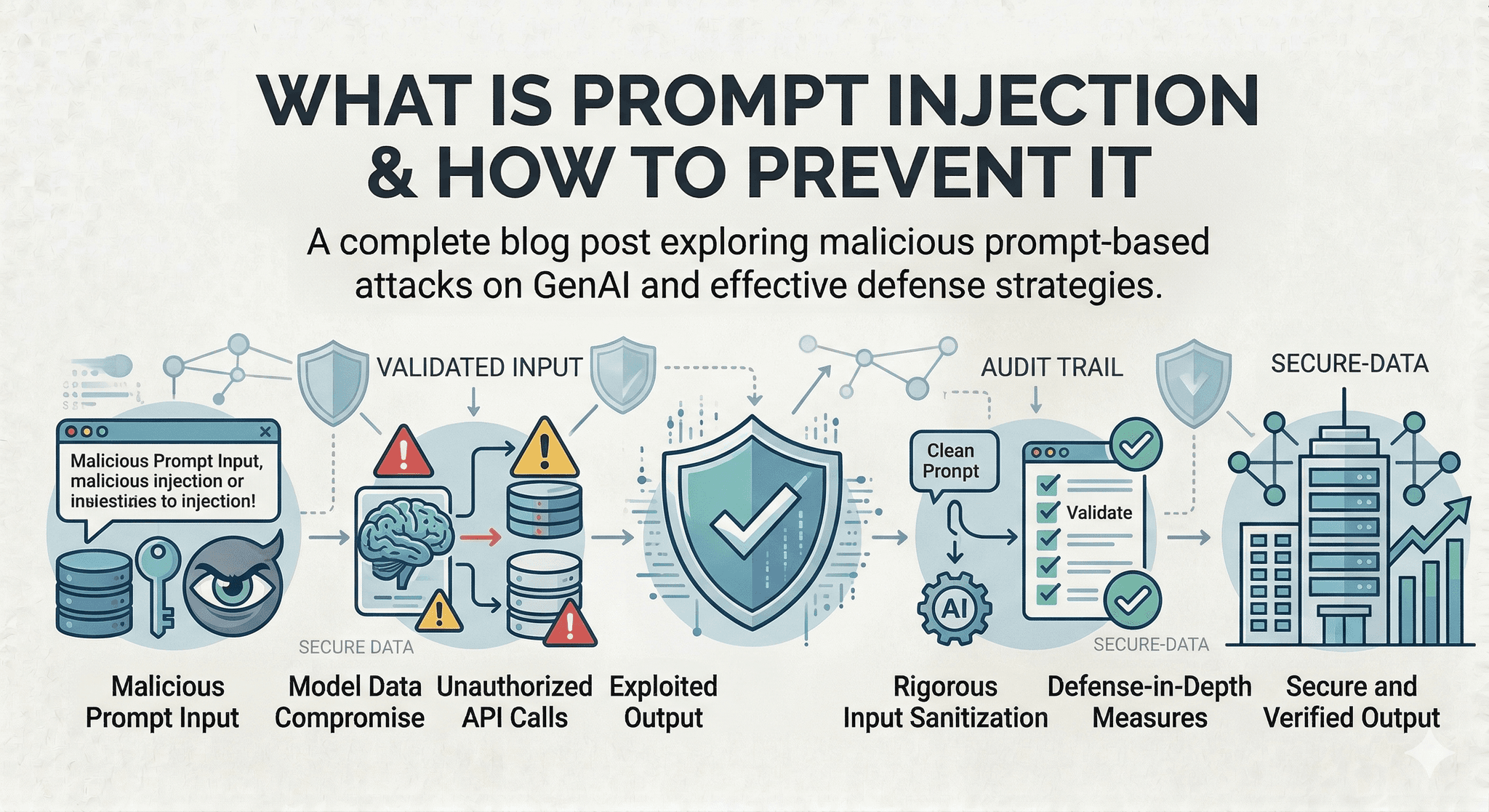
How do you prevent prompt injection at the infrastructure layer?
Direct Answer
You cannot fully prevent prompt injection with prompts alone, so you defend it at the infrastructure layer with defense-in-depth: treat all model input as untrusted, isolate untrusted content from trusted instructions, screen inputs and outputs with guardrail and scanning services (Llama Guard, NVIDIA NeMo Guardrails, Rebuff, Lakera Guard, AWS Bedrock Guardrails), enforce least-privilege access so a hijacked model can't do much damage, run tools and code in sandboxes, require human approval for high-impact actions, and log and monitor everything for detection.
The core principle is the same as classic application security: never trust input, constrain what the system is allowed to do, and assume the model *will* eventually be manipulated. Architecture, not cleverer wording, is what contains the blast radius.
Why prompt injection can't be solved with prompts
Prompt injection happens when attacker-controlled text overrides the developer's instructions — either directly ("ignore previous instructions and...") or indirectly, where malicious instructions are hidden in content the model retrieves (a web page, a document, an email, a RAG chunk) and then acts on.
The root cause is structural: LLMs process instructions and data in the same channel, so they cannot reliably tell a developer's command from text that merely *looks* like one. Because of this, "just write a stronger system prompt" fails — a sufficiently clever injection talks past it.
Robust defense therefore moves down the stack to infrastructure controls that hold regardless of what the model is convinced to attempt.
Layer 1: Isolate untrusted input from trusted instructions
The first infrastructure control is separating channels. Keep developer instructions and untrusted content distinct rather than concatenating them blindly. In practice that means using structured message roles (system vs.
User), clearly delimiting and labeling retrieved or user-supplied text so the model is told it is *data, not commands*, and, where possible, processing untrusted content with a separate, lower-privilege model call whose output is treated as data for a trusted call rather than as instructions.
The dual-LLM and "quarantine" patterns formalize this: an untrusted model handles raw content but is never allowed to trigger actions directly. Isolation doesn't make injection impossible, but it removes the easiest paths.

Reach Kory White, Fractional CRO: 📅 Book a Quick Call · 💼 Kory on LinkedIn · 🏢 CRO Syndicate
Layer 2: Screen inputs and outputs with guardrails
A dedicated guardrail layer sits in front of and behind the LLM to scan traffic, and it belongs in the infrastructure, not buried in application code. On the input side, scanners detect known injection patterns, jailbreak attempts, and policy violations before text reaches the model.
On the output side, they catch leaked secrets, PII, disallowed content, and signs the model was hijacked (e.g., trying to call a tool it shouldn't). Real options include:
- Llama Guard — an open safety classifier for screening prompts and responses.
- NVIDIA NeMo Guardrails — a programmable framework for defining rails on inputs, outputs, and topics.
- Rebuff and Lakera Guard — purpose-built prompt-injection detection.
- AWS Bedrock Guardrails and Azure AI Content Safety — managed cloud guardrails.
- Guardrails AI — an open framework for validating and structuring LLM I/O.
These run as a checkpoint every request passes through, ideally centralized in an AI gateway so policy is uniform across all apps.
Layer 3: Least privilege and tool isolation
The most important infrastructure principle is limiting what a compromised model can do. Assume injection will sometimes succeed, then ensure success buys the attacker little:
- Least-privilege tool access: give the agent only the specific, scoped permissions it needs — read-only where possible, narrow API scopes, no standing access to delete or transfer.
- Sandboxing: run any code execution or tool calls in isolated, ephemeral environments (containers, microVMs, gVisor) with no access to secrets, internal networks, or the host.
- Action allowlists: constrain which tools and parameters are even callable, and validate tool arguments before execution.
- Network egress controls: restrict outbound calls so a hijacked agent can't exfiltrate data to an attacker's server.
This is the layer that turns a successful injection from a breach into a non-event.
Layer 4: Human-in-the-loop for high-impact actions
For consequential operations — sending money, deleting data, emailing customers, changing permissions — require explicit human approval before execution. The model proposes; a person (or a strict policy engine) disposes. This breaks the autonomous loop exactly where the damage would be greatest, so even a perfectly crafted injection cannot complete a destructive action on its own.
Tier actions by risk: low-risk reads run freely, medium-risk actions log and alert, high-risk actions block on approval.
Layer 5: Monitor, log, and detect
Finally, treat the LLM system like any production service that will be attacked. Log every prompt, retrieval, tool call, and output (with appropriate data handling), trace agent runs end-to-end with observability tools like LangSmith, Arize, or Helicone, and alert on anomalies — unusual tool-call patterns, blocked-guardrail spikes, attempts to access out-of-scope resources, or outputs containing secrets.
Detection closes the loop: it catches the injections that slipped past prevention, feeds new patterns back into your guardrails, and gives you the audit trail to investigate incidents. Continuous red-teaming of your own system keeps the defenses honest.
Frequently Asked Questions
Can prompt injection be completely prevented?
No. Because LLMs process instructions and data in the same channel, there is no known way to make a model perfectly immune to injection. The realistic goal is containment: layer defenses so that when injection succeeds, least-privilege access, sandboxing, and human approval limit the damage to near zero.
What is the difference between direct and indirect prompt injection?
Direct injection is when a user types malicious instructions straight into the prompt. Indirect injection hides instructions inside content the model later retrieves — a web page, document, email, or RAG chunk — so the attacker never interacts with the system directly. Indirect injection is more dangerous because it can target users who never see the malicious payload.
Do guardrail tools stop all injections?
No single tool is sufficient. Guardrails like Llama Guard, NeMo Guardrails, Rebuff, and Lakera Guard catch many known patterns and raise the bar significantly, but determined attackers evolve their attacks. Guardrails are one layer in defense-in-depth, most effective when combined with isolation, least privilege, sandboxing, and monitoring.
How does least privilege help if the model is already compromised?
Least privilege assumes compromise and limits its value. If a hijacked agent can only read a narrow dataset, call a couple of scoped APIs, and cannot delete data, transfer funds, or reach the internet, then a successful injection accomplishes almost nothing. It converts a potential breach into a contained, low-impact event.
Where should guardrails live in my architecture?
Centralize them at an AI gateway that every LLM request flows through, so input/output scanning, rate limits, and policies are enforced uniformly across all applications rather than re-implemented per app. The gateway is also the natural place to log traffic for monitoring and to apply provider routing and fallbacks.
Sources
- OWASP Top 10 for LLM Applications (prompt injection) — https://genai.owasp.org/
- Meta Llama Guard documentation — https://www.llama.com/docs/model-cards-and-prompt-formats/llama-guard-4/
- NVIDIA NeMo Guardrails documentation — https://docs.nvidia.com/nemo/guardrails/
- Lakera Guard documentation — https://www.lakera.ai/
- AWS Bedrock Guardrails — https://docs.aws.amazon.com/bedrock/latest/userguide/guardrails.html
- Guardrails AI documentation — https://www.guardrailsai.com/docs
- Simon Willison on prompt injection and the dual-LLM pattern — https://simonwillison.net/series/prompt-injection/
- NIST AI Risk Management Framework — https://www.nist.gov/itl/ai-risk-management-framework