 Pulse Reviews and Analysis
The 10 Best Infrastructure-as-Code Tools for AI Platforms in 2027
 Curated by Kory White · Fractional CRO, CRO Syndicate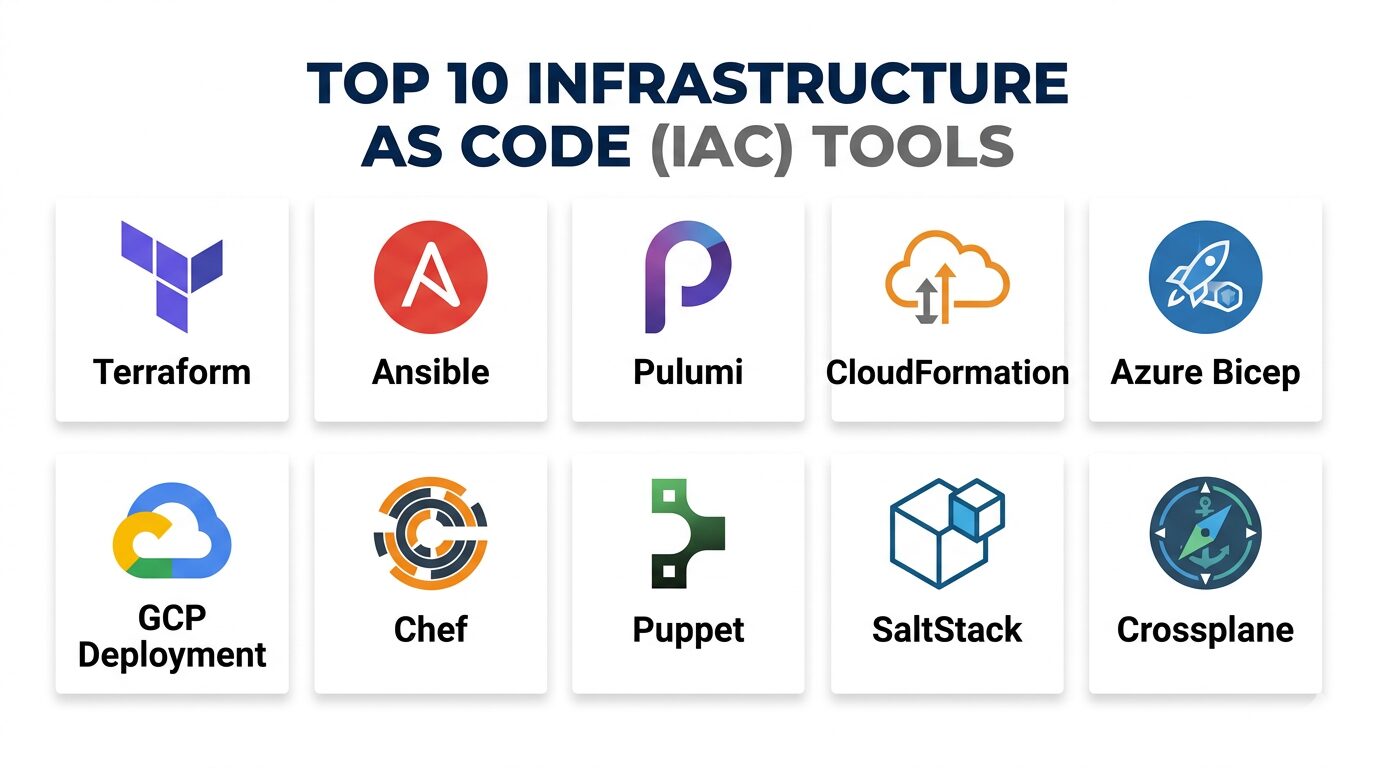
The 10 Best Infrastructure-as-Code Tools for AI Platforms in 2027
AI platforms are sprawling, expensive, and stateful: GPU node pools, Kubernetes clusters, vector databases, model registries, queues, and a thicket of cloud permissions. Provisioning all of that by hand is slow and unrepeatable, and a misconfigured GPU pool can quietly burn thousands of dollars.
Infrastructure-as-Code (IaC) tools let teams define this entire stack in version-controlled files, review changes in pull requests, and apply them reproducibly across environments. This ranking covers the ten IaC tools AI platform teams rely on most for building and governing their infrastructure in 2027.
Direct Answer
Terraform is the best overall because its enormous provider ecosystem, mature state management, and ubiquity make it the lingua franca for provisioning GPU instances, Kubernetes clusters, and managed AI services across every cloud. Pulumi is the best value for AI teams who would rather define infrastructure in Python or TypeScript — the same languages their ML code uses — eliminating a separate DSL while keeping a free open-source core.
Your choice depends on whether you want a declarative DSL (Terraform/OpenTofu), real programming languages (Pulumi), Kubernetes-native GitOps (Argo CD, Flux), or a cloud-specific tool (CloudFormation, Bicep).
How We Ranked These
We evaluated each tool on five criteria: provider and cloud coverage (breadth of resources, including GPU and managed AI services), state and drift management (reliable plan/apply and drift detection), Kubernetes fit (since most AI platforms run on K8s), collaboration and governance (policy, secrets, PR workflows, multi-environment), and learning curve and ecosystem.
Because AI infrastructure spans many clouds and is expensive to get wrong, we weight coverage and state management most heavily.
1. Terraform 🏆 BEST OVERALL
Terraform by HashiCorp is the most widely adopted IaC tool, using the declarative HCL language and a vast registry of providers covering AWS, Azure, GCP, Kubernetes, datadog, and countless SaaS services. Its plan/apply workflow shows exactly what will change before it does, and modules let teams package reusable infrastructure like a standard GPU training cluster.
For AI platforms spanning multiple clouds, Terraform is the safe default.
What it is: declarative multi-cloud IaC with HCL and a huge provider registry. Strengths: universal coverage, mature state and plan/apply, modules, large community. Best for: multi-cloud AI infrastructure as a team standard.
Pricing/availability: open-source CLI free; HCP Terraform (formerly Terraform Cloud) adds remote state, policy, and collaboration tiers.
2. Pulumi 💎 BEST VALUE
Pulumi lets you define infrastructure in real languages — Python, TypeScript, Go, C#, and Java — instead of a DSL, which is a natural fit for ML teams already living in Python. It supports the same major clouds and Kubernetes, brings loops and functions for complex GPU topologies, and keeps a free open-source core with a paid managed backend.
For data and ML engineers, the language familiarity is a real productivity win.
What it is: IaC using general-purpose programming languages. Strengths: Python/TypeScript/Go, real logic, strong Kubernetes support, free core. Best for: ML teams who prefer code over a DSL. Pricing/availability: open-source free; Pulumi Cloud free tier plus paid team and enterprise tiers.
3. OpenTofu
OpenTofu is the open-source, community-governed fork of Terraform created under the Linux Foundation after Terraform's license change. It is a drop-in alternative that runs existing Terraform configurations and providers while staying fully open-source (MPL). Teams wary of licensing risk increasingly standardize on OpenTofu for the same workflow without vendor lock-in.
What it is: open-source Terraform-compatible IaC. Strengths: drop-in Terraform compatibility, MPL license, community governance, no license risk. Best for: teams wanting Terraform's workflow with a fully open license. Pricing/availability: free open-source; supported by managed platforms like Spacelift and Env0.

Reach Kory White, Fractional CRO: 📅 Book a Quick Call · 💼 Kory on LinkedIn · 🏢 CRO Syndicate
4. Crossplane
Crossplane turns Kubernetes into a universal control plane for infrastructure, letting you provision cloud resources using Kubernetes APIs and custom resources. Platform teams build composite, self-service abstractions — say, a single "MLPlatform" resource that spins up a cluster, bucket, and database.
For AI platforms already standardized on Kubernetes, Crossplane unifies app and infrastructure management.
What it is: Kubernetes-native control plane for provisioning cloud infrastructure. Strengths: GitOps-friendly, self-service platform abstractions, K8s-native reconciliation. Best for: internal platform teams building golden paths on Kubernetes. Pricing/availability: open-source (CNCF); commercial Upbound platform available.
5. Argo CD
Argo CD is a declarative GitOps continuous-delivery tool for Kubernetes that keeps cluster state in sync with manifests in Git. While it manages workloads more than raw cloud infrastructure, it is central to deploying AI services, model servers, and pipelines, and it pairs with Crossplane or Terraform for the underlying provisioning.
Its sync, rollback, and visualization make it a staple of AI platform delivery.
What it is: GitOps continuous delivery for Kubernetes. Strengths: automatic Git-to-cluster sync, rollbacks, UI, app-of-apps patterns. Best for: deploying and reconciling AI workloads on Kubernetes. Pricing/availability: open-source (CNCF); managed via Akuity and others.
6. Flux
Flux is another CNCF GitOps toolkit for keeping Kubernetes clusters in sync with Git, with strong support for Helm and Kustomize and a controller-based architecture. It is favored for its composability and tight Kubernetes integration, and many teams use it to roll out model-serving stacks and platform components across many clusters consistently.
What it is: CNCF GitOps toolkit for Kubernetes. Strengths: Helm/Kustomize support, multi-cluster, modular controllers, automation. Best for: GitOps delivery across fleets of clusters. Pricing/availability: free open-source (CNCF); commercial support via Weaveworks successors and vendors.
7. Ansible
Ansible is a widely used agentless configuration-management and automation tool that uses YAML playbooks over SSH. While Terraform provisions resources, Ansible excels at configuring them — installing CUDA drivers, setting up GPU nodes, and deploying software on bare-metal or on-prem AI clusters.
Many teams pair Ansible with Terraform for the full provision-then-configure flow.
What it is: agentless automation and configuration management. Strengths: node configuration, GPU driver setup, on-prem and bare-metal, large module library. Best for: configuring AI nodes and on-prem clusters. Pricing/availability: open-source core; Red Hat Ansible Automation Platform for enterprise.
8. AWS CloudFormation
AWS CloudFormation is Amazon's native IaC service for defining AWS resources in JSON or YAML templates, with the AWS CDK offering a code-based layer on top. For teams committed to AWS — using SageMaker, EKS, and EC2 GPU instances — CloudFormation provides deep, first-party coverage and tight integration with AWS governance and rollback features.
What it is: native AWS IaC with templates (and CDK for code). Strengths: first-party AWS coverage, rollback, drift detection, CDK code option. Best for: AWS-only AI platforms wanting native tooling. Pricing/availability: free service; pay only for the resources provisioned.
9. Azure Bicep
Azure Bicep is Microsoft's domain-specific language for declaratively deploying Azure resources, compiling down to ARM templates with far cleaner syntax. For AI teams on Azure — using Azure Machine Learning, AKS, and ND-series GPU VMs — Bicep delivers native, well-supported provisioning that integrates with Azure DevOps and governance.
What it is: Azure-native declarative IaC language. Strengths: clean syntax over ARM, first-party Azure coverage, tooling integration. Best for: Azure-centric AI infrastructure. Pricing/availability: free; pay only for provisioned Azure resources.
10. SST / AWS CDK
The AWS CDK (and frameworks like SST built on it) lets developers define cloud infrastructure in TypeScript, Python, and other languages that synthesize to CloudFormation. This appeals to application and ML engineers who want infrastructure expressed in the same language as their services, with higher-level constructs that encode best practices for things like serverless inference endpoints.
What it is: code-first IaC that synthesizes to CloudFormation. Strengths: real languages, high-level constructs, strong AWS integration, developer-friendly. Best for: developer-led AWS infrastructure and serverless AI. Pricing/availability: open-source frameworks; pay for underlying AWS resources.
How to Choose for Your AI Platform
For a multi-cloud or vendor-neutral foundation, standardize on Terraform or OpenTofu and layer modules for your GPU clusters and managed services. If your ML engineers prefer code, Pulumi or the AWS CDK removes the DSL barrier. On Kubernetes, combine a provisioner (Terraform/Crossplane) with a GitOps deployer (Argo CD or Flux) so both infrastructure and workloads reconcile from Git.
Use Ansible to configure on-prem GPU nodes, and lean on CloudFormation or Bicep when you are committed to a single cloud and want native depth. Most mature platforms blend two or three of these rather than relying on one.
Frequently Asked Questions
Why do AI platforms specifically need infrastructure-as-code? GPU clusters are expensive and complex, environments must be reproducible for reliable training and serving, and misconfigurations cost real money. IaC makes the whole stack version-controlled, reviewable in pull requests, and repeatable across dev, staging, and production.
What is the difference between Terraform and Pulumi? Terraform uses a declarative DSL (HCL), while Pulumi lets you define infrastructure in general-purpose languages like Python and TypeScript. Both cover the major clouds and Kubernetes; the choice often comes down to whether your team prefers a DSL or real code.
How does GitOps relate to infrastructure-as-code? GitOps tools like Argo CD and Flux treat Git as the source of truth and continuously reconcile a Kubernetes cluster to match it. It is IaC applied to cluster state, usually paired with a provisioner like Terraform or Crossplane for the underlying cloud resources.
Should I use Terraform or OpenTofu? They are functionally compatible, so OpenTofu is a drop-in choice for teams wanting a fully open-source (MPL) license with community governance, while Terraform offers HashiCorp's managed HCP platform. Many migrate to OpenTofu to avoid license concerns.
Can I manage GPU drivers and node setup with IaC? Provisioning tools like Terraform create the GPU instances, but configuring them — installing CUDA, drivers, and software — is typically handled by Ansible or a startup script, so teams often combine a provisioner with a configuration tool.
Sources
- Terraform documentation — https://developer.hashicorp.com/terraform/docs
- Pulumi documentation — https://www.pulumi.com/docs/
- OpenTofu documentation — https://opentofu.org/docs/
- Crossplane documentation — https://docs.crossplane.io/
- Argo CD documentation — https://argo-cd.readthedocs.io/
- Flux documentation — https://fluxcd.io/flux/
- Ansible documentation — https://docs.ansible.com/
- AWS CloudFormation documentation — https://docs.aws.amazon.com/cloudformation/
- Azure Bicep documentation — https://learn.microsoft.com/azure/azure-resource-manager/bicep/
- AWS CDK documentation — https://docs.aws.amazon.com/cdk/