


Should I open or buy a Ruby Tuesday franchise in 2027?
Quality
Certified
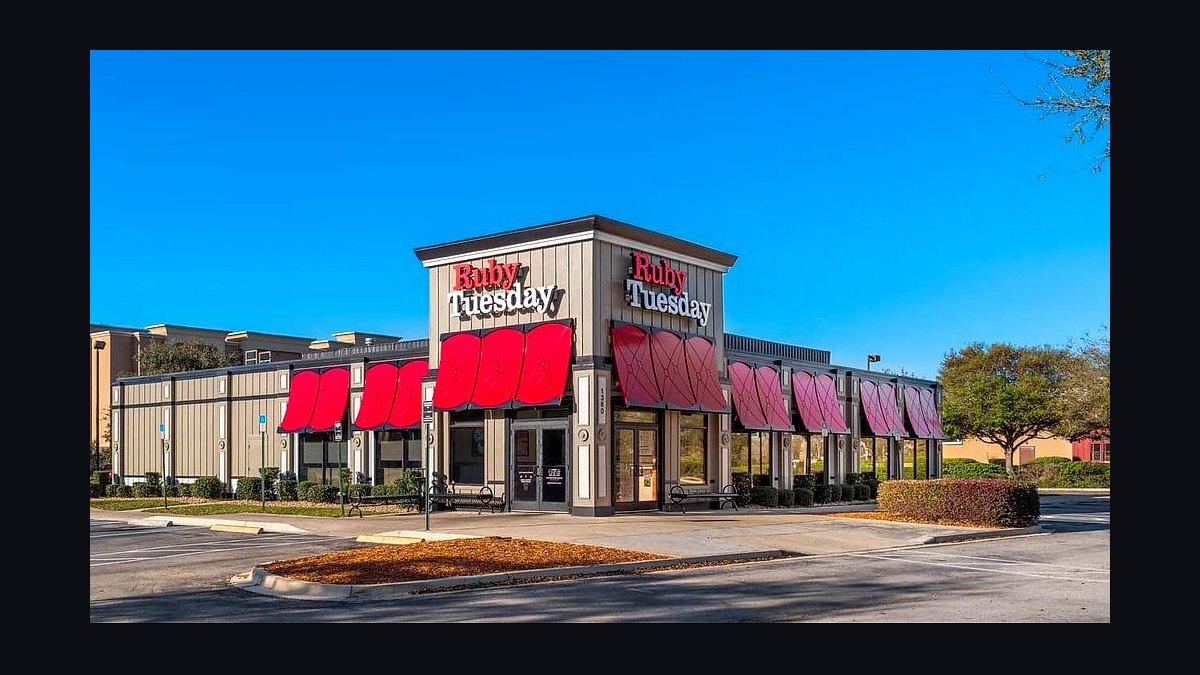
Probably not. Ruby Tuesday has shrunk from roughly 680 locations in 2007 to under 200 today, filed Chapter 11 in October 2020, and posts negative same-store sales in most years. A greenfield build runs $1.5M–$3.9M against a ~$1.6M average unit volume. Only two paths pencil: bolting onto an existing profitable unit, or buying a closing location at salvage.
The operator who almost signed in a Southeast strip center
Picture a specific person, because the abstract version of this decision is always more attractive than the real one. A 47-year-old general manager with 16 years at Applebee's and Outback has $650,000 in home equity, $310,000 in cash, and a signed letter of intent on a 5,400-square-foot second-generation restaurant box in a Georgia town of 41,000 people. The building was a Logan's Roadhouse until 2023. The landlord wants $31 per square foot triple-net, ten-year term, five percent escalators, with $180,000 in tenant improvement allowance. The hood system works, the walk-in works, the parking lot has 92 spaces, and there is a transferable pouring license attached to the county quota.
On paper this is the best possible version of the Ruby Tuesday opportunity. The operator knows full-service P&L cold. The real estate is second-generation, which is the single largest cost lever in casual dining — the difference between inheriting a restaurant shell and building one from a pad is frequently $700,000 to $1.4 million. The market is the Southeast, where Ruby Tuesday retains the most residual brand awareness. The demographic skews older, which matches the brand's actual customer.
Now run the arithmetic that the franchise development conversation will not run for you. Rent at $31 per square foot on 5,400 feet is $167,400 per year before common area maintenance, insurance, and taxes, which in a Sun Belt retail center typically add $6 to $9 per foot. Call it $210,000 all-in occupancy. Healthy casual dining wants occupancy at six to seven percent of revenue. To hit seven percent, this unit must produce $3.0 million in annual revenue. Ruby Tuesday's system average unit volume is nowhere near that — the brand sits in the $1.4 million to $1.9 million band, which is where most of the legacy casual-dining chains that filed and reorganized have landed. At $1.6 million, occupancy is 13 percent of revenue. That single line item, before a dollar of food or labor, eliminates the entire restaurant-level margin that a mid-pack casual-dining unit generates.

This is the trap, and it is not obvious from inside the deal. The operator is not evaluating whether they can run a restaurant. They can. They are evaluating whether a brand with declining traffic can generate enough revenue to carry modern 2027 occupancy costs, 2027 wages, and a 5.5 percent combined royalty and marketing burden. The answer for most sites is no, and the reason has nothing to do with operator skill. A great operator running a declining brand in an expensive box loses more slowly than a bad one. They still lose.
The version of this deal that works looks different in exactly one respect: the occupancy number. If that same operator can secure the box at $14 to $16 per square foot — which happens when a landlord has held a dark restaurant for 18 months and is underwriting to any credit tenant — occupancy drops to roughly $95,000, or six percent of a $1.6 million top line. Suddenly the unit throws real cash. Everything in this decision compresses down to that one variable, and no amount of operational excellence substitutes for it.
How the money actually moves through a franchised unit
Understanding whether to open a Ruby Tuesday requires understanding the order in which cash leaves the building, because franchise economics are fundamentally about what is left after the deductions that happen before you get paid.

Revenue enters as food sales, alcohol sales, and to a lesser degree catering and gift cards. Casual dining with a bar program typically runs 15 to 22 percent of revenue through alcohol, which matters enormously because beverage carries 70 to 80 percent gross margin versus roughly 66 to 69 percent on food. A unit with a weak bar mix has a structurally worse P&L than an identical unit with a strong one, and Ruby Tuesday's daypart profile — heavy on early dinner, light on late-night bar — pushes toward the low end of that alcohol range.
Off the top comes the royalty, typically four percent of gross sales, and the advertising or marketing fund contribution, typically one and a half percent. That combined 5.5 percent is charged on revenue, not profit, which is the single most misunderstood mechanic in franchising. At $1.6 million in sales, that is $88,000 leaving the business annually regardless of whether the restaurant made money. In a year where the unit produces $128,000 in restaurant-level EBITDA, the franchisor's cut is 69 percent as large as the operator's entire pre-debt profit. The franchisor is senior to you in the cash waterfall and their revenue is uncorrelated with your profitability.
Then comes cost of goods, which for a full-service steak-and-burger concept with a salad bar runs 31 to 34 percent of revenue. The salad bar is worth a specific note: it is the brand's historical differentiator and it is also a waste engine. Produce spoilage on an unattended bar in a low-traffic unit can add 100 to 200 basis points of food cost versus a plated-only menu, because the bar must look full at 4:45 p.m. whether eleven people or ninety walk through the door.
Labor is next, and it is where the 2027 math has moved hardest against legacy casual dining. Full-service labor runs 33 to 37 percent of revenue in most markets, and higher in states with elevated minimum wages or tipped-wage elimination. A casual-dining unit needs roughly 55 to 70 employees to cover a seven-day, two-shift schedule with a bar, a line, a dish pit, and a host stand. Every point of labor on a $1.6 million unit is $16,000. Losing three points to a tight local market — which is common — costs $48,000, which is a third of the entire restaurant-level profit.
What is left after cost of goods, labor, occupancy, utilities, repairs, insurance, credit card fees, and supplies is restaurant-level EBITDA, and in casual dining that is five to eleven percent. Then, and only then, does debt service get paid. An operator financing $2.2 million on an SBA 7(a) structure at high-single to low-double-digit rates over ten to twenty-five years carries roughly $20,000 to $23,000 per month, or $240,000 to $276,000 annually. Against $128,000 of mid-pack EBITDA, a fully financed unit is cash-flow negative by a six-figure margin. That gap is the entire investment thesis, and it is negative.
The diagram makes the asymmetry visible. The same brand, the same menu, the same operator, and the same market produce opposite outcomes based entirely on the capital structure at the front end. This is why the salvage-acquisition path is the only Ruby Tuesday path that reliably clears, and why greenfield construction on a declining brand is a structurally losing trade.
Real numbers, ranges, and the benchmarks that matter
Here is the investment stack an operator should expect, based on the ranges disclosed in the franchise disclosure document and typical casual-dining build costs.
| Line item | Low | High |
|---|---|---|
| Initial franchise fee | $35,000 | $35,000 |
| Building and site work / build-out | $850,000 | $2,200,000 |
| Furniture, fixtures, equipment | $325,000 | $725,000 |
| Smallwares, uniforms, signage | $55,000 | $95,000 |
| Opening inventory | $42,000 | $65,000 |
| Training, travel, opening team | $48,000 | $87,000 |
| Working capital, three months | $185,000 | $625,000 |
| Liquor license, state dependent | $20,000 | $45,000 |
| Total all-in | ~$1.56M | ~$3.88M |
Financial qualification typically requires around $900,000 in net worth and $400,000 in liquid capital. Treat that liquid figure as a floor, not a target. A restaurant that opens with exactly the minimum has no cushion for the two events that kill new units: a slower-than-modeled first ninety days, and an unbudgeted capital repair. Refrigeration, HVAC, and hood suppression failures in a second-generation building routinely cost $15,000 to $60,000 and arrive without warning.
The revenue side is where the underwriting has to be honest. Ruby Tuesday's average unit volume sits in the $1.4 million to $1.9 million range. Model three scenarios and require the downside case to survive.
Downside — $1.4M revenue, 6 percent margin. Restaurant-level EBITDA of $84,000. Any debt service above $7,000 per month makes this unit cash-negative. Survival requires either an owned building, a near-free lease, or an all-cash acquisition.
Base — $1.6M revenue, 8 percent margin. EBITDA of $128,000. On a salvage acquisition of $450,000 with $150,000 down and $300,000 financed, debt service runs roughly $45,000 per year, leaving about $83,000 in owner cash flow before the owner's own salary. Equity payback lands near two years. On a $2.2 million greenfield build, the same $128,000 loses to $250,000-plus in debt service.
Upside — $1.9M revenue, 11 percent margin. EBITDA of $209,000. This is a top-quartile unit. On a greenfield build it is roughly break-even to modestly positive after debt service. On a salvage acquisition it is a genuinely good business. Note the asymmetry: even the upside case does not rescue the greenfield structure.
Benchmarks to hold every candidate site against. Occupancy must land at or below seven percent of modeled base-case revenue — at $1.6 million that means total occupancy under $112,000 per year, which at 5,400 square feet is roughly $20 per square foot all-in including CAM, taxes, and insurance. Prime cost, meaning cost of goods plus total labor, must model under 65 percent; above 68 percent, the unit cannot generate meaningful margin at any volume. Sales per square foot should exceed $300; at $1.6 million in a 5,400-foot box, that is $296, which is already thin and argues for a smaller footprint. And check the sales-to-investment ratio — healthy franchised restaurants target revenue at or above total investment. A $1.6 million unit costing $2.8 million to build has a ratio of 0.57, which is a signal to walk regardless of how good the operator is.
Payback on a fully financed greenfield unit runs six to nine years assuming the brand's revenue holds flat, and that assumption is the weakest part of the model. A brand that has comped negative in most of the last decade is not a flat-revenue asset. Model a one to three percent annual same-store decline and the payback period extends past the initial lease term, which means the operator is underwriting a return that arrives after they have to renegotiate rent from a position of weakness.
Trade-offs against the alternatives at the same capital outlay
The relevant comparison is never "Ruby Tuesday versus nothing." It is "Ruby Tuesday versus everything else $1.5 to $3.9 million and a full-service operator's skill set can buy." Framed that way, the decision gets clearer fast.
Texas Roadhouse operates in the adjacent steak-and-burger space with an investment range broadly comparable to Ruby Tuesday's, but with average unit volumes multiples higher and positive same-store sales momentum. The catch is availability: the strongest casual-dining brands are the hardest to get into, often requiring multi-unit commitments, existing franchisee status, or geographic areas that are already spoken for. That constraint is real, and it is precisely why struggling brands are the ones actively recruiting. Ease of entry into a franchise system is inversely correlated with its unit economics. When a brand will sign anyone with $400,000 liquid, that fact is itself a disclosure.
Breakfast and brunch concepts — First Watch and similar formats — carry lower investment, shorter operating hours, no liquor license, and dramatically simpler labor models. A single-daypart restaurant with no bar and a 2 p.m. close runs a fraction of the management complexity of a seven-day, two-shift casual-dining unit with alcohol compliance. For an operator whose real asset is execution discipline rather than brand affinity, this is often the better use of the same capital and the same fifteen years of experience.
The passive alternative deserves honest weight. An operator with $900,000 in net worth can buy a net-leased restaurant property with a credit tenant and collect rent at a mid-six-percent cap rate with no employees, no food cost, no health inspections, and no 11 p.m. phone calls. On $900,000 of equity, that is roughly $55,000 per year of unlevered passive income. Compare that honestly against a base-case Ruby Tuesday greenfield that produces negative cash flow for two years while consuming every waking hour. The restaurant only wins if the operator is confident in a top-quartile outcome and values the option to build a multi-unit platform.
The independent concept alternative is the one most experienced GMs underweight. Zero franchise fee, zero royalty, zero marketing fund, complete menu control, and the ability to reposition when the market shifts. That 5.5 percent of gross sales retained is $88,000 per year on a $1.6 million unit — enough to fund the entire marketing effort that the franchise fund was supposedly buying, with change left over. What the franchise actually provides is a supply chain, an operating system, training infrastructure, and brand recognition. For a first-time operator, that scaffolding is worth real money. For a sixteen-year veteran of Applebee's and Outback, most of it is already in their head, and the brand recognition is the only remaining value — which is exactly the asset a declining chain is losing.
Common pitfalls and how to avoid them
Underwriting to the system average instead of the local site. The average unit volume includes long-tenured, fully depreciated locations in markets where the brand has been embedded for thirty years. A new unit in a market with no brand history opens below system average and takes two to three years to close the gap, if it ever does. Underwrite the first year at 75 to 80 percent of system AUV, not at 100 percent. If the deal only works at system average, it does not work.
Treating the working capital line as a formality. The disclosed working capital range covers three months. New restaurants routinely need twelve. Hold twelve months of fixed costs — occupancy, management salaries, insurance, debt service, and minimum staffing — in reserve beyond the build budget. For a unit with $210,000 occupancy and $250,000 debt service, that reserve is substantial, and running out of it in month eight is the most common way otherwise-viable restaurants die.
Skipping the franchisee calls. Item 20 of the disclosure document lists every current franchisee and, critically, every franchisee who left the system in the last three years. Call at least ten current operators and at least three who exited. Ask five specific questions: what was your unit's revenue trajectory over the last three years, what was your worst operational surprise, would you sign this agreement again, is the marketing fund producing anything you can see in your trade area, and what did you actually net in year three. If fewer than half say they would re-sign, that is a terminal signal. Exited franchisees are the highest-value calls and the ones most people skip out of discomfort.
Signing a lease term longer than the brand's visible runway. A ten-year lease with personal guarantee on a brand that has been contracting for a decade is an asymmetric bet against yourself. Negotiate a co-tenancy or brand-continuity clause if you can get one: if the franchisor's unit count drops below a stated threshold or the brand ceases national marketing, you get a termination right or a rent reduction. Landlords resist this, but a landlord who has held a dark restaurant box for eighteen months is more flexible than one who has not. At minimum, cap the personal guarantee at two to three years of rent rather than the full term.
Assuming a second-generation building is turnkey. Inherited buildings carry inherited problems. Before signing, commission an independent inspection of the hood and suppression system, the walk-in compressors, the grease interceptor, the roof-top HVAC units, and the electrical panel capacity. Verify that the existing occupancy classification and seating count survive a change of tenant under current code — ADA restroom counts and egress requirements have tightened, and a building that was compliant in 2009 may trigger $80,000 to $200,000 in mandatory upgrades on permit. Get the tenant improvement allowance sized after the inspection, not before.
Misjudging the liquor license as a cost rather than an asset. In quota states, a transferable license can be worth six figures on the secondary market independent of restaurant performance. That changes the downside math materially: if the restaurant fails, the license is a recoverable asset. In license-open states, it is a fee and nothing more. Know which regime you are in before you model the downside, because it can be the difference between recovering 40 percent of invested capital in a failure scenario and recovering almost none.
Ignoring the cannibalization radius. If an existing unit sits within roughly 30 miles, a new location does not create incremental demand in a shrinking brand — it splits the existing customer base and both units comp negative. Pull mobility and trade-area data before site selection, not after. Also gate on demographics: for a brand skewing older, a trade area with a thin 55-plus population share is a structurally poor fit no matter how strong the traffic counts look.
Believing a turnaround thesis without evidence of investment. A brand turnaround requires capital: remodels, menu R&D, national media, and technology. Ask directly what the franchisor has spent per unit on remodel support and what national media weight the marketing fund has purchased in the last twenty-four months. If the answer is vague, the marketing fund is functionally a second royalty and should be modeled as one.
Related questions
What is the single most important number in this decision?
Occupancy cost as a percentage of modeled base-case revenue. At or below seven percent, a mid-pack unit can work. Above ten percent, no amount of operational skill rescues it. Every other variable is secondary to the lease you sign.
Is buying an existing profitable location safer than opening new?
Yes, substantially. An operating unit has verifiable revenue history, a trained staff, an established customer base, and a known cost structure. You are buying a proven cash flow rather than underwriting a forecast, and the purchase price is typically a multiple of actual earnings rather than construction cost.
How much of the investment is recoverable if the restaurant fails?
Less than most operators assume. Leasehold improvements are worth close to nothing. Used restaurant equipment recovers roughly 20 to 30 cents on the dollar at auction. A transferable liquor license in a quota state may be the largest recoverable asset. Model a failure scenario recovering 15 to 30 percent of invested capital.
Does a franchise agreement guarantee territory protection?
Not automatically. Single-unit agreements often grant a limited protected radius or none at all. Area development rights with a right of first refusal on adjacent territory cost more upfront but are what make multi-unit economics possible. Negotiate this before signing, never after.
Should an experienced operator consider an independent concept instead?
Often yes. The 5.5 percent of gross sales going to royalty and marketing is roughly $88,000 annually on a $1.6 million unit. An operator with fifteen-plus years of full-service experience already possesses most of what the franchise system supplies, leaving brand recognition as the only unique value.
FAQ
How much liquid capital do I actually need before applying?
Plan on roughly $400,000 liquid and $900,000 net worth as the qualification floor, with total project cost from about $1.56 million to $3.88 million. Treat those as minimums rather than targets — a unit that opens with exactly the qualifying amount has no reserve for a slow first quarter or an unbudgeted equipment failure, which is the most common cause of early failure.
What are the ongoing fees and how much do they actually cost?

A four percent royalty on gross sales plus a one and a half percent marketing fund contribution. On a $1.6 million unit that is $88,000 per year, charged on revenue rather than profit. In a year producing $128,000 of restaurant-level EBITDA, the franchisor collects nearly 70 percent as much as the operator earns before debt service.
How long until the unit pays back my equity?
On a fully financed greenfield build, six to nine years assuming flat revenue — and flat revenue is an optimistic assumption for a contracting brand. On a salvage acquisition under $500,000 all-in, payback can compress to two to three years because the denominator is a fraction of the size. The acquisition price, not the operating performance, drives the answer.
Is the brand growing or shrinking?
Shrinking, and it has been for many years. The chain peaked near 680 locations in 2007, filed Chapter 11 in October 2020, closed a large block of restaurants during reorganization, and emerged in early 2021 as a private company under lender ownership with a fraction of its former footprint. New unit development has been minimal since.
Should I buy a closing corporate location rather than build new?
If you are committed to the brand, yes. Inheriting a turnkey building with functional equipment and an active liquor license can replace a multimillion-dollar build with a purchase in the low-to-mid six figures. You still face the same traffic trends and the same fee structure, but at a capital basis where a mid-pack unit generates positive cash flow instead of negative.
What should trigger an immediate walk-away?
Any one of these: total investment exceeding roughly $2.4 million, a modeled first-year cash flow that is negative in the base case, occupancy above ten percent of modeled revenue, a downside scenario that cannot survive twenty-four months, or fewer than half of the current franchisees you call saying they would sign again.
Sources
- https://www.ftc.gov/business-guidance/resources/franchise-rule-compliance-guide
- https://www.sba.gov/funding-programs/loans/7a-loans
- https://www.bls.gov/oes/current/oes_nat.htm
- https://www.restaurantbusinessonline.com/
- https://www.nrn.com/
- https://restaurant.org/research-and-media/research/
- https://www.rubytuesday.com/
- https://www.franchise.org/
- https://www.bizbuysell.com/
- https://www.cbre.com/insights
Related on PULSE
This page will be disappearing soon. Save it to your device for $1 — or read it free while it is here.
@Kory-White- · if Venmo asks, the last 4 of my number are 2012
This page is gone.
This one is off the shelf now. $1 keeps it on your phone for good — the whole page, pictures and diagrams included.
 franchiseShould I open or buy a Take 5 Oil Change franchise in 2027?
 franchiseShould I open or buy a UPS Store franchise in 2027?
 franchiseShould I open or buy a Jamba franchise in 2027?
 franchiseShould I open or buy a Massage Envy franchise in 2027?
 franchiseShould I open or buy a Smoothie King franchise in 2027?
 franchiseShould I open or buy a KinderCare franchise in 2027?
 franchiseShould I open or buy an F45 Training franchise in 2027?
 franchiseShould I open or buy a Cold Stone Creamery franchise in 2027?
 franchiseShould I open or buy a Wingstop franchise in 2027?
 franchiseShould I open or buy a Goddard School franchise in 2027?