


“Win the week. The quarter follows.” — LinkedIn Banner
Quality
Certified
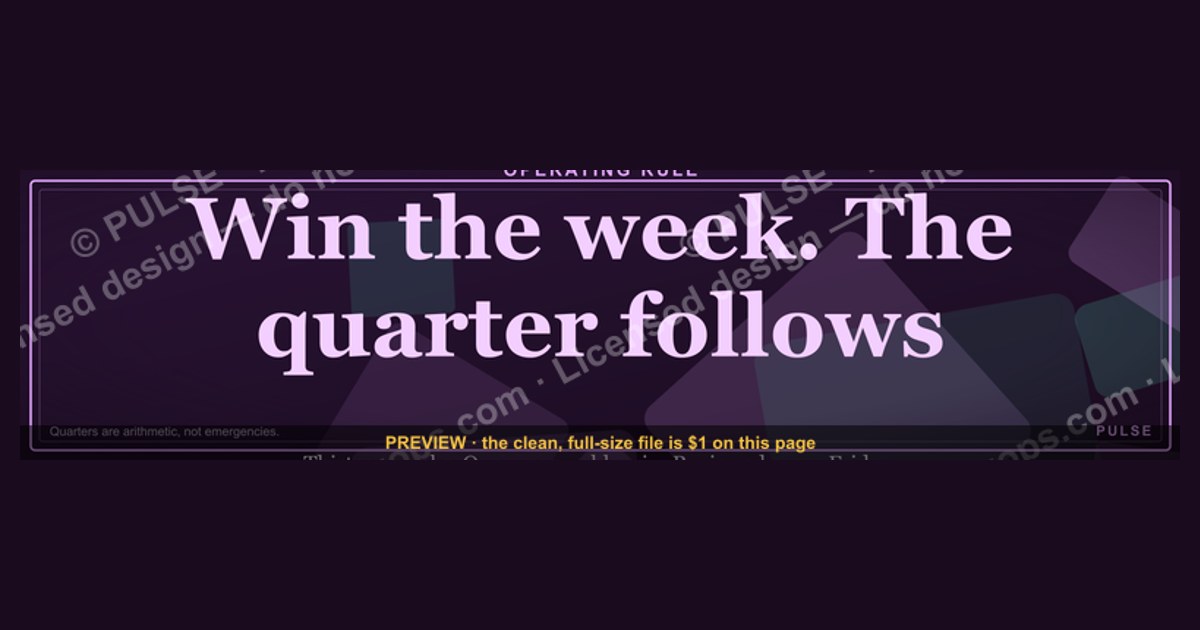

"Win the week. The quarter follows." is a LinkedIn Banner slogan and an operating rule: a quarter is roughly thirteen weeks, so if you define one measurable weekly win and hit it, quarterly revenue arrives as arithmetic rather than a last-minute scramble. The banner signals to your network that you run on short, reviewable cycles.
What the slogan is and why it matters
Strip away the design and the phrase is a claim about planning horizons. Most commercial teams are measured on a quarter — thirteen weeks, sixty-odd working days — but nobody executes on a quarter. They execute on Tuesdays. The gap between the unit of measurement and the unit of work is where quarters get lost, and the slogan collapses that gap by declaring the week the only horizon you actually manage.
That matters because of how forecast error accumulates. If you only inspect progress at the quarter's midpoint, you have burned six weeks before you learn anything. In enterprise sales, where a typical B2B cycle runs somewhere between 45 and 120 days depending on deal size and buying-committee width, six weeks of blind execution is often the entire window in which new pipeline could still have closed inside the period. Discover the shortfall in week seven and your only remaining levers are discounting, pulling deals forward, and pressuring buyers — all of which damage the *next* quarter to rescue this one. Discover it in week two and the lever is simply "book more meetings," which costs nothing but effort.
As a LinkedIn Banner specifically, the phrase does a second job. Your cover image is roughly 1584×396 pixels of prime real estate that most people waste on a stock skyline. A slogan banner is a positioning statement: it tells a visiting buyer, recruiter, or candidate how you think before they read a single line of your headline. "Win the week. The quarter follows" reads as operator, not strategist — someone who ships on a cadence. For fractional CROs, RevOps consultants, and sales leaders in market, that signal is doing real work, because the objection they most often face is "can you actually execute, or do you just make slides?"
The idea is not novel and doesn't pretend to be. It is the same logic behind agile sprints, OKR check-in cadences, and the manufacturing habit of pulling the andon cord the moment a defect appears rather than at end-of-shift. Short feedback loops beat long ones because errors are cheaper to correct while they are small. The banner is a compressed restatement of that principle, aimed at commercial teams who inherited quarterly measurement from finance and never rebuilt their operating rhythm to match how work actually gets done.
There is a cultural argument too. Quarterly-only measurement produces a predictable emotional curve: relaxed weeks one through five, mild anxiety through eight, then a fire drill. That curve is expensive. It burns reps out, trains buyers to wait for end-of-quarter discounts, and makes hiring decisions reactive. Weekly cadence flattens the curve. The work is more boring and the results are more predictable — which is precisely the trade most revenue leaders say they want and few actually build for.
Turning the slogan into an operating cadence
A banner is a reminder, not a system. The phrase implies a three-beat loop — plan, execute, review — and the loop only produces results if each beat has a fixed time, a fixed owner, and a written artifact. Here is the version that survives contact with a real calendar.
Plan (Monday, 30 minutes, before the first meeting). Convert the quarterly number into a weekly number, then convert the weekly number into activity. If the team target is $1.2M for the quarter and you have twelve remaining selling weeks, the weekly revenue rate is $100K. But revenue is a lagging metric, so you do not manage it directly. Work backward through your own conversion rates: if average deal size is $40K, $100K per week is 2.5 closed deals; at a 25% close rate from qualified opportunity, that is ten live opportunities progressing per week; at a 40% conversion from discovery to qualified, that is twenty-five discovery calls held. The weekly win becomes "twenty-five discoveries held," not "$100K closed," because discoveries are something a human can actually go do on a Monday.
Pick three to five outcomes, not fifteen tasks. An outcome is written as a completed state: "the enterprise pricing page is live," not "work on pricing page." The test is whether a stranger could look at the sentence on Friday and say yes or no without asking you a follow-up question. Anything that fails that test is not a weekly win, it is a wish.
Execute (daily, five minutes). Each morning, name the single action that most advances a weekly outcome, and do it before the calendar fills. The failure mode here is not laziness, it is displacement: inbound requests, escalations, and other people's priorities consume the hours that were supposed to belong to your outcomes. Defend by blocking the time as an appointment and treating it with the same seriousness as a customer call.
Review (Friday, 15 minutes, written). Score each outcome hit or miss — no partial credit, because partial credit is how teams talk themselves out of learning. Then write one sentence on why each miss happened. After four or five weeks the sentences form a pattern, and the pattern is worth more than the individual scores. "I consistently underestimate legal review by a week" is an insight you can build into next quarter's plan.
For teams, the same loop scales with one addition: the weekly numbers must be visible to everyone, not just the manager. A shared board where each person's three outcomes sit next to their name creates peer accountability that no amount of one-on-one nagging replicates. Keep the standup to fifteen minutes and enforce a rule that blockers get named but not solved in the room — solving happens after, with the two people who actually need to be there.
Costs, timelines, and what to expect
The direct cost of adopting this is close to zero, which is why it is worth being honest about the indirect costs, because those are what kill adoption.
Time. Thirty minutes planning, five minutes daily, fifteen minutes reviewing — call it ninety minutes a week per person. For a ten-person team that is fifteen hours weekly, roughly 4% of a 40-hour week. If the cadence does not recover more than 4% in avoided rework and dead pipeline, it is not paying for itself. In practice the recovery comes from killing bad deals earlier, which is the single largest source of wasted selling time in most organizations.
Tooling. None required. A spreadsheet with names down the side and weeks across the top does the job. Teams that already run a CRM can build the weekly view as a saved report — pipeline created this week, meetings held this week, stage movement this week — and skip the manual entry entirely. Paid project tools are optional; if you already own one, use it, but buying software to fix a cadence problem is a well-known way to spend money and change nothing.
Time to first signal. Expect three to four weeks before the review produces anything useful. The first week or two you are calibrating — most people set weekly targets that are two or three times what they can actually deliver, then declare the system broken when they miss. Deliberately undershoot the first cycle. Set outcomes you are 90% confident of hitting, bank two clean wins, and raise the bar from there. Momentum is the point; a system you abandon in week three has produced nothing.
Time to measurable effect on the quarter. One full quarter, sometimes two. The mechanism is not that you suddenly work harder — it is that you see shortfalls in week two instead of week seven, which gives you five extra weeks of corrective runway. That advantage only shows up when a quarter actually goes sideways, so a quarter that was going to be fine anyway will not obviously validate the practice.
Where the numbers vary. Thirteen weeks is the calendar, but the usable number is lower. Subtract holiday weeks, the week most of your buyers are at their industry conference, and the last week of the quarter when nothing new starts. Most teams have ten to eleven genuinely productive selling weeks per quarter, which means the honest weekly rate is 15–25% higher than a naive division suggests. Teams that skip this correction build a plan that is quietly 20% short from day one and cannot understand why they are always behind.
Deal-cycle interaction. If your average sales cycle is longer than a quarter — common in enterprise software, construction, and anything requiring procurement or security review — weekly revenue targets are meaningless and you should not set them. Set weekly *pipeline creation* targets instead. The revenue you close this quarter was created two quarters ago; the only thing this week can influence is the quarter after next. Getting this wrong is the most common way the philosophy is misapplied.
Where teams get this wrong
Too many priorities. Five outcomes is the ceiling; three is better. Teams that list twelve weekly priorities have not prioritized, they have made a to-do list and put a new label on it. The forcing function is to ask what you would drop if Wednesday disappeared — if the answer is "nothing, they're all critical," the list is fiction.
Vague win conditions. "Make progress on the migration" cannot be scored. "Migrate the first 500 accounts and confirm field mapping" can. Ambiguity is not accidental — it is a defense mechanism that protects people from having a bad week on the record. Removing it is uncomfortable and necessary.
Confusing activity with outcome. Booking 25 meetings is an activity target that stands in for an outcome when revenue lags too far to measure weekly. That substitution is legitimate. What is not legitimate is stopping there permanently. If a team hits activity targets for six straight weeks and pipeline does not move, the conversion assumption underneath the plan is wrong and you are now efficiently doing the wrong thing. Re-derive the model quarterly.
Skipping the review. The review is the only part that compounds, and it is the first thing cut when Friday gets busy. A cadence without review is just a weekly to-do list. Protect it by making it written and short — five bullets in a shared doc beats a thirty-minute meeting nobody wants.
Punishing the miss. If missing a weekly win triggers a manager escalation, people will set targets they cannot miss and the system stops surfacing information. The whole value is early signal, and early signal requires that reporting bad news be safe. Managers who cannot separate "the number was missed" from "the person failed" should not run this cadence.
Letting one bad week compound. A missed week is data. Three consecutive missed weeks is a broken plan, and the correct response is to re-plan the remaining quarter rather than keep grinding against a target that arithmetic already ruled out. Teams that refuse to re-baseline spend eight weeks pretending, then miss anyway.
Treating the banner as the work. Putting the slogan on your LinkedIn cover and changing nothing about your calendar is the most common outcome. The design is a commitment device only if someone can check the commitment. Worth noting for anyone using it as a personal-brand asset: the phrase now appears on many profiles, so the differentiation comes from what you post underneath it, not the image itself.
Choosing the right cadence for your motion
Weekly is the default, not the law. The correct cycle length is the shortest interval over which your leading indicator actually moves. Pick wrong in either direction and the cadence becomes theater.
Weekly fits transactional and mid-market sales, SDR and BDR teams, agency and freelance delivery, recruiting, and support operations — anywhere volume is high enough that a week contains a statistically meaningful sample. If a rep holds fifteen calls a week, weekly variance is signal. If they hold two, it is noise.
Two weeks fits product and engineering work, longer mid-market cycles, and marketing campaigns where a single week is too short to see channel response. This is the sprint length most product teams settle on for exactly this reason.
Monthly fits enterprise motions with six-month cycles, partnerships and channel development, and anything where a single deal represents a large share of the quarter. Forcing weekly revenue targets onto a motion that produces four deals a quarter generates ten weeks of zeroes and one week of celebration, which teaches nobody anything.
Daily fits almost nothing on a sustained basis — inbound queues, live campaign spend, and genuine incident response are the exceptions. Daily targets on anything else produce measurement overhead that exceeds the value of the signal.
The adjacent decision is what to display publicly versus what to run internally. A slogan Banner is external positioning; the cadence is internal machinery. They do not have to match. Plenty of teams run a disciplined weekly rhythm and never mention it, and plenty of profiles carry the slogan with nothing behind it. The version worth having is the one where a buyer who reads your banner, then talks to your team, finds the same rhythm in both places.
Related questions
How many weeks are actually in a quarter for planning purposes?
Thirteen on the calendar, but subtract holidays, conference weeks, and the dead final week when nothing new starts. Most commercial teams plan against ten or eleven productive selling weeks, which raises the required weekly rate by 15–25% versus naive division.
Should weekly targets be revenue or activity?
Activity, in almost every case. Revenue lags too far behind the work to give weekly feedback. Set weekly targets on meetings held, pipeline created, or stage progression — then verify quarterly that your conversion assumptions still hold and re-derive if they do not.
Does this replace quarterly or annual planning?
No. Quarterly and annual planning set direction and resource allocation; the weekly cadence is the execution layer underneath. Removing either one breaks the system — direction without cadence stalls, cadence without direction produces efficient motion toward nothing in particular.
What size should a LinkedIn banner be?
LinkedIn's personal profile cover renders at 1584×396 pixels. Design in vector so text stays crisp at any scale, and keep critical wording out of the lower-left region where the profile photo overlaps on desktop and mobile layouts crop differently.
How do I run this across a distributed team?
Make the weekly board asynchronous and visible: three written outcomes per person, updated Monday, scored Friday. Replace the standup with a written thread. The cadence survives time zones fine; what kills it is requiring everyone in one room at one hour.
FAQ
What does "Win the week. The quarter follows." actually mean?
It means the quarter is not a thing you execute — it is the sum of thirteen weeks you execute. Rather than managing toward a distant number, you define one measurable weekly win derived from that number and hit it repeatedly. The quarterly result becomes an outcome of arithmetic rather than a heroic final push.
Is this only for sales teams?
No. The cadence originated in commercial contexts and the revenue math is cleanest there, but the underlying principle — short feedback loops beat long ones — applies to product, marketing, recruiting, agency delivery, and solo consulting. What changes is the metric, not the structure. A recruiter's weekly win is candidates submitted; a PM's is a validated assumption.
What if my sales cycle is longer than a quarter?
Then weekly revenue targets are meaningless and you should not set them. Revenue closing this quarter was created two quarters back; this week can only influence a future period. Set weekly pipeline-creation and stage-progression targets instead, and measure revenue at the cadence your cycle actually supports.
What happens if I miss a week?
Nothing, once. Score it a miss, write one sentence on why, move on. The framework is designed to tolerate individual misses — that is the entire point of measuring frequently. Three consecutive misses is different: it means the plan is wrong, and the correct response is to re-baseline the remaining quarter rather than grind against arithmetic that has already ruled the target out.
Do I need special software for this?
No. A shared spreadsheet with names down one axis and weeks across the other is sufficient, and many teams never outgrow it. If you already run a CRM, build a saved weekly report — pipeline created, meetings held, stages advanced — so the numbers populate themselves. Buying a tool to fix a cadence problem generally changes the invoice and nothing else.
How do I make the banner itself?
Design at 1584×396 in any vector tool — Figma, Canva, Illustrator, even PowerPoint at the right slide dimensions — and export as PNG for upload since LinkedIn does not accept SVG for covers. Keep the text large, use two colors at most, and check the result on mobile where the crop is tighter than desktop.
Sources
- https://hbr.org/2018/05/how-to-set-goals-you-actually-achieve — Harvard Business Review on goal structure and achievement
- https://www.linkedin.com/help/linkedin/answer/a568217 — LinkedIn help center, profile image and cover photo specifications
- https://scrumguides.org/scrum-guide.html — The Scrum Guide, on sprint cadence and inspect-adapt loops
- https://www.mckinsey.com/capabilities/people-and-organizational-performance/our-insights/the-organization-blog — McKinsey on organizational performance and operating rhythm
- https://www.apa.org/topics/behavioral-health/motivation — American Psychological Association on motivation and goal pursuit
- https://www.gartner.com/en/sales — Gartner sales research, B2B buying cycles and pipeline management
- https://www.atlassian.com/agile/scrum/sprints — Atlassian on sprint length and iteration planning
- https://www.forbes.com/leadership-strategy/ — Forbes leadership and execution coverage
Related on PULSE
- "Win the week. The quarter wins itself." — Quote Card
- "Win the quarter." — LinkedIn Banner
- Win the week. — LinkedIn Wallpaper
- "Revenue follows relationships." — LinkedIn Banner
- "Revenue follows relationships." — Quote Card
- "DEAL SLIPS TO NEXT QUARTER" — Sales Meme
This page will be disappearing soon. Save it to your device for $1 — or read it free while it is here.
@Kory-White- · if Venmo asks, the last 4 of my number are 2012
This page is gone.
This one is off the shelf now. $1 keeps it on your phone for good — the whole page, pictures and diagrams included.
 graphicHow do you build a Champions sell motion from scratch in 2027?
 graphicProduct Marketing Lead — LinkedIn Banner
 graphicFaster deals, fewer leaks. — LinkedIn Wallpaper
 graphic"Pipeline is the product." — LinkedIn Banner
 graphicCalm closers win. — LinkedIn Wallpaper
 graphicVP of Sales — LinkedIn Banner
 graphicAccount Executive — LinkedIn Banner
 graphicHead of Sales — LinkedIn Banner
 graphicWhat do top-performing graphic designers do differently in 2027?
 graphic“Sell things worth buying.” — LinkedIn Banner