


Motion creates momentum. — LinkedIn Wallpaper
Quality
Certified
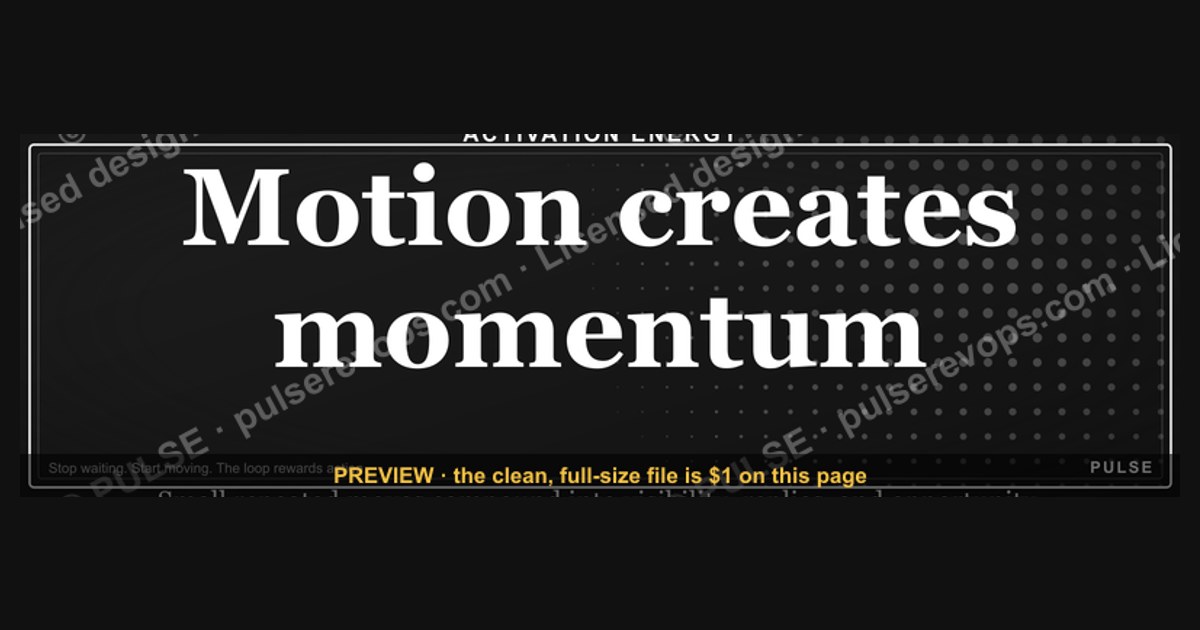
Motion creates momentum means action itself generates the energy that sustains action. On LinkedIn, a wallpaper carrying that line is a commitment device: it signals you are working, not waiting. Small repeated moves — a comment, a message, a profile edit — compound into visibility, replies, and opportunity far faster than any single perfect launch.
The stalled profile problem, in concrete terms
Picture a revenue operations manager named Dana. She has been at the same company four years, has 900 connections, and logs into LinkedIn maybe twice a month — usually because a notification badge nagged her. Her banner is the default blue-gray abstract that ships with every account. Her headline still says her title from two promotions ago. Her last post was a company announcement she reshared without commentary in 2023.
Dana is not lazy. She is stuck in the most ordinary way possible: every path forward looks like it requires a big move. Write a thought-leadership piece. Redo the whole profile. Reach out to thirty people. Each of those feels like a two-hour block she does not have, so she does none of it, and the profile keeps decaying. Meanwhile her peers who post a two-sentence observation twice a week are getting inbound recruiter messages, speaking invitations, and vendor demos they did not chase.
The gap between Dana and those peers is not talent, and it is rarely even quality of insight. It is activation energy. The cost of the first move is priced far above its actual cost, so the move never happens. That is precisely the failure a wallpaper carrying "Motion creates momentum" is designed to interrupt. A cover image is a strange lever — 1584×396 pixels of mostly decorative real estate — but it sits at the top of the one page a professional looks at most often. Every time Dana opens her own profile, the line is the first thing she reads. It is not a strategy. It is a nudge placed at the exact moment the nudge is useful.

The broader version of this problem shows up everywhere in go-to-market work, which is why the phrase resonates with sales and RevOps people specifically. A sequence that never launches because the copy is not finished converts at zero percent. A territory plan revised for six weeks generates no pipeline during those six weeks. A dashboard nobody opens is worth the same as a dashboard that does not exist. The discipline that separates operators who ship from operators who plan is almost never analytical rigor — it is tolerance for launching something imperfect and correcting from live feedback.
So the useful reading of the wallpaper is not "hustle harder." It is narrower and more actionable: reduce the size of the smallest unit of work until starting is trivially easy, then start today rather than at the beginning of the next quarter. The banner exists to keep that instruction in your visual field.
How the momentum loop actually works
There is a mechanism underneath the slogan, and understanding it makes the difference between using it well and treating it as wall art.

Step one: friction reduction. The reason people do not act is almost never the action — it is the imagined scope of the action. "Post on LinkedIn" carries an unstated assumption that a post must be long, polished, and original. Redefine the unit: one comment of two sentences, one message to one person, one line edited in your headline. When the unit drops below roughly five minutes, the internal negotiation stops, because there is nothing worth negotiating about.
Step two: identity shift. Once you have done the thing, even badly, you become a person who does the thing. This is the part most productivity advice skips. Dana who commented once this week is a materially different actor than Dana who has not commented in a year, because the next comment is no longer a first — it is a repeat, and repeats are cheap.
Step three: external feedback. Motion generates responses you cannot generate alone. Someone replies. Someone views your profile. Someone you had forgotten about sends a note. This is the genuinely new energy in the system — you did not manufacture it, your action surfaced it. It is also why sitting and planning cannot substitute: planning produces no external signal to react to.
Step four: signal informs the next motion. The reply tells you what landed. The silence tells you what did not. You now have information you did not have before, which makes the next action better-aimed than the last. This is the same logic as running a small email test before a full send — you are buying data with a cheap action rather than betting everything on a big one.

Step five: compounding. Because each cycle is cheap and each produces signal, the loop can run weekly or daily rather than quarterly. Twenty cycles of a mediocre action beat one cycle of an excellent one, because twenty cycles include twenty corrections.
The loop has one failure point worth naming: if step three never produces a signal, the loop can stall on discouragement. The fix is not to try harder on one channel but to widen the surface — comment, message, and post are three separate signal sources, and it is unlikely all three stay silent for long. That widening is the practical reason a "portfolio of motions" beats a single heroic effort.
What the numbers actually look like
Precision matters here, so separate the things that are documented from the things that are estimates.
Documented and fixed: LinkedIn's personal profile cover image slot is 1584×396 pixels, a 4:1 ratio. That is the number to design against, and it is why the wallpaper file is authored at exactly that size. Mobile crops the banner meaningfully — the profile photo overlaps the lower-left region and the visible vertical band is narrower than on desktop. Practical rule: keep all text inside the horizontal middle third and away from the bottom-left quadrant, or your line gets amputated on phones, which is where a large share of profile views happen.
Format economics: an SVG of a geometric banner is typically a few kilobytes to a few dozen kilobytes, because it stores instructions rather than pixels; the equivalent PNG at 1584×396 is generally a few hundred kilobytes. The practical consequence is not load time — LinkedIn re-encodes uploads anyway — but editability. SVG text stays text, so you can open the file in Figma, Canva, PowerPoint, or Illustrator and swap the line, the accent color, or add your name without any quality loss. Raster editing of a PNG means retyping over a flattened background and matching the font by eye.
Cadence, as a working range rather than a law: a sustainable personal cadence for most working professionals is 10–15 minutes per weekday. Inside that budget, a realistic split is two or three substantive comments, one direct message, and one small profile or content action. That is roughly 50–75 minutes a week — less than a single meeting. Anyone promising you results from three hours a day is selling something; anyone telling you a monthly login is enough is describing decay.
Response rates, honestly stated: cold outreach on any channel is a low-single-digit game; warm re-engagement with people who already know you is dramatically better but still nowhere near universal. Plan for most messages to go unanswered and calibrate your emotional accounting accordingly — if you need a 50% reply rate to feel successful, you will quit in week two. Ten messages producing two real conversations is a good week.
Time-to-visible-effect: profile view counts and post impressions are the first metrics to move, typically within days of restarting activity, because they respond to raw presence. Conversation volume follows on a scale of weeks. Genuine opportunity flow — the recruiter note, the referral, the speaking ask — operates on a scale of months and is lumpy rather than linear. Judging the loop by opportunity flow in week one is the single most common reason people abandon it before it works.
A useful internal ratio: track actions taken per week rather than outcomes per week, at least for the first month. Actions are fully within your control and therefore a fair scorecard; outcomes are not. Once the action count is stable, start watching the ratio of conversations to actions, because that ratio is what improves as your aim gets better.
Trade-offs: the banner is the cheapest lever, not the strongest

It would be dishonest to claim a cover image drives outcomes. It does not. What it does is cheap, immediate, and directionally correct — which is a real category of value, especially for someone stalled.
Rank the levers by cost and by impact and the picture clarifies. Updating the banner costs about two minutes and delivers a small, mostly cosmetic signal that the account is tended. Rewriting the headline and About section costs 30–60 minutes and delivers a much larger effect, because those fields are what search and recruiters read. Consistent commenting costs 10 minutes a day and compounds meaningfully, because it puts your name in front of audiences you did not have to build. Original posting is the highest-variance lever: most posts land quietly, a few travel far, and the only way to catch the far ones is to keep posting. Direct outreach is the highest-conversion lever per unit of effort and the one people avoid most, because rejection is legible.
The honest trade-off is this: the banner's value is almost entirely as an entry point. It is the action small enough that you will actually do it, and doing it makes the next action easier. Treat it as step one of a ladder, not as the work itself. A beautifully branded cover on a profile with a stale headline and no activity is a well-painted door on an empty building.
There are alternatives worth naming. A custom-designed banner from a designer will look better than any template and costs money and turnaround time. A photograph of you speaking or working carries more human signal than a typographic quote and requires having such a photo. A plain company-brand banner is the safest choice if you are heavily identified with your employer and the weakest if you are positioning independently. And a text-free abstract avoids the risk that a motivational line reads as cliché to a skeptical audience — which is a real risk worth weighing, since quote banners are common enough that some readers discount them on sight.
The decision tree above resolves fast for most people: if you do not have a great photo and do not want to spend money, recolor a template and move on to the headline. The wrong answer is spending three weeks deciding, which is the exact inertia the line on the banner is arguing against.
Common pitfalls and how to avoid them
Mistaking motion for busywork. This is the big one. Leaving "Great post!" on forty items is motion in the same sense that idling is driving. The engine is running and you are not moving. The corrective is a quality floor: a comment must add a specific fact, a counterexample, or a question that could not be generated without having read the piece. One such comment outperforms twenty reactions.
Optimizing the artifact instead of shipping it. People spend an hour picking the accent color of a banner and then do not touch their headline. Set a hard cap — ten minutes on the visual, then move down the ladder. If you catch yourself comparing hex codes, the timer has already expired.

Text placement that dies on mobile. Covered above but worth repeating because it is the most frequent technical error: text near the bottom-left disappears behind the profile photo, and text near the outer edges gets cropped on narrow viewports. Preview on a phone before you commit.
Treating silence as verdict. A message with no reply is a data point about timing and framing, not a judgment of your worth. The fix is structural rather than emotional: run enough parallel motions that no single silence carries weight. Three channels running beats one channel scrutinized.
Cadence that requires a good mood. Any routine that depends on feeling motivated will fail within two weeks, because motivation is an output of momentum, not an input. Anchor the routine to an existing habit — the first ten minutes after your morning coffee, the gap before a standing meeting — so the trigger is external and reliable.
Broadcasting without listening. Posting into the void while ignoring your own comment section inverts the loop. The replies are the signal; discarding them means you keep acting without ever aiming better. Budget as much time for responding as for publishing.
Copying someone else's cadence. A creator posting daily has a different job than you do. Borrow the principle, set the volume to what you can sustain for six months, and increase it only after the current level has been boring for a month.
Letting a good week license a bad month. Momentum decays. Three strong weeks followed by six silent ones nets out worse than a steady, unremarkable trickle, because the network's memory of you is short and rebuilding activation energy is the expensive part. The whole argument for small units is that small units survive busy seasons.
Related questions

What size should a LinkedIn banner be?
1584×396 pixels, a 4:1 ratio, for personal profiles. Keep critical text in the horizontal middle and clear of the bottom-left, where the profile photo overlaps on most layouts. Always preview on a phone before saving.
Should I use SVG or PNG for my cover image?
Upload PNG — it is the reliable format for the platform. Keep the SVG as your master file, since vector text stays editable and rescales cleanly when you want to change the line, the color, or add your name later.
Does changing my banner actually get me more profile views?
Not by itself, in any meaningful amount. It signals an active, tended account and it is a two-minute action that makes the next action easier. The views come from commenting, posting, and outreach — the banner is the on-ramp, not the road.
How often should I post to build momentum?
Whatever you can hold for six months. For most working professionals that is two or three substantive comments a week plus one original post every week or two, inside a 10–15 minute daily budget. Consistency beats volume decisively.
What if I have nothing original to say yet?
Then comment first. Reacting specifically to other people's work is lower-risk, generates signal faster, and teaches you which of your observations land. Original posts get easier once you have a few months of comment feedback telling you what your angle actually is.
FAQ
What does "motion creates momentum" mean in a professional context?
It means that action generates the energy that makes further action easier, rather than the reverse. Most people wait to feel ready before they move; the phrase inverts that, arguing that readiness is a byproduct of having already started. In practice it translates to shrinking your smallest unit of work until beginning is trivial, doing it today, and letting the feedback from that first move — a reply, a view, a correction — aim the next one. The compounding is the point: twenty small corrected attempts beat one carefully planned launch.
Is this wallpaper free to use, and can I use it commercially?
The graphic is offered free with no attribution required and no sign-up. It is intended for use as a personal or company profile cover, including in a business context. What you should not do is resell the file itself as a product or present it as your own original design work in a portfolio. If you need it under a specific written license for a corporate compliance process, ask rather than assume — that is a paperwork question, not a permission question.
How do I set it as my LinkedIn background?
Download the file, open your profile, click the edit control on the cover area, and upload. LinkedIn will show a crop and reposition step — use it, and check the result on a phone as well as a desktop, because the mobile crop is tighter and the profile photo overlaps the lower-left corner. If your text is clipped, reposition rather than resize; the 1584×396 source is already the correct ratio.

Can I recolor it or put my own text on it?
Yes. That is the intended use. The recolor controls let you swap the accent and background — including a transparent background — and export as SVG or PNG without a watermark. For deeper edits, open the SVG in Figma, Canva, PowerPoint, or Illustrator; because the text is real vector text rather than baked pixels, you can replace the line with your own tagline, add your name and title, or match your company's exact brand palette.
Will a motivational quote banner make me look generic?
It can, to some audiences — quote banners are common, and a skeptical reader may discount one on sight. Weigh that against your alternatives. If you have a strong photograph of yourself speaking or working, that carries more human signal. If you are heavily identified with your employer, a company-brand banner is safer. A recolored typographic banner is the right pick when you want something clean and on-brand in two minutes and would otherwise ship nothing at all.
How long before I see results from this kind of consistent activity?
Impressions and profile views respond within days, because they track raw presence. Conversation volume shifts over weeks. Real opportunity flow — referrals, recruiter notes, inbound asks — moves on a scale of months and arrives unevenly rather than on a curve. Judge the first month by actions taken, not outcomes received; outcomes are not under your control and scoring yourself on them is how people quit before the loop starts working.
Sources
- https://www.linkedin.com/help/linkedin — LinkedIn Help Center, official guidance on profile fields, cover images, and platform features
- https://hbr.org/ — Harvard Business Review, research and analysis on professional networking, habit formation, and career development
- https://www.apa.org/ — American Psychological Association, research on motivation, goal pursuit, and behavior change
- https://developer.mozilla.org/en-US/docs/Web/SVG — MDN Web Docs, technical reference on SVG as a scalable vector format
- https://www.w3.org/Graphics/SVG/ — W3C, the SVG specification and standards documentation
- https://www.shrm.org/ — Society for Human Resource Management, resources on career advancement and professional development
- https://www.forbes.com/ — Forbes, coverage of personal branding and social platforms in career growth
- https://www.wsj.com/ — The Wall Street Journal, reporting on workplace dynamics and professional networking
Related on PULSE
This page will be disappearing soon. Save it to your device for $1 — or read it free while it is here.
@Kory-White- · if Venmo asks, the last 4 of my number are 2012
This page is gone.
This one is off the shelf now. $1 keeps it on your phone for good — the whole page, pictures and diagrams included.
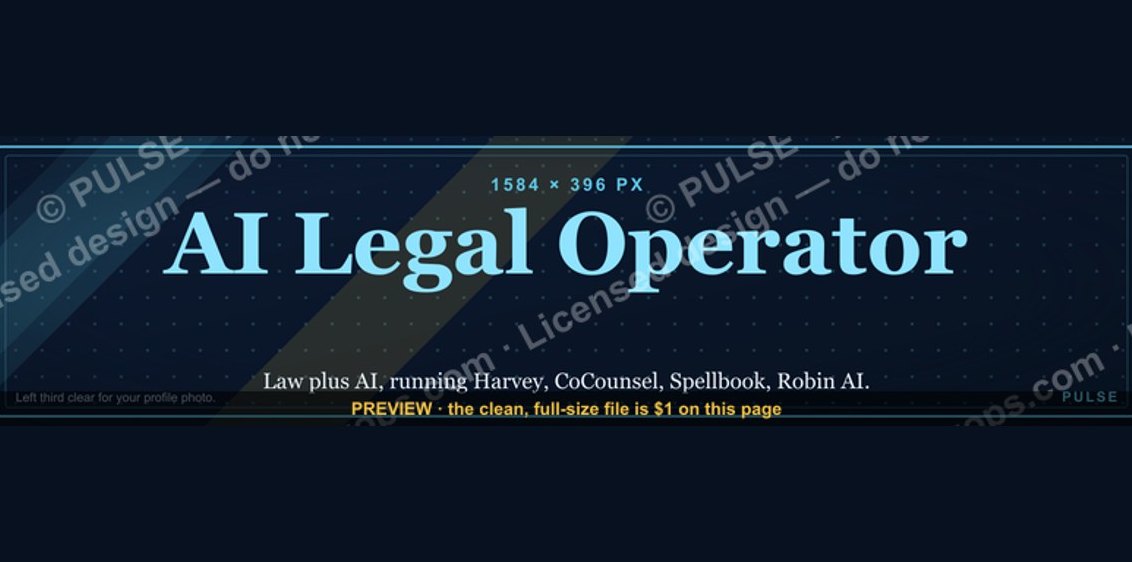 graphicAI Legal Operator — LinkedIn Banner
 graphicHow to build a champion seller playbook in 2027
 graphicHead of Sales — LinkedIn Banner
 graphicProduct Marketing Lead — LinkedIn Banner
 graphic“Ready to lead a sales team.” — LinkedIn Banner
 graphic“The next call is the most important one.” — LinkedIn Banner
 graphicVector Database CTO — LinkedIn Banner
 graphicWhat do top-performing graphic designers do differently in 2027?
 graphic“Process over pressure.” — LinkedIn Banner
 graphicVP of Sales — LinkedIn Banner