


AI Safety Red Team Lead — LinkedIn Banner
Quality
Certified
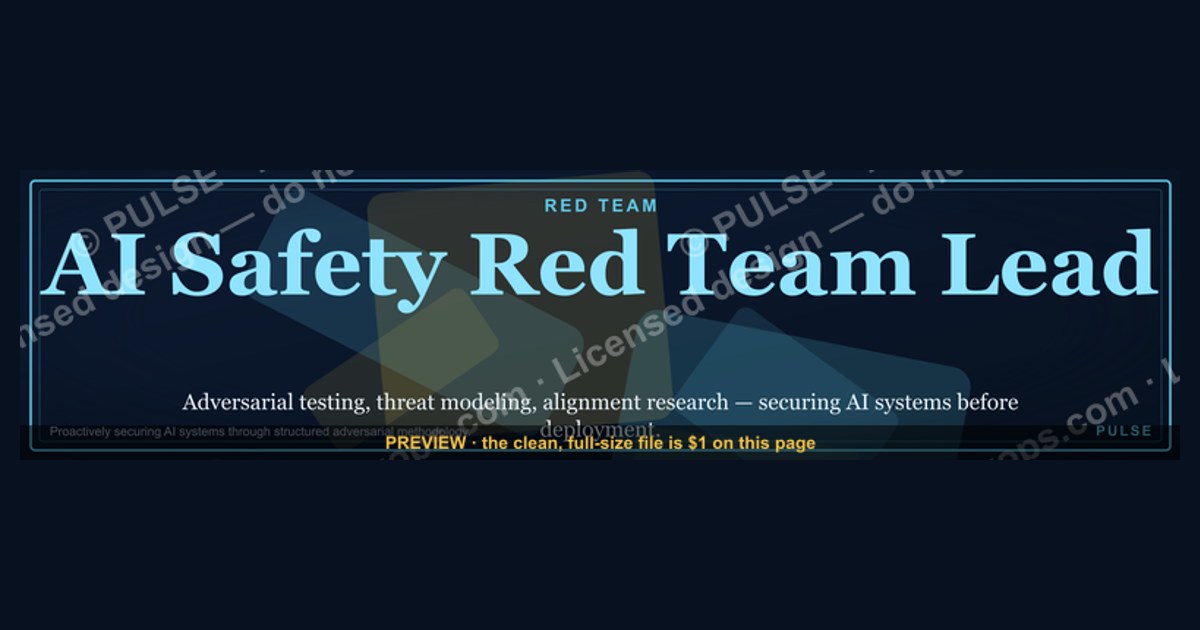
An AI Safety Red Team Lead LinkedIn banner should visually communicate adversarial testing expertise, responsible AI commitment, and technical leadership in a single glance. The optimal design combines a clean, professional aesthetic with subtle security motifs—network nodes, shield icons, or threat-modeling graphics—plus your role title and a concise tagline such as "Proactively securing AI systems." Avoid hype language and focus on concrete signals of red-teaming methodology and alignment research.
The Hiring Manager's First Glance: Why Your Banner Matters
Recruiters and hiring managers at AI labs, enterprise security teams, and government agencies spend an average of six to eight seconds scanning a LinkedIn profile before deciding whether to click "View more" or move to the next candidate. During that brief window, the banner image occupies roughly 30% of the visible screen real estate on desktop—a horizontal strip of 1584×396 pixels that frames your profile photo and headline. For an AI Safety Red Team Lead, this space is prime advertising for a niche skillset that is difficult to convey in a 220-character headline alone.
Consider the context of a typical hiring workflow at a company like Anthropic, Google DeepMind, or a Fortune 500 financial institution building internal LLM applications. The talent team may screen two hundred profiles for a single red team lead opening. They are looking for visual signals that distinguish a practitioner from a theorist: familiarity with red teaming frameworks, evidence of adversarial testing tools, and a professional presentation that suggests they can communicate with executives as well as engineers. A generic banner of a mountain landscape or abstract gradient communicates none of this. A banner that includes a subtle threat-modeling diagram, a shield-and-node motif, or a clean typographic treatment of "AI Safety Red Team" signals that the candidate understands their own professional brand as a safety professional.
The banner also serves a practical function beyond aesthetics. LinkedIn's interface crops the banner differently across devices—desktop shows the full 1584×396 dimension, while mobile displays a narrower central slice. Text placed too close to the edges will be cut off on mobile, and critical visual elements may disappear entirely. A well-designed banner accounts for these cropping variations by keeping essential information—your name, role title, or tagline—within the safe central zone of approximately 1200×300 pixels. This attention to detail itself signals the kind of operational rigor required for red teaming work, where small oversights can lead to significant vulnerabilities.

Building the Banner: Design Decisions That Reflect Red Team Thinking
Creating an effective LinkedIn banner for an AI Safety Red Team Lead requires the same systematic approach you would apply to a threat model. You start by defining the attack surface—in this case, the viewer's attention span and cognitive biases—and then design defenses that maximize information retention and positive impression formation. The process breaks down into four design decisions: layout structure, color psychology, typography hierarchy, and visual metaphor selection.
Layout structure follows a left-to-right, top-to-bottom reading pattern that mirrors how people scan web content. The left third of the banner should contain your name or role title in large, bold type, since this is where the eye naturally lands first. The center third can hold a tagline or core value proposition, such as "Adversarial Testing for Responsible AI" or "Finding Failure Before Users Do." The right third should feature a visual element—a network diagram, shield icon, or abstract representation of model boundaries—that reinforces the safety theme without overwhelming the text. This three-part structure ensures that even a quick glance captures the essential message.
Color psychology plays a significant role in professional perception. Deep blues and dark grays convey trust, technical competence, and stability—qualities that align with safety work. Accent colors like amber or orange can signal alertness and adversarial testing energy, while green suggests safety and approval status. Avoid bright reds or aggressive neon colors that may subconsciously associate with warnings or instability. Many AI safety professionals opt for a dark background with light text, which also makes the banner stand out against LinkedIn's default white interface and creates a sense of premium positioning.

Typography hierarchy should follow a clear order: role title as the largest element, followed by a tagline or specialization, and finally any secondary information like certifications or focus areas. Sans-serif fonts like Inter, Roboto, or Open Sans are standard for tech professionals because they render cleanly at various sizes and project modernity. Avoid decorative or script fonts that sacrifice readability. The font size should be calibrated so that the role title remains legible even when the banner is displayed at LinkedIn's smallest thumbnail size of approximately 400×100 pixels in search results.
Visual metaphor selection is where red team leads can get creative while staying professional. Effective metaphors include: a shield with circuit-board patterns representing defense, a network graph with highlighted nodes indicating attack paths, a lock integrated with neural network nodes, or a magnifying glass over code snippets. One strong approach is using a stylized threat model diagram—showing input, model, output, and potential attack vectors—which immediately communicates domain expertise to those who recognize it. The metaphor should be abstract enough to remain clean at small sizes but specific enough to signal the right domain.
The Technical Toolkit: Tools and Frameworks That Define Your Practice
A LinkedIn banner for an AI Safety Red Team Lead should reflect the actual tools and frameworks you use, because hiring managers increasingly check for alignment with their own technical stacks. The red teaming landscape has matured significantly over the past three years, and a practitioner's toolkit is now a recognizable shorthand for their expertise level.

Python-based red teaming frameworks form the foundation of most AI safety testing programs. PyRIT (Python Risk Identification Toolkit), developed by Microsoft, provides an automated pipeline for generating adversarial prompts, running them against target models, and classifying responses. Garak, an open-source vulnerability scanner for LLMs, offers over 200 built-in probes covering topics from prompt injection to data leakage. Lakera's platform focuses on real-time LLM security monitoring and includes red teaming capabilities. A banner that mentions or visually references these tools—perhaps through a subtle text treatment or icon—signals hands-on experience rather than theoretical knowledge.
Benchmark suites are equally important for demonstrating rigorous evaluation methodology. The OWASP LLM Top 10 provides a structured taxonomy of vulnerabilities, including prompt injection, insecure output handling, training data poisoning, and excessive agency. The AdvBench benchmark, developed by researchers at Carnegie Mellon and other institutions, contains a collection of harmful behaviors for testing model refusal capabilities. The HarmBench framework, released in 2024, standardizes adversarial attack evaluation across multiple model families. A red team lead who can reference these benchmarks in conversation—or subtly in their banner design—demonstrates familiarity with the field's evolving standards.
Operational workflows around these tools matter as much as the tools themselves. A mature red teaming program typically follows a six-phase cycle: scoping (defining the threat model and success criteria), test generation (creating or curating adversarial inputs), execution (running tests against target models), analysis (categorizing failures by severity and type), reporting (translating findings into risk language for stakeholders), and remediation (working with ML engineers to implement fixes and re-test). The banner could reflect this cycle through a circular diagram or process-flow visual, reinforcing that you bring operational discipline, not just technical skill.

Evaluation metrics provide the quantitative backbone that justifies red teaming investment. Common metrics include attack success rate (the percentage of adversarial inputs that bypass safety filters), refusal rate (how often the model appropriately declines harmful requests), false positive rate (how often the model over-refuses benign requests), and coverage percentage (the proportion of threat model categories tested). A lead should track these metrics across model versions to demonstrate improvement or regression. For example, a target might be achieving a 95% refusal rate on a specific category of harmful prompts while maintaining a false positive rate below 5% on benign queries. These numbers belong in your interview conversations and possibly your banner tagline if you have a particularly impressive track record.
Real Numbers: Compensation, Team Sizes, and Program Budgets
Understanding the market context for AI Safety Red Team Leads helps you position yourself accurately on LinkedIn and negotiate effectively when opportunities arise. Public compensation data from sources like Levels.fyi, Glassdoor, and H1B visa disclosure records paints a picture of a rapidly appreciating role.
Compensation ranges vary significantly by organization type. At major AI labs like OpenAI, Anthropic, and Google DeepMind, total compensation for a red team lead typically ranges from $250,000 to $550,000 annually, including base salary, bonus, and equity. The equity component can be substantial—at well-funded startups, it may account for 40-60% of total compensation and can double the cash figure if the company performs well. At enterprise technology companies like Microsoft, Amazon, or Meta, the range is slightly lower but still competitive, typically $220,000 to $450,000. Government and nonprofit organizations pay considerably less, often $150,000 to $250,000, but may offer mission alignment and stability that some candidates prioritize.

Team sizes for AI safety red teaming vary widely based on organizational maturity. A startup with a single LLM product might have a red team of two to four people, including the lead. A major AI lab could have a dedicated safety team of twenty to fifty people, with the red teaming function comprising five to fifteen specialists. Enterprise companies often embed red teamers within broader AI governance or security teams, meaning the "lead" might manage a matrixed team of engineers who split time between red teaming and other responsibilities. Understanding these structures helps you calibrate your LinkedIn profile to the type of organization you are targeting.
Program budgets are rarely public, but industry patterns suggest that a serious red teaming program costs between $500,000 and $5 million annually, depending on compute requirements, external testing contracts, and headcount. Compute costs for running adversarial tests against large models can be substantial—testing a frontier model with millions of prompts may require thousands of GPU hours. External red teaming via platforms like Scale AI or specialized consultancies can add $100,000 to $500,000 per campaign. The lead must be able to articulate these costs and their ROI in terms of avoided incidents, regulatory compliance, and brand protection.
Career trajectory data shows that AI Safety Red Team Leads typically have five to ten years of experience in adjacent fields—machine learning engineering, security research, or applied AI—before stepping into leadership. The role often serves as a stepping stone to broader AI safety leadership positions, such as Head of AI Safety, Chief AI Officer, or Director of Responsible AI. The scarcity of qualified candidates means that many leads are promoted internally from senior individual contributor roles after demonstrating red teaming expertise.
Trade-offs: Internal vs. External Red Teaming, and Other Structural Choices
Every AI Safety Red Team Lead faces a set of structural trade-offs that shape how they design their program, allocate resources, and communicate their approach on LinkedIn and in interviews. Understanding these trade-offs positions you as someone who thinks strategically about the field, not just technically.

Internal vs. external red teaming is the most fundamental structural decision. Internal teams offer consistency, security clearance, and deep product knowledge—they understand the model's intended use cases, the company's risk tolerance, and the technical architecture. They can iterate quickly and maintain continuous testing throughout development. However, they suffer from groupthink, confirmation bias, and limited adversarial creativity. The team may become too familiar with the model and miss novel attack vectors. External red teaming, through platforms like Scale AI's Remotasks, HackerOne bug bounty programs, or specialized consultancies like Robust Intelligence or Cranium, brings diversity of thought, fresh perspectives, and a wider range of attack methodologies. External testers are not constrained by institutional knowledge or politeness. The trade-off is coordination overhead, potential data leakage risks, and the challenge of integrating findings from people who lack deep context about the system.
Automated vs. human-driven testing is another axis of trade-off. Automated tools like PyRIT and Garak can generate and execute thousands of adversarial prompts per hour, providing broad coverage and reproducible results. They are essential for regression testing and for monitoring model updates. However, automated testing often misses subtle, context-dependent vulnerabilities that require human creativity and understanding of social engineering, cultural nuance, or multi-turn conversational dynamics. Human red teamers can probe for these deeper issues but are slower and more expensive. The most effective programs use a layered approach: automated scanning for broad coverage, followed by human-led deep dives on high-risk areas identified by the threat model.
Transparency vs. security is a tension that affects how red teaming findings are handled. Publishing vulnerability disclosures contributes to collective safety by helping other organizations harden their systems. However, detailed disclosures can also serve as attack recipes for malicious actors. The lead must work with legal and communications teams to determine what can be shared publicly, what should be reported through coordinated disclosure channels, and what must remain internal. This trade-off is particularly acute for frontier AI labs, where findings about model capabilities could have national security implications.

Breadth vs. depth in testing scope is a resource allocation question. A red team can either test a wide range of potential vulnerabilities at a shallow level or focus deeply on a few high-priority threat categories. The threat model should guide this decision. For a customer-facing chatbot, deep testing of prompt injection and harmful content generation may be more valuable than broad testing of data extraction attacks. For a code generation model, the priority might shift to producing vulnerable code or enabling cyberattacks. The lead must continuously rebalance based on emerging threats and organizational priorities.
Speed vs. thoroughness is the eternal tension in safety work. Model release deadlines pressure red teams to complete testing quickly, but thorough testing requires time. The lead must develop a triage system that identifies the most critical tests to run first, communicates residual risk to decision-makers, and documents what was not tested. This risk acceptance process is a core leadership responsibility, and it requires the ability to quantify and communicate uncertainty.
Common Pitfalls: What Makes Red Team Leads Fail—and How to Avoid Them
The path to becoming a successful AI Safety Red Team Lead is littered with common mistakes that can derail a career or undermine a red teaming program. Being aware of these pitfalls—and knowing how to avoid them—will make you a stronger candidate and a more effective leader.
Pitfall one: Red teaming theater. This occurs when a program produces findings but those findings do not lead to meaningful changes. The red team runs thousands of prompts, documents dozens of vulnerabilities, and then the findings are filed away without triggering remediation. The lead must fight against this by establishing clear feedback loops with engineering teams, tracking remediation rates, and escalating unresolved high-severity findings to executive leadership. On your LinkedIn profile, you can signal that you avoid this pitfall by highlighting metrics like "remediated 90% of high-severity findings within two weeks" or "reduced attack success rate by 75% across three model versions."

Pitfall two: Over-indexing on quantity over quality. Teams that are evaluated on the number of findings they produce will naturally optimize for volume, generating hundreds of low-severity issues while missing the few critical vulnerabilities that actually matter. The lead must establish a severity classification system and focus the team's energy on high-impact findings. This requires the courage to tell stakeholders that a finding is not worth fixing, just as much as advocating for the critical ones.
Pitfall three: Poor communication with non-technical stakeholders. Red teaming findings are often nuanced—a model might refuse 90% of harmful prompts but fail on specific categories or in specific languages. Translating this nuance into actionable risk language for product managers, legal teams, and executives is a core skill. Many technical leads fail because they cannot articulate why a vulnerability matters in business terms, such as regulatory risk, brand damage, or user harm. The lead must develop a communication framework that maps technical findings to organizational risk.
Pitfall four: Neglecting the positive side of safety. Red teaming focuses on finding failures, but a mature program also evaluates what the model does well. Understanding refusal rates, appropriate behavior, and safety successes helps calibrate testing and provides a balanced picture for stakeholders. Overly negative reporting can lead to safety-fatigue, where stakeholders tune out findings because everything seems broken.
Pitfall five: Failing to stay current. The AI safety landscape evolves rapidly. New attack techniques emerge monthly, new benchmarks are released quarterly, and new regulations appear yearly. A red team lead who relies on last year's toolkit will miss emerging threats. This requires a commitment to continuous learning—reading academic papers, participating in community forums, attending conferences, and experimenting with new tools.

Pitfall six: Ignoring the human element of AI safety. Red teaming often focuses on technical vulnerabilities, but human factors—social engineering, user error, and organizational incentives—can be equally significant. A comprehensive safety program considers the full sociotechnical system, not just the model in isolation. The lead should collaborate with user research teams, policy teams, and customer support to understand how real users interact with the system and where safety failures might emerge in practice.
Related Questions
What are the most important skills to highlight in an AI Safety Red Team Lead LinkedIn banner?
Highlight adversarial testing frameworks like PyRIT or Garak, threat modeling expertise, and experience with benchmarks such as OWASP LLM Top 10. Include quantifiable outcomes like reduced attack success rates and emphasize communication skills for translating technical findings to executives.
How does an AI Safety Red Team Lead banner differ from a general cybersecurity banner?
The AI safety banner should emphasize model-specific risks like prompt injection, jailbreaks, and data poisoning rather than network or infrastructure security. Visual motifs should reflect neural networks, model boundaries, or alignment concepts rather than firewalls or server racks.
What tagline works best for an AI Safety Red Team Lead banner?
Effective taglines are specific and action-oriented, such as "Proactively securing AI systems," "Finding model failures before users do," or "Adversarial testing for responsible AI deployment." Avoid vague phrases like "AI enthusiast" or "Safety advocate" that lack technical specificity.
Should the banner include tools like PyRIT or Garak?
Yes, if you have hands-on experience. Mentioning specific tools signals practical expertise and aligns with hiring managers' technical stack requirements. A subtle text treatment or icon referencing these tools is effective without cluttering the design.
FAQ

What is the ideal file format and size for a LinkedIn banner? LinkedIn recommends a 1584×396 pixel image for the banner, with a file size under 8MB. SVG files scale without quality loss and are ideal for design work, but LinkedIn requires JPG or PNG for upload. Export your SVG as a high-resolution PNG for the best results.
How often should I update my AI Safety Red Team Lead banner? Update your banner when your role changes, when you complete major certifications, or when you want to reflect new expertise areas. A quarterly review is reasonable to ensure the banner stays current with your skills and the evolving field.
Can I use AI-generated images for my banner? Yes, but ensure they are professional and relevant. AI-generated images can create custom motifs, but avoid generic or overly abstract designs that do not signal safety expertise. Review the image at small sizes to ensure text and key elements remain legible.
Should the banner include my contact information? No. LinkedIn already provides contact options through your profile. The banner should focus on professional branding and value proposition, not duplicate information available elsewhere.
What colors are most appropriate for an AI safety banner? Deep blues, dark grays, and muted teals convey trust and technical competence. Accent colors like amber or green can highlight specific elements. Avoid bright reds or aggressive colors that may signal danger rather than safety expertise.
Sources
- LinkedIn Help Center — https://www.linkedin.com/help/linkedin
- OWASP LLM Top 10 — https://owasp.org/www-project-top-10-for-large-language-model-applications/
- NIST AI Risk Management Framework — https://www.nist.gov/itl/ai-risk-management-framework
- Microsoft PyRIT Documentation — https://github.com/Azure/PyRIT
- Garak Vulnerability Scanner — https://github.com/NVIDIA/garak
- Partnership on AI — https://partnershiponai.org
- Levels.fyi Compensation Data — https://www.levels.fyi
- IEEE AI Safety Standards — https://standards.ieee.org
- Center for AI Safety — https://www.safe.ai
- HackerOne AI Bug Bounty Programs — https://www.hackerone.com
Related on PULSE
This page will be disappearing soon. Save it to your device for $1 — or read it free while it is here.
@Kory-White- · if Venmo asks, the last 4 of my number are 2012
This page is gone.
This one is off the shelf now. $1 keeps it on your phone for good — the whole page, pictures and diagrams included.
 graphicHow to build a champion champion plan in 2027?
 graphic“Process over pressure.” — LinkedIn Banner
 graphicMake it predictable. — LinkedIn Wallpaper
 graphicHow to design a LinkedIn banner that converts viewers into leads in 2027?
 graphicFaster deals, fewer leaks. — LinkedIn Wallpaper
 graphic“Bring the energy every call.” — LinkedIn Banner
 graphicAccount Executive — LinkedIn Banner
 graphicIndustrial Robotics CRO — LinkedIn Banner
 graphic"Pipeline is the product." — LinkedIn Banner
 graphicSales Ops Analyst — LinkedIn Banner