 Pulse Reviews and Analysis
The 10 Best Vector Databases for RAG in 2027
 Curated by Kory White · Fractional CRO, CRO Syndicate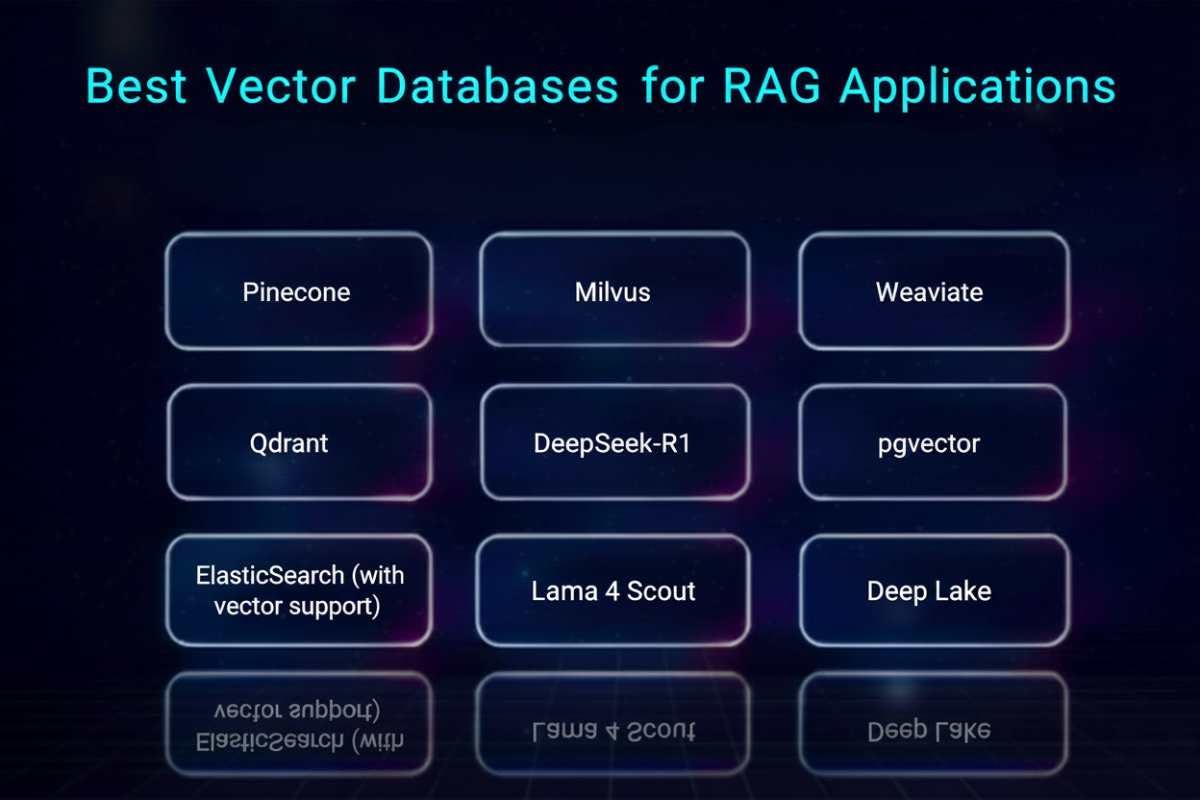
The 10 Best Vector Databases for RAG in 2027
Retrieval-augmented generation (RAG) lives or dies on the vector database underneath it. The store you pick decides your recall quality, your tail latency, your bill, and how much operational pain your team absorbs at 3 a.m. This ranking covers the ten vector databases that production AI teams actually reach for in 2027, from purpose-built managed services like Pinecone to embed-it-in-Postgres options like pgvector.
Direct Answer
Pinecone is the best overall vector database for most production RAG systems because it removes nearly all operational burden while delivering predictable low-latency retrieval at scale. pgvector is the best value because it lets you run vector search inside the PostgreSQL you already operate, avoiding a new system entirely.
The right pick depends on whether you want a managed service, an open-source engine you self-host, or vector search bolted onto a database you already run.
How We Ranked These
We weighed each option on five practical criteria: recall and ranking quality at realistic dataset sizes, query latency at p95 and p99, operational burden (managed vs. Self-hosted, ease of scaling), hybrid and metadata filtering (combining dense vectors with keyword and structured filters), and cost predictability.
Pricing is described in generic terms because vendor list prices change frequently; always confirm current rates and run your own benchmark on your embeddings before committing.
1. Pinecone 🏆 BEST OVERALL
Pinecone is a fully managed vector database built specifically for similarity search and RAG. You create an index, upsert vectors with metadata, and query — the service handles sharding, replication, and index builds for you. Its serverless architecture separates storage from compute so you pay for what you actually query rather than for idle nodes, which suits spiky RAG traffic well.
Pinecone supports hybrid search (combining dense and sparse vectors), rich metadata filtering, and namespaces for multi-tenant isolation.
Strengths: near-zero operational overhead, consistent low latency, strong metadata filtering, mature SDKs. Best for: teams that want production RAG without running infrastructure. Pricing/availability: managed SaaS with a free starter tier and usage-based serverless billing; enterprise plans add SSO and dedicated capacity.
2. Pgvector (PostgreSQL) 💎 BEST VALUE
pgvector is an open-source extension that adds vector columns and similarity operators to PostgreSQL. If you already run Postgres, you can store embeddings beside your relational data, join vectors against business tables, and query both with a single SQL statement. Modern pgvector supports HNSW and IVFFlat indexes, and managed Postgres providers (Supabase, Neon, AWS RDS, Google Cloud SQL, Azure) all expose it.
Strengths: no new system to operate, transactional consistency, SQL-native filtering, huge ecosystem. Best for: teams with moderate vector volumes who value simplicity and already depend on Postgres. Pricing/availability: free and open source; you pay only for the Postgres instance, which makes it the cheapest credible option for many workloads.
3. Weaviate
Weaviate is an open-source vector database with a built-in module system for embeddings, hybrid search, and generative pipelines. It can call embedding models for you, store objects with schema, and run BM25 + vector hybrid queries natively. Weaviate offers both a self-hosted open-source build and Weaviate Cloud, a managed service.
Strengths: native hybrid search, modular embedding integrations, GraphQL and REST APIs, multi-tenancy. Best for: teams that want hybrid search and tight model integration out of the box. Pricing/availability: open source to self-host; managed cloud billed by stored dimensions and throughput.

Reach Kory White, Fractional CRO: 📅 Book a Quick Call · 💼 Kory on LinkedIn · 🏢 CRO Syndicate
4. Qdrant
Qdrant is a high-performance open-source vector database written in Rust, known for efficient filtering and memory use. Its payload-based filtering lets you combine vector similarity with structured conditions efficiently, and it supports quantization (scalar and binary) to shrink memory footprint dramatically for large collections.
Strengths: fast filtered search, strong quantization options, simple API, low resource use. Best for: large filtered datasets where memory cost matters. Pricing/availability: open source plus Qdrant Cloud managed service with free and usage-based tiers.
5. Milvus
Milvus is an open-source vector database designed for very large scale, with a distributed architecture that separates compute, storage, and coordination. It supports many index types (HNSW, IVF, DiskANN) so you can trade recall, latency, and cost deliberately. Zilliz Cloud is the managed offering from the same team.
Strengths: scales to billions of vectors, broad index choice, GPU acceleration options. Best for: the largest RAG and search workloads. Pricing/availability: open source; Zilliz Cloud managed service billed by capacity and compute.
6. Chroma
Chroma is an open-source, developer-friendly vector database popular for prototyping and small-to-medium RAG apps. It has a clean Python-first API, runs embedded in your process or as a server, and integrates tightly with frameworks like LangChain and LlamaIndex.
Strengths: trivial to start, great developer experience, good for local and small deployments. Best for: prototypes and apps that don't yet need distributed scale. Pricing/availability: open source; a hosted Chroma Cloud option is available for teams that want it managed.
7. Redis (with vector search)
Redis offers vector similarity search through its query engine, letting you store embeddings alongside the caching and data structures Redis already provides. Because retrieval happens in memory, Redis delivers very low latency, and you can combine vectors with full-text and tag filters in one query.
Strengths: extremely low latency, unifies cache and vector store, mature operations. Best for: latency-critical RAG where you already use Redis. Pricing/availability: open source core; Redis Cloud and Redis Enterprise add managed scaling and persistence.
8. Elasticsearch / OpenSearch
Elasticsearch and the OpenSearch fork both support dense vector fields with HNSW indexing alongside their mature keyword search. This makes them strong choices for hybrid retrieval, where lexical BM25 scoring and semantic vectors are blended, and for teams that already run these engines for logs or search.
Strengths: best-in-class hybrid lexical + semantic search, mature operations, rich aggregations. Best for: teams that already operate Elastic/OpenSearch and want to add semantic retrieval. Pricing/availability: open source (OpenSearch) and source-available (Elasticsearch); managed via Elastic Cloud, Amazon OpenSearch Service, and others.
9. MongoDB Atlas Vector Search
MongoDB Atlas Vector Search adds approximate nearest-neighbor search to the Atlas managed database, so you can store documents and their embeddings together and filter vectors with the same query language you use for the rest of your data. This appeals strongly to teams already standardized on MongoDB.
Strengths: documents and vectors in one store, familiar query model, fully managed. Best for: existing MongoDB shops adding RAG. Pricing/availability: part of the managed Atlas service, billed with your cluster.
10. Vespa
Vespa is an open-source serving engine for combined vector, lexical, and structured search with custom ranking. It is built for demanding retrieval and recommendation workloads and gives you fine-grained control over multi-phase ranking, which is valuable for sophisticated RAG and search relevance.
Strengths: powerful ranking framework, true hybrid retrieval, proven at large scale. Best for: teams that need advanced relevance tuning and can invest in the learning curve. Pricing/availability: open source to self-host; Vespa Cloud offers a managed option.
How to Choose
Frequently Asked Questions
Do I even need a dedicated vector database for RAG? Not always. For small corpora or when you already run PostgreSQL, pgvector or another database-native option may be enough. Dedicated vector databases earn their keep when you have millions of vectors, strict latency targets, or heavy concurrent traffic.
What is hybrid search and why does it matter? Hybrid search combines dense vector similarity with sparse or keyword (BM25) scoring. It improves recall on queries with rare terms, names, or codes that pure embeddings miss. Weaviate, Elasticsearch, OpenSearch, Qdrant, and Redis all support hybrid retrieval.
How important is metadata filtering? Very. Production RAG almost always filters by tenant, document type, date, or permissions before or during vector search. Qdrant, Pinecone, and pgvector are all strong at combining filters with similarity efficiently.
HNSW or IVF — which index should I use? HNSW gives high recall and low latency at the cost of memory and slower builds; IVF (and IVF-PQ) trade some recall for much lower memory. Start with HNSW for quality, move to IVF or quantization when memory cost becomes the constraint.
Can I switch vector databases later? Yes, because your embeddings are portable vectors. Re-indexing into a new store is straightforward, though you should re-tune index parameters and re-benchmark recall and latency on the new engine.
How do I keep costs predictable? Use quantization to cut memory, choose serverless or usage-based billing for spiky traffic, cache frequent queries, and benchmark recall-vs-cost trade-offs before scaling. Avoid over-provisioning fixed nodes for traffic that is bursty.
Sources
- Pinecone official documentation
- Pgvector project documentation (GitHub)
- Weaviate official documentation
- Qdrant official documentation
- Milvus and Zilliz documentation
- Redis vector search documentation
- Elastic and OpenSearch k-NN / dense vector documentation
- MongoDB Atlas Vector Search documentation