


Negotiation Genius by Malhotra and Bazerman — Cliff Notes Summary
Quality
Certified
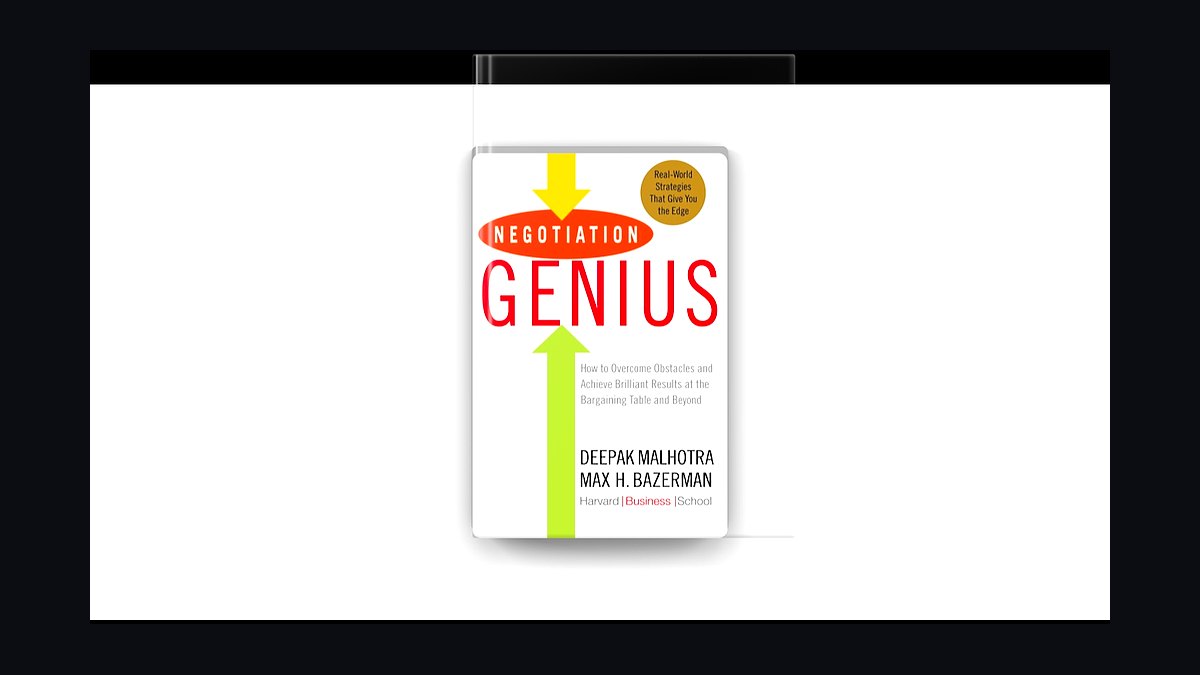
Negotiation Genius by Deepak Malhotra and Max H. Bazerman (Bantam, 2007) is Harvard's practical playbook for negotiation, built on behavioral economics rather than personality. Its core claim is that negotiation excellence is learnable: prepare a BATNA and reservation price, investigate the other side's real interests, neutralize five predictable cognitive biases, and negotiate inside clear ethical lines. This Summary distills that framework into an actionable strategy.
Two paths through the book: toolkit-first versus psychology-first
The most useful way to read this book — and the fastest way to turn a Summary into a working strategy — is to recognize that Malhotra and Bazerman built it as two interlocking halves, and you can enter through either one. The first path is the Negotiator's Toolkit: the mechanical, preparation-heavy machinery of claiming and creating value. The second is the Psychology of Negotiation: the behavioral economics that explains why smart, well-prepared people still leave money on the table. Neither half works alone, and the authors are explicit that the second half is what separates a competent negotiator from a "genius."
The toolkit path is the one most practitioners adopt first because it is concrete and immediately testable. It starts with three numbers you write down before any conversation: your BATNA (Best Alternative To a Negotiated Agreement), your reservation price (the walk-away point), and your estimate of the counterparty's reservation price, which together define the ZOPA — the Zone of Possible Agreement. Malhotra and Bazerman argue that most negotiators over-index on charisma and under-index on preparation, and that power in the room is determined almost entirely by the quality of your alternatives outside it. A negotiator with a strong BATNA can walk; a negotiator without one is negotiating from necessity, and both sides usually know it.

The psychology path is subtler and, for experienced dealmakers, more valuable. Bazerman's earlier academic work on managerial judgment and the Kahneman-Tversky tradition of prospect theory feed directly into the book's catalog of biases: fixed-pie thinking, anchoring, framing, availability, and escalation of commitment. Each one is a predictable, documented failure mode. Fixed-pie bias makes negotiators treat every gain for the other side as a loss for themselves, which destroys the logrolling trades that create value. Anchoring lets the first number on the table drag the entire settlement toward it. Framing flips decisions when identical math is presented as a gain versus a loss. Availability bias lets the last horror-story deal distort your read of this one. Escalation of commitment keeps people throwing good money after bad to justify a prior investment.
Where the two paths intersect is the book's real insight: preparation is not just about knowing your numbers, it is about knowing your own biases well enough to design around them. Malhotra and Bazerman recommend writing your target, reservation price, and BATNA on paper and physically referencing them mid-conversation, precisely so that the emotional, reactive part of your brain cannot quietly renegotiate your own position while you are under pressure. That is a strategy, not a slogan — it converts self-control into a checklist.

A third, often-overlooked path runs through the ethics material. The authors draw a firm line between lies of commission (active false statements about material facts — illegal and unethical, full stop), lies of omission (case-by-case, generally permissible absent a fiduciary duty), and strategic deception like puffery or fake walk-aways (a grey zone they advise avoiding for reputational and long-game reasons). Their operating frame — negotiate as if the transcript will be published — is a strategy that pays off across repeated deals, which is exactly the context most revenue, procurement, and partnerships teams operate in. If you only read one half, read the psychology half; if you only have an hour, read the chapters on Investigative Negotiation and Post-Settlement Settlement.
How to decide which half to lead with
The decision is not arbitrary. It depends on your deal context, your experience level, and where your last three negotiations actually went wrong.
The logic behind this flow is diagnostic rather than prescriptive. If you did not know your BATNA, no amount of psychological sophistication will save you — you are negotiating from a position you never defined. If you knew your numbers but never learned what the other side actually needed, you left integrative value on the table, and Investigative Negotiation is your next read. If you did both and still got dragged, the problem is bias management, and the fix is structural: written pre-commitment, an outside view from someone uninvolved, and decision trees for uncertain outcomes. Only after those three gates are cleared does it make sense to layer on advanced tactics like contingency contracts and post-settlement settlement.

Malhotra's signature contribution, Investigative Negotiation, is organized around five questions: What does the other side really want? What is behind their stated position? What constraints are they under? What is their BATNA? And what shared interest exists? The book illustrates this with a pharmaceutical sourcing case in which a supplier refused to extend an exclusivity deal. The buyer eventually discovered the supplier had a religious-holiday production constraint that had never come up, and a two-week schedule shift resolved the impasse entirely. The principle the authors extract is blunt: the most expensive question in negotiation is the one you never asked.
Concrete numbers behind each option
The book is deliberately light on hard statistics, but the numbers it does supply are load-bearing, and a good Summary should preserve them rather than smooth them into vague advice.
Start with the preparation triad. Your BATNA is not a feeling; it is a specific, verifiable alternative — a competing offer, a signed term sheet, an internal build option, a do-nothing baseline. Your reservation price is the point at which that alternative becomes more attractive than the deal on the table, and it should be calculated, not guessed. The ZOPA is the overlap between your reservation price and your estimate of theirs; if the overlap is empty, the honest move is to walk early rather than grind through a negotiation that cannot close. Malhotra and Bazerman treat these as three numbers that must exist in writing before the meeting, because a negotiator who has not written them down does not actually have them.

Then there is Post-Settlement Settlement, the book's most underused tactic and the one with the clearest reported figure. After both sides have shaken hands, you propose: now that we have a deal, is there a way we could both do better? Because the deal is locked, neither side fears losing it, and both can explore freely. The authors report that this technique surfaces value improvements in roughly 40% of cases, on the reasoning that the original deal almost never sits on the Pareto frontier. That 40% figure is the single most quotable number in the book, and it is worth internalizing: a meaningful share of the value in a typical negotiation is left on the table not because anyone negotiated badly, but because nobody asked the second question.
Contingency Contracts supply the third cluster of concrete mechanics. When you and the counterparty genuinely disagree about a future state — will the equipment run 10,000 hours, will the drug pass trials, will the integration ship on time — do not fight the disagreement to a standstill. Structure the deal so payment varies with the actual outcome. If the seller insists the equipment will run 10,000 hours, tie payment to measured uptime. Honest sellers accept these terms because they believe their own forecast; deceptive ones balk, which makes the contingency contract function as a lie-detector as well as a value-creation device. The authors also recommend contingency contracts as a debiasing tool, because they convert an unresolvable argument about the future into a structured bet that both sides can price.

On the bias side, the catalog is five items and worth memorizing as a set: fixed-pie bias, anchoring, framing, availability, and escalation of commitment. The companion chapter on "biases of the heart" adds egocentrism, overconfidence, self-serving fairness judgments, and regret aversion, drawing on Linda Babcock's research on gender and negotiation and on labor disputes where both sides sincerely believed they were the reasonable party. Bazerman's line here is memorable: the biggest barrier to negotiation success is the negotiator. The remedy is procedural — write target, reservation price, and BATNA before the meeting and reference them during it.
Finally, the ethics numbers are categorical rather than statistical. Lies of commission: banned. Lies of omission: case-by-case. Strategic deception such as puffery or a fake walk-away: a grey zone the authors advise avoiding, because the reputational cost compounds across repeated deals. For teams that negotiate with the same vendors, partners, or customers quarter after quarter, that compounding argument is the whole ballgame.
Implementation details and sequencing
Turning the book into an operating routine is where most readers stall, so it helps to see the sequence as a loop rather than a checklist. The prep loop runs before the conversation; the bias loop runs during it; the value loop runs after the handshake.

Sequencing matters more than most readers expect. Research comes first because your anchor, your questions, and your contingency design all depend on knowing the counterparty's constraints and alternatives. The BATNA and reservation price come second because they define the boundary of anything you are allowed to accept. Only then do you prepare an anchor — and the book is specific that the anchor must be researched and defensible. Anchoring with a number you cannot justify is puffery at best and deception at worst; anchoring with a number you can defend with data is standard, legitimate practice.
The five Investigative Negotiation questions come next, and they should be asked early, in the first ten minutes if possible, because they shape everything downstream. What does the other side really want? What is behind their position? What constraints are they under? What is their BATNA? What shared interest exists? Notice that four of the five are about them, not you — that asymmetry is the point. Investigative Negotiation reframes the encounter from gladiator combat to detective work, and the negotiator who asks the most useful questions usually ends up with the better deal regardless of who talks more.
Logrolling follows naturally once you know what the other side values. The mechanic is trading across issues where the two parties have asymmetric preferences: if the buyer cares more about delivery date and the seller cares more about payment terms, both can win by trading what they value less for what they value more. The book's orange story — two sisters fighting over a single orange, one wanting the juice and one wanting the peel — is the canonical illustration of how positions hide interests. The operational rule is to negotiate multiple issues simultaneously rather than one at a time, because single-issue negotiations collapse into fixed-pie contests by construction.
Contingency contracts close the loop on uncertainty, and Post-Settlement Settlement closes the loop on value. Then comes the step most teams skip entirely: the debrief. Which bias nearly moved you off your written plan? Did an anchor drag you? Did a loss frame make you reject a deal that was mathematically identical to one you would have accepted as a gain? Did escalation of commitment keep you in a negotiation three rounds past your reservation price? Naming the near-miss is how the bias catalog stops being trivia and starts being a strategy you actually run.
Two structural cautions belong in any implementation plan. First, multi-party negotiation is exponentially more complex than two-party negotiation, and the authors recommend caucus-style sub-negotiations to identify coalition partners before plenary sessions — a point that maps directly onto modern procurement, where a single vendor conversation is often really five internal stakeholder conversations wearing a trench coat. Second, when your BATNA is genuinely weak, the playbook shifts rather than breaks: investigate shared interests harder, broaden the deal scope so more issues create more trade opportunities, and build coalitions to manufacture leverage you do not have on your own. The book cites the Pixar-Disney dynamic under Steve Jobs as an illustration of leveraging emotional commitment and relationship capital to extract terms a standalone BATNA could never have justified.

What has aged and what holds up is worth a short note, because a good Summary should be honest about shelf life. The toolkit is timeless — BATNA, anchoring, logrolling, and Investigative Negotiation remain the operating system of every modern deal desk, and the bias catalog has only been reinforced by two more decades of behavioral research. The ethics chapter has arguably become more relevant as regulators scrutinize deceptive commercial tactics. What has aged is the texture: the 2007 examples skew toward in-person, manual negotiation, and the book predates the remote-deal era, where video and asynchronous negotiation introduce signal-loss dynamics the authors never address. Modern negotiators also contend with identity-protective cognition, confirmation bias, and sunk-cost effects that 2007-era behavioral science had not yet operationalized for the bargaining table. Read the frameworks as durable and the examples as period pieces.
Related questions
Is Negotiation Genius better than Getting to Yes?
They serve different purposes. Fisher and Ury's 1981 classic introduced principled negotiation and the BATNA concept; Malhotra and Bazerman build on it with behavioral economics, the bias catalog, and Investigative Negotiation. Read Getting to Yes for the philosophy and Negotiation Genius for the playbook.
Should sellers use the five Investigative Negotiation questions instead of MEDDPICC?
They are complementary, not substitutes. MEDDPICC qualifies whether a deal is real; Investigative Negotiation extracts hidden value once you are inside one. Best-in-class revenue operations teams run both, using qualification to decide where to invest and investigation to decide how to trade.
Is anchoring ethical?

Anchoring with a researched, defensible number is standard practice. Anchoring with a number you cannot defend is puffery at best and deception at worst. The book's rule is simple: always be able to justify your anchor with data.
Does Post-Settlement Settlement actually work?
Yes, when both parties trust the relationship will outlive the deal. The authors report it surfaces improvements in roughly 40% of cases. It fails in purely transactional settings where one side fears reopening the deal will unravel the original terms.
How does Negotiation Genius compare to Never Split the Difference?
Chris Voss is tactical — labels, mirrors, calibrated questions drawn from FBI hostage work. Malhotra and Bazerman are strategic — preparation frameworks, bias management, and ethics. Most operators run Voss's tactics inside the Malhotra-Bazerman strategy.
FAQ
Which chapter should I read first if I only have an hour? Chapter 3 on Investigative Negotiation and Chapter 14 on Post-Settlement Settlement. Those two alone will change how you negotiate next week, because one teaches you to find hidden interests and the other teaches you to harvest value after the deal appears closed.
What are the five biases the book warns about?

Fixed-pie bias, anchoring, framing, availability, and escalation of commitment. A companion chapter adds egocentrism, overconfidence, self-serving fairness judgments, and regret aversion — the "biases of the heart" that survive even when your analysis is correct.
What is a Contingency Contract and when should I use one? It is a deal structure where payment varies with an actual future outcome, used when the two sides genuinely disagree about what will happen. It converts an unresolvable argument into a structured bet, and it doubles as a lie-detector because honest counterparties accept the terms.
What is the ZOPA and why does it matter? The Zone of Possible Agreement is the overlap between your reservation price and your estimate of theirs. If the overlap is empty, no deal exists and the right move is to walk early rather than grind through a negotiation that cannot close.
How should I handle a weak BATNA? Investigate shared interests harder, broaden the deal scope so more issues create more trade opportunities, and build coalitions to manufacture leverage. The book's Pixar-Disney example shows relationship capital can substitute for structural leverage.
Does the book's ethics guidance still hold up? Yes, and arguably more so. The commission-omission-deception framework maps cleanly onto modern regulatory scrutiny, and the "negotiate as if the transcript will be published" test is a durable strategy for anyone negotiating repeatedly with the same counterparties.
Sources
- Harvard Program on Negotiation — https://www.pon.harvard.edu
- Deepak Malhotra faculty page, Harvard Business School — https://www.hbs.edu/faculty/Pages/profile.aspx?facId=252587
- Max H. Bazerman faculty page, Harvard Business School — https://www.hbs.edu/faculty/Pages/profile.aspx?facId=6419
- Negotiation Genius publisher page, Penguin Random House — https://www.penguinrandomhouse.com/books/56216/negotiation-genius-by-deepak-malhotra-and-max-h-bazerman/
- Kahneman and Tversky, "Prospect Theory: An Analysis of Decision Under Risk," Econometrica — https://www.jstor.org/stable/1914185
- Robert Cialdini, Influence — https://www.influenceatwork.com
- Roger Fisher and William Ury, Getting to Yes — https://www.penguinrandomhouse.com/books/33025/getting-to-yes-by-roger-fisher-and-william-ury/
- Chris Voss, Never Split the Difference — https://www.blackswanltd.com/never-split-the-difference
Related on PULSE
- Never Split the Difference by Chris Voss — Cliff Notes Summary for Sellers
- Getting to Yes by Fisher and Ury — Cliff Notes Summary for Sellers
- Inked by Jeb Blount — Cliff Notes Summary for Sales Leaders
- Influence by Robert Cialdini — Cliff Notes Summary for Sellers
- Thinking, Fast and Slow by Daniel Kahneman — Cliff Notes Summary for Sellers
This page will be disappearing soon. Save it to your device for $1 — or read it free while it is here.
@Kory-White- · if Venmo asks, the last 4 of my number are 2012
This page is gone.
This one is off the shelf now. $1 keeps it on your phone for good — the whole page, pictures and diagrams included.
 pulse-recentThe Transparency Sale by Todd Caponi — Top 10 Key Takeaways for Sales Leaders in 2027
 pulse-recentStart with No by Jim Camp — Top 10 Key Takeaways for Sales Leaders in 2027
 pulse-recentConceptual Selling by Robert Miller and Stephen Heiman — Top 10 Key Takeaways for Sales Leaders in 2027
 book-summaryWhat factors drive the price of Book Summaries up or down in 2027?
 pulse-recentWhat are the concrete steps in Sandler Rule #7 for handling a prospect's budget objection in 2027?
 pulse-recentCoaching Salespeople into Sales Champions by Keith Rosen — Top 10 Key Takeaways for Sales Leaders in 2027
 pulse-recentWhat is the first concrete step in The Sandler Rules by David Mattson for a sales leader to implement the system in 2027?
 pulse-recentSales EQ by Jeb Blount — Top 10 Key Takeaways for Sales Leaders in 2027
 pulse-recentProActive Selling by Skip Miller — Top 10 Key Takeaways for Sales Leaders in 2027
 pulse-recentCrossing the Chasm by Geoffrey Moore — Top 10 Key Takeaways for Sales Leaders in 2027