


Antifragile by Nassim Taleb — Cliff Notes Summary for Sellers
Quality
Certified
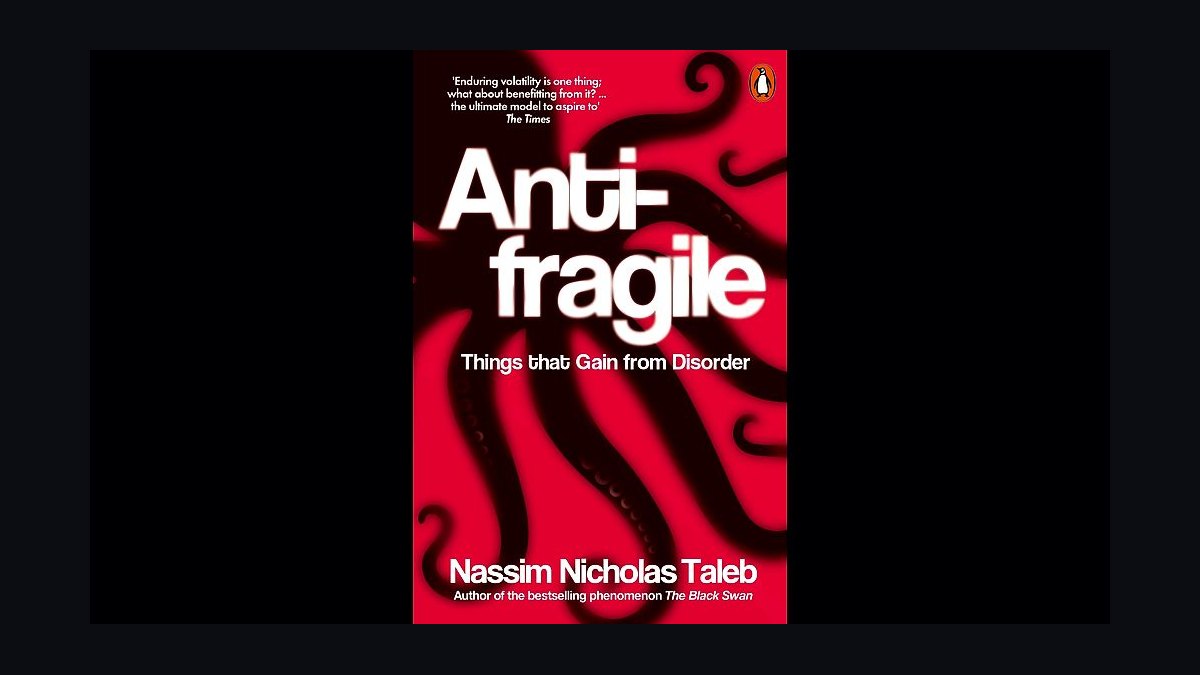
*Antifragile* (2012) is Nassim Nicholas Taleb's argument that some systems don't merely survive shocks — they improve from them. He splits the world into fragile, robust, and antifragile, then prescribes barbell risk allocation, optionality, subtraction over addition, and skin in the game. For sellers, it's a portfolio-construction manual for pipeline, comp, and territory design.
The outcome you should expect from reading it as a seller
Most sales books hand you a script. *Antifragile* hands you a classification scheme, and the practical outcome is that you stop optimizing things that should be deleted and stop protecting things that should be stressed. That sounds abstract until you apply it to a forecast. A rep carrying four deals that all close on the same enterprise procurement calendar has a Damocles pipeline: one policy change at one buyer, and the quarter is gone. A rep carrying twenty-six opportunities across three segments, where any single loss costs 4% of the number, has a Hydra pipeline. Same total pipeline dollars, radically different survival odds. Taleb's contribution is giving you language to see that difference before the quarter breaks, rather than in the post-mortem.
The second outcome is a bias shift toward subtraction. Taleb calls it *via negativa* — improvement through removal. Sales orgs are almost universally additive: a new SPIFF layered on last year's accelerator, a new sequence layered on the old cadence, a new forecast call layered on the pipeline review that already existed. Nobody deletes. The via negativa move is to inventory every comp rule, ritual, required field, and mandatory meeting, then cut the worst-performing fifth before you approve any new tool. This is unglamorous and it is where most of the durable gain lives, because the removed thing stops consuming attention forever, whereas the added thing needs maintenance forever.
Third, you should expect to think differently about volatility in your own career. Taleb's contrast between the taxi driver and the bank employee is the sharpest career passage in the book. The bank employee's income is a smooth line right up until the day it becomes zero — the volatility is hidden, not absent, and it arrives all at once. The taxi driver's income wobbles daily and never goes to zero, because a bad Tuesday carries information and a bad Tuesday is survivable. Translate that: the AE with one whale account at 70% of quota attainment has a bank-employee income profile. The AE with a book of forty mid-market accounts and a live network of former buyers has a taxi-driver profile. The second one looks less impressive on a leaderboard in a good year and is dramatically harder to kill in a bad one.

Fourth — and this is the outcome people underrate — you get a defensible reason to say no to prediction-dependent planning. Taleb's whole nonpredictive program says: don't forecast the rare event, measure your exposure to it. A sales leader who accepts this stops asking "will the market soften next year?" and starts asking "if bookings drop 30%, which parts of this org break, and which parts just get uncomfortable?" That question has an answer you can actually work on. The forecast question doesn't.
What drives that outcome
The engine underneath every chapter is the Triad, and it's worth being precise about it because the middle category is the one people misread. Fragile means you lose disproportionately from disorder — the harm curve is concave, so double the stress and you get more than double the damage. Robust means you're roughly indifferent; you neither gain nor lose. Antifragile means you gain — the payoff curve is convex, so the upside from a surprise exceeds the downside. Taleb's mythological shorthand: Damocles under the sword (one shock ends it), the Phoenix (burns and returns identical), the Hydra (cut a head, two grow).
The biological mechanism Taleb leans on is overcompensation. Bone doesn't merely repair after loading — Wolff's law describes it remodeling denser along lines of stress. Muscle responds to micro-damage by building past the prior baseline. Vaccination works by introducing a controlled weak dose so the system prepares for a strong one. He generalizes this as hormesis and mithridatization: small, frequent, recoverable doses of stress produce adaptation, while the absence of stress produces atrophy that stays invisible until a large dose arrives.

That mechanism explains why over-protective systems fail. Suppress every small forest fire and you accumulate fuel until one fire is unstoppable. Suppress every small business failure with subsidy and you get an economy of zombies that collapses together. Suppress every small deal loss with heroic discounting and you get a rep who has never learned what actually disqualifies a buyer — and who then loses the one deal that mattered. Taleb's word for the harm caused by the intervention itself is *iatrogenics*, borrowed from medicine, and his claim is that interventionist bias systematically underweights it because the harm is diffuse and the intervention is visible.
The financial mechanism is convexity, and Thales of Miletus is the canonical illustration: he paid small deposits for the right to use olive presses ahead of harvest. Bad harvest, he loses the deposits. Great harvest, he controls scarce capacity. Small fixed downside, large uncapped upside. Taleb's claim is that antifragility is engineerable — it equals optionality plus tinkering plus convexity, and you don't need to forecast the harvest to benefit from the option. The barbell is the allocation rule that follows: put the large majority in something you understand and can't lose catastrophically, put a small minority in things with uncapped upside, and refuse the medium-risk middle where you carry real ruin exposure without real convexity.
The epistemic mechanism is the one Taleb spends the most venom on. His claim in "Lecturing Birds on How to Fly" is that the standard story — theory produces application — runs backward more often than academics admit. Practitioners tinker, something works, and the formal explanation gets written afterward. He points at the jet engine coming from an engineer, powered flight coming from bicycle mechanics, and traders using rule-of-thumb option heuristics before the formal pricing models were published. The lesson for a sales org is not anti-intellectualism; it's that your best process documentation is usually a description of what your top performers already do, not a theory imposed on them from a deck.
Benchmarks and realistic ranges

Taleb deliberately avoids optimization constants, and honest reporting means saying so: the book gives you one hard number — the 90/10 barbell — plus a set of qualitative detectors. Everything below is applied interpretation, not a figure Taleb published, and you should calibrate against your own history rather than treat any range as authoritative.
The barbell itself: roughly 90% in the maximally safe bucket, roughly 10% in the maximally aggressive bucket, nothing in the middle. Taleb states this for personal financial exposure — cash and short-duration government paper on one end, small speculative positions on the other, no medium-risk instruments where you can lose a lot without a shot at a lot. He's explicit that the exact split is less important than the shape: the safe leg must be genuinely safe (not "investment grade," which is a rating, not a guarantee), and the risky leg must be small enough that total loss is survivable.
Translating to territory design, the reasonable operating question is what share of a rep's time sits on repeatable ICP business versus low-probability, high-ceiling pursuits. If a rep spends effectively all of their time on safe renewals and expansions, the territory is robust and will never surprise anyone upward. If they spend most of it chasing logos with a low single-digit close rate, they'll miss the number. The barbell shape says: the large majority of hours on business you know how to win, a deliberately small and explicitly budgeted slice on asymmetric swings, and near-zero on the accounts that are hard to win *and* small — the medium-risk middle where effort and outcome are both mediocre.
For optionality, the operating benchmark is cost-to-maintain per open option. An option is only convex if the downside is genuinely capped. A discovery call with a plausible-fit prospect is cheap: an hour, and the loss is bounded by that hour. A six-month unfunded pilot with three engineers seconded to it is not an option — it's a concentrated bet wearing an option costume, because the downside is unbounded in the resource that matters. The practical test: write down the maximum you can lose on the bet before you take it. If you can't state that number in one sentence, it isn't an option.

For via negativa, the workable starting range is a single-digit-to-20% cut of process surface per planning cycle. Pick the comp rules, required CRM fields, recurring meetings, and mandatory sequence steps; rank them by complaint volume and by whether anyone can name a decision the artifact has ever changed; delete the bottom slice. Then hold the line for a full quarter before adding anything, because the whole point is that removal compounds and addition doesn't.
The Lindy Effect gives you a genuinely useful benchmark for training spend without requiring any statistics. For non-perishable things — books, methodologies, frameworks — expected remaining life is proportional to current age. A methodology that has been taught for three decades has a longer expected future than one launched last year, not because it's better in some absolute sense but because it has already survived a long selection process. Practically: weight your enablement budget toward the durable canon, treat the newest framework as the speculative leg of a barbell, and require the new thing to prove itself on a small cohort before it becomes mandatory.
For the fragility detector, the number that matters is the ratio between harm at one dose of stress and harm at two. Run the thought experiment on your own org: if quota rises 20%, does attrition rise 20% or 60%? If your largest customer churns, do you lose their revenue or their revenue plus the reference that was closing three other deals? If harm accelerates faster than stress, you've found concavity, and you've found it without predicting anything.
Risks, edge cases, and failure modes

The most common misreading is treating antifragility as a synonym for resilience or grit. It isn't. Resilience is the Phoenix — it returns to the same state. Antifragility requires the system to end up *better* than before, which means there must be a mechanism that converts the stress into an improvement: a feedback loop, a learning process, a selection pressure. A sales team told to "be antifragile" about a brutal quarter, with no change to how deals are reviewed or how losses are dissected, is just being told to endure. Endurance is robustness at best. If you can't name the mechanism, you're using the word as a motivational poster.
The second failure mode is barbell theater. Teams announce a 90/10 split and then quietly fill the "safe" 90 with things that are merely familiar rather than actually safe — a single dominant customer segment, one channel partner producing most of the sourced pipeline, one champion inside the largest account. Familiar is not safe. The safe leg has to be safe against the specific shock that would ruin you, and concentration is the shock most sales orgs are exposed to. Run the test explicitly: name the single event that would cost you 30% of revenue, then check whether your "safe" allocation is exposed to it.
Third, optionality has a real and frequently ignored carrying cost. Taleb writes from a trading seat where options expire and the loss is the premium. Sales options don't expire cleanly. A hundred open, unqualified opportunities each consume forecast attention, pollute pipeline coverage math, and generate false confidence at the exact moment you need clean signal. Optionality without ruthless kill criteria degrades into hoarding. The discipline that makes it work is a pre-committed expiry: if this account shows no buying signal by date X, it leaves the pipeline. Without that, you've bought a portfolio of options and forgotten to let them expire.
Fourth, via negativa can be run off a cliff. Subtraction is more reliable than addition *at the margin*, in over-engineered systems, where most additions were never load-bearing. It is not a general theory that less is always more. Delete the wrong thing — the enablement program that was actually transferring product knowledge, the deal desk that was actually preventing bad contracts, the one recurring meeting where cross-functional conflict got resolved — and you'll discover which parts were structural. Practical guard: subtract reversibly. Suspend the ritual for a quarter and measure, rather than deleting it in a reorg where restoring it requires political capital nobody wants to spend.

Fifth, there's a survivorship problem baked into the book's examples. Penicillin, the Wright brothers, the microwave — these are the tinkering bets that worked, drawn from an enormous unseen pool of tinkering that didn't. Taleb is aware of this and his answer is that convexity makes the strategy sound even with a low hit rate, provided each failure is small. But the strategy only holds if you genuinely cap the downside on every attempt. If your "tinkering" involves betting the roadmap on an unvalidated segment, you're not running the Thales trade; you're running a concentrated bet and citing Taleb as cover.
Sixth, the book is genuinely hard to recommend as a reading experience, and pretending otherwise does readers a disservice. It's long, and Taleb digresses at length into etymology, Mediterranean food, and personal quarrels with named academics. His combative public persona has alienated readers who would benefit from the ideas. Some of the medical assertions — particularly around screening and pharmaceutical intervention — are stated with more confidence than the evidence base supports, and a reader without a medical background should treat those chapters as provocations rather than guidance. The frameworks are excellent; the delivery is uneven. Chapter-skipping is legitimate here.
Seventh, watch for the ethics inversion Taleb names in the skin-in-the-game chapters, because sales comp reproduces it constantly. Antifragility is only legitimate when the person capturing the upside also carries the downside. A rep paid entirely on bookings, with no exposure to whether the customer renews, has personal antifragility at the company's expense — they gain from aggressive deals whose downside lands on customer success eighteen months later. The structural fix is symmetric exposure: some portion of variable comp tied to retention or net revenue outcome, with a genuine clawback window on the deals most likely to go bad. Every objection to that design is, in Taleb's framing, an objection to bearing the downside of your own decisions.
A practical rollout plan

Start with classification, not change. Spend the first week producing a written inventory that sorts your revenue system into the three buckets — no fixes yet. Pipeline concentration, channel concentration, champion concentration, comp structure, forecast process, tooling dependencies. For each item, answer one question: does disorder here hurt us disproportionately, leave us flat, or actually help? Most teams discover two or three genuine Damocles exposures they'd never articulated, and discover that almost nothing in the org is antifragile — it's mostly fragile with a robust veneer.
Week two is the fragility stress test, and it's a tabletop exercise, not a model. Take each fragile item and ask what happens at one dose and two doses of stress. Largest customer churns; now the two largest churn. Best rep leaves; now the two best leave. Inbound drops 25%; now 50%. You're looking for the places where the second dose costs far more than the first, because that acceleration is the signature of concavity and it tells you where to spend remediation effort. Write down the answers. Vagueness here is how fragility survives audits.
Week three is subtraction, and it must come before any addition. Run the via negativa inventory across comp rules, required fields, recurring meetings, and mandatory process steps. For each, ask whether anyone can name a specific decision it changed in the last two quarters. Cut the bottom slice. Communicate the cuts loudly — the message that this org removes things is itself culturally load-bearing, because it's the only thing that makes future removals politically possible.
Week four is barbell reallocation. Split rep time and named accounts explicitly: a large majority on known-good ICP work with repeatable motion, a small explicit slice on asymmetric pursuits, and near-zero on the hard-and-small middle. The critical detail is that the aggressive slice must be *budgeted and protected*, not carved out of evenings. If moonshot work is unofficial, it gets sacrificed the moment the quarter gets tight — which is exactly when optionality is most valuable.

Week five is optionality hygiene. Every speculative pursuit gets a written maximum loss and a written expiry date at the moment it enters the pipeline. Anything that can't state its downside in a sentence isn't an option and gets reclassified as a concentrated bet requiring approval. Run the expiry sweep monthly and enforce it. This is the step that most teams skip and it's the step that determines whether the barbell works or just inflates pipeline.
Week six is skin in the game. Redesign at least one incentive so the decision-maker carries the downside — retention-linked variable comp, a clawback window, or deal-desk approvals where the approver's name stays attached to the outcome. Start with one. Symmetric-exposure changes generate real resistance, and the resistance is diagnostic: the loudest objection usually identifies the exact place where someone has been capturing upside without downside.
From there it becomes a quarterly loop rather than a project. Re-run the classification, re-run the two-dose stress test, and specifically look for evidence of overcompensation: which parts of the org came back stronger after being stressed, and what mechanism made that happen? Those mechanisms — a loss-review ritual that actually changes behavior, a churn post-mortem that reaches product, a rep who returns from a lost deal with a better qualification question — are the antifragile parts. Protect them, and resist the instinct to smooth them out. The smoothing is what created the fragility in the first place.
Related questions
Is Antifragile worth reading if I've already read The Black Swan?
Yes, but they answer different questions. *The Black Swan* explains why we're blind to rare, high-impact events. *Antifragile* is the practical follow-up: what to build so you benefit rather than break. If you only read one and you're operating a business, read *Antifragile*.
Where should I start in the Incerto series?
*Fooled by Randomness* is the shortest and most accessible entry. *The Black Swan* is the most famous. *Antifragile* is the most actionable. *Skin in the Game* is the tightest-written. Sequential order works, but starting with *Antifragile* and backfilling is perfectly reasonable.
What's the fastest way to apply this to a sales pipeline?

Two moves. Count how much of your number depends on your three largest deals — that's your Damocles exposure. Then delete the single worst comp rule or required process step before adding anything new. Classification plus one subtraction beats a full reorg.
Does the barbell strategy actually work outside finance?
The shape transfers; the specific 90/10 ratio does not automatically. What transfers is refusing the medium-risk middle — bets that carry real ruin exposure without real upside. Calibrate the split against your own loss history, not against a number borrowed from a portfolio context.
Is antifragility the same as being resilient?
No, and the distinction is the whole book. Resilient systems return to their prior state after a shock. Antifragile systems end up better than before, which requires an actual improvement mechanism — feedback, selection, or adaptation. Without a named mechanism, you have resilience.
FAQ
Why does Taleb say English has no word for the opposite of fragile?
Because the words we reach for — robust, resilient, tough — all mean *doesn't break*, which describes neutrality to stress rather than gain from it. If fragile means harmed by disorder, the true antonym should mean helped by disorder, and no common word carries that meaning. Taleb argues the linguistic gap is causal: because we lack the word, we design institutions for robustness when antifragility was available, and we mistake the absence of visible volatility for the absence of risk.
What is the barbell strategy in one sentence?
Hold the large majority of your exposure in something genuinely safe and a small minority in bets with capped downside and uncapped upside, while refusing the medium-risk middle entirely — because medium risk carries real ruin exposure without enough convexity to pay for it.

How does the Lindy Effect apply to sales methodology?
For non-perishable things, expected remaining life is proportional to age. A methodology taught for three decades has already survived selection pressure that last year's framework hasn't faced yet. Practically: anchor your enablement budget on the durable canon, treat new frameworks as the speculative leg of a barbell, and require them to prove out on a small cohort before mandating them org-wide.
What does via negativa look like on a Monday morning?
Open the comp plan, the required-fields list, the recurring meeting calendar, and the mandatory sequence steps. For each item, ask whether anyone can name a decision it changed in the last two quarters. Cut the bottom fifth. Then add nothing for a full quarter. Suspend rather than delete where restoring would be politically expensive — subtract reversibly so you can find out which parts were actually structural.
What is iatrogenics and why does it matter to a sales leader?
Iatrogenics is harm caused by the intervention itself, a term Taleb borrows from medicine. It matters because sales leadership is structurally biased toward visible action — a new tool, a new SPIFF, a new cadence — while the cost of the intervention is diffuse and rarely measured. The disciplined counter-question before any change: what is the downside if this doesn't work, who absorbs it, and would doing nothing have been better?
How does skin in the game connect to antifragility?
Antifragility is only ethically legitimate when whoever captures the upside also carries the downside. When they're separated — upside to one party, downside to another — the first party is antifragile at the second's expense, and the overall system becomes more fragile because bad decisions stop being punished where they're made. In sales, the fix is symmetric exposure: variable comp partly tied to retention outcomes, with a real clawback window.
Sources
- https://www.penguinrandomhouse.com/books/176227/antifragile-by-nassim-nicholas-taleb/
- https://www.fooledbyrandomness.com/
- https://www.nature.com/articles/nature.2012.11961
- https://www.economist.com/books-and-arts/2012/12/01/beyond-resilience
- https://www.newyorker.com/magazine/2013/02/04/blowing-up
- https://plato.stanford.edu/entries/thales/
- https://sre.google/sre-book/table-of-contents/
- https://netflixtechblog.com/the-netflix-simian-army-16e57fbab116
- https://aws.amazon.com/blogs/architecture/chaos-engineering-in-the-cloud/
- https://www.ncbi.nlm.nih.gov/books/NBK526046/
Related on PULSE
- The 12 Week Year by Brian Moran and Michael Lennington — Cliff Notes Summary for Sellers
- Contagious by Jonah Berger — Cliff Notes Summary for Sellers
- The Tipping Point by Malcolm Gladwell — Cliff Notes Summary for Sellers
- Exactly What to Say by Phil M. Jones — Cliff Notes Summary for Sellers
- Steve Jobs by Walter Isaacson — Cliff Notes Summary for Sellers
- Sprint by Jake Knapp — Cliff Notes Summary for Sellers
This page will be disappearing soon. Save it to your device for $1 — or read it free while it is here.
@Kory-White- · if Venmo asks, the last 4 of my number are 2012
This page is gone.
This one is off the shelf now. $1 keeps it on your phone for good — the whole page, pictures and diagrams included.
 pulse-recentWhat is the first concrete step in the Sandler Selling System for handling a prospect's initial brush-off in 2027?
 pulse-recentThe Sales Acceleration Formula by Mark Roberge — Top 10 Key Takeaways for Sales Leaders in 2027
 pulse-recentNever Split the Difference by Chris Voss — Top 10 Key Takeaways for Sales Leaders in 2027
 pulse-recentHyper Sales Growth by Jack Daly — Top 10 Key Takeaways for Sales Leaders in 2027
 pulse-booksWhat are the most common mistakes in Book Summaries in 2027?
 pulse-recentThe Transparency Sale by Todd Caponi — Top 10 Key Takeaways for Sales Leaders in 2027
 pulse-recentHow do you implement the Sandler Rules in your first 30 days as a new sales rep in 2027?
 pulse-recentSales EQ by Jeb Blount — Top 10 Key Takeaways for Sales Leaders in 2027
 pulse-recentWhat is the first concrete step in SPIN Selling by Neil Rackham for structuring a discovery call in 2027?
 pulse-recentObviously Awesome by April Dunford — Top 10 Key Takeaways for Sales Leaders in 2027