


How does *The Mom Test* define a "bad customer" to disqualify early in your discovery process in 2027?
Quality
Certified
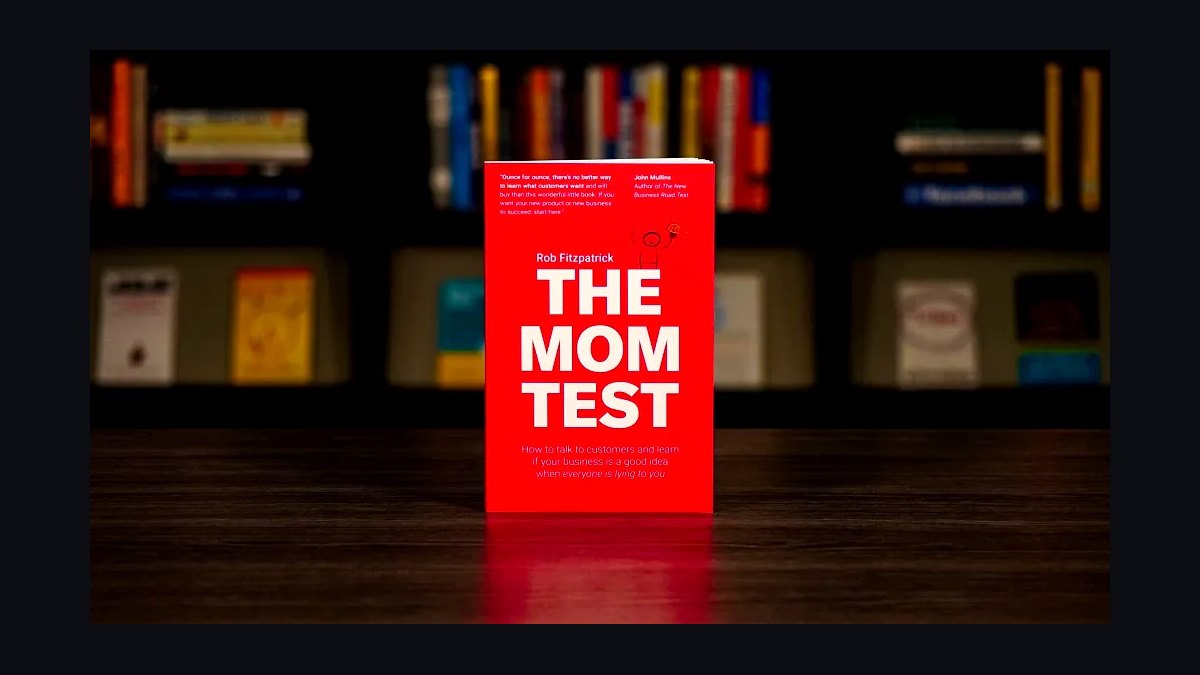
*The Mom Test* defines a bad customer as anyone whose feedback is unfalsifiable — compliments, hypotheticals, and future promises instead of specific past behavior. Rob Fitzpatrick's rule is simple: if a person cannot name a recent time the problem hurt them, what they did about it, and what it cost, they cannot validate anything, so disqualify them fast.
The call that felt great and taught you nothing
Picture a Tuesday discovery call. You are building a tool that reconciles quota attainment across a CRM and a commissions spreadsheet. On the other end is a VP of Sales at a 180-person company. She takes the full thirty minutes, laughs at your jokes, says "honestly this is the kind of thing we should have bought two years ago," and ends with "send me something and I'll take a look." You hang up energized. You log her in your CRM as a warm lead. You tell your co-founder the pain is real.
Now replay the transcript and ask a colder question: what did you actually learn? She never named a month when the reconciliation broke. She never said who owns the spreadsheet. She never mentioned a tool they tried, a consultant they hired, a headcount they added, or a dollar they spent. Every statement she made was about a hypothetical future — *we should have*, *I'd take a look*, *if it worked like that*. Nothing she said could be wrong. That is the tell. Fitzpatrick's whole framework rests on the idea that useful information is falsifiable: it describes a world that either did or did not happen, and you can go check. Compliments and predictions describe no world at all.
The book's title comes from this observation. Ask your mom whether your business idea is good and she will say yes, because the question invites her to protect your feelings rather than report reality. But the failure is not your mom's — it is the question's. A well-built question is one your mom could not answer flatteringly even if she wanted to, because it asks about facts rather than opinions. "Do you think people would pay for this?" is a bad question at any age. "Walk me through the last time you did this manually" is a question that has only one honest answer, and that answer is either useful or it disqualifies.

So the "bad customer" in Fitzpatrick's sense is rarely a bad person. Our VP was gracious, senior, and probably even right that reconciliation is annoying. She was a bad customer for the specific purpose of a discovery conversation because she produced zero evidence. She would go on to occupy three follow-ups, one demo, one "let me loop in RevOps," and about six weeks of your pipeline hope before going quiet. The cost of not disqualifying her was not the thirty minutes. It was the six weeks — and worse, the roadmap decisions you made because you believed her.
That distinction matters for how you use the rest of this page. Disqualification here does not mean rudeness, ghosting, or deciding someone is unworthy. It means downgrading a conversation from "evidence" to "anecdote" and refusing to let it steer your build. You can still like the person. You can still keep them on a newsletter. You simply stop treating their enthusiasm as a data point, and you stop spending scarce discovery hours where the signal is structurally unavailable.
How the disqualification mechanism actually works
The mechanism is a filter on *statement type*, not on *sentiment*. Fitzpatrick's insight is that the same person can produce both good and bad data in a single call, and your job is to sort the sentences, not the human. Three categories do most of the work.

Facts about the past are the gold. "Last quarter we closed the books nine days late twice." "I built the spreadsheet in 2023 and I still maintain it every Friday morning." "We bought a tool, used it for four months, and turned it off." These are checkable. They imply effort already spent, which is the only reliable proxy for pain. A person who has spent time, money, or political capital on a problem has demonstrated priority in the only currency that does not lie.
Opinions and predictions are noise. "That would be really useful." "I think our team would adopt that." "We'd probably pay for something like that." Notice these cannot be wrong today; they can only be disproven later, at your expense. Fitzpatrick's guidance is to treat every one of them as a prompt to dig, not as a result. When you hear a prediction, your next sentence should convert it into a past-tense question: "Has anything like that come across your desk before? What happened to it?"
Commitments and advancements are the tiebreaker. A commitment is the prospect giving up something they value — time on a calendar with a named date, an introduction to a colleague, access to their data, a reputational endorsement, or money. An advancement is the conversation moving to a concretely defined next step. Compliments cost nothing, so they carry no information. Commitments cost something, so they carry a lot. When a call ends without either, the conversation was, in Fitzpatrick's phrase, a zombie: it looks alive and it has no pulse.
Running the filter in real time takes practice. The habit that helps most is a mental ledger during the call: every time you hear a fact about the past, mark it; every time you hear an opinion, mark it in a second column and immediately try to convert it. At the end you glance at the ledger. Three facts and one commitment is a real conversation. Zero facts and nine compliments is a bad customer, no matter how good it felt.

A second mechanism worth naming is the *deflection* move. When someone opens with praise, the instinct is to accept it and move on, which quietly ends the useful part of the call. The alternative is to deflect and redirect in one breath: "That's kind of you — but tell me about the last time this actually bit you." This does two things. It signals you are not fishing for approval, which lowers their social pressure to be nice. And it converts a dead sentence into a live question. Prospects almost never take offense; most are relieved, because being asked about their real work is more interesting than being asked to grade your idea.
The third mechanism is *anchoring on the customer's own workflow rather than your product*. The moment you describe what you are building, every subsequent answer is contaminated — the person is now reacting to your framing instead of reporting their own. Fitzpatrick's advice is to keep your idea out of the room as long as possible. In practice this means the first two-thirds of the call contains no mention of what you are making. You are a researcher studying how they do a job. Only once you have your facts do you introduce the product, and at that point you are testing commitment rather than gathering evidence.
Reading the numbers: what a healthy discovery process actually looks like
Fitzpatrick does not publish a benchmark table, and you should be suspicious of anyone who claims a universal one. But there are internal ratios you can compute from your own calls that make the bad-customer problem visible instead of vibes-based. Track these for a month and the pattern is usually unmistakable.
Facts-per-call. Count distinct, checkable statements about the past that a prospect volunteers. A call where you can write down four or five specific incidents is a strong call. A call where you write down zero — and this happens more often than founders admit — is a signal about your questions as much as about the person. If your average across ten calls is under one, the problem is upstream: you are asking opinion questions and your sample is behaving exactly as designed.

Compliment-to-fact ratio. Tally compliments alongside facts. A ratio skewed heavily toward compliments across many calls usually means you are recruiting from your friendly network — former colleagues, LinkedIn connections, people who want you to succeed. That population is structurally incapable of disqualifying you. It is not that they lie; it is that the social contract of the conversation makes honesty expensive for them.
Commitment rate. Of your last twenty conversations, in how many did the other person give up something real by the end — a scheduled follow-up with a date, an intro, a data sample, a paid pilot, a signature? This is the single most sobering number most founders compute. Many discover the answer is close to zero while their CRM shows a dozen "warm" leads. The gap between those two figures is the exact size of your false-positive problem.
Recency of the pain. Ask when the problem last occurred and record the answer in weeks. Something that happened last week is a live wound. Something that last happened eighteen months ago is a scar, and scars do not generate budget. A useful discipline is to sort your qualified pool by recency and notice that the ones who eventually buy cluster hard at the recent end.
Effort already spent. Record what they have tried: a spreadsheet, a contractor, a hire, an internal build, a tool they bought and abandoned. Each of those is a receipt. Zero receipts across an entire segment is worth taking seriously — it may mean the pain is real but ranks below the line where anyone acts, which for your purposes is indistinguishable from no pain at all.
Time cost of a non-disqualification. This is the number that changes behavior. Estimate what a false positive actually costs you: the original call, the follow-up, the demo, the proposal, the two nudge emails, the internal debate about whether to build the feature they asked for. In most early-stage teams that bundle runs to several hours of founder time plus a roadmap distortion that can last a sprint or more. Multiply by the number of unqualified conversations sitting in your pipeline right now and the case for aggressive early disqualification makes itself.

Two cautions on measuring. First, these are diagnostic ratios for your own process, not industry standards — do not present them externally as if they were. Second, watch for the sample-selection trap: if you recruit conversations through a warm network, your facts-per-call will be low and your compliment ratio high for reasons that have nothing to do with your product. Fix the sample before you conclude anything about the market. Cold-sourced conversations, practitioner communities, and people who have publicly complained about the problem all produce denser evidence than your friends do, precisely because they owe you nothing.
The trade-offs of disqualifying fast
Aggressive early disqualification is a strategy with real costs, and pretending otherwise leads to the opposite failure — a founder who cuts everyone and learns nothing. Three trade-offs deserve honest treatment.
Speed versus false negatives. Disqualify on the first weak signal and you will occasionally cut someone who had genuine pain but a bad day, an unfamiliar vocabulary, or a natural reticence. Senior operators in particular often understate problems; they have normalized the workaround so thoroughly they no longer perceive it as pain. The mitigation is not to loosen the standard but to probe twice before concluding. Ask the past-tense question, get a vague answer, then reframe once with a different entry point — "walk me through last Friday afternoon" instead of "tell me about the process." If the second probe also produces nothing concrete, you have your answer.
Cheap disqualification versus expensive qualification. There is a spectrum of filters, and they trade rigor against cost. A screener question in a scheduling form is nearly free and catches obvious mismatches. A fifteen-minute call catches most compliment-only prospects. A paid pilot or a letter of intent catches almost everything, because almost nobody signs one to be polite — but each one costs weeks. The right move is a ladder: cheapest filters first, expensive commitments only for the survivors. Running expensive filters early is the most common way founders exhaust themselves on discovery.

Disqualifying the person versus disqualifying the moment. A prospect with real, documented pain and no budget authority is not garbage — they are a bad customer *today* and possibly a great one after a reorg or a budget cycle. The failure mode is treating disqualification as binary and deleting them. The better process parks them with a specific revisit trigger: a named event ("when the new CRO starts"), a date, or a threshold ("when you cross 40 reps"). This preserves optionality without letting them consume current attention.
There are also alternative frameworks worth knowing, because *The Mom Test* is a research instrument, not a sales methodology, and people frequently misapply it. Classic qualification frameworks like BANT or MEDDIC are about deciding whether a deal will close — they assume the product exists and the market is known. Fitzpatrick's method sits upstream of that: it asks whether the problem exists at all. Steve Blank's customer development and Eric Ries's build-measure-learn loop occupy the same upstream territory with more machinery. Teresa Torres's continuous discovery work extends it into an ongoing habit for established product teams rather than a pre-launch exercise. Use the Mom Test to decide what to build; use MEDDIC-style qualification to decide which deals to work once you have something to sell. Confusing the two produces founders who interrogate paying customers about whether they have pain and salespeople who accept compliments as forecast.
One more trade-off, less discussed: disqualifying too well can shrink your worldview. If you only talk to people with acute, recent, expensive pain, you learn a great deal about a narrow segment and nothing about why the adjacent ninety percent are indifferent. Periodically interviewing the indifferent — people who have the problem and do nothing about it — tells you where the action threshold sits, which is often the most commercially useful thing you can know. Fitzpatrick would call those conversations non-evidence for validation purposes. They are still excellent for market sizing and positioning, as long as you file them in the right drawer.
Pitfalls that survive even when you know the framework

Most people who read the book still run bad discovery, because the failure modes are subtle and socially comfortable. These are the ones that recur.
Pitching too early. The single most common mistake. You get eight minutes in, the person seems interested, and you cannot resist describing the product. From that moment every answer is a reaction to your framing. The fix is mechanical: write your first three questions before the call and forbid yourself from saying "so what I'm building is" until you have three logged facts.
Asking questions that have a socially correct answer. "Is this a problem for you?" invites yes. "How important is data accuracy to your team?" invites very. Any question where one answer makes the respondent look better is contaminated. Rewrite it as an incident request: "When did you last catch a data error, and how did you find it?"
Treating a signup as a signal. A free-tier account, a waitlist email, or a webinar registration costs nothing, so it proves nothing about willingness to pay. This is a specific instance of the general rule about commitment. The useful version is to look at what someone does *after* signing up — did they import real data, invite a colleague, return in week two? Those are costly actions and therefore informative.
Confusing volume with rigor. Fifty compliment-only calls are worth less than five with documented incidents. Founders under pressure often respond to weak signal by scheduling more of the same conversation. If the ratio is bad, change the questions and the sourcing, not the quantity.

Letting the champion be the whole picture. An enthusiastic mid-level advocate with no budget is genuinely useful — as a source of facts and as a route to the decision-maker. They become a trap only when you accept their enthusiasm as a substitute for the decision-maker's. Ask directly and early: who else would need to be in the room, and would you introduce me? The answer to that request is itself a commitment test.
Skipping the write-up. Notes taken during a call skew toward what felt exciting. Fitzpatrick emphasizes recording the actual words, especially the specific facts and numbers. A short structured summary written within an hour — facts, commitments, disqualification decision, and the exact quotes — is what makes patterns visible across twenty conversations. Without it you are pattern-matching on memory, which reliably remembers the compliments.
Using synthetic conversation as a substitute for a real one. Simulating a customer with a language model can be genuinely useful for rehearsing questions or drafting a screener, and it is a reasonable way to catch leading phrasing before you burn a real call. What it cannot do is supply evidence, because it has no past, no budget, and no receipts. Keep it in the preparation drawer, never the validation drawer.
Forgetting that the process applies downstream too. The same discipline that disqualifies a bad discovery conversation applies to churn interviews, win-loss analysis, and expansion research. Ask a churned customer "why did you leave?" and you will get a tidy narrative constructed after the fact. Ask "walk me through the last month you used it" and you get behavior. The mechanism generalizes wherever you need truth from someone who has a social reason to be pleasant.
Related questions
Is a bad customer the same as an unqualified lead?

No. Unqualified is a sales judgment about deal fit — budget, authority, timing. A bad customer in Fitzpatrick's sense is a research judgment: this person cannot produce falsifiable evidence, regardless of how well they fit your ideal profile on paper.
Can a bad customer become a good one later?
Often, yes. Most disqualifications are about the moment, not the person. Park them with a specific revisit trigger — a funding event, a headcount threshold, a new executive — and re-run the past-behavior questions when it fires rather than assuming the answer changed.
How many discovery calls before you trust a pattern?
There is no fixed number, and rigor beats volume. Watch for repetition of specific incidents across independent sources rather than repetition of opinions. Five conversations with documented, similar past behavior tell you more than fifty agreeable ones.
Should you ever tell someone you are disqualifying them?
Rarely, and never in those words. Disqualification is an internal bookkeeping decision. Externally you simply thank them, skip the follow-up sequence, and stop investing. Being gracious costs nothing and keeps the door open for the revisit trigger.
Does this apply to enterprise deals or only startups?
It applies anywhere you need truth from someone with a social incentive to be pleasant. Enterprise discovery has more stakeholders and longer cycles, which makes past-behavior questions more valuable, not less — there are simply more people available to flatter you.
FAQ
What exactly is the Mom Test?
It is a rule for constructing questions, not for choosing people. A question passes the Mom Test if your own mother could not answer it in a way that flatters you, because it asks about facts in her life rather than opinions about your idea. "Would you use this?" fails. "What did you do the last time this came up?" passes.

Why are compliments considered harmful rather than just neutral?
Because they carry emotional weight without informational content. A compliment makes you more confident while telling you nothing, which is strictly worse than silence. Fitzpatrick's framing is that praise is the cost you pay for asking a bad question, and the correct response is to deflect it and re-ask.
Should I disqualify someone who has the problem but no budget?
For evidence purposes, their story still counts — a documented incident is a documented incident. For pipeline purposes, no budget means no near-term customer. Log the facts, park the relationship with a revisit trigger, and do not let their enthusiasm influence roadmap priority.
What counts as a real commitment?
Anything the person values and gives up: time on a calendar with a specific date, an introduction to a colleague or decision-maker, access to real data, a public reference, or money. The test is whether it costs them something. "Send me some info" costs nothing and is therefore not a commitment.
How do I keep a call from turning into a pitch?
Structure it. Decide before the call that you will not describe your product until you have logged concrete facts about how they work today. Open with "I'm not selling anything, I'm trying to understand how you handle X," and mean it. Save the product reveal for the commitment test at the end.
Does the framework still work when buyers are harder to reach?
Yes, and arguably it matters more. Scarce conversations raise the cost of wasting one on a person who cannot produce evidence. Tighter access is an argument for better screening upstream and sharper past-behavior questions during the call, not for lowering the bar.
Sources
- https://www.momtestbook.com/
- https://www.goodreads.com/book/show/52283963-the-mom-test
- https://steveblank.com/category/customer-development/
- https://www.startupschool.org/
- https://www.ycombinator.com/library/6g-how-to-talk-to-users
- https://hbr.org/2011/05/why-most-product-launches-fail
- https://www.producttalk.org/continuous-discovery-habits/
- https://theleanstartup.com/principles
- https://www.nngroup.com/articles/interviewing-users/
Related on PULSE
- The Mom Test by Rob Fitzpatrick — Cliff Notes Summary
- The Mom Test by Rob Fitzpatrick — Cliff Notes Summary for Sellers
- How does *SPIN Selling* help you uncover customer needs during discovery calls in 2027?
- Continuous Discovery Habits by Teresa Torres — Cliff Notes Summary
- How does *Gap Selling* help you identify hidden customer pain points?
- Beyond the Sales Process by Andersen and Stein — Cliff Notes Summary
This page will be disappearing soon. Save it to your device for $1 — or read it free while it is here.
@Kory-White- · if Venmo asks, the last 4 of my number are 2012
This page is gone.
This one is off the shelf now. $1 keeps it on your phone for good — the whole page, pictures and diagrams included.
 bsHow can *Influence: The Psychology of Persuasion* help you build trust with skeptical clients?
 bsWhat’s the most persuasive story structure from *Pitch Anything* for a product demo in 2027?
 bsHow do you use *Never Split the Difference* to negotiate a contract renewal in 2027?
 bsHow does *The JOLT Effect* recommend handling a buyer who keeps delaying the final decision in 2027?
 pulse-booksTop 10 Book Summaries strategies for 2027
 bsWhat sales script does *New Sales. Simplified.* recommend for cold calls in 2027?
 bsWhat’s the most practical selling tip from *The Psychology of Selling* for closing deals in 2027?
 bsHow do you build a sales team's resilience after a major market downturn in 2027?
 bsHow does *Predictable Revenue* recommend structuring a sales team for growth in 2027?
 pulse-booksWhat are the most common mistakes in Book Summaries in 2027?